PUBLISHER: Mordor Intelligence | PRODUCT CODE: 2114510

PUBLISHER: Mordor Intelligence | PRODUCT CODE: 2114510
Endoscopic Ultrasound Needles - Market Share Analysis, Industry Trends & Statistics, Growth Forecasts (2026 - 2031)
According to Mordor Intelligence, the endoscopic ultrasound needles market size was valued at USD 162.08 million in 2025 and estimated to grow from USD 172.62 million in 2026 to reach USD 236.49 million by 2031, at a CAGR of 6.50% during the forecast period (2026-2031).
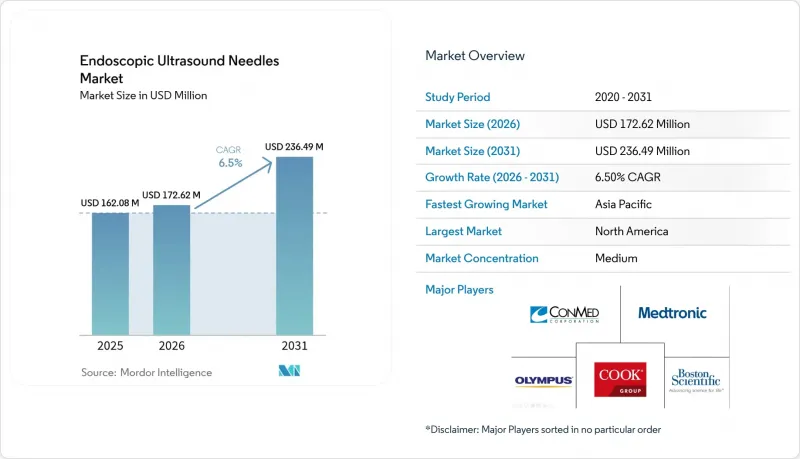
This report is Segmented by Product Type (Aspiration Needles and Biopsy Needles), Needle Gauge (19G, 22G, and 25G), Tip Design (Lancet, Franseen, Fork-Tip, and Side-Beveled), Application (Pancreatic Lesions, and More), Material (Stainless-Steel, Nitinol), End-User (Hospitals, and More), and Geography (North America, Europe, and More). The Market Forecasts are Provided in Terms of Value (USD).
Global Endoscopic Ultrasound Needles Market Trends and Insights
Growing Burden of Gastrointestinal and Pancreatic Cancers
Early-onset pancreatic cancer diagnoses have risen 2.47% annually since 2019, increasing reliance on tissue sampling for definitive staging. Molecular profiling protocols now accompany most pancreatic biopsy requests, which boosts daily use of EUS needles in oncology centers. Higher sample-volume requirements favor biopsy rather than aspiration tools and reinforce hospital procurement of premium designs. The endoscopic ultrasound needles market, therefore, benefits from the oncology community's shift toward large-core tissue retrieval. In the Asia-Pacific region, national cancer plans mirror this trend, accelerating device adoption across public hospitals.
Rising Preference for Minimally Invasive Diagnostic Procedures
CMS broadened coverage for EUS-guided fine needle aspiration and biopsy in 2024, validating the approach as cost-effective compared with open or laparoscopic biopsies. Clinical evidence shows a single EUS pass can achieve histological confirmation that once required multiple surgical attempts, cutting anesthesia exposure and recovery time. Ambulatory surgical centers report higher patient satisfaction scores and stronger profit margins when using streamlined outpatient EUS workflows. These factors collectively stimulate procurement budgets, sustaining near-term growth in the Endoscopic Ultrasound Needles market. Manufacturers are therefore prioritizing compact systems tailored to outpatient settings.
Shortage of Skilled Endoscopic Ultrasound Operators
Fewer than 15% of practicing gastroenterologists perform advanced EUS, limiting daily capacity in both urban and rural centers. Training requires 150-200 mentored cases, a hurdle for hospitals with thin specialist rosters. Asia-Pacific health systems build new cancer institutes faster than they can train operators, which caps near-term installations despite equipment subsidies. Private teaching partnerships and tele-proctorship programs aim to narrow the skills gap, but the shortage remains a long-tail restraint on the Endoscopic Ultrasound Needles market.
Other drivers and restraints analyzed in the detailed report include:
- Increasing Geriatric Population with Comorbidities
- Integration of AI-Guided Targeting Systems in EUS Platforms
- High Cost of Premium Biopsy Needles and Reusable Accessories
For complete list of drivers and restraints, kindly check the Table Of Contents.
Segment Analysis
Biopsy needles held a 57.84% market share of the endoscopic ultrasound needles market in 2025, reflecting oncologists' demand for intact core tissue that enables comprehensive molecular profiling. Their 8.29% CAGR through 2031 outpaces aspiration tools as personalized medicine protocols standardize across cancer centers. The endoscopic ultrasound needles market benefits from this structural shift, with biopsy instruments commanding premium pricing against stable year-on-year volume growth.
Aspiration needles retain their value for rapid on-site cytology, particularly in community settings without access to molecular labs. Yet the widening tissue requirements of pancreatic, biliary, and bronchial oncology place a growing ceiling on cytology-only devices. Established vendors leverage FDA 510(k) pathways to deploy iterative enhancements that maintain regulatory compliance while boosting diagnostic yield.
The 22 G gauge provided the largest contribution at 28.22% in 2025, balancing core volume with manageable bleeding risk. However the 25 G category shows a 7.41% CAGR through 2031, winning adoption for delicate pancreatic and pediatric cases where minimal trauma is paramount. Endoscopic Ultrasound Needles market size for 25 G solutions is projected to expand steadily as nitinol alloys allow thinner walls yet maintain lumen integrity.
Larger 19 G products support demanding genomic studies at academic centers, although slower growth keeps them niche. Gauge selection remains tightly linked to FDA validation protocols that test each diameter for tensile strength and biocompatibility.
Complete Report Scope:
- By Product Type
- Aspiration Needles
- Biopsy Needles
- By Needle Gauge
- 19G
- 22G
- 25G
- By Tip Design
- Lancet
- Franseen
- Fork-Tip
- Side-Beveled
- By Application
- Pancreatic Lesions
- Gastrointestinal Wall Lesions
- Bronchial / Mediastinal Lesions
- Biliary Lesions
- By Material
- Stainless-Steel
- Nitinol
- By End-User
- Hospitals
- Ambulatory Surgical Centers
- Specialty Clinics
- Geography
- North America
- United States
- Canada
- Mexico
- Europe
- Germany
- United Kingdom
- France
- Italy
- Spain
- Rest of Europe
- Asia-Pacific
- China
- Japan
- India
- Australia
- South Korea
- Rest of Asia-Pacific
- Middle East & Africa
- GCC
- South Africa
- Rest of Middle East & Africa
- South America
- Brazil
- Argentina
- Rest of South America
- North America
Geography Analysis
North America generated 41.95% of global revenue in 2025, buoyed by CPT codes 43238 and 43242 that secure reimbursement in both hospital and ambulatory settings. Academic networks funnel constant clinical trials, which accelerates early adoption of AI-guided targeting and nitinol needles. Canadian centers follow U.S. protocols, while Mexican medical tourism funnels additional volumes from uninsured U.S. patients seeking lower procedure costs.
Asia-Pacific records the fastest 7.29% CAGR, driven by government oncology initiatives, growing specialist training pipelines, and urban hospital expansion. China's cancer screening plan funds EUS suites in provincial centers, while Japan's aging demographics propel demand for gentler diagnostics. Private hospitals in India add premium EUS services for overseas patients, broadening the endoscopic ultrasound needles market footprint. Diverse regulatory regimes require tailored submissions, but recent alignment of China's National Medical Products Administration with ISO standards eases entry for global brands.
Europe exhibits steady growth anchored in evidence-based guidelines and well-funded universal healthcare. Germany, the United Kingdom, and France lead installations, often pairing high-end needles with AI-assisted imaging upgrades. Southern Europe trails slightly yet benefits from EU Medical Device Regulation harmonization, which streamlines purchasing decisions. Real-world evidence programs across university hospitals further validate performance claims, reinforcing clinician confidence in new designs.
- ACE Medical Devices
- Boston Scientific
- Conmed
- Cook Group
- Endo-Flex
- FUJIFILM
- GI Supply
- Hakko Co. Ltd
- Laborie Medical Technologies
- Lishen Scientific
- Medi-Globe
- Medtronic
- Micro-tech
- Olympus
- Pentax Medical (HOYA)
- Sono Scape Medical
- South-Pioneer Technology
- Steris Endoscopy
- Taewoong Medical Co.
- US Endoscopy
Additional Benefits:
- The market estimate (ME) sheet in Excel format
- 3 months of analyst support
TABLE OF CONTENTS
1 Introduction
- 1.1 Study Assumptions & Market Definition
- 1.2 Scope Of The Study
2 Research Methodology
3 Executive Summary
4 Market Landscape
- 4.1 Market Overview
- 4.2 Market Drivers
- 4.2.1 Growing Burden of Gastrointestinal and Pancreatic Cancers
- 4.2.2 Rising Preference for Minimally Invasive Diagnostic Procedures
- 4.2.3 Increasing Geriatric Population with Comorbidities
- 4.2.4 Favorable Reimbursement Policies for Endoscopic Ultrasound Procedures
- 4.2.5 Rapid Adoption of Franseen and Fork-Tip Fine Needle Biopsy Technology
- 4.2.6 Integration of AI-Guided Targeting Systems in EUS Platforms
- 4.3 Market Restraints
- 4.3.1 Shortage of Skilled Endoscopic Ultrasound Operators
- 4.3.2 High Cost of Premium Biopsy Needles and Reusable Accessories
- 4.3.3 Stringent Infection-Control Protocols Increasing Procedure Turnaround Time
- 4.3.4 Competition from Emerging Non-Invasive Liquid Biopsy Technologies
- 4.4 Value / Supply-Chain Analysis
- 4.5 Regulatory Landscape
- 4.6 Technological Outlook
- 4.7 Porter's Five Forces
- 4.7.1 Threat Of New Entrants
- 4.7.2 Bargaining Power Of Buyers
- 4.7.3 Bargaining Power Of Suppliers
- 4.7.4 Threat Of Substitutes
- 4.7.5 Intensity Of Competitive Rivalry
5 Market Size & Growth Forecasts (Value, USD)
- 5.1 By Product Type
- 5.1.1 Aspiration Needles
- 5.1.2 Biopsy Needles
- 5.2 By Needle Gauge
- 5.2.1 19G
- 5.2.2 22G
- 5.2.3 25G
- 5.3 By Tip Design
- 5.3.1 Lancet
- 5.3.2 Franseen
- 5.3.3 Fork-Tip
- 5.3.4 Side-Beveled
- 5.4 By Application
- 5.4.1 Pancreatic Lesions
- 5.4.2 Gastrointestinal Wall Lesions
- 5.4.3 Bronchial / Mediastinal Lesions
- 5.4.4 Biliary Lesions
- 5.5 By Material
- 5.5.1 Stainless-Steel
- 5.5.2 Nitinol
- 5.6 By End-User
- 5.6.1 Hospitals
- 5.6.2 Ambulatory Surgical Centers
- 5.6.3 Specialty Clinics
- 5.7 Geography
- 5.7.1 North America
- 5.7.1.1 United States
- 5.7.1.2 Canada
- 5.7.1.3 Mexico
- 5.7.2 Europe
- 5.7.2.1 Germany
- 5.7.2.2 United Kingdom
- 5.7.2.3 France
- 5.7.2.4 Italy
- 5.7.2.5 Spain
- 5.7.2.6 Rest of Europe
- 5.7.3 Asia-Pacific
- 5.7.3.1 China
- 5.7.3.2 Japan
- 5.7.3.3 India
- 5.7.3.4 Australia
- 5.7.3.5 South Korea
- 5.7.3.6 Rest of Asia-Pacific
- 5.7.4 Middle East & Africa
- 5.7.4.1 GCC
- 5.7.4.2 South Africa
- 5.7.4.3 Rest of Middle East & Africa
- 5.7.5 South America
- 5.7.5.1 Brazil
- 5.7.5.2 Argentina
- 5.7.5.3 Rest of South America
- 5.7.1 North America
6 Competitive Landscape
- 6.1 Market Concentration
- 6.2 Market Share Analysis
- 6.3 Company Profiles (includes Global level Overview, Market level overview, Core Segments, Financials as available, Strategic Information, Market Rank/Share, Products & Services, Recent Developments)
- 6.3.1 ACE Medical Devices Pvt. Ltd
- 6.3.2 Boston Scientific Corporation
- 6.3.3 CONMED Corporation
- 6.3.4 Cook Medical (Cook Group)
- 6.3.5 ENDO-FLEX GmbH
- 6.3.6 Fujifilm Holdings Corporation
- 6.3.7 GI Supply
- 6.3.8 Hakko Co. Ltd
- 6.3.9 Laborie Medical Technologies
- 6.3.10 Lishen Scientific
- 6.3.11 Medi-Globe GmbH
- 6.3.12 Medtronic Plc
- 6.3.13 Micro-Tech Endoscopy
- 6.3.14 Olympus Corporation
- 6.3.15 Pentax Medical (HOYA)
- 6.3.16 Sono Scape Medical
- 6.3.17 South-Pioneer Technology
- 6.3.18 Steris Endoscopy
- 6.3.19 Taewoong Medical Co.
- 6.3.20 US Endoscopy
7 Market Opportunities & Future Outlook
- 7.1 White-Space & Unmet-Need Assessment

