PUBLISHER: Mordor Intelligence | PRODUCT CODE: 2114526

PUBLISHER: Mordor Intelligence | PRODUCT CODE: 2114526
Aloe Vera-Based Drinks - Market Share Analysis, Industry Trends & Statistics, Growth Forecasts (2026 - 2031)
According to Mordor Intelligence, aloe vera-based drinks market size in 2026 is estimated at USD 190.51 million, growing from 2025 value of USD 172.07 million with 2031 projections showing USD 317.02 million, growing at 10.72% CAGR over 2026-2031.
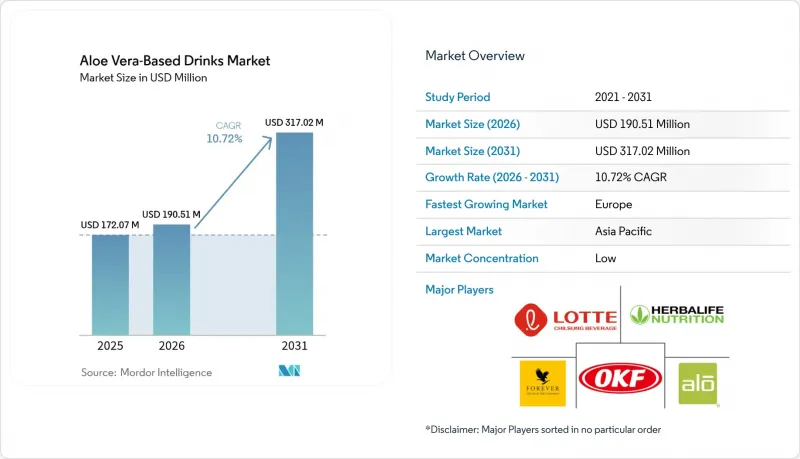
This report is Segmented by Product Type (Aloe Vera Juice/Drink, Aloe Vera Concentrate, Others), Flavor Type (Flavored, Unflavored/Natural), Packaging Material (PET Bottles, Cans, and More), Distribution Channel (Supermarkets/Hypermarkets, Convenience/Grocery Stores, and More), and Geography (North America, Europe, Asia-Pacific, and More). The Market Forecasts are Provided in Terms of Value (USD).
Global Aloe Vera-Based Drinks Market Trends and Insights
Rising Consumer Preference for Functional Beverages
Consumers are now allocating a greater portion of their beverage spending toward drinks that deliver measurable health benefits. Aloe's acemannan content supports natural gut health claims, which resonate strongly with millennials and Gen Z shoppers. Supermarkets have responded by creating dedicated functional-drink sections, moving aloe from niche shelves into high-traffic aisles. The proliferation of adaptogens and probiotics in new blends deepens perceived wellness benefits and sustains price elasticity. These factors, together, underpin a structural rise in category shelf presence across developed retail markets.
Increasing Popularity of Natural Digestive-Health Products
Skepticism toward synthetic additives steers consumers toward botanicals with long medicinal histories. Aloe's inner-leaf gel offers a recognizable solution, but standardizing acemannan levels remains an industry-wide hurdle. The International Aloe Science Council establishes voluntary benchmarks that enable premium brands to establish and maintain consumer trust. Regulatory frameworks such as 21 CFR Part 170 in the United States provide further guardrails for food-grade formulations. Companies, therefore, stress inner-leaf extraction and low-aloin processes to meet both safety and efficacy expectations, according to The International Aloe Science Council.
Limited Awareness of Functional Benefits
Outside major urban centers, aloe remains better known as a topical cosmetic ingredient than as a drink. Educational campaigns are expensive, and health-claim regulations require robust clinical evidence, which smaller firms may struggle to fund. Certification logos are helpful, but their recognition remains low in developing regions. Over time, coordinated industry research could broaden understanding, although fragmentation among producers complicates joint outreach efforts.
Other drivers and restraints analyzed in the detailed report include:
- Expansion of Ready-to-Drink (RTD) Formats
- Fruit and Herbal Flavor Innovations
- Short Shelf Life for Minimally Processed Drinks
For complete list of drivers and restraints, kindly check the Table Of Contents.
Segment Analysis
In 2025, juice and drink formats accounted for 72.15% of the Aloe Vera-based drinks market, underscoring shoppers' preference for grab-and-go convenience. Concentrates, although smaller, are advancing at a 12.05% CAGR because they ship lighter weight and co-pack close to the destination, which lowers unit logistics expenses. These savings are especially relevant for exporters in the Asia-Pacific who dilute and bottle nearer to North American and European consumers. Processing choices matter: hand-filleted gel maximizes polysaccharide retention, while whole-leaf grinding boosts yield but demands stricter aloin control. For concentrates, spray-drying and freeze-drying extend shelf stability to 24 months, although they require high energy, prompting interest in solar-drying pilots that reduce operating costs in tropical zones.
Commercial players also segment by usage occasion. Ready-to-drink bottles target hydration and digestion on the go, whereas concentrate sachets cater to smoothie bars and functional shot producers. The flexibility of concentrates supports private-label and food-service contracts, broadening revenue streams beyond retail shelves. Those dynamics position Aloe Vera-based concentrates to keep outpacing the overall Aloe Vera-based drinks market growth through the forecast horizon.
Flavored variants held 56.70% share in 2025, leveraging fruit and herb blends to offset aloe's natural bitterness. Tropical pairings, such as pineapple and mango, convey freshness, while ginger or turmeric infusions layer on immune-boosting or anti-inflammatory cues. The critical constraint is dilution: excessive flavor bases can lower acemannan density below functional thresholds, so formulators fine-tune ratios to protect health claims. Retail buyers prioritize taste for repeat sales, making flavor leadership a pathway to prime shelf locations in broad-channel supermarkets.
Unflavored options, though historically niche, are gaining at 11.58% CAGR as clean-label consumers tolerate, and sometimes seek, the plant's original taste. The segment benefits from e-commerce, where long-copy product pages explain purity credentials, and from specialty channels that allow sampling. Short ingredient lists, often just aloe gel, water, and ascorbic acid, strengthen trust. This minimalism is closely linked to organic certification, raising basket value but requiring dependable, high-grade supplies. As transparency expectations rise, the Aloe Vera-based drinks market will likely see converging flavor and purity propositions that widen consumer choice.
Complete Report Scope:
- By Product Type
- Aloe Vera Juice/Drink
- Aloe Vera Concentrate
- Others (Aloe vera Infused Water, Aloe Vera Mixed Juice, Aloe Vera Gel, and Others)
- By Flavor Type
- Flavored
- Unflavored/Natural
- By Packaging Material
- PET Bottles
- Cans
- Tetra-Pak and Cartons
- Others
- By Distribution Channel
- Supermarkets/Hypermarkets
- Convenience/Grocery Stores
- Specialty Stores
- Online Retail Stores
- Other Distribution Channels
- By Geography
- North America
- United States
- Canada
- Mexico
- Rest of North America
- Europe
- Germany
- United Kingdom
- Italy
- France
- Spain
- Russia
- Rest of Europe
- Asia-Pacific
- China
- India
- Japan
- Australia
- Rest of Asia-Pacific
- South America
- Brazil
- Argentina
- Rest of South America
- Middle East and Africa
- South Africa
- United Arab Emirates
- Rest of Middle East and Africa
- North America
Geography Analysis
The Asia-Pacific region commanded 38.25% of the 2025 value, driven by the entrenched cultural acceptance of aloe in traditional remedies and its scalable cultivation bases in China, India, and South Korea. Rapid urbanization and the premiumization of RTD beverages provide brands with a receptive audience, while investments like Suntory's carbon-neutral Queensland plant indicate confidence in continued demand for functional drinks. Challenges include fragmented farm structures and varying quality control regimes, which raise adulteration risks and complicate cross-border traceability. National initiatives in India to boost medicinal-plant acreage could expand supply, but high marketing costs and limited price supports still constrain farmer profitability.
Europe, freed from its prior food-use ban in late 2024, is now the fastest-growing region at a 12.37% CAGR. Germany, Spain, and Italy lead early adoption thanks to established organic food cultures, while the United Kingdom's health-and-wellness retail ecosystem accelerates trial. EFSA oversight imposes strict aloin limits, raising compliance costs but assuring consumers of safety. Deposit-return schemes push aluminum-can recycling rates above 90%, aligning with sustainable packaging expectations that favor aloe drinks, positioned as eco-friendly. Supply remains tight as organic acreage lags demand, prompting closer sourcing ties between European fillers and growers in Mexico and Kenya.
North America presents a mature but still expanding opportunity anchored by high functional-beverage awareness and robust e-commerce penetration. U.S. organic food sales reached USD 63.8 billion in 2023 despite inflationary pressures. The USDA's Organic Transition Initiative supports acreage growth, yet adoption momentum has been slower than hoped, leaving brands dependent on imported gel. Canada mirrors U.S. preferences but on a smaller scale and benefits from harmonized labeling rules that simplify cross-border distribution. Mexico, with arid regions suited to aloe cultivation, is a critical supplier, though producers must navigate certification audits to meet Northern buyers' quality thresholds.
South America and the Middle East & Africa together account for a modest but rising share of the Aloe Vera-based drinks market. Brazil's beverage majors have begun pilot aloe lines, but cold-chain constraints beyond big cities delay broad rollout. Argentina leverages proximity to cultivation zones, while Colombia explores solar-drying techniques that could give smallholders year-round income streams. In the Gulf Cooperation Council, affluent expatriate populations seek premium wellness drinks, yet extreme heat and logistical costs keep prices high. South Africa's organized retail network provides a springboard for regional growth, although interrupted power supply occasionally disrupts refrigeration-dependent segments.
- OKF Corporation
- ALO Drink (SPI West-Port)
- Forever Living Products
- Houssy Global
- Lotte Chilsung Beverage
- Keumkang B&F
- Tulip International
- Aloe Farms
- Grace Foods / Grace Kennedy
- Dynamic Health Laboratories
- Simplee Aloe
- RITA Food & Drink
- Herbalife Nutrition
- Nature's Way Products
- Aloecorp, Inc.
- Fruit of the Earth, Inc.
- Suja Life, LLC
- Aloe Drink For Life
- Patanjali Ayurved
- Nam Viet F&B (VINUT)
Additional Benefits:
- The market estimate (ME) sheet in Excel format
- 3 months of analyst support
TABLE OF CONTENTS
1 INTRODUCTION
- 1.1 Study Assumptions and Market Definition
- 1.2 Scope of the Study
2 RESEARCH METHODOLOGY
3 EXECUTIVE SUMMARY
4 MARKET DYNAMICS
- 4.1 Market Overview
- 4.2 Market Drivers
- 4.2.1 Rising consumer preference for functional beverages
- 4.2.2 Increasing popularity of natural digestive health products
- 4.2.3 Expansion of ready-to-drink (RTD) formats
- 4.2.4 Fruit and herbal flavor innovations
- 4.2.5 Premium and organic product lines
- 4.2.6 Low-calorie and sugar-conscious variants
- 4.3 Market Restraints
- 4.3.1 Limited awareness of functional benefits
- 4.3.2 Short shelf life for fresh or minimally processed drinks
- 4.3.3 High production and ingredient costs
- 4.3.4 Risk of adulteration or inconsistent quality
- 4.4 Consumer Behavaior Analysis
- 4.5 Regulatory Landscape
- 4.6 Technological Outlook
- 4.7 Porter's Five Forces
- 4.7.1 Threat of New Entrants
- 4.7.2 Bargaining Power of Buyers
- 4.7.3 Bargaining Power of Suppliers
- 4.7.4 Threat of Substitute Products
- 4.7.5 Intensity of Competitive Rivalry
5 MARKET SIZE AND GROWTH FORECASTS (VALUE)
- 5.1 By Product Type
- 5.1.1 Aloe Vera Juice/Drink
- 5.1.2 Aloe Vera Concentrate
- 5.1.3 Others (Aloe vera Infused Water, Aloe Vera Mixed Juice, Aloe Vera Gel, and Others)
- 5.2 By Flavor Type
- 5.2.1 Flavored
- 5.2.2 Unflavored/Natural
- 5.3 By Packaging Material
- 5.3.1 PET Bottles
- 5.3.2 Cans
- 5.3.3 Tetra-Pak and Cartons
- 5.3.4 Others
- 5.4 By Distribution Channel
- 5.4.1 Supermarkets/Hypermarkets
- 5.4.2 Convenience/Grocery Stores
- 5.4.3 Specialty Stores
- 5.4.4 Online Retail Stores
- 5.4.5 Other Distribution Channels
- 5.5 By Geography
- 5.5.1 North America
- 5.5.1.1 United States
- 5.5.1.2 Canada
- 5.5.1.3 Mexico
- 5.5.1.4 Rest of North America
- 5.5.2 Europe
- 5.5.2.1 Germany
- 5.5.2.2 United Kingdom
- 5.5.2.3 Italy
- 5.5.2.4 France
- 5.5.2.5 Spain
- 5.5.2.6 Russia
- 5.5.2.7 Rest of Europe
- 5.5.3 Asia-Pacific
- 5.5.3.1 China
- 5.5.3.2 India
- 5.5.3.3 Japan
- 5.5.3.4 Australia
- 5.5.3.5 Rest of Asia-Pacific
- 5.5.4 South America
- 5.5.4.1 Brazil
- 5.5.4.2 Argentina
- 5.5.4.3 Rest of South America
- 5.5.5 Middle East and Africa
- 5.5.5.1 South Africa
- 5.5.5.2 United Arab Emirates
- 5.5.5.3 Rest of Middle East and Africa
- 5.5.1 North America
6 COMPETITIVE LANDSCAPE
- 6.1 Market Concentration
- 6.2 Strategic Moves
- 6.3 Market Share Analysis
- 6.4 Company Profiles (includes Global level Overview, Market level overview, Core Segments, Financials, Strategic Information, Market Rank/Share, Products and Services, Recent Developments)
- 6.4.1 OKF Corporation
- 6.4.2 ALO Drink (SPI West-Port)
- 6.4.3 Forever Living Products
- 6.4.4 Houssy Global
- 6.4.5 Lotte Chilsung Beverage
- 6.4.6 Keumkang B&F
- 6.4.7 Tulip International
- 6.4.8 Aloe Farms
- 6.4.9 Grace Foods / Grace Kennedy
- 6.4.10 Dynamic Health Laboratories
- 6.4.11 Simplee Aloe
- 6.4.12 RITA Food & Drink
- 6.4.13 Herbalife Nutrition
- 6.4.14 Nature's Way Products
- 6.4.15 Aloecorp, Inc.
- 6.4.16 Fruit of the Earth, Inc.
- 6.4.17 Suja Life, LLC
- 6.4.18 Aloe Drink For Life
- 6.4.19 Patanjali Ayurved
- 6.4.20 Nam Viet F&B (VINUT)
7 MARKET OPPORTUNITIES AND FUTURE TRENDS

