PUBLISHER: Mordor Intelligence | PRODUCT CODE: 2114527

PUBLISHER: Mordor Intelligence | PRODUCT CODE: 2114527
Landscaping Tools - Market Share Analysis, Industry Trends & Statistics, Growth Forecasts (2026 - 2031)
According to Mordor Intelligence, the landscaping tools market size is expected to grow from USD 35.20 billion in 2025 to USD 37.22 billion in 2026 and is forecast to reach USD 49.21 billion by 2031 at 5.74% CAGR over 2026-2031.
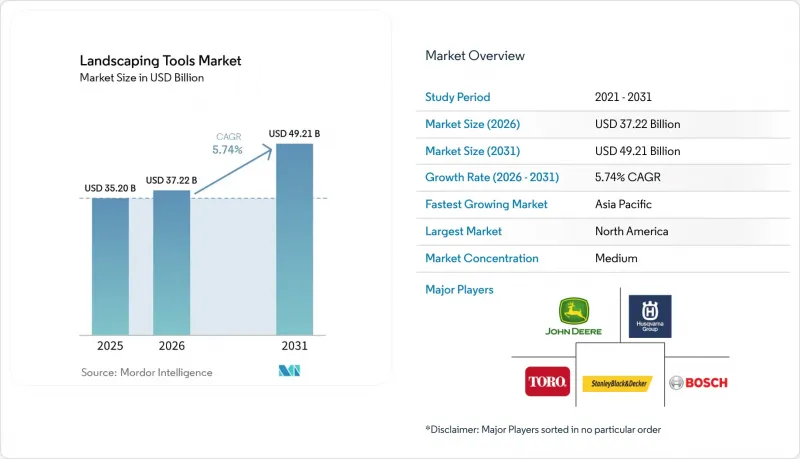
This report is Segmented by Product (Lawnmowers, Power Tools, Hand Tools, and Other Landscaping Tools), by End User (Residential and Commercial), and by Geography (North America, Europe, Asia-Pacific, South America, and the Middle East and Africa). The Market Forecasts are Provided in Terms of Value (USD).
Global Landscaping Tools Market Trends and Insights
Surging DIY (Do it Yourself) Lawn-Care Culture in Suburban Housing
Suburban housing expansion across developed markets is driving unprecedented demand for residential landscaping tools as homeowners increasingly embrace DIY (Do it Yourself) maintenance practices. Work-from-home trends established during 2020-2021 have created sustained engagement with outdoor property improvement, with homeowners investing in professional-grade equipment previously reserved for commercial users. The shift toward DIY (Do it Yourself) culture reflects both cost consciousness and lifestyle preferences, as property owners seek greater control over maintenance schedules and quality standards. Dealers report rising demand for modular power-head systems that accept multiple attachments. Manufacturers able to bundle batteries with cross-platform compatibility gain repeat sales as consumers expand their tool sets.
Rapid Urban Adoption of Green Roofs and Vertical Gardens
Urban sustainability mandates are creating specialized demand for lightweight, precision landscaping tools designed for green infrastructure applications. Green roof installations require equipment capable of operating in weight-constrained environments, typically limiting loads to 80-150 pounds (36.3-68.0 kg) per square foot compared to traditional ground-level applications. This constraint drives demand for compact, battery-powered tools with specialized attachments for irrigation system maintenance, drainage management, and plant care in vertical growing systems. Compact cordless trimmers and irrigation-service attachments now feature quick-swap batteries and compact transport cases that fit standard roof access hatches.
Shortage of Trained Landscaping Labor
The landscaping industry's labor shortages restrict market growth by limiting service capacity and increasing operational costs across equipment categories. In 2024, H-2B visa applications for seasonal workers exceeded the United States cap of 66,000 by nearly 50%. While contractors are increasing automation adoption to address crew shortages, they continue to face challenges in meeting peak-season schedules, which affects equipment turnover. The National Association of Landscape Professionals advocates changing statutory language from "may authorize" to "shall authorize" for presidential H-2B visa approvals to improve workforce planning certainty. This labor constraint simultaneously drives automation adoption while restricting market expansion, as contractors cannot scale operations despite equipment availability.
Other drivers and restraints analyzed in the detailed report include:
- Battery Pack Price Declines Below USD 100 /Kwh
- Integration of Iot-Enabled Fleet Management for Commercial Landscaping
- High Upfront Cost of Commercial-Grade Cordless Tools
For complete list of drivers and restraints, kindly check the Table Of Contents.
Segment Analysis
Lawnmowers maintain market dominance with a 37.45% market share share in 2025, driven by essential lawn maintenance needs across residential and commercial segments. Traditional walk-behind and riding mowers benefit from established distribution networks and proven reliability, and face increasing competition from robotic alternatives that eliminate labor requirements and reduce operational complexity.
Power tools emerge as the fastest-growing category at 9.28% CAGR through 2031, led by battery-powered hedge trimmers, chainsaws, and blowers. Power tools capitalize on electrification trends and regulatory mandates that favor battery-powered alternatives over gasoline engines, with manufacturers like STIHL launching multi-tool systems such as the KMA 120 R that connect to 12 interchangeable implements through quick-coupling mechanisms.
Complete Report Scope:
- By Product
- Lawnmowers
- Power Tools
- Hand Tools
- Other Landscaping Tools
- By End User
- Residential
- Commercial
- Government
- By Geography
- North America
- United States
- Canada
- Mexico
- Rest of North America
- Europe
- Germany
- United Kingdom
- France
- Russia
- Spain
- Rest of Europe
- Asia-Pacific
- China
- Japan
- India
- South Korea
- Rest of Asia-Pacific
- South America
- Brazil
- Argentina
- Rest of South America
- Middle East
- Saudi Arabia
- United Arab Emirates
- Rest of Middle East
- Africa
- South Africa
- Egypt
- Rest of Africa
- North America
Geography Analysis
North America retained 37.62% of the 2025 global market share. Widespread suburban lawns, mature contractor networks, and state-level zero-emission regulations combine to support sustained demand. Market volatility is tied to H-2B visa allocations that cap seasonal labor, nudging firms toward autonomous platforms. SiteOne Landscape Supply, the region's largest distributor, posted USD 4.54 billion in 2024 sales after 66 acquisitions, illustrating ongoing consolidation.
Europe holds a significant market share due to stringent sustainability regulations and high disposable incomes. Ireland's 2025 procurement regulations increase the demand for battery-powered equipment in public tenders. European suppliers benefit from their proximity to regional buyers, while the United Kingdom faces import challenges due to post-Brexit trade barriers.
Asia-Pacific is the fastest-growing region at a 7.30% CAGR. Urbanization and rising middle-class incomes underpin residential sales, while local manufacturers scale robotic exports. Chinese producer Ninebot reported RMB 595 million (USD 82 million) in lawn-mower robot revenue for the first nine months of 2024. Japan and South Korea show early adoption of high-precision cordless platforms, whereas India presents upside once infrastructure for battery charging advances.
- Deere and Company
- Husqvarna AB
- Stanley Black and Decker Inc.
- The Toro Company
- Robert Bosch GmbH
- Honda Motor Co., Ltd.
- Kubota Corporation
- Makita Corporation
- STIHL Holding AG & Co. KG
- Techtronic Industries Co. Ltd.
- AriensCo
- Briggs & Stratton LLC
- Fiskars Corporation
- Globe Group
- Yamabiko Corporation
Additional Benefits:
- The market estimate (ME) sheet in Excel format
- 3 months of analyst support
TABLE OF CONTENTS
1 Introduction
- 1.1 Study Assumptions and Market Definition
- 1.2 Scope of the Study
2 Research Methodology
3 Executive Summary
4 Market Landscape
- 4.1 Market Overview
- 4.2 Market Drivers
- 4.2.1 Surging DIY (Do It Yourself) Lawn Care Culture in Suburban Housing
- 4.2.2 Rapid Urban Adoption of Green Roofs and Vertical Gardens
- 4.2.3 Battery Pack Price Declines Below USD 100 /Kwh
- 4.2.4 Integration Of Iot-Enabled Fleet Management for Commercial Landscaping
- 4.2.5 Municipal Carbon-Neutral Targets Boosting Electric Tool Procurement
- 4.2.6 Landscaping Robots Bundled with Subscription-Maintenance Service
- 4.3 Market Restraints
- 4.3.1 Shortage of Trained Landscaping Labor
- 4.3.2 High Upfront Cost of Commercial-Grade Cordless Tools
- 4.3.3 Grid-Edge Power Limitations in Large Parks Restricting Electrification
- 4.3.4 Rising Noise-Pollution Bylaws Curbing Gas-Powered Tool Usage Windows
- 4.4 Regulatory Landscape
- 4.5 Technological Outlook
- 4.6 Porter's Five Forces Analysis
- 4.6.1 Bargaining Power of Suppliers
- 4.6.2 Bargaining Power of Buyers
- 4.6.3 Threat of Substitutes
- 4.6.4 Threat of New Entrants
- 4.6.5 Intensity of Competitive Rivalry
5 Market Size and Growth Forecasts (Value, USD)
- 5.1 By Product
- 5.1.1 Lawnmowers
- 5.1.2 Power Tools
- 5.1.3 Hand Tools
- 5.1.4 Other Landscaping Tools
- 5.2 By End User
- 5.2.1 Residential
- 5.2.2 Commercial
- 5.2.3 Government
- 5.3 By Geography
- 5.3.1 North America
- 5.3.1.1 United States
- 5.3.1.2 Canada
- 5.3.1.3 Mexico
- 5.3.1.4 Rest of North America
- 5.3.2 Europe
- 5.3.2.1 Germany
- 5.3.2.2 United Kingdom
- 5.3.2.3 France
- 5.3.2.4 Russia
- 5.3.2.5 Spain
- 5.3.2.6 Rest of Europe
- 5.3.3 Asia-Pacific
- 5.3.3.1 China
- 5.3.3.2 Japan
- 5.3.3.3 India
- 5.3.3.4 South Korea
- 5.3.3.5 Rest of Asia-Pacific
- 5.3.4 South America
- 5.3.4.1 Brazil
- 5.3.4.2 Argentina
- 5.3.4.3 Rest of South America
- 5.3.5 Middle East
- 5.3.5.1 Saudi Arabia
- 5.3.5.2 United Arab Emirates
- 5.3.5.3 Rest of Middle East
- 5.3.6 Africa
- 5.3.6.1 South Africa
- 5.3.6.2 Egypt
- 5.3.6.3 Rest of Africa
- 5.3.1 North America
6 Competitive Landscape
- 6.1 Market Concentration
- 6.2 Strategic Moves
- 6.3 Market Share Analysis
- 6.4 Company Profiles (Includes Global level Overview, Market level Overview, Core Segments, Financials as Available, Strategic Information, Market Rank/Share for key companies, Products and Services, and Recent Developments)
- 6.4.1 Deere and Company
- 6.4.2 Husqvarna AB
- 6.4.3 Stanley Black and Decker Inc.
- 6.4.4 The Toro Company
- 6.4.5 Robert Bosch GmbH
- 6.4.6 Honda Motor Co., Ltd.
- 6.4.7 Kubota Corporation
- 6.4.8 Makita Corporation
- 6.4.9 STIHL Holding AG & Co. KG
- 6.4.10 Techtronic Industries Co. Ltd.
- 6.4.11 AriensCo
- 6.4.12 Briggs & Stratton LLC
- 6.4.13 Fiskars Corporation
- 6.4.14 Globe Group
- 6.4.15 Yamabiko Corporation
7 Market Opportunities and Future Outlook

