PUBLISHER: Mordor Intelligence | PRODUCT CODE: 2114528

PUBLISHER: Mordor Intelligence | PRODUCT CODE: 2114528
Forestry Machinery - Market Share Analysis, Industry Trends & Statistics, Growth Forecasts (2026 - 2031)
According to Mordor Intelligence, the forestry machinery market size in 2026 is estimated at USD 12.54 billion, growing from 2025 value of USD 12.0 billion with 2031 projections showing USD 15.66 billion, growing at 4.54% CAGR over 2026-2031.
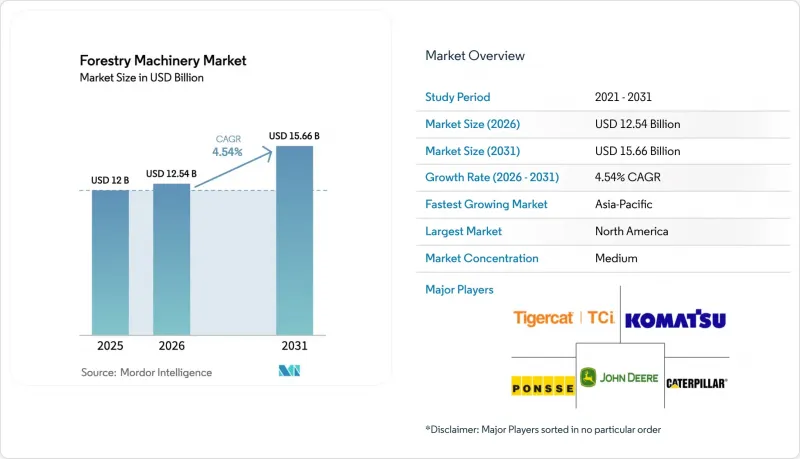
This report is Segmented by Machine Type (Skidders, Forwarders, Feller Bunchers, and More), by Power Source (Diesel, Hybrid, and More), by Automation Level (Manual, and More), by End User (Contract Logging Firms, Forest Ownership Groups, and More), and by Geography (North America, Europe, Asia-Pacific, and More). The Market Forecasts are Provided in Terms of Value (USD).
Global Forestry Machinery Market Trends and Insights
Surge in Mechanized Logging in Emerging Economies
Mechanization rates in China increased as government mandates strengthened sustainable forest management requirements. Productivity gains in Brazilian eucalyptus plantations demonstrate measurable benefits - forwarder output reaches 60.97 m3 per effective work hour when individual tree volume exceeds 0.58 m3, compared to 42.06 m3 at lower volumes. Operational costs in developing regions have decreased, becoming lower than in several developed markets. Paraguay's plantation area quadrupled as investors targeted returns from mechanized eucalyptus stands. Equipment manufacturers developed lighter forwarders and oscillating bogies that reduce soil compaction for local terrain conditions, enabling emerging operators to achieve both productivity and environmental standards.
Rising Global Demand for Certified Timber Products
Forest Stewardship Council certification increased oak log prices by 19.28% and beech log prices by 12.30% in Turkey in 2023, demonstrating that certification premiums can offset investments in precision equipment. The European Deforestation Regulation, which takes effect in December 2024, requires exporters to provide geolocation and traceability data, necessitating the implementation of digital recorders and satellite systems. Certification requirements in Japan and Western Europe promote the use of selective cutting equipment and low-impact vehicles to maintain forest quality. Major buyers now incorporate audit systems that process data, making machine-generated logging records essential for market access.
High Upfront and Lifecycle Ownership Costs
Tracked harvesters in the southeastern United States range from USD 316,000 to USD 763,000. In Brazil, maintenance accounts for 33.5% of hourly operating costs for John Deere models with over 30,000 operating hours. Research from the Czech Republic indicates that personnel costs comprise 35-66% of forwarder operating expenses, making operator efficiency essential for return on investment. Machine size and brand influence value retention, with larger carriers maintaining higher resale values despite requiring greater initial capital. Financing packages combining telematics subscriptions and residual-value guarantees help manage costs, but small contractors continue to face limited credit availability.
Other drivers and restraints analyzed in the detailed report include:
- Government Re-Afforestation Incentives and Subsidies
- Electrification of Off-Highway Machinery Fleets
- Volatility in Soft-Wood Commodity Prices
For complete list of drivers and restraints, kindly check the Table Of Contents.
Segment Analysis
Harvesters generated 33.80% of the forestry machinery market share in 2025 as manufacturers embedded precision felling heads and real-time length-diameter optimization algorithms. The forwarder segment is projected to grow at a 7.65% CAGR through 2031, as plantation operators adopt integrated cut-to-length systems that minimize soil impact and reduce skidder usage. The technological advancement in the industry is exemplified by Deere's C7.1 twin turbo harvester engine, which delivers 30% higher swing torque while reducing maintenance time by 15%.
Feller bunchers maintain their market position in Southern pine operations due to specific tree characteristics and stand density requirements. Their market share may decline as harvesting heads develop enhanced multi-tree handling capabilities. Swing machines and loaders continue to serve specialized processing requirements at roadside locations, while mulchers maintain consistent demand from municipal wildfire prevention programs. Equipment manufacturers' order backlogs indicate increasing preference for versatile carriers that accommodate interchangeable harvesting, forwarding, and hoe-chucking attachments, helping operators manage market fluctuations effectively.
Diesel engines maintain a 77.30% share in the forestry machinery market in 2025, primarily due to operational duty cycles exceeding current battery capabilities. Battery-electric solutions are growing at a 10.25% CAGR. The introduction of Volvo's EW240 Electric Material Handler demonstrates the viability of heavy battery-powered equipment, while mobile charging trailers become standard offerings in dealer catalogs. Hybrid systems function as transitional technology, with Sennebogen's Green Hybrid energy recovery system reducing fuel consumption by up to 30% in crane operations.
Financial institutions now incorporate carbon credit revenue streams in their equipment financing programs for low-emission machines. This shift has led to powertrain selection decisions based on total environmental ownership costs rather than initial purchase price. In Scandinavia, public land contract bids award additional points for zero-emission harvesters, indicating regulatory influences that may accelerate the transition away from diesel faster than economic factors alone would predict.
Complete Report Scope:
- By Machine Type
- Skidders
- Forwarders
- Feller Bunchers
- Harvesters
- Swing Machines
- Loaders
- Other Machine Type
- By Power Source
- Diesel
- Hybrid
- Battery-Electric
- By Automation Level
- Manual
- Semi-Autonomous
- Fully Autonomous
- By End User
- Contract Logging Firms
- Forest Ownership Groups
- Pulp and Paper Companies
- Sawmills
- By Geography
- North America
- United States
- Canada
- Mexico
- Rest of North America
- Europe
- Germany
- Sweden
- Finland
- United Kingdom
- France
- Spain
- Russia
- Rest of Europe
- Asia-Pacific
- China
- Japan
- India
- South Korea
- Rest of Asia-Pacific
- South America
- Brazil
- Argentina
- Rest of South America
- Middle East
- Saudi Arabia
- United Arab Emirates
- Turkey
- Rest of Middle East
- Africa
- South Africa
- Egypt
- Rest of Africa
- North America
Geography Analysis
North America holds a 36.50% share in the forestry machinery market in 2025 due to established mechanized practices and autonomous harvester trials addressing labor shortages. The region benefits from USD 80 million in federal grants for 2025 and tax incentives that reduce payback periods for electrified carriers. Canada's fivefold increase in temporary foreign workers indicates persistent labor constraints, supporting automated equipment adoption. Dealers manage inventory against Deere's projected decline for 2025, and demand for telematics module retrofits remains strong as operators focus on equipment uptime.
Asia-Pacific shows the highest growth rate at 7.05% CAGR, with China's commercial harvest mechanization exceeding 60%. Komatsu anticipates continued market expansion based on wood demand, labor constraints, and enhanced safety requirements. Japanese certification premiums currently limit harvester upgrades, and domestic manufacturers identify export opportunities in the Asia Pacific's expanding plantation sector.
Europe maintains robust replacement cycles driven by certification requirements. The European Union Deforestation Regulation, effective December 2024, mandates GPS-accurate harvest data, increasing demand for modern cabs with StanForD-compatible logging systems. Sweden and Finland are pioneers in electric truck implementations, with SCA's timber haulers reducing their annual emissions by 55 metric tons. Ponsse reported EUR 336.0 million (USD 393.4 million) in order intake from Nordic countries during the first half of 2024, demonstrating stable replacement demand despite weakness in the construction sector.
South America optimizes operations through uniform eucalyptus plantations supporting high-capacity, automated fleets. Brazil sets productivity standards for cost efficiency, while Paraguay's expanding cultivation area creates opportunities for Original Equipment Manufacturers (OEM) financing services. The Middle East and Africa markets remain early-stage, with reforestation programs supported by donor funding creating specific opportunities for light skidders and multipurpose loaders.
- Deere & Company
- Komatsu Ltd.
- Caterpillar Inc.
- Tigercat International Inc.
- Ponsse Plc
- Volvo Construction Equipment AB (AB Volvo)
- Hitachi Construction Machinery Co., Ltd. (Hitachi Ltd.)
- Kubota Corporation
- Barko Hydraulics LLC (Heico Companies)
- Rottne Industri AB
- Kawasaki Heavy Industries, Ltd.
- Doosan Bobcat Inc. (Doosan Group)
- LKT Holding s. r. o.
- Kesla Oyj
- Sennebogen Maschinenfabrik GmbH
Additional Benefits:
- The market estimate (ME) sheet in Excel format
- 3 months of analyst support
TABLE OF CONTENTS
1 Introduction
- 1.1 Study Assumptions and Market Definition
- 1.2 Scope of the Study
2 Research Methodology
3 Executive Summary
4 Market Landscape
- 4.1 Market Overview
- 4.2 Market Drivers
- 4.2.1 Surge in Mechanized Logging in Emerging Economies
- 4.2.2 Rising Global Demand for Certified Timber Products
- 4.2.3 Government Re-Afforestation Incentives and Subsidies
- 4.2.4 Electrification of Off-Highway Machinery Fleets
- 4.2.5 Labor-Shortage-Led Adoption of Autonomous Machineries
- 4.2.6 Digital Twin Deployment for Predictive Maintenance
- 4.3 Market Restraints
- 4.3.1 High Upfront and Lifecycle Ownership Costs
- 4.3.2 Volatility in Soft-Wood Commodity Prices
- 4.3.3 Shortage of Skilled Operators for Advanced Machines
- 4.3.4 Cyber-Security Gaps in Telemetry-Enabled Equipment
- 4.4 Regulatory Landscape
- 4.5 Technological Outlook
- 4.6 Porter's Five Forces Analysis
- 4.6.1 Bargaining Power of Suppliers
- 4.6.2 Bargaining Power of Buyers
- 4.6.3 Threat of Substitute Products
- 4.6.4 Threat of New Entrants
- 4.6.5 Intensity of Competitive Rivalry
5 Market Size and Growth Forecasts (Value)
- 5.1 By Machine Type
- 5.1.1 Skidders
- 5.1.2 Forwarders
- 5.1.3 Feller Bunchers
- 5.1.4 Harvesters
- 5.1.5 Swing Machines
- 5.1.6 Loaders
- 5.1.7 Other Machine Type
- 5.2 By Power Source
- 5.2.1 Diesel
- 5.2.2 Hybrid
- 5.2.3 Battery-Electric
- 5.3 By Automation Level
- 5.3.1 Manual
- 5.3.2 Semi-Autonomous
- 5.3.3 Fully Autonomous
- 5.4 By End User
- 5.4.1 Contract Logging Firms
- 5.4.2 Forest Ownership Groups
- 5.4.3 Pulp and Paper Companies
- 5.4.4 Sawmills
- 5.5 By Geography
- 5.5.1 North America
- 5.5.1.1 United States
- 5.5.1.2 Canada
- 5.5.1.3 Mexico
- 5.5.1.4 Rest of North America
- 5.5.2 Europe
- 5.5.2.1 Germany
- 5.5.2.2 Sweden
- 5.5.2.3 Finland
- 5.5.2.4 United Kingdom
- 5.5.2.5 France
- 5.5.2.6 Spain
- 5.5.2.7 Russia
- 5.5.2.8 Rest of Europe
- 5.5.3 Asia-Pacific
- 5.5.3.1 China
- 5.5.3.2 Japan
- 5.5.3.3 India
- 5.5.3.4 South Korea
- 5.5.3.5 Rest of Asia-Pacific
- 5.5.4 South America
- 5.5.4.1 Brazil
- 5.5.4.2 Argentina
- 5.5.4.3 Rest of South America
- 5.5.5 Middle East
- 5.5.5.1 Saudi Arabia
- 5.5.5.2 United Arab Emirates
- 5.5.5.3 Turkey
- 5.5.5.4 Rest of Middle East
- 5.5.6 Africa
- 5.5.6.1 South Africa
- 5.5.6.2 Egypt
- 5.5.6.3 Rest of Africa
- 5.5.1 North America
6 Competitive Landscape
- 6.1 Market Concentration
- 6.2 Strategic Moves
- 6.3 Market Share Analysis
- 6.4 Company Profiles (Includes Global-level Overview, Market-level Overview, Core Segments, Financials as available, Strategic Information, Market Rank/Share, Products and Services, and Recent Developments)
- 6.4.1 Deere & Company
- 6.4.2 Komatsu Ltd.
- 6.4.3 Caterpillar Inc.
- 6.4.4 Tigercat International Inc.
- 6.4.5 Ponsse Plc
- 6.4.6 Volvo Construction Equipment AB (AB Volvo)
- 6.4.7 Hitachi Construction Machinery Co., Ltd. (Hitachi Ltd.)
- 6.4.8 Kubota Corporation
- 6.4.9 Barko Hydraulics LLC (Heico Companies)
- 6.4.10 Rottne Industri AB
- 6.4.11 Kawasaki Heavy Industries, Ltd.
- 6.4.12 Doosan Bobcat Inc. (Doosan Group)
- 6.4.13 LKT Holding s. r. o.
- 6.4.14 Kesla Oyj
- 6.4.15 Sennebogen Maschinenfabrik GmbH
7 Market Opportunities and Future Outlook

