PUBLISHER: Mordor Intelligence | PRODUCT CODE: 2114536

PUBLISHER: Mordor Intelligence | PRODUCT CODE: 2114536
Rodenticides - Market Share Analysis, Industry Trends & Statistics, Growth Forecasts (2026 - 2031)
According to Mordor Intelligence, the rodenticides market size is expected to grow from USD 6.0 billion in 2025 to USD 6.29 billion in 2026 and is forecast to reach USD 7.94 billion by 2031 at 4.78% CAGR over 2026-2031.
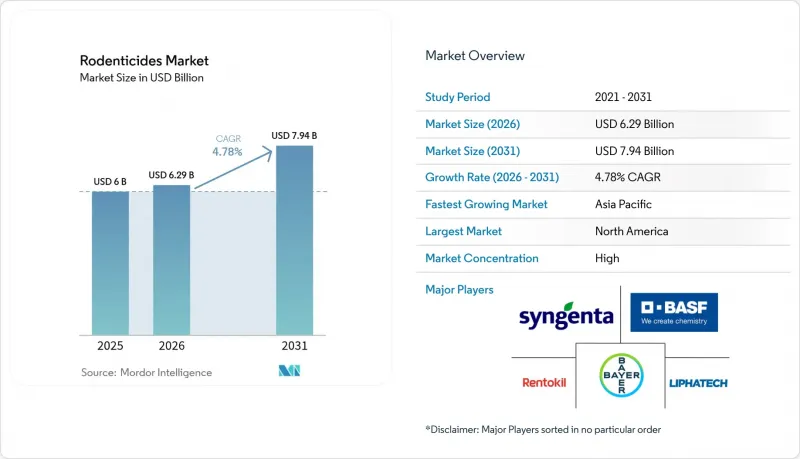
This report is Segmented by Type (Non-Anticoagulant Rodenticides, and Anticoagulant Rodenticides), Form (Blocks, Pellets, Powders, and More), Application (Agricultural Fields, Warehouses and Storage Facilities, and More), Mode of Distribution (Pest Control Operators (PCO), and More) and Geography (North America, Europe, Asia-Pacific, and More). The Market Forecasts are Provided in Terms of Value (USD).
Global Rodenticides Market Trends and Insights
Surge in Bio-secure Commodity Trade Standards
Trade agreements are increasingly requiring certified rodent-control protocols to prevent the transmission of pests across borders, compelling grain terminals, warehouses, and shipping lines to adopt professionally applied rodenticides and integrated pest-management (IPM) plans. Parallel mandates in the European Union and North America tie export eligibility to pest-free storage certificates, prompting exporters to deploy tamper-resistant bait boxes that comply with stewardship codes for second-generation anticoagulant rodenticides (SGAR). These measures shield multi-million-dollar consignments from quarantine holds, making professional-grade rodenticides a frontline tool in safeguarding trade continuity. The economic incentive widens as the Organisation for Economic Co-operation and Development and Food and Agriculture Organization (OECD-FAO) Agricultural Outlook anticipates 1.3% annual growth in consumption through 2032, intensifying pressure on already-stretched logistics networks .
Increasing Demand for Food and Agricultural Productivity
Rising calorie needs and climate-induced yield volatility expose grain and horticulture systems to heavier post-harvest losses, which can reach 30-40% in emerging markets when rodent control is inadequate. Field studies across Asia-Pacific rice belts show ecologically based rodent management lifting yields 6-15% and farm incomes beyond 15%, a compelling return on rodenticide investments. In Africa, multimammate rats shave as much as 48% from maize harvests, pushing governments to subsidize broad-acre zinc-phosphide campaigns. The Food and Agriculture Organization confirms that combining structural silo upgrades with targeted chemical control sharply curtails storage losses. As climate shifts stretch breeding seasons, growers scale up from spot treatments to programmatic applications, reinforcing long-run volume growth in the rodenticides market.
Rise in the Number of Resistant Pests
Genetic mutations, particularly in the Vkorc1 gene, undermine first- and second-generation anticoagulants, raising treatment costs and prolonging infestation timelines. Lebanese fieldwork confirmed resistance in house mice and rats despite limited oversight of rodenticide sales. New Zealand studies detected brodifacoum tolerance in isolated populations lacking prior exposure, hinting at spontaneous resistance via genetic drift. California ground squirrels now survive diphacinone and chlorophacinone pulses, compelling rotation to zinc-phosphide or cholecalciferol mixtures. Resistance inflates service calls and drives investment in diagnostics, tempering volume growth for legacy chemistries.
Other drivers and restraints analyzed in the detailed report include:
- Proliferation of Large-scale, Vertically Integrated Farming
- Rapid Urban Rodent Infestations Linked to Climate Change
- Environmental and Human Health Hazards
For complete list of drivers and restraints, kindly check the Table Of Contents.
Segment Analysis
Anticoagulants secured 65.40% of 2025 revenue, underpinning the rodenticides market leadership story. Their single-dose lethality against resistant strains anchors usage in warehouses and food plants even as regulators trim permissible concentrations. Second-generation molecules, such as brodifacoum, remain favored among professionals, while non-anticoagulant classes are projected to grow at a 7.35% CAGR to 2031, drawing demand toward zinc phosphide and cholecalciferol hybrids. Studies show that zinc phosphide reduced field populations by 58.15%, surpassing traditional first-generation outcomes.
In parallel, bromethalin and strychnine hold niche utility for burrow systems where anticoagulant resistance soars. Regulatory developments against metal phosphides in low-income regions temper broader adoption, yet specialized needs sustain modest demand. Overall, portfolio diversification lets market leaders buffer exposure to any single regulatory clampdown, keeping the rodenticides market adaptable.
Blocks retained a 44.30% share of the 2025 market size demand due to weather resistance and compatibility with tamper-proof stations mandated under Second-generation anticoagulant rodenticides (SGAR) stewardship. Professionals appreciate their longevity outdoors, limiting call-backs. Pellets followed, favored for mechanical broadcast across rice paddies and row crops. The rodenticides market size attributable to liquid concentrates is forecast to grow 7.05% CAGR, outpacing overall sector expansion as precision-spray rigs and bait baggers gain traction.
Fieldwork shows that paraffin blocks kept 100% active-ingredient recovery in open air, although 50% detached within five weeks, prompting innovation in anchor systems. Pastes and gels have a growing demand in high-visibility retail and hospitality settings, where discreet application is crucial. Powders are declining due to drift concerns, but retain relevance for fumigant burrow dusting in grain facilities. Ready-to-use sachets meet the demand among homeowners for convenience, but rising licensing barriers on Second-generation anticoagulant rodenticides (SGARs) are tilting the DIY aisle toward first-generation actives or fertility tablets. The move toward internet-connected bait boxes amplifies demand for formulations stable under sensor rigs that log consumption. Manufacturers of engineering denser blocks that resist fragmentation stand to capture incremental volume as service contracts specify reduced site visits.
Complete Report Scope:
- By Type
- Non-Anticoagulant Rodenticides
- Bromethalin
- Cholecalciferol
- Zinc Phosphide
- Strychnine
- Anticoagulant Rodenticides
- First-Generation
- Warfarin
- Chlorophacinone
- Diphacinone
- Coumatetralyl
- Second-Generation
- Difenacoum
- Brodifacoum
- Flocoumafen
- Bromadiolone
- First-Generation
- Non-Anticoagulant Rodenticides
- By Form
- Blocks
- Pellets
- Powders
- Pastes and Gels
- Liquid Concentrates
- By Application
- Agricultural Fields
- Warehouses and Storage Facilities
- Commercial and Industrial Premises
- Residential Buildings
- By Mode of Distribution
- Pest Control Operators (PCOs)
- Retail/DIY Channels
- Government Vector-Control Programs
- By Geography
- North America
- United States
- Canada
- Mexico
- Rest of North America
- Europe
- Germany
- United Kingdom
- France
- Russia
- Spain
- Rest of Europe
- Asia-Pacific
- China
- Japan
- India
- Australia
- Rest of Asia-Pacific
- South America
- Brazil
- Argentina
- Rest of South America
- Middle East
- Saudi Arabia
- United Arab Emirates
- Rest of Middle East
- Africa
- South Africa
- Egypt
- Rest of Africa
- North America
Geography Analysis
North America maintained the largest regional market share at 35.60% in 2025, reflecting mature regulatory frameworks, high adoption of professional pest control services, and substantial commercial and industrial applications. The region's leadership stems from stringent food-safety regulations in warehousing and processing facilities, extensive agricultural operations requiring systematic pest management, and urbanization patterns that create ideal conditions for rodent infestations. Growth is projected at 3.98% CAGR through 2031, constrained by environmental regulations yet supported by climate-driven urban rodent population rises and advances in application technology. The Environmental Protection Agency's comprehensive rodenticide strategy, released in November 2024, delivers regulatory clarity while adding targeted mitigation measures for endangered-species protection.
Asia-Pacific represents the fastest-growing regional segment at a 5.95% CAGR to 2031, propelled by rapid urbanization, agricultural expansion, and heightened food security awareness in developing economies. China's rodent programs rely heavily on diphacinone for commensal species and zinc phosphide for field pests, with provincial agencies coordinating large-scale campaigns across urban and rural zones. Ecologically-based rodent management has lifted cereal yields by 6-15% and farm income by more than 15% across multiple nations, reinforcing adoption momentum.
Europe is expected to advance at a 3.65% CAGR through 2031, as harmonized EU rules encourage standardized product labeling and spur the development of eco-friendly formulations. The United Kingdom's ban on outdoor bromadiolone and difenacoum, effective July 2024, shifts product portfolios toward cholecalciferol and flocoumafen. Africa and the Middle East are projected to post CAGRs of 5.25% and 4.72%, respectively, driven by urban growth, expanding agriculture, and public health measures aimed at controlling rodent-borne diseases. South America is projected to advance at a 5.02% CAGR, with Brazil's biosecurity-centered trade rules underpinning steady demand. A gradual shift toward ecologically based rodent management in Sub-Saharan Africa signals a strategic evolution, yet acute outbreaks still necessitate conventional rodenticides.
- BASF SE
- Bayer AG
- Syngenta Group
- Liphatech
- Rentokil Initial plc
- Neogen Corporation
- JT Eaton
- Bell Laboratories
- SenesTech Inc.
- PelGar International
- Impex Europa
- Russell IPM
- Truly Nolen
- Vebi Istituto Biochimico
- Fumakilla
- UPL Limited
- Detia Degesch GmbH
Additional Benefits:
- The market estimate (ME) sheet in Excel format
- 3 months of analyst support
TABLE OF CONTENTS
1 Introduction
- 1.1 Study Assumptions and Market Definition
- 1.2 Scope of the Study
2 Research Methodology
3 Executive Summary
4 Market Landscape
- 4.1 Market Overview
- 4.2 Market Drivers
- 4.2.1 Surge in bio-secure commodity trade standards
- 4.2.2 Increasing demand for food and agricultural productivity
- 4.2.3 Proliferation of large-scale, vertically-integrated farming
- 4.2.4 Rapid urban rodent infestations linked to climate change
- 4.2.5 Adoption of single-dose, eco-labeled second-generation anticoagulants
- 4.2.6 Subsidized rodent-borne zoonosis prevention programs
- 4.3 Market Restraints
- 4.3.1 Rise in the number of resistant pests
- 4.3.2 Environmental and human-health hazards
- 4.3.3 Tightening restrictions on outdoor SGAR use
- 4.3.4 Growing availability of fertility-control alternatives
- 4.4 Regulatory Landscape
- 4.5 Technological Outlook
- 4.6 Porter's Five Forces
- 4.6.1 Threat of New Entrants
- 4.6.2 Bargaining Power of Buyers
- 4.6.3 Bargaining Power of Suppliers
- 4.6.4 Threat of Substitutes
- 4.6.5 Intensity of Competitive Rivalry
5 Market Size and Growth Forecasts (Value, USD)
- 5.1 By Type
- 5.1.1 Non-Anticoagulant Rodenticides
- 5.1.1.1 Bromethalin
- 5.1.1.2 Cholecalciferol
- 5.1.1.3 Zinc Phosphide
- 5.1.1.4 Strychnine
- 5.1.2 Anticoagulant Rodenticides
- 5.1.2.1 First-Generation
- 5.1.2.1.1 Warfarin
- 5.1.2.1.2 Chlorophacinone
- 5.1.2.1.3 Diphacinone
- 5.1.2.1.4 Coumatetralyl
- 5.1.2.2 Second-Generation
- 5.1.2.2.1 Difenacoum
- 5.1.2.2.2 Brodifacoum
- 5.1.2.2.3 Flocoumafen
- 5.1.2.2.4 Bromadiolone
- 5.1.2.1 First-Generation
- 5.1.1 Non-Anticoagulant Rodenticides
- 5.2 By Form
- 5.2.1 Blocks
- 5.2.2 Pellets
- 5.2.3 Powders
- 5.2.4 Pastes and Gels
- 5.2.5 Liquid Concentrates
- 5.3 By Application
- 5.3.1 Agricultural Fields
- 5.3.2 Warehouses and Storage Facilities
- 5.3.3 Commercial and Industrial Premises
- 5.3.4 Residential Buildings
- 5.4 By Mode of Distribution
- 5.4.1 Pest Control Operators (PCOs)
- 5.4.2 Retail/DIY Channels
- 5.4.3 Government Vector-Control Programs
- 5.5 By Geography
- 5.5.1 North America
- 5.5.1.1 United States
- 5.5.1.2 Canada
- 5.5.1.3 Mexico
- 5.5.1.4 Rest of North America
- 5.5.2 Europe
- 5.5.2.1 Germany
- 5.5.2.2 United Kingdom
- 5.5.2.3 France
- 5.5.2.4 Russia
- 5.5.2.5 Spain
- 5.5.2.6 Rest of Europe
- 5.5.3 Asia-Pacific
- 5.5.3.1 China
- 5.5.3.2 Japan
- 5.5.3.3 India
- 5.5.3.4 Australia
- 5.5.3.5 Rest of Asia-Pacific
- 5.5.4 South America
- 5.5.4.1 Brazil
- 5.5.4.2 Argentina
- 5.5.4.3 Rest of South America
- 5.5.5 Middle East
- 5.5.5.1 Saudi Arabia
- 5.5.5.2 United Arab Emirates
- 5.5.5.3 Rest of Middle East
- 5.5.6 Africa
- 5.5.6.1 South Africa
- 5.5.6.2 Egypt
- 5.5.6.3 Rest of Africa
- 5.5.1 North America
6 Competitive Landscape
- 6.1 Market Concentration
- 6.2 Strategic Moves
- 6.3 Market Share Analysis
- 6.4 Company Profiles (Includes Global-level Overview, Market-level Overview, Core Segments, Financials as available, Strategic Information, Market Rank/Share, Products & Services, Recent Developments)
- 6.4.1 BASF SE
- 6.4.2 Bayer AG
- 6.4.3 Syngenta Group
- 6.4.4 Liphatech
- 6.4.5 Rentokil Initial plc
- 6.4.6 Neogen Corporation
- 6.4.7 JT Eaton
- 6.4.8 Bell Laboratories
- 6.4.9 SenesTech Inc.
- 6.4.10 PelGar International
- 6.4.11 Impex Europa
- 6.4.12 Russell IPM
- 6.4.13 Truly Nolen
- 6.4.14 Vebi Istituto Biochimico
- 6.4.15 Fumakilla
- 6.4.16 UPL Limited
- 6.4.17 Detia Degesch GmbH
7 Market Opportunities and Future Outlook

