PUBLISHER: Mordor Intelligence | PRODUCT CODE: 2114549

PUBLISHER: Mordor Intelligence | PRODUCT CODE: 2114549
Thoracic Drainage Devices - Market Share Analysis, Industry Trends & Statistics, Growth Forecasts (2026 - 2031)
According to Mordor Intelligence, the thoracic drainage devices market size is expected to grow from USD 0.9 billion in 2025 to USD 0.94 billion in 2026 and is forecast to reach USD 1.17 billion by 2031 at 4.47% CAGR over 2026-2031.
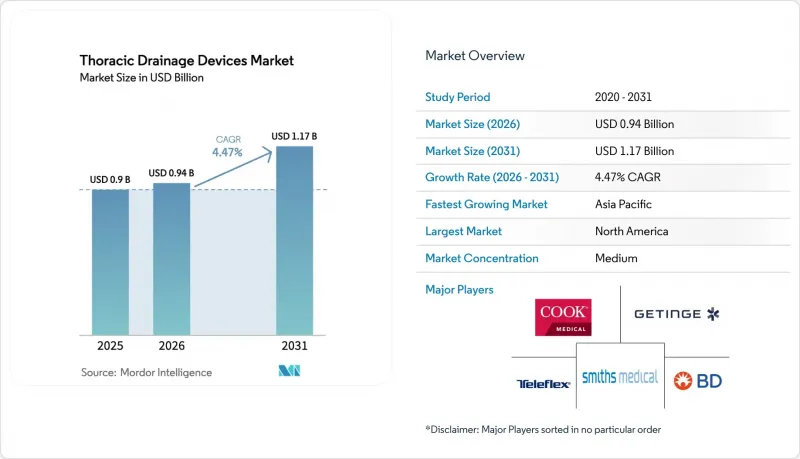
This report is Segmented by Product Type (Chest Drainage Systems, and More), Material Composition (Silicone, Polyurethane, and More), Application (Thoracic Surgery & Pulmonology, Cardiac Surgery, and More), End User (Hospitals, and More), and Geography (North America, Europe, Asia-Pacific, Middle East & Africa, South America). The Market Forecasts are Provided in Terms of Value (USD).
Global Thoracic Drainage Devices Market Trends and Insights
Rising Prevalence of Pleural Diseases
More than 1.5 million U.S. patient admissions per year require pleural drainage, and spontaneous pneumothorax is increasing 2.3% annually in adults aged >= 65. Similar momentum in Germany, France, and the UK shows a 4.1% rise in diagnoses between 2024 and 2025. Medicare payment reforms that reward same-day discharge are increasing outpatient small-bore catheter deployment, now accounting for 40% of ambulatory cases. Low-income regions continue to have a demand for cost-effective large-bore solutions, as tuberculosis-related empyema remains a common condition. Device design pivots toward 14-Fr or smaller indwelling catheters that balance comfort with flow efficiency.
Increasing Thoracic & Cardiac Surgery Volumes
Thoracic surgery volumes rebounded to 3.2 million procedures in 2025, surpassing pre-pandemic peaks by 7%. Cardiac-surgery procedures reached 2.8 million worldwide due to aging demographics, and China's reimbursement approval for robotic thoracic interventions triggered a 12% uptick in minimally invasive cases. The U.S. bundled-payment model incentivizes hospitals to deploy digital drainage devices that shorten stays. However, Eastern Europe and Latin America lag as capital constraints and a limited surgical workforce suppress adoption.
High Cost of Advanced Digital Systems
Digital units list at USD 2,500-4,000 versus USD 600-800 for analog, restricting uptake in India where only 8% of hospitals deploy them. Brazil's fixed reimbursement lacks differentiation, disincentivizing upgrades. The UK negotiated a 22% discount to maintain cost neutrality, taking into account nursing savings. Rental models ease barriers, yet the total cost of ownership stays 40-60% higher.
Other drivers and restraints analyzed in the detailed report include:
- Technological Advancements In Digital Drainage Systems
- Growing Adoption of Minimally-Invasive & Robotic Procedures
- Stringent Regulatory Approvals & Recalls
For complete list of drivers and restraints, kindly check the Table Of Contents.
Segment Analysis
Chest drainage systems accounted for 37.81% of the revenue in 2025. In contrast, thoracic drainage kits, valued for their sterilized convenience, are projected to outpace the market at a 6.38% CAGR, driven by ASC demand. Small-bore pleural catheters (<=14 Fr) predominate in the outpatient management of malignant effusions, whereas large-bore variants remain crucial for the treatment of trauma and empyema. Digital systems, though fewer in unit shipments, command 40-50% price premiums and lock in disposable revenue.
Silicone represented 46.13% of material revenue, favored for biocompatibility. Polyurethane is closing the gap with a 6.81% annual growth rate, aided by thin-wall extrusion technologies. PVC's share of the thoracic drainage devices market size is expected to drop below 10% by 2031 as regulatory curbs escalate. Advanced polymers such as antimicrobial-coated polyurethane reduce infections by 38%, supporting a 30% price premium.
Complete Report Scope:
- By Product Type
- Chest Drainage Systems
- Water-Seal Systems
- Dry-Seal Systems
- Digital / Automated Systems
- Pleural Drainage Catheters
- Small-Bore
- Large-Bore
- Thoracic Drainage Kits
- Trocar Drains
- Secured Needles
- Unsecured Needles
- Accessories
- Chest Drainage Systems
- By Material Composition
- Silicone
- Polyurethane
- Polyvinyl Chloride (PVC)
- Latex
- Other Advanced Polymers
- By Application
- Thoracic Surgery & Pulmonology
- Cardiac Surgery
- Trauma & Emergency Medicine
- Oncology & Pain Management
- Infectious Diseases
- Intensive Care & ECMO
- Others
- By End User
- Hospitals
- Ambulatory Surgical Centers
- Specialty Thoracic & Cardiac Centers
- Home Healthcare Settings
- By Geography
- North America
- United States
- Canada
- Mexico
- Europe
- Germany
- United Kingdom
- France
- Italy
- Spain
- Rest of Europe
- Asia-Pacific
- China
- Japan
- India
- Australia
- South Korea
- Rest of Asia-Pacific
- Middle East & Africa
- GCC
- South Africa
- Rest of Middle East & Africa
- South America
- Brazil
- Argentina
- Rest of South America
- North America
Geography Analysis
North America's thoracic drainage devices market share was 39.64% in 2025, as digital platforms gained penetration in academic centers above 22%. Medicare's Hospital-at-Home expansion accelerated demand for portable catheters, while Canada piloted digital devices to cut ICU stays. Germany's DRG system favors analog systems, whereas the UK negotiated national contracts that bundle device cost with reduced nursing time. France and Italy expanded surgical capacity via public-private partnerships, although expenditure caps limit digital conversion.
The Asia-Pacific market is expected to grow at a 7.32% annual rate through 2031. China is establishing 120 thoracic centers under the Healthy China 2030 initiative, which is funded by the government. India's procedure volumes increased by 19% after the inclusion of Ayushman Bharat reimbursement. Japan and South Korea's expansion of robotic-surgery coverage further boosts demand for small-bore catheters.
- Argon Medical Devices
- Armstrong Medical
- ATMOS MedizinTechnik
- B. Braun
- Beckton Dickinson
- Boston Scientific
- Cardinal Health
- Centese, Inc.
- Cook Group
- Getinge
- Medela
- Medtronic
- Merit Medical Systems
- Redax S.p.A.
- Rocket Medical plc
- Sinapi Biomedical
- Smiths Group
- Teleflex
- Utah Medical Products
- Vygon
Additional Benefits:
- The market estimate (ME) sheet in Excel format
- 3 months of analyst support
TABLE OF CONTENTS
1 Introduction
- 1.1 Study Assumptions & Market Definition
- 1.2 Scope of the Study
2 Research Methodology
3 Executive Summary
4 Market Landscape
- 4.1 Market Overview
- 4.2 Market Drivers
- 4.2.1 Rising Prevalence of Pleural Diseases
- 4.2.2 Increasing Thoracic & Cardiac Surgery Volumes
- 4.2.3 Technological Advances in Digital Drainage Systems
- 4.2.4 Growing Adoption of Minimally-Invasive & Robotic Procedures
- 4.2.5 Home-Hospital Reimbursement Models Boosting Portable Devices
- 4.2.6 ECMO & Lung-Transplant Program Expansion
- 4.3 Market Restraints
- 4.3.1 High Cost of Advanced Digital Systems
- 4.3.2 Stringent Regulatory Approvals & Recalls
- 4.3.3 Sustainability Mandates Targeting Single-Use Plastics
- 4.3.4 Shortage of Thoracic Nursing Specialists
- 4.4 Regulatory Landscape
- 4.5 Technological Outlook
- 4.6 Porter's Five Forces Analysis
- 4.6.1 Threat of New Entrants
- 4.6.2 Bargaining Power of Buyers
- 4.6.3 Bargaining Power of Suppliers
- 4.6.4 Threat of Substitutes
- 4.6.5 Competitive Rivalry
5 Market Size & Growth Forecasts
- 5.1 By Product Type
- 5.1.1 Chest Drainage Systems
- 5.1.1.1 Water-Seal Systems
- 5.1.1.2 Dry-Seal Systems
- 5.1.1.3 Digital / Automated Systems
- 5.1.2 Pleural Drainage Catheters
- 5.1.2.1 Small-Bore
- 5.1.2.2 Large-Bore
- 5.1.3 Thoracic Drainage Kits
- 5.1.4 Trocar Drains
- 5.1.5 Secured Needles
- 5.1.6 Unsecured Needles
- 5.1.7 Accessories
- 5.1.1 Chest Drainage Systems
- 5.2 By Material Composition
- 5.2.1 Silicone
- 5.2.2 Polyurethane
- 5.2.3 Polyvinyl Chloride (PVC)
- 5.2.4 Latex
- 5.2.5 Other Advanced Polymers
- 5.3 By Application
- 5.3.1 Thoracic Surgery & Pulmonology
- 5.3.2 Cardiac Surgery
- 5.3.3 Trauma & Emergency Medicine
- 5.3.4 Oncology & Pain Management
- 5.3.5 Infectious Diseases
- 5.3.6 Intensive Care & ECMO
- 5.3.7 Others
- 5.4 By End User
- 5.4.1 Hospitals
- 5.4.2 Ambulatory Surgical Centers
- 5.4.3 Specialty Thoracic & Cardiac Centers
- 5.4.4 Home Healthcare Settings
- 5.5 By Geography
- 5.5.1 North America
- 5.5.1.1 United States
- 5.5.1.2 Canada
- 5.5.1.3 Mexico
- 5.5.2 Europe
- 5.5.2.1 Germany
- 5.5.2.2 United Kingdom
- 5.5.2.3 France
- 5.5.2.4 Italy
- 5.5.2.5 Spain
- 5.5.2.6 Rest of Europe
- 5.5.3 Asia-Pacific
- 5.5.3.1 China
- 5.5.3.2 Japan
- 5.5.3.3 India
- 5.5.3.4 Australia
- 5.5.3.5 South Korea
- 5.5.3.6 Rest of Asia-Pacific
- 5.5.4 Middle East & Africa
- 5.5.4.1 GCC
- 5.5.4.2 South Africa
- 5.5.4.3 Rest of Middle East & Africa
- 5.5.5 South America
- 5.5.5.1 Brazil
- 5.5.5.2 Argentina
- 5.5.5.3 Rest of South America
- 5.5.1 North America
6 Competitive Landscape
- 6.1 Market Concentration
- 6.2 Market Share Analysis
- 6.3 Company Profiles (includes Global level Overview, Market-level Overview, Core Segments, Financials, Strategic Information, Market Rank/Share, Products & Services, Recent Developments)
- 6.3.1 Argon Medical Devices
- 6.3.2 Armstrong Medical
- 6.3.3 ATMOS MedizinTechnik
- 6.3.4 B. Braun Melsungen AG
- 6.3.5 Becton, Dickinson & Co.
- 6.3.6 Boston Scientific
- 6.3.7 Cardinal Health
- 6.3.8 Centese, Inc.
- 6.3.9 Cook Medical
- 6.3.10 Getinge AB
- 6.3.11 Medela AG
- 6.3.12 Medtronic
- 6.3.13 Merit Medical Systems
- 6.3.14 Redax S.p.A.
- 6.3.15 Rocket Medical plc
- 6.3.16 Sinapi Biomedical
- 6.3.17 Smiths Medical
- 6.3.18 Teleflex Incorporated
- 6.3.19 Utah Medical Products
- 6.3.20 Vygon SA
7 Market Opportunities & Future Outlook
- 7.1 White-space & Unmet-need Assessment

