PUBLISHER: Mordor Intelligence | PRODUCT CODE: 2114550

PUBLISHER: Mordor Intelligence | PRODUCT CODE: 2114550
Veterinary Drugs - Market Share Analysis, Industry Trends & Statistics, Growth Forecasts (2026 - 2031)
According to Mordor Intelligence, the veterinary drugs market size was valued at USD 32.5 billion in 2025 and estimated to grow from USD 34.72 billion in 2026 to reach USD 48.31 billion by 2031, at a CAGR of 6.83% during the forecast period (2026-2031).
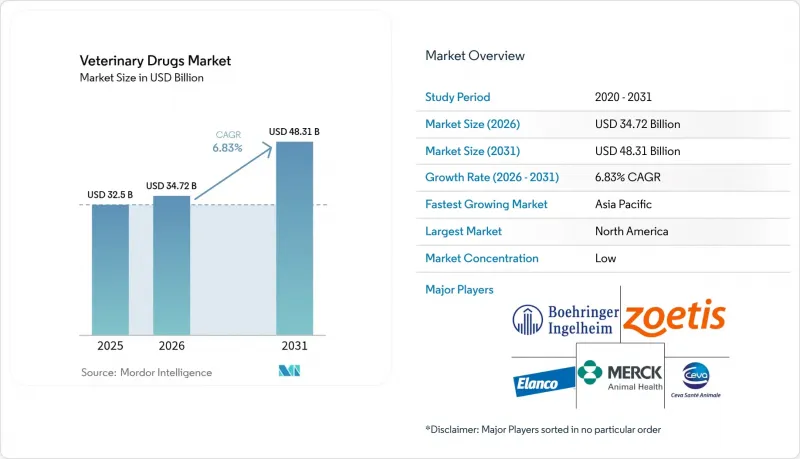
This report is Segmented by Product Type (Anti-Infectives, Anti-Inflammatory, and More), Route of Administration (Oral, Parenteral, and More), Animal Type [Livestock (Cattle, Poultry, and More), and Companion Animals (Dogs, Cats, and More)], Distribution Channel (Veterinary Hospitals, and More), and Geography (North America, Europe, and More). The Market Forecasts are Provided in Terms of Value (USD).
Global Veterinary Drugs Market Trends and Insights
Rise in Prevalence of Infectious Diseases in Pets & Livestock
Soaring case counts of African swine fever, highly pathogenic avian influenza, and lumpy skin disease are reshuffling procurement priorities for the veterinary drugs market. Emergency culls of 18 million U.S. poultry during 1H 2025 created a scramble for autogenous vaccines that match regional viral strains. Canine parvovirus variants that slip past legacy epitopes now oblige polyvalent boosters, which favors firms able to keep broad strain libraries. Rapid tech-transfer capability from research to fermentation gives suppliers an edge when regulators fast-track conditional licenses. Together, more frequent outbreaks and compressed response windows amplify product pull-through for broad-spectrum anti-infectives and customized biologics across the global veterinary drugs market.
Growing Demand for Animal-Sourced Protein
Projected meat output of 366 million t by 2030 is tightening the linkage between herd health and national food security. China's pig herd recovery to 440 million head in 2024 reignited demand for vaccines, growth promoters, and prescription antibiotics under veterinary oversight, sustaining baseline volumes for the veterinary drugs market. India's push to reach 300 million t of milk by 2028 widens the addressable market for mastitis therapies and reproductive hormones. Aquaculture hotspots in Vietnam and Indonesia now rely on medicated feeds to curb gill disease, illustrating how aquatic species are becoming a material revenue stream. Rising protein consumption, therefore, guarantees steady unit volumes even as stewardship rules restrain per-animal antibiotic intensity.
Heightened Antimicrobial-Residue Regulations Raising Costs
EU sales of veterinary antimicrobials fell 23% between 2021 and 2024 after prophylactic bans and e-prescription mandates, directly trimming volume growth for traditional anti-infectives. FDA Guidance #263 removed over-the-counter channels in 2024, forcing livestock operators to absorb additional veterinary consultation and record-keeping expenses. Compliance adds USD 12-18 per head in beef feedlots, squeezing margins in commodity chains where antibiotic-free premiums remain volatile. Drug makers must now fund residual trials and global surveillance programs, which are extending regulatory timelines. As margins thin, capital shifts toward alternatives like bacteriophages and immune-priming vaccines, slowing reinvestment in new small-molecule classes.
Other drivers and restraints analyzed in the detailed report include:
- Advances in Biologics & Novel Drug-Delivery Platforms
- Pet-Humanization Boosting Preventive-Care Spend
- Climate-Driven Parasite Resistance Escalating R&D Burden
For complete list of drivers and restraints, kindly check the Table Of Contents.
Segment Analysis
Vaccines are on track to expand at an 8.25% CAGR, outpacing every other therapeutic class and reshaping demand patterns inside the veterinary drugs market. Anti-infectives still held 42.55% of 2025 revenue, the highest single-category veterinary drugs market share, but growth now levels off as stewardship policies restrict prophylactic use. Parasiticides remain indispensable for both livestock and pets, yet mounting resistance obliges more frequent product rotation, which lifts unit volume but compresses margins. Anti-inflammatory drugs support surgical and chronic pain protocols, while reproductive hormones boost conception rates in beef and dairy herds, anchoring ancillary demand. Nutritional supplements and anesthetics create smaller but recurring revenue streams that support the clinic workflow.
Advances in platform biologics are repositioning vaccines beyond core viral targets into chronic disease management, as evidenced by a monoclonal antibody for canine dermatitis that generated USD 420 million in 2024 sales. Combination products such as antibiotic-NSAID injectables bundle convenience for veterinarians who face dosing-compliance constraints on large farms. As first-in-class molecules mature, biosimilar entrants are expected to temper pricing power after 2028, especially in the Asia-Pacific generics corridor. Overall, diversification toward prevention secures longer product life cycles and stabilizes the veterinary drugs market against antimicrobial-policy shocks.
Oral products captured 53.53% of 2025 revenue, the highest contribution to the veterinary drugs market size for any delivery format, by leveraging ease of mass medication in feed or treats. Tablets, chews, and soluble premixes set the convenience benchmark, yet palatability issues and variable gut absorption cap bioavailability in some molecules. Parenteral formulations are advancing at a 7.75% CAGR as long-acting microsphere-based injectables push dosing intervals from weekly to quarterly, cutting labor costs on intensive livestock systems. Topical spot-ons dominate ectoparasite control for cats and dogs, supplying targeted dermal delivery with low systemic exposure.
Pour-on insecticides remain popular in extensive grazing regions but are now subject to environmental reviews related to runoff in the EU. Intramammary tubes for bovine mastitis and intravaginal hormone devices fill niche but play essential roles in dairy management. An emerging micro-needle patch for small-ruminant vaccines passed Phase II trials in 2025, hinting at future label expansion that will clip market share from conventional syringes. Route innovation, therefore, acts as a latent growth lever that multiplies existing molecule value across the veterinary drugs market.
Complete Report Scope:
- By Product Type
- Anti-infectives
- Parasiticides
- Vaccines
- Anti-inflammatory
- Hormones
- Other Product Types
- By Route of Administration
- Oral
- Parenteral
- Topical
- Other Route of Administration
- By Animal Type
- Livestock
- Cattle
- Poultry
- Swine
- Sheep & Goats
- Aquaculture
- Companion Animals
- Dogs
- Cats
- Horses
- Other Pets
- Livestock
- By Distribution Channel
- Veterinary Hospitals
- Veterinary Clinics
- Pharmacies
- Online Retail
- Other Distribution Channels
- By Geography
- North America
- United States
- Canada
- Mexico
- Europe
- Germany
- United Kingdom
- France
- Italy
- Spain
- Rest of Europe
- Asia-Pacific
- China
- India
- Japan
- Australia
- South Korea
- Rest of Asia-Pacific
- Middle East and Africa
- GCC
- South Africa
- Rest of Middle East and Africa
- South America
- Brazil
- Argentina
- Rest of South America
- North America
Geography Analysis
North America accounted for 38.55% of global revenue in 2025, with robust pet insurance adoption and intensive feedlot systems driving steady biologics uptake. The United States spearheads innovation, averaging 24 FDA veterinary drug approvals per year since 2024, which sustains premium pricing for early-cycle products. Canada benefits from regulatory harmonization and proximity to U.S. manufacturers, whereas Mexico's generics expansion preserves regional cost competitiveness.
Asia-Pacific is projected to clock a 7.22% CAGR, surpassing the global veterinary drugs market size growth rate, fueled by China's aggressive livestock vaccination drives and India's formalization of veterinary pharmaceutical manufacturing. Japan commands high per-pet spending and pet insurance penetration above 15%, stabilizing premium-therapy sales. Australia's stringent residue controls underpin demand for on-label antibiotics and vaccine programs aligned with export certification schemes.
Europe maintains a mature regulatory framework that enables centralized product launches, yet national reimbursement differences fragment uptake. Germany and the United Kingdom anchor EU sales, while Spain's large swine sector consumes disproportionate volumes of respiratory-disease vaccines. The Middle East and Africa remain under-penetrated because of counterfeit risk and limited cold chain, although Gulf countries invest in modern dairy and poultry complexes that specify vetted suppliers. South America's export-oriented beef and poultry chains depend on traceability-compliant therapeutics, with Brazil shipping 2.1 million t of beef in 2024 under strict residue surveillance.
- Bayer Animal Health
- Bimeda Holdings
- Boehringer Ingelheim
- Ceva Sante Animale
- Chanelle Pharma
- Dechra Pharmaceuticals
- Elanco
- Huvepharma
- IDEXX
- Intas Pharmaceuticals
- Merck
- Norbrook Laboratories
- PetIQ
- Phibro Animal Health
- Vetoquinol
- Virbac
- Zoetis
Additional Benefits:
- The market estimate (ME) sheet in Excel format
- 3 months of analyst support
TABLE OF CONTENTS
1 Introduction
- 1.1 Study Assumptions & Market Definition
- 1.2 Scope of the Study
2 Research Methodology
3 Executive Summary
4 Market Landscape
- 4.1 Market Overview
- 4.2 Market Drivers
- 4.2.1 Rise in Prevalence of Infectious Diseases in Pets & Livestock
- 4.2.2 Growing Demand for Animal-Sourced Protein
- 4.2.3 Advances in Biologics & Novel Drug Delivery Platforms
- 4.2.4 Pet-Humanization Boosting Preventive Care Spend
- 4.2.5 Long-Acting Injectable & Precision-Dosing Technologies
- 4.2.6 AI-Driven Disease Surveillance Accelerating Demand Spikes
- 4.3 Market Restraints
- 4.3.1 Heightened Antimicrobial-Residue Regulations Raising Costs
- 4.3.2 Climate-Driven Parasite Resistance Escalating R&D Burden
- 4.3.3 Global Shortage of Veterinarians
- 4.3.4 Proliferation of Counterfeit Medicines
- 4.4 Supply-Chain Analysis
- 4.5 Regulatory Landscape
- 4.6 Technological Outlook
- 4.7 Porter's Five Forces
- 4.7.1 Threat of New Entrants
- 4.7.2 Bargaining Power of Buyers
- 4.7.3 Bargaining Power of Suppliers
- 4.7.4 Threat of Substitutes
- 4.7.5 Intensity of Competitive Rivalry
5 Market Size & Growth Forecasts (Value, USD)
- 5.1 By Product Type
- 5.1.1 Anti-infectives
- 5.1.2 Parasiticides
- 5.1.3 Vaccines
- 5.1.4 Anti-inflammatory
- 5.1.5 Hormones
- 5.1.6 Other Product Types
- 5.2 By Route of Administration
- 5.2.1 Oral
- 5.2.2 Parenteral
- 5.2.3 Topical
- 5.2.4 Other Route of Administration
- 5.3 By Animal Type
- 5.3.1 Livestock
- 5.3.1.1 Cattle
- 5.3.1.2 Poultry
- 5.3.1.3 Swine
- 5.3.1.4 Sheep & Goats
- 5.3.1.5 Aquaculture
- 5.3.2 Companion Animals
- 5.3.2.1 Dogs
- 5.3.2.2 Cats
- 5.3.2.3 Horses
- 5.3.2.4 Other Pets
- 5.3.1 Livestock
- 5.4 By Distribution Channel
- 5.4.1 Veterinary Hospitals
- 5.4.2 Veterinary Clinics
- 5.4.3 Pharmacies
- 5.4.4 Online Retail
- 5.4.5 Other Distribution Channels
- 5.5 By Geography
- 5.5.1 North America
- 5.5.1.1 United States
- 5.5.1.2 Canada
- 5.5.1.3 Mexico
- 5.5.2 Europe
- 5.5.2.1 Germany
- 5.5.2.2 United Kingdom
- 5.5.2.3 France
- 5.5.2.4 Italy
- 5.5.2.5 Spain
- 5.5.2.6 Rest of Europe
- 5.5.3 Asia-Pacific
- 5.5.3.1 China
- 5.5.3.2 India
- 5.5.3.3 Japan
- 5.5.3.4 Australia
- 5.5.3.5 South Korea
- 5.5.3.6 Rest of Asia-Pacific
- 5.5.4 Middle East and Africa
- 5.5.4.1 GCC
- 5.5.4.2 South Africa
- 5.5.4.3 Rest of Middle East and Africa
- 5.5.5 South America
- 5.5.5.1 Brazil
- 5.5.5.2 Argentina
- 5.5.5.3 Rest of South America
- 5.5.1 North America
6 Competitive Landscape
- 6.1 Market Concentration
- 6.2 Market Share Analysis
- 6.3 Company Profiles (includes Global level Overview, Market level overview, Core Segments, Financials as available, Strategic Information, Market Rank/Share for key companies, Products & Services, and Recent Developments)
- 6.3.1 Bayer Animal Health
- 6.3.2 Bimeda Holdings
- 6.3.3 Boehringer Ingelheim International GmbH
- 6.3.4 Ceva Sante Animale
- 6.3.5 Chanelle Pharma
- 6.3.6 Dechra Pharmaceuticals
- 6.3.7 Elanco Animal Health
- 6.3.8 Huvepharma
- 6.3.9 Idexx Laboratories
- 6.3.10 Intas Pharmaceuticals
- 6.3.11 Merck Animal Health
- 6.3.12 Norbrook Laboratories
- 6.3.13 PetIQ
- 6.3.14 Phibro Animal Health
- 6.3.15 Vetoquinol SA
- 6.3.16 Virbac SA
- 6.3.17 Zoetis Inc.
7 Market Opportunities & Future Outlook
- 7.1 White-space & Unmet-Need Assessment

