PUBLISHER: Mordor Intelligence | PRODUCT CODE: 2114551

PUBLISHER: Mordor Intelligence | PRODUCT CODE: 2114551
Viral Inactivation - Market Share Analysis, Industry Trends & Statistics, Growth Forecasts (2026 - 2031)
According to Mordor Intelligence, the viral inactivation market size was valued at USD 6.78 billion in 2025 and is estimated to grow from USD 7.36 billion in 2026 to reach USD 10.78 billion by 2031, at a CAGR of 7.93% during the forecast period (2026-2031).
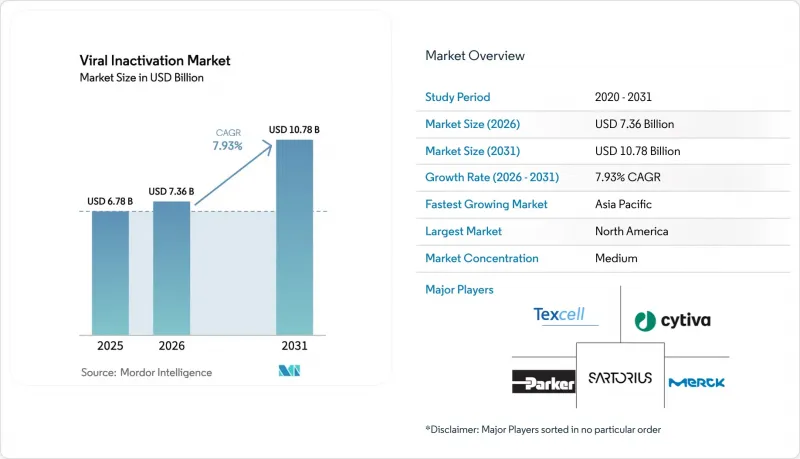
This report is Segmented by Method (Solvent-Detergent, and More), Product (Viral Inactivation Systems & Accessories, and More), Application (Vaccines & Therapeutics, Blood & Plasma Products, and More), End-User (Biopharma & Biotechnology Companies, and More), and Geography (North America, Europe, Asia-Pacific, Middle East & Africa, South America). The Market Forecasts are Provided in Terms of Value (USD).
Global Viral Inactivation Market Trends and Insights
Expansion of Biologics & Gene-Therapy Pipelines
FDA approvals of Itvisma and Papzimeos in 2025 highlighted the regulatory expectation that adeno-associated virus (AAV) therapies demonstrate robust upstream viral inactivation against replication-competent AAV. The American Society of Gene and Cell Therapy documented 2,129 active gene-therapy programs in Q3 2025, nearly half of which used in vivo vectors that shift inactivation earlier in the process. Sponsors are installing dedicated skids upstream of chromatography, which raises capital outlays but compresses timelines by eliminating dilution steps. Biosimilar developers in emerging markets favor turnkey reagent kits that package detergent, buffer, and hold-vessel specifications to sidestep lengthy process-development work. ICH Q5A(R2) now allows platform viral clearance data when process similarity is proven, reducing the per-program validation burden.
Rising Incidence of Viral-Contamination Recalls
The FDA issued Complete Response Letters and warning letters to Coherus, Scholar Rock, and multiple CAR-T producers during 2024-2025 after detecting shortcomings in viral safety. These actions triggered the widespread adoption of dual orthogonal inactivation, which combines solvent-detergent treatment with a low-pH hold or nanofiltration, even when one step alone meets log-reduction targets. Plasma fractionators faced extra scrutiny after trace amounts of parvovirus B19 DNA were detected in post-market surveillance, prompting the European Medicines Agency to tighten documentation requirements in 2024. Manufacturers responded by extending detergent hold times and adding UV-C barriers for non-enveloped viruses. Collectively, these events reinforced the imperative for validated, multi-step clearance strategies across biologics portfolios.
High CAPEX for Advanced Inactivation Infrastructure
Inline systems that couple with perfusion bioreactors cost between USD 1.5 million and USD 3 million per line, a hurdle that small CDMOs in India and Brazil struggle to clear. Samsung Biologics' USD 2.1 billion Songdo outlay covered dedicated viral-inactivation suites, yet mid-tier firms retrofit legacy vessels and accept longer cycles to hold capital spending down. Heat-inactivation pasteurizers exceed USD 800,000 each, and plasma fractionators often run six to eight units in parallel, tying up cash that could be used to fund process analytics upgrades. Gene-therapy sites face similar economic challenges, but with smaller batch sizes, which dilutes the return on invested capital and slows adoption.
Other drivers and restraints analyzed in the detailed report include:
- Stringent Global Regulatory Mandates for Viral Safety
- Shift Toward Single-Use Bioprocessing Platforms
- Complex & Lengthy Validation / Regulatory Approval Cycles
For complete list of drivers and restraints, kindly check the Table Of Contents.
Segment Analysis
Solvent-detergent processing retained 46.71% of the viral inactivation market share in 2025, underpinned by its four-hour inactivation window and entrenched use in plasma pools. Low-pH adjustment, however, is forecast to post an 11.48% CAGR, outpacing the overall viral inactivation market by integrating seamlessly after protein-A capture in antibody lines. Heat-pasteurization stays niche at <15% of biologic volumes because many recombinant proteins denature above 50 °C. Nanofiltration and UV-C round out the toolkit for non-enveloped viruses but await broader validation before capturing a larger share.
The solvent-detergent's strength also reflects regulators' confidence in its track record of eliminating HIV, HBV, and HCV from plasma pools ranging from 20,000 to 50,000 liters. Still, the EU ban on Triton X-100 forces requalification with new surfactants, stretching project timelines by a year. Low-pH users avoid chemical substitutions altogether, relying instead on buffer adjustments. Nanofiltration is rising in AAV and lentiviral manufacture; Planova cartridges demonstrated 6-log removal of minute virus of mice in 2024, prompting several CDMOs to pair 20-nm filters with pH holds for redundancy.
Kits and reagents accounted for 39.23% of revenue in 2025; however, single-use viral-inactivation systems are projected to grow at a 12.23% CAGR, the fastest among all products. Cytiva's FlexFactory and Sartorius single-use mixers compress cleaning validation from weeks to hours, allowing CDMOs to swing quickly between campaigns.
Consumable margins remain under pressure because biosimilar producers in Asia price aggressively, leading suppliers to bundle detergents with pre-qualified tubing and bags. Validation-service revenue is climbing as ICH Q5A(R2) obliges sponsors to document viral clearance during steady state. Charles River and Texcell completed over 300 spiking studies in 2025, marking a shift toward outsourced expertise. Ancillary products, such as UV-C chambers and nanofiltration housings, occupy smaller niches but gain relevance where non-enveloped viruses dominate the risk profile.
Complete Report Scope:
- By Method
- Solvent-Detergent
- Low-pH Adjustment
- Pasteurization / Heat
- Other Methods
- By Product
- Viral Inactivation Systems & Accessories
- Kits & Reagents
- Validation & Testing Services
- Other Products
- By Application
- Vaccines & Therapeutics
- Blood & Plasma Products
- Cellular & Gene-Therapy Products
- Other Applications
- By End-User
- Biopharma & Biotechnology Companies
- Contract Development & Manufacturing Organizations (CDMOs)
- Contract Research Organizations (CROs)
- Other End-Users
- By Geography
- North America
- United States
- Canada
- Mexico
- Europe
- Germany
- United Kingdom
- France
- Italy
- Spain
- Rest of Europe
- Asia-Pacific
- China
- Japan
- India
- Australia
- South Korea
- Rest of Asia-Pacific
- Middle East & Africa
- GCC
- South Africa
- Rest of Middle East & Africa
- South America
- Brazil
- Argentina
- Rest of South America
- North America
Geography Analysis
North America accounted for 43.64% of 2025 revenue, driven by a dense cluster of gene-therapy developers and an assertive FDA that issued multiple warning letters regarding contamination-control lapses between 2024 and 2025. The agency's stance compels sponsors to deploy dual orthogonal inactivation even when single methods satisfy pharmacopeial benchmarks. Canada and Mexico contribute lower volumes, but they align their protocols with U.S. standards to preserve cross-border supply chains. Venture capital continues to fund viral-vector capacity in Massachusetts and California, reinforcing regional dominance.
Asia-Pacific is forecast to register a 13.16% CAGR to 2031. Korean incentives and Samsung Biologics' USD 2.1 billion expansion underpin regional momentum, while WuXi Biologics' Singapore build-out delivers viral-vector capability near Southeast Asian clinical hubs. India's Biocon and Syngene retrofit downstream trains with low-pH holds to meet EU and U.S. export standards. China's NMPA adopted ICH Q5A(R2) in 2025, accelerating uptake of platform viral-clearance approaches. Japan's PMDA harmonized guidance in 2024, shortening validation cycles for multiregional trials.
Germany hosts key single-use hardware output from Sartorius, while the United Kingdom completed Nereid trials in 2025, securing an endocrine-safe solvent-detergent path. France and Italy's plasma networks continue solvent-detergent plus heat workflows, whereas Spain's biosimilar producers lean on low-pH alternatives. Switzerland and the Nordics supply contract testing and specialized filters. The Middle East and Africa invest gradually in plasma fractionation; the Gulf Cooperation Council aims for regional self-sufficiency but still imports most finished immunoglobulin. South America faces capital constraints; Brazil and Argentina maintain legacy solvent-detergent lines and have yet to mandate the substitution of Triton X-100.
- Asahi Kasei Medical
- Catalent
- Charles River
- Clean Cells
- Cygnus Technologies
- Cytiva
- Getinge
- Lonza Group
- Meissner Filtration
- Merck
- Pall
- Parker Hannifin
- Rad Source Technologies
- Repligen
- Sartorius
- Texcell
- Thermo Fisher Scientific
- Vironova
- Wuxi Biologics
Additional Benefits:
- The market estimate (ME) sheet in Excel format
- 3 months of analyst support
TABLE OF CONTENTS
1 Introduction
- 1.1 Study Assumptions & Market Definition
- 1.2 Scope of the Study
2 Research Methodology
3 Executive Summary
4 Market Landscape
- 4.1 Market Overview
- 4.2 Market Drivers
- 4.2.1 Expansion of Biologics & Gene-Therapy Pipelines
- 4.2.2 Rising Incidence of Viral-Contamination Recalls
- 4.2.3 Stringent Global Regulatory Mandates for Viral Safety
- 4.2.4 Shift Toward Single-Use Bioprocessing Platforms
- 4.2.5 Phase-Out of Triton X-100 Accelerating Alternative Chemistries
- 4.2.6 AI-Enabled Real-Time Inline Viral-Safety Analytics
- 4.3 Market Restraints
- 4.3.1 High CAPEX for Advanced Inactivation Infrastructure
- 4.3.2 Complex & Lengthy Validation / Regulatory Approval Cycles
- 4.3.3 Supply-Chain Volatility for GMP-Grade Detergents & Filters
- 4.3.4 Bioprocess Integration Challenges with Continuous Manufacturing
- 4.4 Regulatory Landscape
- 4.5 Technological Outlook
- 4.6 Porter's Five Forces Analysis
- 4.6.1 Threat of New Entrants
- 4.6.2 Bargaining Power of Buyers
- 4.6.3 Bargaining Power of Suppliers
- 4.6.4 Threat of Substitutes
- 4.6.5 Competitive Rivalry
5 Market Size & Growth Forecasts
- 5.1 By Method
- 5.1.1 Solvent-Detergent
- 5.1.2 Low-pH Adjustment
- 5.1.3 Pasteurization / Heat
- 5.1.4 Other Methods
- 5.2 By Product
- 5.2.1 Viral Inactivation Systems & Accessories
- 5.2.2 Kits & Reagents
- 5.2.3 Validation & Testing Services
- 5.2.4 Other Products
- 5.3 By Application
- 5.3.1 Vaccines & Therapeutics
- 5.3.2 Blood & Plasma Products
- 5.3.3 Cellular & Gene-Therapy Products
- 5.3.4 Other Applications
- 5.4 By End-User
- 5.4.1 Biopharma & Biotechnology Companies
- 5.4.2 Contract Development & Manufacturing Organizations (CDMOs)
- 5.4.3 Contract Research Organizations (CROs)
- 5.4.4 Other End-Users
- 5.5 By Geography
- 5.5.1 North America
- 5.5.1.1 United States
- 5.5.1.2 Canada
- 5.5.1.3 Mexico
- 5.5.2 Europe
- 5.5.2.1 Germany
- 5.5.2.2 United Kingdom
- 5.5.2.3 France
- 5.5.2.4 Italy
- 5.5.2.5 Spain
- 5.5.2.6 Rest of Europe
- 5.5.3 Asia-Pacific
- 5.5.3.1 China
- 5.5.3.2 Japan
- 5.5.3.3 India
- 5.5.3.4 Australia
- 5.5.3.5 South Korea
- 5.5.3.6 Rest of Asia-Pacific
- 5.5.4 Middle East & Africa
- 5.5.4.1 GCC
- 5.5.4.2 South Africa
- 5.5.4.3 Rest of Middle East & Africa
- 5.5.5 South America
- 5.5.5.1 Brazil
- 5.5.5.2 Argentina
- 5.5.5.3 Rest of South America
- 5.5.1 North America
6 Competitive Landscape
- 6.1 Market Concentration
- 6.2 Market Share Analysis
- 6.3 Company Profiles (includes Global level Overview, Market-level Overview, Core Segments, Financials, Strategic Information, Market Rank/Share, Products & Services, Recent Developments)
- 6.3.1 Asahi Kasei Medical
- 6.3.2 Catalent Inc.
- 6.3.3 Charles River Laboratories
- 6.3.4 Clean Cells
- 6.3.5 Cygnus Technologies
- 6.3.6 Cytiva (Danaher Corporation)
- 6.3.7 Getinge AB
- 6.3.8 Lonza Group
- 6.3.9 Meissner Filtration
- 6.3.10 Merck KGaA
- 6.3.11 Pall Corporation
- 6.3.12 Parker Hannifin Corp
- 6.3.13 Rad Source Technologies
- 6.3.14 Repligen Corporation
- 6.3.15 Sartorius AG
- 6.3.16 Texcell SA
- 6.3.17 Thermo Fisher Scientific Inc.
- 6.3.18 Vironova AB
- 6.3.19 WuXi Biologics
7 Market Opportunities & Future Outlook
- 7.1 White-space & Unmet-need Assessment

