PUBLISHER: Mordor Intelligence | PRODUCT CODE: 2114555

PUBLISHER: Mordor Intelligence | PRODUCT CODE: 2114555
Graphic Film - Market Share Analysis, Industry Trends & Statistics, Growth Forecasts (2026 - 2031)
According to Mordor Intelligence, the graphic films market size in 2026 is estimated at USD 34.96 billion, growing from 2025 value of USD 33.29 billion with 2031 projections showing USD 44.66 billion, growing at 5.03% CAGR over 2026-2031.
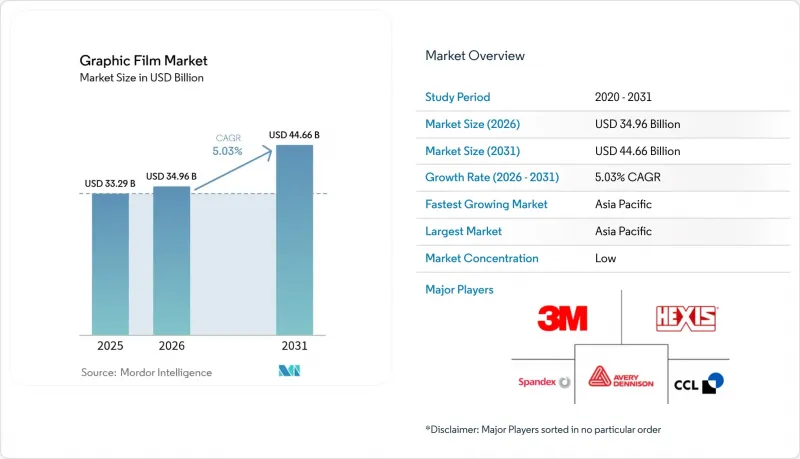
This report is Segmented by Film Type (Opaque, Transparent, Translucent, and Reflective), Polymer (Polyvinyl Chloride (PVC), Polypropylene (PP), Polyethylene (PE), and More), Printing Technology (Digital, Flexography, Rotogravure, Screen Printing), End-User (Automotive, Advertising and Promotion Agencies, Building and Construction, and More), and Geography. The Market Forecasts are Provided in Value (USD).
Global Graphic Film Market Trends and Insights
Growth in the construction industry and higher living standards
Urbanization across Asia-Pacific and the Middle East spurs large-scale infrastructure builds that specify graffiti-resistant, long-life graphic films for wayfinding and facade branding. Project owners integrate Building Information Modeling with graphic film specifications, enabling precise material planning and lower installation waste. Architects favor customizable finishes that merge aesthetics with energy-efficient glazing, widening application breadth. Government stimulus for transport hubs, public housing, and smart cities anchors volume commitments. As living standards rise, residential developers are adopting interior decorative films that meet green certification goals, thereby reinforcing the medium-term growth of the graphic films market.
Rising demand for vehicle-wrap and fleet graphics
Fleet operators shift from paint to film wraps to achieve rapid brand makeovers and paint protection in one step. Surging electric vehicle fleets intensify demand for lightweight, easily updatable graphics that minimize drag and power consumption. Ride-sharing and last-mile delivery companies frequently refresh their campaign artwork, favoring removable, low-adhesion films. Premium wraps enhance resale values and reduce downtime, as entire fleets can be rebranded overnight. Growth momentum in APAC follows the U.S. and European adoption curves as small businesses adopt wraps for hyper-local marketing, supporting a near-term uplift in the graphic films market.
Volatility in prices of PVC, PET and specialty additives
Swinging crude oil and energy costs ripple through PVC and PET resin markets, compressing converter margins on long-term contracts. Concentrated supply in Asia magnifies geopolitical and weather-related disruptions that can idle downstream coating lines. Specialty additives, such as UV stabilizers and plasticizers, often come from narrow supplier pools with limited ramp-up capability, resulting in spot shortages. Producers respond by dual-sourcing, expanding resin capacity closer to demand centers, and introducing price-adjustment clauses, yet cost unpredictability remains a drag on the graphic films market.
Other drivers and restraints analyzed in the detailed report include:
- Penetration of digital and UV-inkjet printing technologies
- Expansion of retail PoS and way-finding signage
- Stringent regulations on PVC and solvent-based inks
For complete list of drivers and restraints, kindly check the Table Of Contents.
Segment Analysis
Opaque films accounted for 41.88% of the graphic films market share in 2025, driven by their universal suitability for vehicle wraps, storefronts, and facade graphics. These films mask substrate flaws and deliver vivid branding, sustaining high-volume demand. Innovations now target UV-inkjet compatibility and low-temperature pliability, broadening end-use scenarios across climates. In contrast, reflective films, driven by safety regulations and energy-saving mandates, outpace the total graphic films market at a 7.05% CAGR. Transparent and translucent variants gain niche share in retail showcases and backlit architectural elements. Suppliers expand their portfolios with antimicrobial and graffiti-resistant topcoats, which help lift average selling prices.
Reflective film adoption accelerates as transportation departments mandate higher retroreflectivity for road signs and railcars. Architects specify heat-reflective window films that cut HVAC loads, linking optics to sustainability targets. Meanwhile, installers favor next-generation opaque films featuring repositionable adhesives that cut labor time by 10-15%. ORAFOL's USD 165-175 million expansion underpins supply security for multiple film classes, underscoring confidence in long-range demand. Collectively, these dynamics entrench film-type diversity and fuel healthy revenue streams in the graphic films market.
PVC controlled 62.98% of the global graphic films market size in 2025, owing to its low cost, ease of calendering, and robust adhesion on irregular surfaces. Yet, sustainability drivers and scrutiny of plasticizers propel PET volumes, driving the material at a 6.12% CAGR. PET's recyclability appeals to specifiers chasing circular-economy credits, especially in Europe. Polypropylene and polyethylene remain in specialized niches where chemical resistance or tearability is essential.
The pending PFAS phase-out forces value-chain adjustments in high-durability topcoats, creating white space for novel resins. PET investments in Alabama by Polyplex diversify the North American supply and shorten lead times for converters hit by freight volatility. Producers hedge by developing PVC-free portfolios that match flexibility and printability benchmarks. Success here would realign polymer shares, yet near-term economics keep PVC at the helm of the graphic films market.
Complete Report Scope:
- By Film Type
- Opaque Film
- Transparent Film
- Translucent Film
- Reflective Film
- By Polymer
- Polyvinyl Chloride (PVC)
- Polypropylene (PP)
- Polyethylene (PE)
- Polyethylene Terephthalate (PET)
- Other Polymers
- By Printing Technology
- Digital
- Flexography
- Offset Lithography
- Rotogravure
- Screen Printing
- By End-User Industry
- Automotive
- Advertising and Promotion Agencies
- Building and Construction
- Institutional and Public Infrastructure
- Other End-User Industries
- By Geography
- North America
- United States
- Canada
- Mexico
- South America
- Brazil
- Argentina
- Chile
- Rest of South America
- Europe
- United Kingdom
- Germany
- France
- Italy
- Spain
- Russia
- Rest of Europe
- Asia-Pacific
- China
- India
- Japan
- South Korea
- Australia
- Rest of Asia-Pacific
- Middle East and Africa
- Middle East
- Saudi Arabia
- United Arab Emirates
- Turkey
- Rest of Middle East
- Africa
- South Africa
- Nigeria
- Rest of Africa
- Middle East
- North America
Geography Analysis
The Asia-Pacific region secured 45.30% of global revenue in 2025 and is expected to grow at a 7.28% CAGR to 2031, driven by unmatched polymer capacity and government infrastructure agendas. China's Belt and Road projects, India's smart-city initiatives, and the relocation of Southeast Asian manufacturing continually widen their application breadth. Domestic converters benefit from short lead times and rising middle-class consumption that lifts automotive wraps and retail signage volumes.
North America's demand is mature yet value-rich, centered on premium wraps, solar-control window films, and antimicrobial coatings. Polyplex's new PET line in Alabama secures local feedstock, trimming dependency on imports and sharpening cost predictability. Regulatory leadership in low-VOC inks and recyclable substrates prompts converters to pioneer sustainable offerings, which later cascade worldwide.
Europe matches North America in terms of technology adoption and sustainability regulations. REACH updates and discussions on the plastic tax accelerate the adoption of PVC alternatives and the migration to solvent-free inks, influencing product formulation globally. Elsewhere, the Middle East leverages tourism and mega-event developments for signage demand, while South America's infrastructure revival in Brazil and Mexico nurtures moderate growth. These multi-regional trends collectively reinforce the expansion outlook for the graphic films market.
- 3M Company
- Avery Dennison Corporation
- ORAFOL Europe GmbH
- Hexis S.A.S.
- Arlon Graphics LLC
- FDC Graphic Films, Inc.
- Spandex AG
- Drytac Corporation
- Lintec Corporation
- LX Hausys Ltd.
- Taghleef Industries LLC
- CCL Industries Inc.
- Cosmos Films Ltd
- Ultraflex Systems Inc.
- Contra Vision Ltd
Additional Benefits:
- The market estimate (ME) sheet in Excel format
- 3 months of analyst support
TABLE OF CONTENTS
1 INTRODUCTION
- 1.1 Study Assumptions and Market Definition
- 1.2 Scope of the Study
2 RESEARCH METHODOLOGY
3 EXECUTIVE SUMMARY
4 MARKET LANDSCAPE
- 4.1 Market Overview
- 4.2 Market Drivers
- 4.2.1 Growth in the construction industry and higher living standards
- 4.2.2 Rising demand for vehicle-wrap and fleet graphics
- 4.2.3 Penetration of digital and UV-inkjet printing technologies
- 4.2.4 Expansion of retail PoS and way-finding signage
- 4.2.5 Emerging antimicrobial graphic films in healthcare settings
- 4.2.6 Adoption of electrochromic/smart glazing graphic films
- 4.3 Market Restraints
- 4.3.1 Volatility in prices of PVC, PET and specialty additives
- 4.3.2 Stringent regulations on PVC and solvent-based inks
- 4.3.3 Limited recyclability hindering green-building certification
- 4.3.4 Supply shortages of photoinitiators for UV-cure inks
- 4.4 Industry Supply-Chain Analysis
- 4.5 Regulatory Landscape
- 4.6 Technological Outlook
- 4.7 Porter's Five Forces Analysis
- 4.7.1 Threat of New Entrants
- 4.7.2 Bargaining Power of Suppliers
- 4.7.3 Bargaining Power of Buyers
- 4.7.4 Threat of Substitutes
- 4.7.5 Industry Rivalry
5 MARKET SIZE AND GROWTH FORECASTS (VALUE)
- 5.1 By Film Type
- 5.1.1 Opaque Film
- 5.1.2 Transparent Film
- 5.1.3 Translucent Film
- 5.1.4 Reflective Film
- 5.2 By Polymer
- 5.2.1 Polyvinyl Chloride (PVC)
- 5.2.2 Polypropylene (PP)
- 5.2.3 Polyethylene (PE)
- 5.2.4 Polyethylene Terephthalate (PET)
- 5.2.5 Other Polymers
- 5.3 By Printing Technology
- 5.3.1 Digital
- 5.3.2 Flexography
- 5.3.3 Offset Lithography
- 5.3.4 Rotogravure
- 5.3.5 Screen Printing
- 5.4 By End-User Industry
- 5.4.1 Automotive
- 5.4.2 Advertising and Promotion Agencies
- 5.4.3 Building and Construction
- 5.4.4 Institutional and Public Infrastructure
- 5.4.5 Other End-User Industries
- 5.5 By Geography
- 5.5.1 North America
- 5.5.1.1 United States
- 5.5.1.2 Canada
- 5.5.1.3 Mexico
- 5.5.2 South America
- 5.5.2.1 Brazil
- 5.5.2.2 Argentina
- 5.5.2.3 Chile
- 5.5.2.4 Rest of South America
- 5.5.3 Europe
- 5.5.3.1 United Kingdom
- 5.5.3.2 Germany
- 5.5.3.3 France
- 5.5.3.4 Italy
- 5.5.3.5 Spain
- 5.5.3.6 Russia
- 5.5.3.7 Rest of Europe
- 5.5.4 Asia-Pacific
- 5.5.4.1 China
- 5.5.4.2 India
- 5.5.4.3 Japan
- 5.5.4.4 South Korea
- 5.5.4.5 Australia
- 5.5.4.6 Rest of Asia-Pacific
- 5.5.5 Middle East and Africa
- 5.5.5.1 Middle East
- 5.5.5.1.1 Saudi Arabia
- 5.5.5.1.2 United Arab Emirates
- 5.5.5.1.3 Turkey
- 5.5.5.1.4 Rest of Middle East
- 5.5.5.2 Africa
- 5.5.5.2.1 South Africa
- 5.5.5.2.2 Nigeria
- 5.5.5.2.3 Rest of Africa
- 5.5.5.1 Middle East
- 5.5.1 North America
6 COMPETITIVE LANDSCAPE
- 6.1 Market Concentration
- 6.2 Strategic Moves
- 6.3 Market Share Analysis
- 6.4 Company Profiles (includes Global level Overview, Market level overview, Core Segments, Financials as available, Strategic Information, Market Rank/Share for key companies, Products and Services, and Recent Developments)
- 6.4.1 3M Company
- 6.4.2 Avery Dennison Corporation
- 6.4.3 ORAFOL Europe GmbH
- 6.4.4 Hexis S.A.S.
- 6.4.5 Arlon Graphics LLC
- 6.4.6 FDC Graphic Films, Inc.
- 6.4.7 Spandex AG
- 6.4.8 Drytac Corporation
- 6.4.9 Lintec Corporation
- 6.4.10 LX Hausys Ltd.
- 6.4.11 Taghleef Industries LLC
- 6.4.12 CCL Industries Inc.
- 6.4.13 Cosmos Films Ltd
- 6.4.14 Ultraflex Systems Inc.
- 6.4.15 Contra Vision Ltd
7 MARKET OPPORTUNITIES AND FUTURE OUTLOOK
- 7.1 White-space and Unmet-need Assessment

