PUBLISHER: Mordor Intelligence | PRODUCT CODE: 2114559

PUBLISHER: Mordor Intelligence | PRODUCT CODE: 2114559
Cerebral Somatic Oximeters - Market Share Analysis, Industry Trends & Statistics, Growth Forecasts (2026 - 2031)
According to Mordor Intelligence, the cerebral somatic oximeters market size was valued at USD 203.12 million in 2025 and estimated to grow from USD 215.56 million in 2026 to reach USD 290.33 million by 2031, at a CAGR of 6.14% during the forecast period (2026-2031).
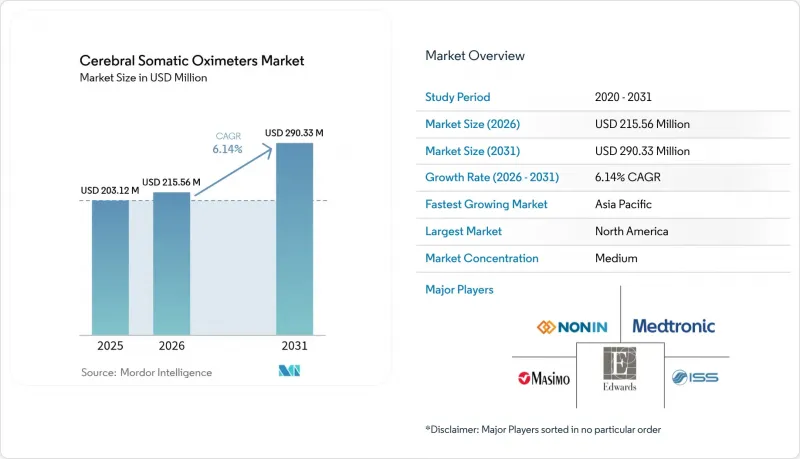
This report is Segmented by Type (Dual Emitter & Dual Detector, Single Emitter & Dual Detector, and Other Types), Application (Cardiac Surgery, and More), Patient Type (Neonates, Pediatrics, and Adults), End User (Hospitals and Clinics, and More), and Geography (North America, Europe, Asia-Pacific, Middle East & Africa, and South America). The Market Forecasts are Provided in Terms of Value (USD).
Global Cerebral Somatic Oximeters Market Trends and Insights
Growing Prevalence of Cardiovascular and Neurological Disorders
Cardiovascular disease remains the top global killer, driving consistent demand for perioperative brain oxygenation monitoring during cardiac bypass and valve repair. Stroke and traumatic brain injury add further volume, with the CDC reporting 2.8 million brain-injury cases and 795,000 strokes annually in the United States. Elderly patients often present multiple comorbidities that heighten the risk of cerebral hypoxia, making real-time monitoring indispensable in complex surgeries. Advances in dual-wavelength NIRS now provide depth-resolved quantitative data that reduce extracranial contamination. As health systems aim to curb postoperative cognitive dysfunction, clinical guidelines increasingly position cerebral oximetry as standard of care.
Increasing Adoption of Advanced Perioperative Monitoring Standards
Clinical societies embed brain oximetry in updated perioperative checklists, citing evidence that early detection of cerebral desaturation cuts complication rates. The 2024 AHA/ACC guidelines endorse comprehensive neuromonitoring for high-risk cardiac cases. ELSO recommends NIRS for ECMO management, while the I-PROTECT consensus supplies reference ranges that simplify bedside interpretation. The FDA's Breakthrough Devices and Safety & Performance Based Pathway accelerate clearances for innovative sensors, shrinking time-to-market. Hospitals in Scandinavia pioneer multimodal neuromonitoring bundles that pair cerebral oximetry with BIS and processed EEG, setting replicable global templates.
High Capital and Consumable Costs of Devices
Advanced cerebral oximetry consoles retail between USD 15,000 and USD 50,000, a sizeable investment for secondary hospitals. Single-use sensors add USD 25-75 per case, pressuring budgets in high-volume centers. Purchasing committees often favor multipurpose imaging gear over specialized monitors, delaying adoption even when clinical teams advocate for brain saturation tracking. Emerging markets feel cost barriers most acutely, although tiered sensor portfolios and re-use-validated probes begin to lower run-time expenses.
Other drivers and restraints analyzed in the detailed report include:
- Rising Demand for Minimally Invasive and Point-of-Care Devices
- Expanding Surgical Procedure Volumes in Emerging Economies
- Limited Clinical Evidence Linking Monitoring to Improved Outcomes
For complete list of drivers and restraints, kindly check the Table Of Contents.
Segment Analysis
Dual emitter and dual detector systems generated the largest revenue slice in 2025, reflecting 41.85% of the cerebral somatic oximeters market. These platforms optimize signal-to-noise ratio, granting surgeons stable readings despite patient motion and electrocautery interference. In value terms, the cerebral somatic oximeters market size for dual emitter technology is forecast to grow at 5.92% CAGR to 2031, mirroring steady capital refresh cycles in tertiary centers. Other emerging architectures, including wireless and wearable variants, post an 8.02% CAGR as battery efficiency and Bluetooth privacy protocols mature.
Complementary trends include integrated multimodal solutions that merge NIRS with EEG and electromyography, as demonstrated by Artinis Medical Systems' acquisition of TMSi. Time-domain NIRS prototypes progress toward commercial launch, offering depth-resolved data that mitigate extracranial contamination. FDA Breakthrough designations shorten market entry for novel laser-diode arrays, and intellectual property clustering intensifies around optical coupling algorithms. Collectively, such innovations expand addressable use cases beyond the operating room into neuro-rehab and sports physiology, broadening the cerebral somatic oximeters market.
Cardiac surgery retained 44.90% revenue in 2025, underpinned by mandated brain perfusion monitoring during cardiopulmonary bypass. At segment level, the cerebral somatic oximeters market size for cardiac surgery is projected to reach USD 123.36 million by 2031, with a steady 5.18% CAGR as valve repair and aortic procedures climb in older populations. Neuro-surgery and traumatic brain injury applications accelerate at 7.63% CAGR as ICUs adopt cerebral oximetry to guide ventilator and vasoactive management.
Beyond these core indications, vascular interventions, pediatric cardiac arrest resuscitation, and ECMO circuits integrate brain saturation targets into perfusion algorithms. Guideline endorsements from ELSO and the AHA bolster clinical confidence, while software updates overlay autoregulation indices on live trend screens. As outcome registries collect comparative data, neuro-focused growth may narrow the gap with cardiac usage, reshaping application mix by the decade's end.
Complete Report Scope:
- By Type
- Dual Emitter & Dual Detector
- Single Emitter & Dual Detector
- Other Types
- By Application
- Cardiac Surgery
- Vascular Surgery
- Neuro-Surgery & Traumatic Brain Injury
- Other Applications
- By Patient Type
- Neonates
- Pediatrics
- Adults
- By End User
- Hospitals and Clinics
- Ambulatory Surgical Centers
- Other End Users
- Geography
- North America
- United States
- Canada
- Mexico
- Europe
- Germany
- United Kingdom
- France
- Italy
- Spain
- Rest of Europe
- Asia-Pacific
- China
- Japan
- India
- Australia
- South Korea
- Rest of Asia-Pacific
- Middle East & Africa
- GCC
- South Africa
- Rest of Middle East & Africa
- South America
- Brazil
- Argentina
- Rest of South America
- North America
Geography Analysis
North America accounted for 41.10% of the revenue in 2025, supported by CMS add-on payments and FDA pathways that expedite the approval of novel devices. High procedural volumes in cardiac and vascular surgery sustain regular sensor consumption, and large integrated delivery networks adopt enterprise-wide contracts that bundle disposables at scale. Clinician familiarity with cerebral oximetry, combined with malpractice-risk mitigation, underpins continued purchasing.
Europe ranks second in value, with mature healthcare systems emphasizing patient safety. CE-marked multimodal platforms dominate university hospitals, and public procurement often rewards suppliers that present cost-effectiveness data tied to shortened ICU stays. Nordic countries set leading practice, using cerebral saturation targets during anesthesia induction and in post-operative step-down units. Pan-EU research consortia, such as EuroNIRS, develop uniform outcome metrics that guide further reimbursement alignment.
Asia-Pacific delivers the fastest 7.10% CAGR, propelled by China's hospital capacity expansion and Japan's optical sensor R&D leadership. Regional makers localize production to qualify for tender programs, and private cardiac specialty chains in India adopt brain oximetry to differentiate service quality. Government insurance schemes across ASEAN broaden coverage for complex surgeries, indirectly boosting monitor demand. In parallel, joint ventures with domestic electronics firms accelerate the commercialization of wireless sensors, bringing cost-optimized units to mid-tier hospitals. South America and the Middle East & Africa show incremental uptake as training programs disseminate perioperative neuromonitoring standards.
- Abbott Laboratories
- Artinis Medical Systems
- Boston Scientific
- Edward Lifesciences
- GE Healthcare
- Hamamatsu Photonics
- Honeywell Life Sciences
- HyperMed Imaging
- ISS
- Lepu Medical Tech
- Masimo Corp.
- Medtronic
- Mindray Medical
- Mespere LifeSciences
- Moor Instruments
- Natus Medical
- Nihon Kohden
- Nonin Medical
- Ornim Medical
- Koninklijke Philips
- Reflectance Medical
- Spacelabs Healthcare
Additional Benefits:
- The market estimate (ME) sheet in Excel format
- 3 months of analyst support
TABLE OF CONTENTS
1 Introduction
- 1.1 Study Assumptions & Market Definition
- 1.2 Scope Of The Study
2 Research Methodology
3 Executive Summary
4 Market Landscape
- 4.1 Market Overview
- 4.2 Market Drivers
- 4.2.1 Growing Prevalence of Cardiovascular and Neurological Disorders
- 4.2.2 Increasing Adoption of Advanced Perioperative Monitoring Standards
- 4.2.3 Rising Demand for Minimally Invasive and Point-Of-Care Devices
- 4.2.4 Expanding Surgical Procedure Volumes in Emerging Economies
- 4.2.5 Technological Advancements in Near-Infrared Spectroscopy Sensors
- 4.2.6 Favorable Government Initiatives and Reimbursement Policies
- 4.3 Market Restraints
- 4.3.1 High Capital and Consumable Costs Of Devices
- 4.3.2 Limited Clinical Evidence Linking Monitoring to Improved Outcomes
- 4.3.3 Reimbursement Gaps in Low- and Middle-Income Countries
- 4.3.4 Competitive Pressure from Alternative Neuro-Monitoring Modalities
- 4.4 Value / Supply-Chain Analysis
- 4.5 Regulatory Landscape
- 4.6 Technological Outlook
- 4.7 Porter's Five Forces Analysis
- 4.7.1 Threat Of New Entrants
- 4.7.2 Bargaining Power Of Buyers
- 4.7.3 Bargaining Power Of Suppliers
- 4.7.4 Threat Of Substitutes
- 4.7.5 Competitive Rivalry
5 Market Size & Growth Forecasts (Value, USD)
- 5.1 By Type
- 5.1.1 Dual Emitter & Dual Detector
- 5.1.2 Single Emitter & Dual Detector
- 5.1.3 Other Types
- 5.2 By Application
- 5.2.1 Cardiac Surgery
- 5.2.2 Vascular Surgery
- 5.2.3 Neuro-Surgery & Traumatic Brain Injury
- 5.2.4 Other Applications
- 5.3 By Patient Type
- 5.3.1 Neonates
- 5.3.2 Pediatrics
- 5.3.3 Adults
- 5.4 By End User
- 5.4.1 Hospitals and Clinics
- 5.4.2 Ambulatory Surgical Centers
- 5.4.3 Other End Users
- 5.5 Geography
- 5.5.1 North America
- 5.5.1.1 United States
- 5.5.1.2 Canada
- 5.5.1.3 Mexico
- 5.5.2 Europe
- 5.5.2.1 Germany
- 5.5.2.2 United Kingdom
- 5.5.2.3 France
- 5.5.2.4 Italy
- 5.5.2.5 Spain
- 5.5.2.6 Rest of Europe
- 5.5.3 Asia-Pacific
- 5.5.3.1 China
- 5.5.3.2 Japan
- 5.5.3.3 India
- 5.5.3.4 Australia
- 5.5.3.5 South Korea
- 5.5.3.6 Rest of Asia-Pacific
- 5.5.4 Middle East & Africa
- 5.5.4.1 GCC
- 5.5.4.2 South Africa
- 5.5.4.3 Rest of Middle East & Africa
- 5.5.5 South America
- 5.5.5.1 Brazil
- 5.5.5.2 Argentina
- 5.5.5.3 Rest of South America
- 5.5.1 North America
6 Competitive Landscape
- 6.1 Market Concentration
- 6.2 Market Share Analysis
- 6.3 Company Profiles (includes Global level Overview, Market level overview, Core Segments, Financials as available, Strategic Information, Market Rank/Share, Products & Services, Recent Developments)
- 6.3.1 Abbott Laboratories
- 6.3.2 Artinis Medical Systems
- 6.3.3 Boston Scientific
- 6.3.4 Edwards Lifesciences
- 6.3.5 GE Healthcare
- 6.3.6 Hamamatsu Photonics
- 6.3.7 Honeywell Life Sciences
- 6.3.8 HyperMed Imaging
- 6.3.9 ISS Inc.
- 6.3.10 Lepu Medical Tech
- 6.3.11 Masimo Corp.
- 6.3.12 Medtronic Plc
- 6.3.13 Mindray Medical
- 6.3.14 Mespere LifeSciences
- 6.3.15 Moor Instruments
- 6.3.16 Natus Medical
- 6.3.17 Nihon Kohden
- 6.3.18 Nonin Medical
- 6.3.19 Ornim Medical
- 6.3.20 Philips Healthcare
- 6.3.21 Reflectance Medical
- 6.3.22 Spacelabs Healthcare
7 Market Opportunities & Future Outlook
- 7.1 White-Space & Unmet-Need Assessment

