PUBLISHER: Mordor Intelligence | PRODUCT CODE: 2114572

PUBLISHER: Mordor Intelligence | PRODUCT CODE: 2114572
Over-The-Air (OTA) Testing - Market Share Analysis, Industry Trends & Statistics, Growth Forecasts (2026 - 2031)
According to Mordor Intelligence, the over-The-Air testing market size was valued at USD 2.23 billion in 2025 and is estimated to grow from USD 2.35 billion in 2026 to reach USD 3.01 billion by 2031, at a CAGR of 5.08% during the forecast period (2026-2031).
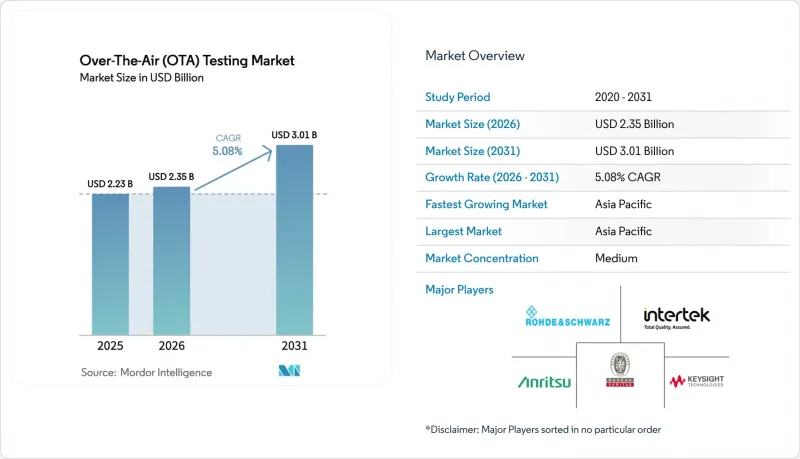
This report is Segmented by Offering (Hardware, Software and Analytics, and Services), Technology (5G NR, LTE, UMTS, GSM, Wi-Fi, Bluetooth, and LPWAN), Test Type (Antenna Performance, Conformance, Compatibility, and Production), Application (Telecom, and More), Test Environment (Far-Field, CATR, Near-Field, and Reverberation), and Geography. Market Forecasts are Provided in Terms of Value (USD).
Global Over-The-Air (OTA) Testing Market Trends and Insights
Proliferation of 5G Non-Standalone and Stand-Alone Deployments Requiring New Conformance Protocols
Stand-alone 5G cores reached mass-market status in 2025 as more than 300 operators enabled network slicing and low-latency services. Third Generation Partnership Project Release 17 introduced test cases for 64-stream massive-MIMO above 3.5 GHz, compelling laboratories to install dual-polarized probe arrays capable of simultaneous sampling. The Cellular Telecommunications Industry Association tightened its OTA 5.9 specification to include radiated spurious-emission checks at frequencies beyond 52.6 GHz, forcing device makers to upgrade legacy fixtures. With non-stand-alone architectures being phased out, smartphone vendors are compressing dual-mode validation windows, migrating budgets to stand-alone-specific instrumentation, and fragmenting demand across captive design-center labs.
Surging OTA Compliance Demand For mmWave And Massive-MIMO Antennas in Consumer Devices
Flagship phones now integrate up to 16 phased-array elements, each requiring total radiated power and isotropic sensitivity sweeps over 360-degree azimuth and 180-degree elevation planes. Federal Communications Commission rules for 24.25-29.5 GHz bands extend chamber occupancy by 40% versus sub-6 GHz tests, straining global capacity. Apple's 2025 millimeter-wave launches sparked a surge of over-the-air orders from contract manufacturers, pushing lead times for multi-probe systems beyond 18 months. Concurrently, China Mobile's 192-element base stations require reciprocity calibration, creating demand for portable near-field scanners that validate beamforming without service downtime.
Capital-Intensive Anechoic and Reverberation Chambers Discouraging Adoption by Tier-2 Labs
A 5-meter millimeter-wave chamber costs USD 2.5-4 million, while reverberation rooms run USD 0.8-1.2 million, outlays that emerging-market labs struggle to justify at sub-60% utilization. The International Electrotechnical Commission's 2024 stirrer-efficiency revision shortened refurbishment cycles, tightening return-on-investment timelines. Consequently, Latin American and African test centers outsource to global networks, increasing lead times and concentrating revenue among the top five certification houses.
Other drivers and restraints analyzed in the detailed report include:
- Accelerating Satellite-To-Device Direct-Link Constellations Necessitating New Near-Field OTA Protocols
- Automotive OEM Shift to Software-Defined and V2X Connectivity Platforms in North America
- Technical Skill Scarcity For mmWave Near-Field-To-Far-Field Transform Algorithms
For complete list of drivers and restraints, kindly check the Table Of Contents.
Segment Analysis
The Over-The-Air testing market size for hardware stood at 48% of total revenue in 2025, reflecting entrenched investments in anechoic chambers, compact ranges, and instrument stacks. Software and analytics platforms, however, are expanding at a 5.99% CAGR as cloud-hosted orchestration tools slash report-generation time and correlate multi-site measurements in real time. Continuous-integration pipelines now call test scripts through application programming interfaces, turning chambers into on-demand assets rather than static fixtures.
Services round out the category, with OEMs outsourcing Cellular Vehicle-to-Everything validation to specialist labs that package conformance, electromagnetic compatibility, and safety submissions into unified campaigns. The momentum behind software-defined radio instrumentation further erodes discrete hardware demand, as a single reconfigurable transceiver can span sub-6 GHz and millimeter-wave bands. This shift favours vendors capable of bundling code libraries, analytics dashboards, and remote-access controls with modular enclosures, positioning them for recurring revenue streams as subscription models replace one-off equipment sales.
5G New Radio commanded 37.5% share in 2025, underlining its status as the baseline for modern handset launches and fixed-wireless access points. Yet satellite direct-link services represent the fastest-growing slice, advancing at 6.21% CAGR and forcing laboratories to integrate orbital-motion emulators, high-dynamic-range Doppler sources, and low-elevation beam trackers. Long-Term Evolution and machine-type evolutions remain staples in industrial Internet-of-Things segments where decade-long lifecycles demand relentless backward compatibility.
Conversely, second- and third-generation cellular protocols fade as operators reform spectrum, though certification houses still process late-cycle devices destined for emerging markets. Wi-Fi 6, Wi-Fi 7, Bluetooth low energy, and ultra-wideband round out the roster, with coordinated beamforming and 320-MHz channels driving fresh over-the-air requirements. Laboratories capable of multi-protocol, multi-band validation under a single roof stand to capture cross-technology synergies that legacy single-band facilities cannot match.
Complete Report Scope:
- By Offering
- Hardware
- Chambers (Anechoic, Reverberation, Compact Range)
- Instrumentation (Signal Generators, Spectrum Analysers, Controllers)
- Software and Analytics
- Services
- Testing and Certification Services
- Consulting and Integration
- Hardware
- By Technology
- 5G NR (Sub-6 GHz and mmWave)
- LTE, LTE-A and LTE-M
- UMTS and WCDMA
- GSM and CDMA
- Wi-Fi 6, Wi-Fi 7 and Wi-Fi HaLow
- Bluetooth and UWB
- LPWAN (NB-IoT, LoRaWAN, Sigfox)
- By Test Type
- Antenna Performance (TRP, TIS, EIRP, EIS)
- Conformance and Certification
- Compatibility and Inter-operability
- Production and End-of-Line
- By Application
- Telecom and Consumer Electronics
- Automotive and Transportation
- Industrial and Manufacturing IoT
- Aerospace and Defense
- Healthcare Devices and Wearables
- Smart Home and Building Automation
- By Test Environment
- Far-Field Anechoic Chambers
- Compact Antenna Test Range
- Near-Field Systems
- Reverberation Chambers
- By Geography
- North America
- United States
- Canada
- Mexico
- Europe
- Germany
- United Kingdom
- France
- Nordics
- Rest of Europe
- South America
- Brazil
- Rest of South America
- Asia Pacific
- China
- Japan
- India
- South-East Asia
- Rest of Asia Pacific
- Middle East
- Gulf Cooperation Council Countries
- Turkey
- Rest of Middle East
- Africa
- South Africa
- Rest of Africa
- North America
Geography Analysis
Asia Pacific held 32.4% of 2025 revenue and is projected to expand at a 5.56% CAGR through 2031, buoyed by China's certification pipeline that cleared more than 1,200 5G smartphones in 2025 and India's Telecommunications Engineering Centre fast-track for domestic brands. Local device makers increasingly house captive labs to cut lead times yet still rely on external providers for millimeter-wave validation until homegrown expertise matures. Government incentives in South Korea and Japan further elevate regional demand by subsidizing non-terrestrial test infrastructure.
North America ranked second as automotive OEMs funnelled budgets into Cellular Vehicle-to-Everything validation and the Federal Communications Commission enforced stringent millimeter-wave emissions limits. Captive labs mushroomed around Detroit and Silicon Valley, but independent certifiers sustained volumes by specializing in replay chambers that emulate real-world multipath and Doppler. Canada contributed incremental growth via private-5G deployments in resource extraction sites that require ruggedized device validation.
Europe posted steady gains anchored by smart-factory rollouts in Germany, France, and the Nordics that mandate over-the-air verification of time-sensitive networking controllers. Reverberation chambers gained traction for industrial Internet-of-Things modules, while satellite non-terrestrial tests clustered in Munich and Toulouse. South America saw modest momentum led by Brazil's 5G launches, yet a paucity of accredited labs funnelled certifications to North American facilities, elongating schedules. Middle East and Africa remain nascent, though the African Telecommunications Union's mutual-recognition framework could catalyse regional capacity as spectrum auctions proceed.
- Keysight Technologies Inc.
- Rohde and Schwarz GmbH and Co. KG
- Anritsu Corporation
- SGS SA
- Intertek Group plc
- Bureau Veritas SA
- UL Solutions Inc.
- Eurofins Scientific SE
- Microwave Vision Group
- CETECOM GmbH
- BluFlux LLC
- Element Materials Technology
- National Technical Systems Inc.
- TUV Rheinland AG
- Spirent Communications plc
- VIAVI Solutions Inc.
- ETS-Lindgren Inc.
- Chotest Technology Inc.
- Shenzhen Sunwave Communications Co., Ltd.
Additional Benefits:
- The market estimate (ME) sheet in Excel format
- 3 months of analyst support
TABLE OF CONTENTS
1 INTRODUCTION
- 1.1 Study Assumptions and Market Definition
- 1.2 Scope of the Study
2 RESEARCH METHODOLOGY
3 EXECUTIVE SUMMARY
4 MARKET LANDSCAPE
- 4.1 Market Overview
- 4.2 Market Drivers
- 4.2.1 Proliferation of 5G Non-Standalone and Stand-Alone Deployments Requiring New Conformance Protocols
- 4.2.2 Surging OTA Compliance Demand for mmWave and Massive-MIMO Antennas in Consumer Devices
- 4.2.3 Automotive OEM Shift to Software-Defined and V2X Connectivity Platforms in North America
- 4.2.4 Industrial Private-5G Roll-outs in Europe for Smart Factories Requiring Robust RF Validation
- 4.2.5 Rapid Certification Cycles Mandated by CTIA and GCF for IoT Modules Below USD-10 BOM
- 4.2.6 Accelerating Satellite-to-Device Direct-Link Constellations Necessitating New Near-Field OTA Protocols
- 4.3 Market Restraints
- 4.3.1 Capital-Intensive Anechoic and Reverberation Chambers Discouraging Adoption by Tier-2 Labs
- 4.3.2 Technical Skill Scarcity for mmWave Near-Field-to-Far-Field Transform Algorithms
- 4.3.3 Lack of Harmonised Global Standards for LPWAN OTA Testing Delaying Market Convergence
- 4.3.4 Supply-Chain Volatility of RF Absorber Materials Inflating Test Infrastructure Costs
- 4.3.5 Rising Cyber-Security Concerns over Remote OTA Testbed Connectivity in Shared Facilities
- 4.4 Industry Value-Chain Analysis
- 4.5 Regulatory and Technological Outlook
- 4.5.1 Standardisation Roadmap (3GPP Rel-17/18, CTIA OTA 5.x)
- 4.5.2 Emerging Test Methodologies (OTA for Reconfigurable Intelligent Surfaces, 6G Terahertz)
- 4.6 Impact of Macroeconomic Factors on the Market
- 4.7 Porter's Five Forces Analysis
- 4.7.1 Bargaining Power of Suppliers
- 4.7.2 Bargaining Power of Buyers
- 4.7.3 Threat of New Entrants
- 4.7.4 Threat of Substitutes
- 4.7.5 Intensity of Competitive Rivalry
5 MARKET SIZE AND GROWTH FORECASTS (VALUES)
- 5.1 By Offering
- 5.1.1 Hardware
- 5.1.1.1 Chambers (Anechoic, Reverberation, Compact Range)
- 5.1.1.2 Instrumentation (Signal Generators, Spectrum Analysers, Controllers)
- 5.1.2 Software and Analytics
- 5.1.3 Services
- 5.1.3.1 Testing and Certification Services
- 5.1.3.2 Consulting and Integration
- 5.1.1 Hardware
- 5.2 By Technology
- 5.2.1 5G NR (Sub-6 GHz and mmWave)
- 5.2.2 LTE, LTE-A and LTE-M
- 5.2.3 UMTS and WCDMA
- 5.2.4 GSM and CDMA
- 5.2.5 Wi-Fi 6, Wi-Fi 7 and Wi-Fi HaLow
- 5.2.6 Bluetooth and UWB
- 5.2.7 LPWAN (NB-IoT, LoRaWAN, Sigfox)
- 5.3 By Test Type
- 5.3.1 Antenna Performance (TRP, TIS, EIRP, EIS)
- 5.3.2 Conformance and Certification
- 5.3.3 Compatibility and Inter-operability
- 5.3.4 Production and End-of-Line
- 5.4 By Application
- 5.4.1 Telecom and Consumer Electronics
- 5.4.2 Automotive and Transportation
- 5.4.3 Industrial and Manufacturing IoT
- 5.4.4 Aerospace and Defense
- 5.4.5 Healthcare Devices and Wearables
- 5.4.6 Smart Home and Building Automation
- 5.5 By Test Environment
- 5.5.1 Far-Field Anechoic Chambers
- 5.5.2 Compact Antenna Test Range
- 5.5.3 Near-Field Systems
- 5.5.4 Reverberation Chambers
- 5.6 By Geography
- 5.6.1 North America
- 5.6.1.1 United States
- 5.6.1.2 Canada
- 5.6.1.3 Mexico
- 5.6.2 Europe
- 5.6.2.1 Germany
- 5.6.2.2 United Kingdom
- 5.6.2.3 France
- 5.6.2.4 Nordics
- 5.6.2.5 Rest of Europe
- 5.6.3 South America
- 5.6.3.1 Brazil
- 5.6.3.2 Rest of South America
- 5.6.4 Asia Pacific
- 5.6.4.1 China
- 5.6.4.2 Japan
- 5.6.4.3 India
- 5.6.4.4 South-East Asia
- 5.6.4.5 Rest of Asia Pacific
- 5.6.5 Middle East
- 5.6.5.1 Gulf Cooperation Council Countries
- 5.6.5.2 Turkey
- 5.6.5.3 Rest of Middle East
- 5.6.6 Africa
- 5.6.6.1 South Africa
- 5.6.6.2 Rest of Africa
- 5.6.1 North America
6 COMPETITIVE LANDSCAPE
- 6.1 Market Concentration
- 6.2 Strategic Moves
- 6.3 Market Share Analysis
- 6.4 Company Profiles (includes Global Level Overview, Market Level Overview, Core Segments, Financials as Available, Strategic Information, Market Rank/Share for Key Companies, Products and Services, and Recent Developments)
- 6.4.1 Keysight Technologies Inc.
- 6.4.2 Rohde and Schwarz GmbH and Co. KG
- 6.4.3 Anritsu Corporation
- 6.4.4 SGS SA
- 6.4.5 Intertek Group plc
- 6.4.6 Bureau Veritas SA
- 6.4.7 UL Solutions Inc.
- 6.4.8 Eurofins Scientific SE
- 6.4.9 Microwave Vision Group
- 6.4.10 CETECOM GmbH
- 6.4.11 BluFlux LLC
- 6.4.12 Element Materials Technology
- 6.4.13 National Technical Systems Inc.
- 6.4.14 TUV Rheinland AG
- 6.4.15 Spirent Communications plc
- 6.4.16 VIAVI Solutions Inc.
- 6.4.17 ETS-Lindgren Inc.
- 6.4.18 Chotest Technology Inc.
- 6.4.19 Shenzhen Sunwave Communications Co., Ltd.
7 MARKET OPPORTUNITIES AND FUTURE OUTLOOK
- 7.1 White-Space and Unmet-Need Assessment

