PUBLISHER: Mordor Intelligence | PRODUCT CODE: 2114579

PUBLISHER: Mordor Intelligence | PRODUCT CODE: 2114579
Artificial Disc - Market Share Analysis, Industry Trends & Statistics, Growth Forecasts (2026 - 2031)
According to Mordor Intelligence, the artificial disc market size was valued at USD 3.71 billion in 2025 and estimated to grow from USD 4.17 billion in 2026 to reach USD 7.45 billion by 2031, at a CAGR of 12.33% during the forecast period (2026-2031).
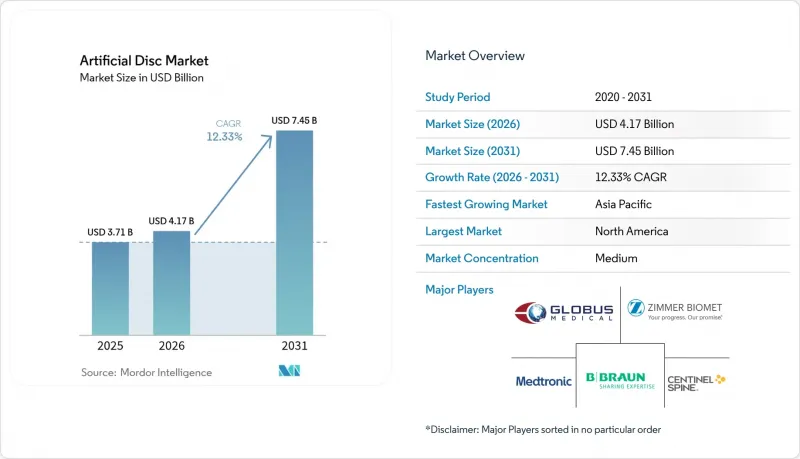
This report is Segmented by Disc Type (Cervical Artificial Disc and Lumbar Artificial Disc), Material (Metal-On-Metal, Metal-On-Polymer, and Ceramic-On-Polymer), Design (Constrained (Fixed-Core), and More), Core Mobility (Fixed Core and Mobile Core), End-User (Hospitals, and More), and Geography (North America, Europe, and More). The Market Forecasts are Provided in Terms of Value (USD).
Global Artificial Disc Market Trends and Insights
Rising Global Prevalence of Degenerative Disc Disease
Global low-back and neck pain cases exceed 600 million and are projected to rise markedly by 2050 as populations age. Higher life expectancy and sedentary work patterns exacerbate disc degeneration, compelling payers to seek durable, motion-preserving solutions. The economic burden encompasses lost productivity and disability payments, making artificial discs an attractive option for stakeholders who look beyond short-term surgical costs. Traditional fusion often fails to restore biomechanics, positioning disc arthroplasty as a credible alternative that maintains mobility and quality of life. Public health agencies are increasingly framing musculoskeletal wellness as a productivity imperative, thereby reinforcing the demand for next-generation implants.
Rapid Technological Advances in Motion-Preservation Implants
Viscoelastic cervical discs, 3D-printed patient-specific endplates, and ceramic-on-polymer bearings illustrate a design paradigm shift toward more biomimetic constructs. These innovations reduce wear debris, permit physiologic motion in six degrees of freedom, and simplify imaging follow-up by minimizing artifacts. The incorporation of additive manufacturing enables the creation of optimized lattice structures that distribute loads evenly, potentially prolonging implant survivorship. Such advancements widen indications, including multi-level disease, and feed surgeon confidence in newer systems. AI-enhanced planning software further fine-tunes sizing and positioning, trimming OR time and revision risk.
High Implant & Procedure Costs Versus Fusion Alternatives
Artificial disc systems command premium pricing versus fusion cages, challenging adoption where budgets are tight. Although lifetime economic models favor motion preservation, upfront costs remain a hurdle for public payers; Medicare still restricts lumbar coverage to patients under 60 years. Emerging economies grapple with capital constraints and variable private insurance penetration, slowing penetration despite rising disease burden. Volume-based procurement and local manufacturing incentives are gradually narrowing the gap, yet cost containment will continue to temper near-term growth.
Other drivers and restraints analyzed in the detailed report include:
- Growing Surgeon & Patient Preference for Minimally Invasive Disc Arthroplasty
- Expanding Long-Term Clinical Evidence Supporting Safety and Superior Outcomes
- Limited Surgeon Training & Learning Curve for Complex Disc Arthroplasty
For complete list of drivers and restraints, kindly check the Table Of Contents.
Segment Analysis
The lumbar segment supplied 51.20% of the artificial disc market size in 2025, reflecting the prevalence of low-back disorders. Still, cervical volumes are scaling faster, projected at a 15.16% CAGR, thanks to demonstrated 82.3% clinical success and more straightforward anatomy. Multi-level regulatory clearances and viscoelastic designs, such as the M6-C, strengthen the cervical value proposition. Lumbar devices retain traction through long-term durability data, with the Prodisc L exhibiting just 0.67% revision rate across two decades . Together, these patterns illustrate how the artificial disc market is diversifying across spinal levels rather than concentrating solely on lumbar pathology.
Enhanced cervical uptake also reshapes surgical workflow, resulting in shorter operative times, reduced blood loss, and faster ambulatory qualification, which encourages ASC migration. Reimbursement parity between cervical fusion and arthroplasty in many U.S. plans neutralizes cost objections, allowing surgeons to emphasize the functional benefits. Disc height maintenance and segmental lordosis restoration further differentiate cervical arthroplasty, influencing guidelines and referral flows.
Metal-on-polymer constructs delivered 59.10% of the artificial disc market share in 2025, yet ceramic-based systems now post a 15.82% CAGR-the segment's fastest rate. Zirconia-toughened alumina reduces wear debris and eliminates the risks of metal ion hypersensitivity, which affects 10-15% of patients. Improved sintering methods have mitigated earlier concerns about brittleness, while radiolucency aids postoperative imaging. As MRI follow-up becomes routine, the advantage becomes even more pronounced. Price differentials are narrowing as ceramic supply chains scale, enabling broader payer acceptance. Manufacturers continue to combine titanium endplates with ceramic-polymer cores to strike a balance between osseointegration and articulation performance.
The move toward ceramics also aligns with patient marketing, as allergy-free, low-noise implants resonate with health-conscious demographics. Europe, with stringent metal-ion monitoring, leads in adoption and provides a template for other regions. Concurrently, R&D into gradient materials and hybrid constructs signals an innovation pipeline geared to erode metal's historical lead further.
Complete Report Scope:
- By Disc Type
- Cervical Artificial Disc
- Lumbar Artificial Disc
- By Material
- Metal-on-Metal
- Metal-on-Polymer
- Ceramic-on-Polymer
- By Design
- Constrained (Fixed-Core)
- Semi-Constrained (Mobile-Core)
- Non-Constrained (Elastic-Core)
- By Core Mobility
- Fixed Core
- Mobile Core
- By End-User
- Hospitals
- Orthopedic & Spine Specialty Clinics
- Ambulatory Surgical Centers (ASCs)
- Geography
- North America
- United States
- Canada
- Mexico
- Europe
- Germany
- United Kingdom
- France
- Italy
- Spain
- Rest of Europe
- Asia-Pacific
- China
- Japan
- India
- South Korea
- Australia
- Rest of Asia-Pacific
- Middle East and Africa
- GCC
- South Africa
- Rest of Middle East and Africa
- South America
- Brazil
- Argentina
- Rest of South America
- North America
Geography Analysis
North America held a 37.60% market share in the artificial disc market in 2025, driven by favorable reimbursement, extensive spine-center networks, and the rapid adoption of AI-guided planning tools. Two-level cervical approvals expanded the eligible cohort, intensifying procedure counts. The region confronts reimbursement headwinds-Medicare's age limit on lumbar disc arthroplasty persists-but private insurers are increasingly authorizing motion preservation based on cost-effectiveness evidence.
Europe ranks second, buoyed by public systems that acknowledge long-term economic gains from reduced adjacent segment disease. Germany and France are early adopters of ceramic-dominated platforms, leveraging their local expertise in biomaterials. Harmonized CE-Mark updates in 2025 clarified post-market surveillance requirements, smoothing market entry for next-generation discs. Aging demographics and wellness-oriented cultural norms are driving the growth of procedures across the continent.
The Asia-Pacific region is the fastest-growing, projected to grow at a 14.62% CAGR through 2031. Japan's super-aged society and government-backed robotics programs channel investment into spine technologies. [3] China, via its volume-based procurement reforms, supports domestic manufacturing and accelerates time-to-market for locally developed discs. India's Production Linked Incentive (PLI) scheme nurtures indigenous MedTech capacity, narrowing import dependency and lowering costs. Varied regulatory pathways create complexity, yet the overarching trajectory remains upward as healthcare access widens.
- Medtronic
- Zimmer Biomet
- Johnson & Johnson
- Centinel Spine
- NuVasive
- Globus Medical
- Stryker
- Orthofix
- Alphatec Spine Inc
- AxioMed
- B. Braun Melsungen AG (Aesculap)
- Synergy Spine Solutions Inc
- Spineart
- Prodorth Spine
- Vertebral Technologies Inc
- Paradigm Spine
- Spineway
Additional Benefits:
- The market estimate (ME) sheet in Excel format
- 3 months of analyst support
TABLE OF CONTENTS
1 Introduction
- 1.1 Study Assumptions & Market Definition
- 1.2 Scope of the Study
2 Research Methodology
3 Executive Summary
4 Market Landscape
- 4.1 Market Overview
- 4.2 Market Drivers
- 4.2.1 Rising Global Prevalence of Degenerative Disc Disease and Chronic Low-Back Pain
- 4.2.2 Rapid Technological Advances in Motion-Preservation Implants (Mobile-Core & Biomimetic Materials)
- 4.2.3 Growing Surgeon & Patient Preference for Minimally Invasive Disc Arthroplasty over Spinal Fusion
- 4.2.4 Expanding Long-Term Clinical Evidence Supporting Safety and Superior Functional Outcomes
- 4.2.5 Increasing Healthcare Expenditure and Access to Advanced Spinal Care in Emerging Economies
- 4.3 Market Restraints
- 4.3.1 High Implant & Procedure Costs Versus Fusion Alternatives in Cost-Constrained Health Systems
- 4.3.2 Stringent Regulatory Approval Pathways and Lengthy Clinical Trial Requirements
- 4.3.3 Limited Surgeon Training & Learning Curve for Complex Disc Arthroplasty Techniques
- 4.3.4 Uncertainty Over Long-Term Implant Survivability and Revision Surgery Complexity
- 4.4 Supply-Chain Analysis
- 4.5 Technological Outlook
- 4.6 Porter's Five Forces
- 4.6.1 Bargaining Power of Buyers
- 4.6.2 Bargaining Power of Suppliers
- 4.6.3 Threat of New Entrants
- 4.6.4 Threat of Substitutes
- 4.6.5 Intensity of Competitive Rivalry
5 Market Size & Growth Forecasts (Value, USD)
- 5.1 By Disc Type
- 5.1.1 Cervical Artificial Disc
- 5.1.2 Lumbar Artificial Disc
- 5.2 By Material
- 5.2.1 Metal-on-Metal
- 5.2.2 Metal-on-Polymer
- 5.2.3 Ceramic-on-Polymer
- 5.3 By Design
- 5.3.1 Constrained (Fixed-Core)
- 5.3.2 Semi-Constrained (Mobile-Core)
- 5.3.3 Non-Constrained (Elastic-Core)
- 5.4 By Core Mobility
- 5.4.1 Fixed Core
- 5.4.2 Mobile Core
- 5.5 By End-User
- 5.5.1 Hospitals
- 5.5.2 Orthopedic & Spine Specialty Clinics
- 5.5.3 Ambulatory Surgical Centers (ASCs)
- 5.6 Geography
- 5.6.1 North America
- 5.6.1.1 United States
- 5.6.1.2 Canada
- 5.6.1.3 Mexico
- 5.6.2 Europe
- 5.6.2.1 Germany
- 5.6.2.2 United Kingdom
- 5.6.2.3 France
- 5.6.2.4 Italy
- 5.6.2.5 Spain
- 5.6.2.6 Rest of Europe
- 5.6.3 Asia-Pacific
- 5.6.3.1 China
- 5.6.3.2 Japan
- 5.6.3.3 India
- 5.6.3.4 South Korea
- 5.6.3.5 Australia
- 5.6.3.6 Rest of Asia-Pacific
- 5.6.4 Middle East and Africa
- 5.6.4.1 GCC
- 5.6.4.2 South Africa
- 5.6.4.3 Rest of Middle East and Africa
- 5.6.5 South America
- 5.6.5.1 Brazil
- 5.6.5.2 Argentina
- 5.6.5.3 Rest of South America
- 5.6.1 North America
6 Competitive Landscape
- 6.1 Market Concentration
- 6.2 Market Share Analysis
- 6.3 Company Profiles (includes Global level Overview, Market level overview, Core Business Segments, Financials, Headcount, Key Information, Market Rank, Market Share, Products and Services, and analysis of Recent Developments)
- 6.3.1 Medtronic PLC
- 6.3.2 Zimmer Biomet
- 6.3.3 Johnson & Johnson (DePuy Synthes)
- 6.3.4 Centinel Spine LLC
- 6.3.5 NuVasive Inc
- 6.3.6 Globus Medical
- 6.3.7 Stryker Corporation
- 6.3.8 Orthofix Medical Inc
- 6.3.9 Alphatec Spine Inc
- 6.3.10 AxioMed LLC
- 6.3.11 B. Braun Melsungen AG (Aesculap)
- 6.3.12 Synergy Spine Solutions Inc
- 6.3.13 Spineart SA
- 6.3.14 Prodorth Spine
- 6.3.15 Vertebral Technologies Inc
- 6.3.16 Paradigm Spine
- 6.3.17 Spineway
7 Market Opportunities & Future Outlook
- 7.1 White-Space & Unmet-Need Assessment

