PUBLISHER: Mordor Intelligence | PRODUCT CODE: 2114580

PUBLISHER: Mordor Intelligence | PRODUCT CODE: 2114580
Gynecology Drugs - Market Share Analysis, Industry Trends & Statistics, Growth Forecasts (2026 - 2031)
According to Mordor Intelligence, the gynecology drugs market size was valued at USD 72.97 billion in 2025 and estimated to grow from USD 76.43 billion in 2026 to reach USD 96.3 billion by 2031, at a CAGR of 4.74% during the forecast period (2026-2031).
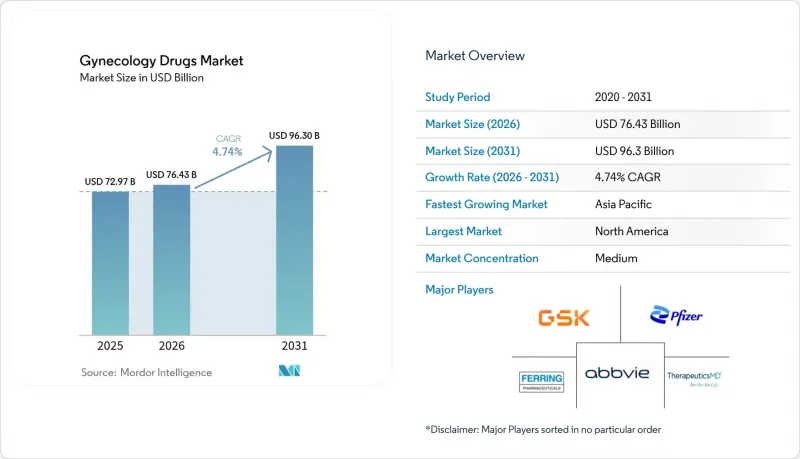
This report is Segmented by Therapeutic Class (Hormonal Therapy, Non-Hormonal Therapy), Indication (Contraception, Gynecology Infections and More), Route of Administration (Oral, Parenteral, and More), Distribution Channel (Retail Pharmacies, Hospital Pharmacies, and More), and Geography (North America, Europe, and More). The Market Forecasts are Provided in Terms of Value (USD), Based On Availability.
Global Gynecology Drugs Market Trends and Insights
Growing Preference for Long-Acting Reversible Contraceptives (LARCs)
Health-system cost analyses consistently favor LARCs over short-acting options, pushing payers to bolster reimbursement. CooperSurgical's upgraded Paragard inserter, engineered for one-handed deployment, streamlines in-office placement workflows. Uptake is visible in low-resource clinics where copper IUDs reduce supply-chain dependency and follow-up visits. Policy makers now bundle counseling for LARCs into preventive-care visits, aligning with public-health objectives that target unintended pregnancies. These structural enablers stand to funnel recurrent demand into the gynecology drugs market over the medium term. As more Medicaid programs waive insertion fees, provider adoption is poised to quicken further.
Surging Adoption of Once-Daily Non-Hormonal Menopause Therapies
Phase III data for Bayer's elinzanetant confirmed significant vasomotor symptom relief without estrogen exposure, validating neurokinin antagonism as an effective pathway. The FDA approval of fezolinetant set a regulatory precedent in 2024, although post-launch liver-monitoring requirements heightened pharmacovigilance expectations. An estimated 1.2 billion women will reach menopause by 2030, framing a sizeable patient pool for safer alternatives. Physicians report rising demand from individuals contraindicated for hormones, further stimulating the gynecology drugs market. Educational campaigns by industry groups now emphasize differentiation between systemic estrogens and selective neurokinin blockers to allay residual safety concerns.
Hormone-Therapy Safety Perceptions
Black-box warnings highlighting venous-thromboembolism and breast-cancer risk still dampen prescription volumes despite modern evidence favoring transdermal and natural-estrogen profiles. Specialist societies lobby for nuanced labeling, but behavior change among general practitioners progresses slowly. Patients over 65 remain a challenging subgroup where cardiovascular risk complicates benefit-risk dialogues. Transdermal patches offer a pharmacokinetic advantage yet struggle for formulary placement without long-term outcomes data. Until labeling updates materialize, hesitancy will cap the gynecology drugs market's hormone-segment upside.
Other drivers and restraints analyzed in the detailed report include:
- FDA Fast-Track Approvals for Antibody-Drug Conjugates in Gynecologic Oncology
- Rapid Expansion of Online Direct-to-Consumer Fertility Drug Platforms
- Patent-Cliff Price Erosion in Oral Contraceptives
For complete list of drivers and restraints, kindly check the Table Of Contents.
Segment Analysis
Hormonal agents generated 68.07% revenue in 2025, sustained by entrenched physician familiarity and decades of efficacy data. Yet non-hormonal entrants grew at a robust 5.33% CAGR, carving niches in menopause and cancer care. Elevated safety profiles attract users who previously avoided hormones, broadening addressable populations. ADCs now create a hybrid sub-class blurring lines between cytotoxics and targeted biologics, pushing parenteral volumes upward. To protect incumbency, leading firms redesign progestins and estrogen analogs with improved metabolic impact. Generics crowd the low-dose contraceptive segment, but premium non-hormonal brands partially offset revenue attrition.
Forward-looking R&D increasingly incorporates sex-specific endpoints following updated FDA guidance, accelerating bench-to-clinic translation. Venture-backed biotechs exploit this opening with novel neurokinin and GnRH modulators. The gynecology drugs market consequently pivots toward a balanced mix where hormonal stalwarts coexist with innovation-driven non-hormonal franchises.
Contraception controlled 34.12% of revenue in 2025, reflecting broad public-health adoption. Nevertheless, oncology posted the fastest 5.95% CAGR as ADCs and targeted inhibitors gained traction. Infertility pharmacotherapy maintains mid-single-digit growth, fueled by rising maternal age and employer-funded IVF benefits. Postmenopausal disorders await broader hormone-safety consensus, but non-hormonal breakthroughs stimulate moderate uptake. PCOS therapies evolve beyond insulin sensitizers toward metabolic agents, expanding indication breadth. Endometriosis saw renewed interest after European endorsement of linzagolix, underscoring global unmet need.
Osteoporosis biologics achieve incremental gains as reimbursement widens. Infectious-disease antimicrobials remain stable, though topical innovations improve patient adherence. Collectively, the shifting indication mix recalibrates the gynecology drugs market toward higher biological complexity and differentiated value propositions.
Complete Report Scope:
- By Therapeutic Class (Value)
- Hormonal Therapy
- Non-Hormonal Therapy
- By Indication (Value)
- Contraception
- Gynecology Infections
- Female Infertility
- Postmenopausal Disorders
- Polycystic Ovary Syndrome
- Osteoporosis
- Gynecology Cancer
- Endometriosis
- Others
- By Route of Administration (Value)
- Oral
- Parenteral
- Topical
- Vaginal
- Others
- By Distribution Channel (Value)
- Retail Pharmacies
- Hospital Pharmacies
- Online Pharmacies
- Others
- By Geography (Value)
- North America
- United States
- Canada
- Mexico
- Europe
- Germany
- United Kingdom
- France
- Italy
- Spain
- Rest of Europe
- Asia-Pacific
- China
- India
- Japan
- South Korea
- Australia
- Rest of Asia-Pacific
- South America
- Brazil
- Argentina
- Rest of South America
- Middle East and Africa
- GCC
- South Africa
- Rest of Middle East and Africa
- North America
Geography Analysis
North America generated 31.88% of 2025 sales, leveraging mature reimbursement and rapid FDA approvals to maintain therapeutic leadership. The region's payer mix encourages swift formulary inclusion of innovations such as elinzanetant, although carboplatin shortages expose manufacturing fragility. Fem-tech investment ecosystems in Boston and San Francisco funnel capital into PCOS and endometriosis pipelines, invigorating competitive churn. Insurer coverage expansions for infertility drugs amplify prescription volumes, further enlarging the gynecology drugs market footprint.
Europe follows with steady uptake across contraceptive and menopause segments, supported by coordinated regulatory pathways. The European Commission's nod for linzagolix broadened endometriosis options and underscored the continent's receptivity to non-hormonal mechanisms. Divergent country reimbursement rules necessitate granular market-access strategies, yet centralized safety evaluations speed pan-regional launches. Aging demographics intensify demand for osteoporosis biologics, anchoring long-term growth.
Asia-Pacific is projected to deliver a 6.07% CAGR through 2031, powered by healthcare infrastructure upgrades and rising disposable incomes. Japanese and Australian markets show receptivity to advanced oncology biologics, whereas populous Southeast Asian nations concentrate on affordable contraceptives. Local API production hubs in India and China offer cost advantages yet also present geopolitical risk. Cultural barriers in certain economies moderate hormone-therapy uptake, but urban consumers increasingly prioritize evidence-based gynecological care. Government initiatives that subsidize LARC insertions invigorate segment penetration, expanding the gynecology drugs market across emerging settings.
- Bayer
- Pfizer
- Merck
- GlaxoSmithKline
- Abbvie
- AstraZeneca
- Johnson & Johnson
- Eisai
- Roche
- Novartis
- Eli Lilly and Company
- Teva Pharmaceutical Industries
- Viatris
- Amgen
- Sanofi
- Agile Therapeutics, Inc.
- Organon
- Cooper Companies, Inc.
- Lupin
- Cadila Healthcare Ltd. (Zydus Group)
Additional Benefits:
- The market estimate (ME) sheet in Excel format
- 3 months of analyst support
TABLE OF CONTENTS
1 Introduction
- 1.1 Study Assumptions & Market Definition
- 1.2 Scope of the Study
2 Research Methodology
3 Executive Summary
4 Market Landscape
- 4.1 Market Overview
- 4.2 Market Drivers
- 4.2.1 Growing preference for long-acting reversible contraceptives (LARCs)
- 4.2.2 Surging adoption of once-daily non-hormonal menopause therapies
- 4.2.3 FDA fast-track approvals for antibody-drug conjugates in gynecologic oncology
- 4.2.4 Rapid expansion of online direct-to-consumer (DTC) fertility drug platforms
- 4.2.5 Rising investment in fem-tech start-ups targeting PCOS & endometriosis
- 4.2.6 Country-level reimbursement for osteoporosis biologics
- 4.3 Market Restraints
- 4.3.1 Hormone-therapy safety concerns (VTE, breast-cancer risk)
- 4.3.2 Patent-cliff driven price erosion in oral contraceptives
- 4.3.3 Socio-cultural barriers to contraception in conservative economies
- 4.3.4 API supply-chain fragility for niche gynecologic oncology drugs
- 4.4 Value / Supply-Chain Analysis
- 4.5 Regulatory Landscape
- 4.6 Technological Outlook
- 4.7 Porter's Five Forces
- 4.7.1 Threat of New Entrants
- 4.7.2 Bargaining Power of Suppliers
- 4.7.3 Bargaining Power of Buyers
- 4.7.4 Threat of Substitute Products
- 4.7.5 Intensity of Competitive Rivalry
5 Market Size & Growth Forecasts
- 5.1 By Therapeutic Class (Value)
- 5.1.1 Hormonal Therapy
- 5.1.2 Non-Hormonal Therapy
- 5.2 By Indication (Value)
- 5.2.1 Contraception
- 5.2.2 Gynecology Infections
- 5.2.3 Female Infertility
- 5.2.4 Postmenopausal Disorders
- 5.2.5 Polycystic Ovary Syndrome
- 5.2.6 Osteoporosis
- 5.2.7 Gynecology Cancer
- 5.2.8 Endometriosis
- 5.2.9 Others
- 5.3 By Route of Administration (Value)
- 5.3.1 Oral
- 5.3.2 Parenteral
- 5.3.3 Topical
- 5.3.4 Vaginal
- 5.3.5 Others
- 5.4 By Distribution Channel (Value)
- 5.4.1 Retail Pharmacies
- 5.4.2 Hospital Pharmacies
- 5.4.3 Online Pharmacies
- 5.4.4 Others
- 5.5 By Geography (Value)
- 5.5.1 North America
- 5.5.1.1 United States
- 5.5.1.2 Canada
- 5.5.1.3 Mexico
- 5.5.2 Europe
- 5.5.2.1 Germany
- 5.5.2.2 United Kingdom
- 5.5.2.3 France
- 5.5.2.4 Italy
- 5.5.2.5 Spain
- 5.5.2.6 Rest of Europe
- 5.5.3 Asia-Pacific
- 5.5.3.1 China
- 5.5.3.2 India
- 5.5.3.3 Japan
- 5.5.3.4 South Korea
- 5.5.3.5 Australia
- 5.5.3.6 Rest of Asia-Pacific
- 5.5.4 South America
- 5.5.4.1 Brazil
- 5.5.4.2 Argentina
- 5.5.4.3 Rest of South America
- 5.5.5 Middle East and Africa
- 5.5.5.1 GCC
- 5.5.5.2 South Africa
- 5.5.5.3 Rest of Middle East and Africa
- 5.5.1 North America
6 Competitive Landscape
- 6.1 Market Concentration
- 6.2 Market Share Analysis
- 6.3 Company Profiles (includes Global level Overview, Market level overview, Core Segments, Financials as available, Strategic Information, Market Rank/Share for key companies, Products & Services, and Recent Developments)
- 6.3.1 Bayer AG
- 6.3.2 Pfizer Inc.
- 6.3.3 Merck & Co., Inc.
- 6.3.4 GSK plc
- 6.3.5 AbbVie Inc.
- 6.3.6 AstraZeneca plc
- 6.3.7 Johnson & Johnson (Janssen)
- 6.3.8 Eisai Co., Ltd.
- 6.3.9 F. Hoffmann-La Roche Ltd
- 6.3.10 Novartis AG
- 6.3.11 Eli Lilly and Company
- 6.3.12 Teva Pharmaceutical Industries Ltd.
- 6.3.13 Viatris Inc.
- 6.3.14 Amgen Inc.
- 6.3.15 Sanofi S.A.
- 6.3.16 Agile Therapeutics, Inc.
- 6.3.17 Organon & Co.
- 6.3.18 Cooper Companies, Inc.
- 6.3.19 Lupin Limited
- 6.3.20 Cadila Healthcare Ltd. (Zydus Group)
7 Market Opportunities & Future Outlook
- 7.1 White-space & Unmet-Need Assessment

