PUBLISHER: Mordor Intelligence | PRODUCT CODE: 2114589

PUBLISHER: Mordor Intelligence | PRODUCT CODE: 2114589
Dental Lasers - Market Share Analysis, Industry Trends & Statistics, Growth Forecasts (2026 - 2031)
According to Mordor Intelligence, the dental lasers market size is expected to grow from USD 371.54 million in 2025 to USD 401.30 million in 2026 and is forecast to reach USD 589.91 million by 2031 at 8.01% CAGR over 2026-2031.
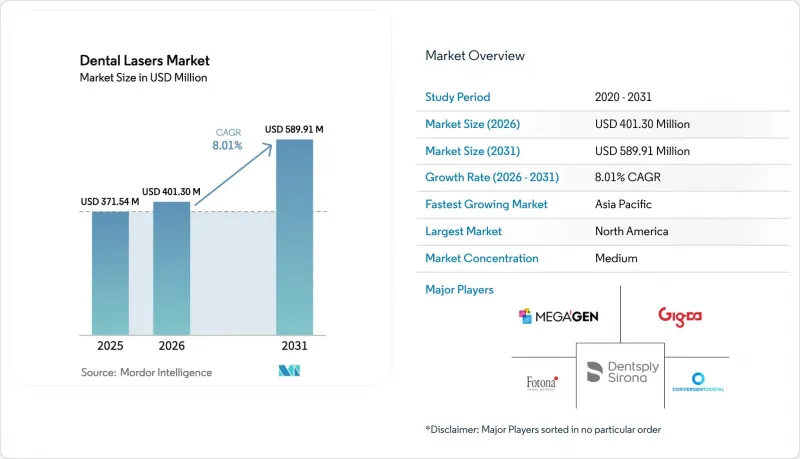
This report is Segmented by Product Type (Soft Tissue Lasers and Hard Tissue Lasers), Technology (Diode, Nd:yag, Er:yag, and CO2), Application (Conservative Dentistry, Endodontic Treatment, Oral Surgery, Periodontics, and Implantology), End User (Dental Clinics & DSOs, Hospitals, and Academic & Research Institutions), and Geography (North America, Europe, and More). Market Forecasts are Provided in Value (USD).
Global Dental Lasers Market Trends and Insights
Rising Prevalence of Periodontal & Peri-Implant Diseases
Severe periodontitis afflicts roughly 1 billion adults and climbs sharply after age 50. Peri-implantitis adds a recurrent clinical burden, as conventional debridement risks scratching titanium. Erbium:YAG lasers vaporize biofilm while sparing implant surfaces, and diode units coagulate inflamed soft tissue. Evidence-based protocols such as laser-assisted new attachment procedures gain traction because they avoid flap surgery and encourage faster healing. Aging populations in the United States, Germany, and Japan ensure a steady influx of complex periodontal cases that are well-suited for laser therapy. Practices adopting these protocols report higher treatment acceptance because patients associate lasers with lower pain and quicker recovery.
Growing Adoption of Minimally Invasive Dentistry
Patient demand for gentle care accelerates the shift away from scalpels and burs. Soft tissue lasers complete gingivectomy and frenectomy with limited bleeding, enabling same-day discharge. Hard-tissue erbium:YAG systems can excise caries while preserving enamel, thereby reducing postoperative sensitivity. DSOs capitalize on this preference by marketing laser procedures as premium offerings and implementing standardized protocols across their extensive networks. In dense urban markets, the ability to advertise no-shot cavity removal differentiates practices and drives elective case volume. The trend integrates seamlessly with digital scanning and on-site milling, enabling practitioners to complete restorations in a single visit.
Regulatory Uncertainty for New Laser Classes (Class IV+)
High-power or multi-wavelength devices may be classified into stricter regulatory categories, thereby prolonging clearance cycles under FDA 510(k), EU MDR, or China's NMPA regimes. Extended approval timelines can increase development costs and delay market entry by 12-18 months. Manufacturers hedge by releasing incremental upgrades rather than breakthrough configurations, modestly slowing the pace of innovation available to clinicians.
Other drivers and restraints analyzed in the detailed report include:
- Rapid Technological Advances (Short-Pulse, Dual-Wavelength Systems)
- Expansion of Chair-Side CAD/CAM Workflow Compatibility
- Limited Reimbursement Across Major Payer Systems
For complete list of drivers and restraints, kindly check the Table Of Contents.
Segment Analysis
Soft tissue lasers accounted for 57.54% of the dental lasers market size in 2025, driven by lower price points and their broad applicability in gingival contouring, frenectomy, and periodontal debridement. Their ease of integration delivers quick payback, especially in high-throughput DSO branches that perform large volumes of cosmetic reshaping. Hard-tissue-capable erbium:YAG systems, though more expensive, are gaining visibility as evidence mounts for painless caries excavation and peri-implantitis management. Over the forecast period, rising clinician proficiency and the introduction of bundled dual-wavelength consoles will gradually shift the product mix toward platforms that address both tissue types within a single workflow. DSOs already deploy soft tissue units system-wide and concentrate premium hard-tissue models at specialty hubs where procedure complexity justifies higher capital allocation.
Soft tissue dominance reflects the financial calculus of independent practices that often start with a diode laser to gain surgical flexibility and patient marketing appeal. Once utilization stabilizes, some practices trade up to dual-wavelength devices that unlock restorative indications and expand revenue streams. Continued refinement of pulse modulation and fiber delivery will further broaden the indications for soft tissue. Yet, the comparative clinical value of hard-tissue capability suggests a measured but steady shift toward full-spectrum systems as amortization barriers ease.
Diode platforms held 36.54% of the 2025 dental lasers market share because they address everyday soft tissue cases at entry-level pricing. However, erbium:YAG units are projected to post the highest 10.65% CAGR through 2031 as clinicians seek single-visit hard-tissue treatments that preserve tooth structure. Carbon dioxide lasers, once favored for excisional biopsy and vaporization, face share erosion due to higher cost and competitive diode upgrades. Neodymium:YAG remains niche for deep tissue coagulation and photobiomodulation, often bundled as a secondary wavelength in multi-mode consoles.
Technological convergence is accelerating. Short-pulse erbium modules achieve enamel ablation with negligible thermal spread, while software-guided parameter libraries simplify setup. Manufacturers now combine diode and erbium beams in a single chassis, allowing practitioners to transition from gingivectomy to cavity preparation without switching equipment. These hybrid systems reduce operatory clutter and strengthen the overall value proposition, positioning erbium as the logical next-round investment for practices already comfortable with diode workflows.
Complete Report Scope:
- By Product Type
- Soft Tissue Lasers
- Hard Tissue Lasers
- By Technology
- Diode Lasers
- Nd:YAG Lasers
- Er:YAG Lasers
- CO? Lasers
- By Application
- Conservative Dentistry
- Endodontic Treatment
- Oral Surgery
- Periodontics
- Implantology
- By End User
- Dental Clinics & DSOs
- Hospitals
- Academic & Research Institutions
- Geography
- North America
- United States
- Canada
- Mexico
- Europe
- Germany
- United Kingdom
- France
- Italy
- Spain
- Rest Of Europe
- Asia-Pacific
- China
- Japan
- India
- Australia
- South Korea
- Rest Of Asia-Pacific
- Middle East And Africa
- GCC
- South Africa
- Rest Of Middle East And Africa
- South America
- Brazil
- Argentina
- Rest Of South America
- North America
Geography Analysis
North America retained 40.34% share in 2025, anchored by the United States, where DSO expansion and high disposable income underpin equipment upgrades. Mature CAD/CAM penetration creates natural integration points for lasers, while continuing education ecosystems sustain clinician competency. Canada mirrors these trends on a smaller scale, with provincial variations in scope-of-practice regulations shaping uptake. Mexico's border clinics exploit dental tourism by advertising laser-assisted veneers and implant placement to U.S. patients seeking price relief.
Asia-Pacific is forecast to grow fastest at 9.43% CAGR through 2031. China's rising middle class drives the opening of private clinics, which view lasers as a modern brand signal. Japan's high implant prevalence drives demand for erbium units suitable for peri-implant maintenance, whereas South Korea's well-established medical tourism sector positions dual-wavelength consoles as standard amenities. India exhibits early-stage adoption, primarily in urban areas where competitive differentiation is crucial. Thailand and the Philippines, on the other hand, bank on laser-branded packages to attract overseas clientele.
Europe exhibits mixed dynamics. Germany benefits from selective insurance reimbursement for periodontal laser therapy, fostering penetration among periodontists. The United Kingdom sees strong private-sector interest, but reimbursement gaps within the National Health Service limit broader deployment. France and Italy maintain a moderate level of adoption, focusing on urban cosmetic clinics. In the Middle East, Gulf countries invest in cutting-edge equipment to build regional centers of excellence. South Africa's private market pilots laser units in Johannesburg and Cape Town, but broader diffusion is hindered by currency volatility and limited access to training. Brazil leads South America through private dental chains that equip high-volume sites with diode systems to cater to cosmetic surgery travelers.
- AMD LASERS
- A.R.C. Laser
- CAO Group Inc.
- Convergent Dental Inc.
- DenMat Holdings LLC
- Dentsply Sirona
- Envista Holdings (Kerr)
- Fotona d.o.o.
- Gigaalaser
- Guildford Laser & Technology
- Ivoclar Vivadent
- J. Morita Corp.
- LightScalpel LLC
- Millennium Dental Technologies
- MegaGen Implant
- Planmeca
- The Yoshida Dental Mfg. Co. Ltd.
- Ultradent Products
- ZOLAR Technology & Mfg.
Additional Benefits:
- The market estimate (ME) sheet in Excel format
- 3 months of analyst support
TABLE OF CONTENTS
1 Introduction
- 1.1 Study Assumptions & Market Definition
- 1.2 Scope of the Study
2 Research Methodology
3 Executive Summary
4 Market Landscape
- 4.1 Market Overview
- 4.2 Market Drivers
- 4.2.1 Rising Prevalence of Periodontal & Peri-Implant Diseases
- 4.2.2 Growing Adoption of Minimally-Invasive Dentistry
- 4.2.3 Rapid Technological Advances (Short-Pulse, Dual-Wavelength Systems)
- 4.2.4 Expansion of Chair-side CAD/CAM Workflow Compatibility
- 4.2.5 Increasing DSO (-led) Investments in High-ROI Capital Equipment
- 4.2.6 Emerging Dental Tourism Clusters Adopting Laser-Enabled Procedures
- 4.3 Market Restraints
- 4.3.1 High Acquisition & Maintenance Costs for Practitioners
- 4.3.2 Limited Reimbursement Across Major Payer Systems
- 4.3.3 Steep Learning Curve & Training Deficits
- 4.3.4 Regulatory Uncertainty for New Laser Classes (Class IV+)
- 4.4 Value/Supply-Chain Analysis
- 4.5 Regulatory Landscape
- 4.6 Technological Outlook
- 4.7 Porter's Five Forces Analysis
- 4.7.1 Threat of New Entrants
- 4.7.2 Bargaining Power of Buyers/Consumers
- 4.7.3 Bargaining Power of Suppliers
- 4.7.4 Threat of Substitute Products
- 4.7.5 Intensity of Competitive Rivalry
5 Market Size & Growth Forecasts (Value, USD)
- 5.1 By Product Type
- 5.1.1 Soft Tissue Lasers
- 5.1.2 Hard Tissue Lasers
- 5.2 By Technology
- 5.2.1 Diode Lasers
- 5.2.2 Nd:YAG Lasers
- 5.2.3 Er:YAG Lasers
- 5.2.4 CO? Lasers
- 5.3 By Application
- 5.3.1 Conservative Dentistry
- 5.3.2 Endodontic Treatment
- 5.3.3 Oral Surgery
- 5.3.4 Periodontics
- 5.3.5 Implantology
- 5.4 By End User
- 5.4.1 Dental Clinics & DSOs
- 5.4.2 Hospitals
- 5.4.3 Academic & Research Institutions
- 5.5 Geography
- 5.5.1 North America
- 5.5.1.1 United States
- 5.5.1.2 Canada
- 5.5.1.3 Mexico
- 5.5.2 Europe
- 5.5.2.1 Germany
- 5.5.2.2 United Kingdom
- 5.5.2.3 France
- 5.5.2.4 Italy
- 5.5.2.5 Spain
- 5.5.2.6 Rest Of Europe
- 5.5.3 Asia-Pacific
- 5.5.3.1 China
- 5.5.3.2 Japan
- 5.5.3.3 India
- 5.5.3.4 Australia
- 5.5.3.5 South Korea
- 5.5.3.6 Rest Of Asia-Pacific
- 5.5.4 Middle East And Africa
- 5.5.4.1 GCC
- 5.5.4.2 South Africa
- 5.5.4.3 Rest Of Middle East And Africa
- 5.5.5 South America
- 5.5.5.1 Brazil
- 5.5.5.2 Argentina
- 5.5.5.3 Rest Of South America
- 5.5.1 North America
6 Competitive Landscape
- 6.1 Market Concentration
- 6.2 Market Share Analysis
- 6.3 Company Profiles {(Includes Global Level Overview, Market Level Overview, Core Segments, Financials as Available, Strategic Information, Market Rank/Share for Key Companies, Products & Services, and Recent Developments)}
- 6.3.1 AMD LASERS
- 6.3.2 A.R.C. Laser
- 6.3.3 CAO Group Inc.
- 6.3.4 Convergent Dental Inc.
- 6.3.5 DenMat Holdings LLC
- 6.3.6 Dentsply Sirona
- 6.3.7 Envista Holdings (Kerr)
- 6.3.8 Fotona d.o.o.
- 6.3.9 Gigaalaser
- 6.3.10 Guildford Laser & Technology
- 6.3.11 Ivoclar Vivadent AG
- 6.3.12 J. Morita Corp.
- 6.3.13 LightScalpel LLC
- 6.3.14 Millennium Dental Technologies
- 6.3.15 MegaGen Implant
- 6.3.16 Planmeca Oy
- 6.3.17 The Yoshida Dental Mfg. Co. Ltd.
- 6.3.18 Ultradent Products Inc.
- 6.3.19 ZOLAR Technology & Mfg.
7 Market Opportunities & Future Outlook
- 7.1 White-Space & Unmet-Need Assessment

