PUBLISHER: Mordor Intelligence | PRODUCT CODE: 2114594

PUBLISHER: Mordor Intelligence | PRODUCT CODE: 2114594
Gooseberry - Market Share Analysis, Industry Trends & Statistics, Growth Forecasts (2026 - 2031)
According to Mordor Intelligence, the gooseberry market size is projected to be USD 2.09 billion in 2025, USD 2.16 billion in 2026, and will reach USD 2.57 billion by 2031, reflecting a 3.54% CAGR.
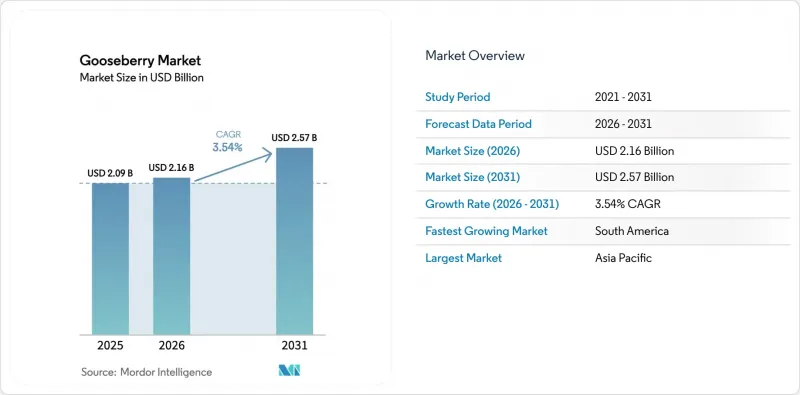
This report is Segmented by Geography (North America, South America, Asia-Pacific, Europe, and More). The Report Includes Production Analysis (Volume), Consumption Analysis (Value and Volume), Import Analysis (Value and Volume), Export Analysis (Value and Volume), Wholesale Price Trend Analysis, List of Key Players, and More. The Market Forecasts are Provided in Terms of Value (USD) and Volume (Metric Tons).
Global Gooseberry Market Trends and Insights
Surge in Ayurvedic and Nutraceutical Demand
Gooseberry has transitioned from a traditional remedy to a prominent supplement in global nutraceutical markets. Major brands now require extracts with specific tannin content, driving investments in advanced drying and extraction technologies. Regulatory requirements in key export markets mandate stringent identity testing and batch-level traceability, prompting smaller exporters to consolidate or adopt blockchain-based documentation systems. Buyers in the nutraceutical segment are generally less price-sensitive than those in fresh fruit markets, providing growers with financial stability during years of lower harvests. In some regions, cereal acreage is being converted into gooseberry orchards, supported by guaranteed minimum prices for processed amla powder. This shift is transforming agricultural landscapes and reinforcing gooseberries' role in health-oriented product portfolios.
Cosmetic-Grade Natural Vitamin-C Sourcing Boom
The clean-beauty movement is encouraging cosmetic companies in Europe and North America to replace synthetic vitamin C with natural botanical sources. Gooseberry has emerged as a preferred option due to its high ascorbic acid content and superior oxidative stability compared to other fruits. Leading cosmetic brands have increased their reliance on botanical vitamin C, with gooseberry becoming one of their top inputs by volume. Strict residue and microbial standards, along with adherence to international cosmetic regulations, favor plantations with certifications such as organic and GLOBALG.A.P. (Global Good Agricultural Practice). Premium processors in regions like South Asia and South America are securing higher prices for certified gooseberry materials. This trend is establishing gooseberry as a key ingredient in the natural skincare and cosmetics industry.
High Production and Processing Cost
Gooseberry cultivation and processing face significant cost challenges, limiting competitiveness against synthetic alternatives. Labor constitutes a substantial portion of orchard expenses, while energy-intensive freeze-drying further pressures margins. Rising industrial power rates have increased processing costs, reducing profitability for many operators. Additionally, cold-chain logistics add to distribution expenses, making gooseberry products more costly compared to synthetic inputs. These challenges are particularly pronounced in price-sensitive categories where affordability is a priority. Without efficiency improvements or premium positioning, producers may struggle to remain competitive in broader markets.
Other drivers and restraints analyzed in the detailed report include:
- Government Export Incentives for Horticulture
- Contract Farming Clusters Scaling Output
- Seasonal Production Constraints
For complete list of drivers and restraints, kindly check the Table Of Contents.
Complete Report Scope:
- By Geography
- North America
- United States
- Production Analysis (Area Harvested, Yield, and Production Volume)
- Consumption Analysis (Consumption Value and Volume)
- Import Market Analysis (Import Value, Volume, and Key Supplying Markets)
- Export Market Analysis (Export Value, Volume, and Key Destination Markets)
- Wholesale Price Trend Analysis and Forecast
- Regulatory Framework
- List of Key Players
- Logistics and Infrastructure
- Seasonality Analysis
- Canada
- Production Analysis (Area Harvested, Yield, and Production Volume)
- Consumption Analysis (Consumption Value and Volume)
- Import Market Analysis (Import Value, Volume, and Key Supplying Markets)
- Export Market Analysis (Export Value, Volume, and Key Destination Markets)
- Wholesale Price Trend Analysis and Forecast
- Regulatory Framework
- List of Key Players
- Logistics and Infrastructure
- Seasonality Analysis
- United States
- Europe
- Germany
- Production Analysis (Area Harvested, Yield, and Production Volume)
- Consumption Analysis (Consumption Value and Volume)
- Import Market Analysis (Import Value, Volume, and Key Supplying Markets)
- Export Market Analysis (Export Value, Volume, and Key Destination Markets)
- Wholesale Price Trend Analysis and Forecast
- Regulatory Framework
- List of Key Players
- Logistics and Infrastructure
- Seasonality Analysis
- Spain
- Production Analysis (Area Harvested, Yield, and Production Volume)
- Consumption Analysis (Consumption Value and Volume)
- Import Market Analysis (Import Value, Volume, and Key Supplying Markets)
- Export Market Analysis (Export Value, Volume, and Key Destination Markets)
- Wholesale Price Trend Analysis and Forecast
- Regulatory Framework
- List of Key Players
- Logistics and Infrastructure
- Seasonality Analysis
- United Kingdom
- Production Analysis (Area Harvested, Yield, and Production Volume)
- Consumption Analysis (Consumption Value and Volume)
- Import Market Analysis (Import Value, Volume, and Key Supplying Markets)
- Export Market Analysis (Export Value, Volume, and Key Destination Markets)
- Wholesale Price Trend Analysis and Forecast
- Regulatory Framework
- List of Key Players
- Logistics and Infrastructure
- Seasonality Analysis
- Germany
- Asia-Pacific
- China
- Production Analysis (Area Harvested, Yield, and Production Volume)
- Consumption Analysis (Consumption Value and Volume)
- Import Market Analysis (Import Value, Volume, and Key Supplying Markets)
- Export Market Analysis (Export Value, Volume, and Key Destination Markets)
- Wholesale Price Trend Analysis and Forecast
- Regulatory Framework
- List of Key Players
- Logistics and Infrastructure
- Seasonality Analysis
- India
- Production Analysis (Area Harvested, Yield, and Production Volume)
- Consumption Analysis (Consumption Value and Volume)
- Import Market Analysis (Import Value, Volume, and Key Supplying Markets)
- Export Market Analysis (Export Value, Volume, and Key Destination Markets)
- Wholesale Price Trend Analysis and Forecast
- Regulatory Framework
- List of Key Players
- Logistics and Infrastructure
- Seasonality Analysis
- Indonesia
- Production Analysis (Area Harvested, Yield, and Production Volume)
- Consumption Analysis (Consumption Value and Volume)
- Import Market Analysis (Import Value, Volume, and Key Supplying Markets)
- Export Market Analysis (Export Value, Volume, and Key Destination Markets)
- Wholesale Price Trend Analysis and Forecast
- Regulatory Framework
- List of Key Players
- Logistics and Infrastructure
- Seasonality Analysis
- China
- South America
- Brazil
- Production Analysis (Area Harvested, Yield, and Production Volume)
- Consumption Analysis (Consumption Value and Volume)
- Import Market Analysis (Import Value, Volume, and Key Supplying Markets)
- Export Market Analysis (Export Value, Volume, and Key Destination Markets)
- Wholesale Price Trend Analysis and Forecast
- Regulatory Framework
- List of Key Players
- Logistics and Infrastructure
- Seasonality Analysis
- Colombia
- Production Analysis (Area Harvested, Yield, and Production Volume)
- Consumption Analysis (Consumption Value and Volume)
- Import Market Analysis (Import Value, Volume, and Key Supplying Markets)
- Export Market Analysis (Export Value, Volume, and Key Destination Markets)
- Wholesale Price Trend Analysis and Forecast
- Regulatory Framework
- List of Key Players
- Logistics and Infrastructure
- Seasonality Analysis
- Brazil
- Middle East
- Turkey
- Production Analysis (Area Harvested, Yield, and Production Volume)
- Consumption Analysis (Consumption Value and Volume)
- Import Market Analysis (Import Value, Volume, and Key Supplying Markets)
- Export Market Analysis (Export Value, Volume, and Key Destination Markets)
- Wholesale Price Trend Analysis and Forecast
- Regulatory Framework
- List of Key Players
- Logistics and Infrastructure
- Seasonality Analysis
- Turkey
- Africa
- Kenya
- Production Analysis (Area Harvested, Yield, and Production Volume)
- Consumption Analysis (Consumption Value and Volume)
- Import Market Analysis (Import Value, Volume, and Key Supplying Markets)
- Export Market Analysis (Export Value, Volume, and Key Destination Markets)
- Wholesale Price Trend Analysis and Forecast
- Regulatory Framework
- List of Key Players
- Logistics and Infrastructure
- Seasonality Analysis
- South Africa
- Production Analysis (Area Harvested, Yield, and Production Volume)
- Consumption Analysis (Consumption Value and Volume)
- Import Market Analysis (Import Value, Volume, and Key Supplying Markets)
- Export Market Analysis (Export Value, Volume, and Key Destination Markets)
- Wholesale Price Trend Analysis and Forecast
- Regulatory Framework
- List of Key Players
- Logistics and Infrastructure
- Seasonality Analysis
- Kenya
- North America
Geography Analysis
The Asia-Pacific holds the largest share, 48.2% in the gooseberry market in 2025, driven by extensive cultivation in India, China, and Southeast Asia. In India, northern and central states are key contributors, with orchards increasingly replacing traditional cereal crops. Regulatory harmonization has enhanced export opportunities, particularly to European markets, spurring investments in processing facilities and cold-chain infrastructure. In China, provinces are reallocating vegetable acreage to gooseberry orchards to meet growing demand for nutraceutical and cosmetic applications. Indonesia, on the other hand, focuses on supplying local fresh-fruit markets, with gooseberries primarily consumed domestically rather than exported. The region benefits from robust agricultural capacity, supportive government initiatives, and increasing consumer awareness, solidifying Asia Pacific's position as the global leader in gooseberry production and trade.
South America is the fastest-growing region in the gooseberry market, with a 4.1% CAGR through 2031, led by Colombia and Brazil. Colombia's high-altitude regions produce gooseberries with high vitamin C content, which fetch premium prices in international markets. A significant share of production is exported, either fresh or processed, with quick-freezing technologies preserving nutritional value and extending shelf life. In Brazil, southern and southeastern states are expanding cultivation to meet rising domestic demand for functional foods and cosmetic ingredients. The region also benefits from counter-seasonal production, enabling fresh shipments to Europe and North America during their off-season. This seasonal advantage strengthens South America's position as a reliable supplier, while investments in cooperatives and processing facilities enhance competitiveness and support long-term market growth.
North America and Europe remain net importers of gooseberries, with demand concentrated in supplements, functional beverages, artisanal foods, and cosmetics. Regulatory challenges, such as novel-food authorizations, slow mainstream adoption, but niche markets continue to grow steadily. In the Middle East and Africa, production is smaller but expanding, with Turkey promoting acreage growth through export incentives. Pilot projects in Kenya and trials in South Africa focus on supplying domestic fresh markets, reflecting the early stages of development. Despite these constraints, the regions are gradually building production capacity, supported by consumer interest in natural vitamin C sources and functional nutrition. Collectively, these markets contribute incremental growth, complementing Asia Pacific's dominance and South America's rapid expansion in the global gooseberry industry.
- The market estimate (ME) sheet in Excel format
- 3 months of analyst support
TABLE OF CONTENTS
1 Introduction
- 1.1 Study Assumptions and Market Definition
- 1.2 Scope of the Study
2 Research Methodology
3 Executive Summary
4 Market Landscape
- 4.1 Market Overview
- 4.2 Market Drivers
- 4.2.1 Surge in ayurvedic and nutraceutical demand
- 4.2.2 Cosmetic-grade natural vitamin-C sourcing boom
- 4.2.3 Government export incentives for horticulture
- 4.2.4 Contract farming clusters scaling output
- 4.2.5 E-commerce B2B ingredient marketplaces
- 4.2.6 Mechanical harvesting and optical grading
- 4.3 Market Restraints
- 4.3.1 High production and processing cost
- 4.3.2 Seasonal production constraints
- 4.3.3 High post-harvest perishability
- 4.3.4 Climate-induced fruit drop volatility
- 4.4 Opportunities
- 4.5 Challenges
- 4.6 Value Chain Analysis
- 4.7 Technologies and usage of AI in the Industry
- 4.8 Input Market Analysis
- 4.8.1 Seeds
- 4.8.2 Fertilizers
- 4.8.3 Crop Protection Chemicals
- 4.9 Distribution Channel Analysis
- 4.10 Market Sentiment Analysis
- 4.11 PESTLE Analysis
5 Market Size and Growth Forecasts (Value and Volume)
- 5.1 By Geography
- 5.1.1 North America
- 5.1.1.1 United States
- 5.1.1.1.1 Production Analysis (Area Harvested, Yield, and Production Volume)
- 5.1.1.1.2 Consumption Analysis (Consumption Value and Volume)
- 5.1.1.1.3 Import Market Analysis (Import Value, Volume, and Key Supplying Markets)
- 5.1.1.1.4 Export Market Analysis (Export Value, Volume, and Key Destination Markets)
- 5.1.1.1.5 Wholesale Price Trend Analysis and Forecast
- 5.1.1.1.6 Regulatory Framework
- 5.1.1.1.7 List of Key Players
- 5.1.1.1.8 Logistics and Infrastructure
- 5.1.1.1.9 Seasonality Analysis
- 5.1.1.2 Canada
- 5.1.1.2.1 Production Analysis (Area Harvested, Yield, and Production Volume)
- 5.1.1.2.2 Consumption Analysis (Consumption Value and Volume)
- 5.1.1.2.3 Import Market Analysis (Import Value, Volume, and Key Supplying Markets)
- 5.1.1.2.4 Export Market Analysis (Export Value, Volume, and Key Destination Markets)
- 5.1.1.2.5 Wholesale Price Trend Analysis and Forecast
- 5.1.1.2.6 Regulatory Framework
- 5.1.1.2.7 List of Key Players
- 5.1.1.2.8 Logistics and Infrastructure
- 5.1.1.2.9 Seasonality Analysis
- 5.1.1.1 United States
- 5.1.2 Europe
- 5.1.2.1 Germany
- 5.1.2.1.1 Production Analysis (Area Harvested, Yield, and Production Volume)
- 5.1.2.1.2 Consumption Analysis (Consumption Value and Volume)
- 5.1.2.1.3 Import Market Analysis (Import Value, Volume, and Key Supplying Markets)
- 5.1.2.1.4 Export Market Analysis (Export Value, Volume, and Key Destination Markets)
- 5.1.2.1.5 Wholesale Price Trend Analysis and Forecast
- 5.1.2.1.6 Regulatory Framework
- 5.1.2.1.7 List of Key Players
- 5.1.2.1.8 Logistics and Infrastructure
- 5.1.2.1.9 Seasonality Analysis
- 5.1.2.2 Spain
- 5.1.2.2.1 Production Analysis (Area Harvested, Yield, and Production Volume)
- 5.1.2.2.2 Consumption Analysis (Consumption Value and Volume)
- 5.1.2.2.3 Import Market Analysis (Import Value, Volume, and Key Supplying Markets)
- 5.1.2.2.4 Export Market Analysis (Export Value, Volume, and Key Destination Markets)
- 5.1.2.2.5 Wholesale Price Trend Analysis and Forecast
- 5.1.2.2.6 Regulatory Framework
- 5.1.2.2.7 List of Key Players
- 5.1.2.2.8 Logistics and Infrastructure
- 5.1.2.2.9 Seasonality Analysis
- 5.1.2.3 United Kingdom
- 5.1.2.3.1 Production Analysis (Area Harvested, Yield, and Production Volume)
- 5.1.2.3.2 Consumption Analysis (Consumption Value and Volume)
- 5.1.2.3.3 Import Market Analysis (Import Value, Volume, and Key Supplying Markets)
- 5.1.2.3.4 Export Market Analysis (Export Value, Volume, and Key Destination Markets)
- 5.1.2.3.5 Wholesale Price Trend Analysis and Forecast
- 5.1.2.3.6 Regulatory Framework
- 5.1.2.3.7 List of Key Players
- 5.1.2.3.8 Logistics and Infrastructure
- 5.1.2.3.9 Seasonality Analysis
- 5.1.2.1 Germany
- 5.1.3 Asia-Pacific
- 5.1.3.1 China
- 5.1.3.1.1 Production Analysis (Area Harvested, Yield, and Production Volume)
- 5.1.3.1.2 Consumption Analysis (Consumption Value and Volume)
- 5.1.3.1.3 Import Market Analysis (Import Value, Volume, and Key Supplying Markets)
- 5.1.3.1.4 Export Market Analysis (Export Value, Volume, and Key Destination Markets)
- 5.1.3.1.5 Wholesale Price Trend Analysis and Forecast
- 5.1.3.1.6 Regulatory Framework
- 5.1.3.1.7 List of Key Players
- 5.1.3.1.8 Logistics and Infrastructure
- 5.1.3.1.9 Seasonality Analysis
- 5.1.3.2 India
- 5.1.3.2.1 Production Analysis (Area Harvested, Yield, and Production Volume)
- 5.1.3.2.2 Consumption Analysis (Consumption Value and Volume)
- 5.1.3.2.3 Import Market Analysis (Import Value, Volume, and Key Supplying Markets)
- 5.1.3.2.4 Export Market Analysis (Export Value, Volume, and Key Destination Markets)
- 5.1.3.2.5 Wholesale Price Trend Analysis and Forecast
- 5.1.3.2.6 Regulatory Framework
- 5.1.3.2.7 List of Key Players
- 5.1.3.2.8 Logistics and Infrastructure
- 5.1.3.2.9 Seasonality Analysis
- 5.1.3.3 Indonesia
- 5.1.3.3.1 Production Analysis (Area Harvested, Yield, and Production Volume)
- 5.1.3.3.2 Consumption Analysis (Consumption Value and Volume)
- 5.1.3.3.3 Import Market Analysis (Import Value, Volume, and Key Supplying Markets)
- 5.1.3.3.4 Export Market Analysis (Export Value, Volume, and Key Destination Markets)
- 5.1.3.3.5 Wholesale Price Trend Analysis and Forecast
- 5.1.3.3.6 Regulatory Framework
- 5.1.3.3.7 List of Key Players
- 5.1.3.3.8 Logistics and Infrastructure
- 5.1.3.3.9 Seasonality Analysis
- 5.1.3.1 China
- 5.1.4 South America
- 5.1.4.1 Brazil
- 5.1.4.1.1 Production Analysis (Area Harvested, Yield, and Production Volume)
- 5.1.4.1.2 Consumption Analysis (Consumption Value and Volume)
- 5.1.4.1.3 Import Market Analysis (Import Value, Volume, and Key Supplying Markets)
- 5.1.4.1.4 Export Market Analysis (Export Value, Volume, and Key Destination Markets)
- 5.1.4.1.5 Wholesale Price Trend Analysis and Forecast
- 5.1.4.1.6 Regulatory Framework
- 5.1.4.1.7 List of Key Players
- 5.1.4.1.8 Logistics and Infrastructure
- 5.1.4.1.9 Seasonality Analysis
- 5.1.4.2 Colombia
- 5.1.4.2.1 Production Analysis (Area Harvested, Yield, and Production Volume)
- 5.1.4.2.2 Consumption Analysis (Consumption Value and Volume)
- 5.1.4.2.3 Import Market Analysis (Import Value, Volume, and Key Supplying Markets)
- 5.1.4.2.4 Export Market Analysis (Export Value, Volume, and Key Destination Markets)
- 5.1.4.2.5 Wholesale Price Trend Analysis and Forecast
- 5.1.4.2.6 Regulatory Framework
- 5.1.4.2.7 List of Key Players
- 5.1.4.2.8 Logistics and Infrastructure
- 5.1.4.2.9 Seasonality Analysis
- 5.1.4.1 Brazil
- 5.1.5 Middle East
- 5.1.5.1 Turkey
- 5.1.5.1.1 Production Analysis (Area Harvested, Yield, and Production Volume)
- 5.1.5.1.2 Consumption Analysis (Consumption Value and Volume)
- 5.1.5.1.3 Import Market Analysis (Import Value, Volume, and Key Supplying Markets)
- 5.1.5.1.4 Export Market Analysis (Export Value, Volume, and Key Destination Markets)
- 5.1.5.1.5 Wholesale Price Trend Analysis and Forecast
- 5.1.5.1.6 Regulatory Framework
- 5.1.5.1.7 List of Key Players
- 5.1.5.1.8 Logistics and Infrastructure
- 5.1.5.1.9 Seasonality Analysis
- 5.1.5.1 Turkey
- 5.1.6 Africa
- 5.1.6.1 Kenya
- 5.1.6.1.1 Production Analysis (Area Harvested, Yield, and Production Volume)
- 5.1.6.1.2 Consumption Analysis (Consumption Value and Volume)
- 5.1.6.1.3 Import Market Analysis (Import Value, Volume, and Key Supplying Markets)
- 5.1.6.1.4 Export Market Analysis (Export Value, Volume, and Key Destination Markets)
- 5.1.6.1.5 Wholesale Price Trend Analysis and Forecast
- 5.1.6.1.6 Regulatory Framework
- 5.1.6.1.7 List of Key Players
- 5.1.6.1.8 Logistics and Infrastructure
- 5.1.6.1.9 Seasonality Analysis
- 5.1.6.2 South Africa
- 5.1.6.2.1 Production Analysis (Area Harvested, Yield, and Production Volume)
- 5.1.6.2.2 Consumption Analysis (Consumption Value and Volume)
- 5.1.6.2.3 Import Market Analysis (Import Value, Volume, and Key Supplying Markets)
- 5.1.6.2.4 Export Market Analysis (Export Value, Volume, and Key Destination Markets)
- 5.1.6.2.5 Wholesale Price Trend Analysis and Forecast
- 5.1.6.2.6 Regulatory Framework
- 5.1.6.2.7 List of Key Players
- 5.1.6.2.8 Logistics and Infrastructure
- 5.1.6.2.9 Seasonality Analysis
- 5.1.6.1 Kenya
- 5.1.1 North America
6 End Use Applications and Industries
- 6.1 Primary Applications and Emerging Applications
- 6.2 Consumption Breakdown by Industries
7 Competitive Landscape
- 7.1 Overview of the Competition
- 7.2 Recent Developments
- 7.3 Market Concentration Analysis
8 Market Opportunities and Future Outlook

