PUBLISHER: Mordor Intelligence | PRODUCT CODE: 2114603

PUBLISHER: Mordor Intelligence | PRODUCT CODE: 2114603
Self-Cleaning Glass - Market Share Analysis, Industry Trends & Statistics, Growth Forecasts (2026 - 2031)
According to Mordor Intelligence, self-Cleaning glass market size in 2026 is estimated at USD 128.91 million, growing from 2025 value of USD 123.45 million with 2031 projections showing USD 160.06 million, growing at 4.42% CAGR over 2026-2031.
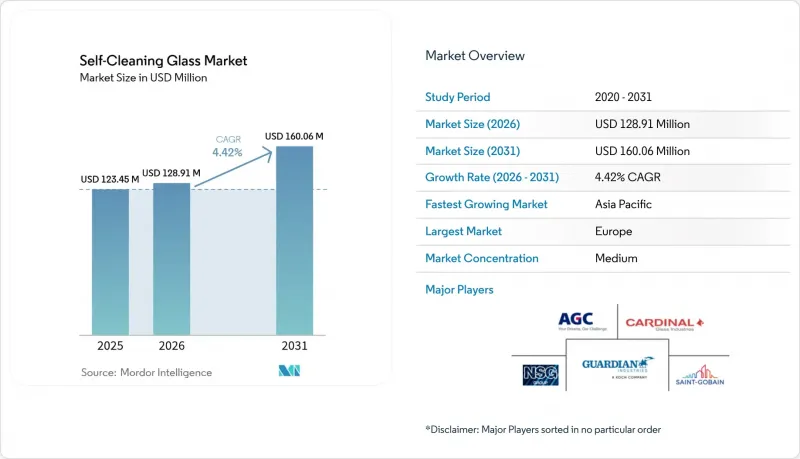
This report is Segmented by Coating Type (Hydrophilic Coating, Hydrophobic Coating), Application (Facades and Windows, Roofs and Skylights, and More), End-User Industry (Buildings and Construction, Automotive and Transportation, Solar Energy, and More), and Geography (North America, Europe, Asia-Pacific, South America, and Middle-East and Africa). The Market Forecasts are Provided in Terms of Value (USD).
Global Self-Cleaning Glass Market Trends and Insights
Growing Green-Building Mandates
Regulations are resetting glazing specifications as authorities tighten energy codes to reach carbon targets. The European Union's Energy Performance of Buildings Directive 2024/1275 requires that all member states deliver zero-emission building stock by 2050, which directly boosts demand for advanced glazing that lowers operational loads. Similar rules now appear in the United States and major Asia Pacific economies. Certification programs such as LEED and BREEAM award points for self-cleaning systems because lower maintenance cuts resource use. This incentive framework helps the self-cleaning glass market gain traction among developers chasing premium building ratings. Government data showing buildings account for 40% of carbon emissions strengthens the policy drive toward high-performance facades.
Rapid Facade Replacement in High-Rise Retrofits
A large cohort of towers built during the 1980s and 1990s is entering the replacement window for curtain-wall systems. For buildings above 20 stories, the economics favor self-cleaning glass because rope-access washing is expensive and risky. AGC has upgraded continuous coaters to serve the retrofit boom and reports rising orders linked to urban renewal projects. Insurers in Europe and North America offer premium discounts for properties that reduce facade maintenance accidents, increasing owner interest. The combined safety and operating-cost rationale is accelerating the penetration of the self-cleaning glass market in central business districts.
Slow Adoption in Cost-Sensitive Sectors
Self-cleaning panes carry a 20-40% premium over standard float glass, which deters residential and public procurement projects where upfront budgets dominate decision-making. In emerging economies, labor rates for window washing remain low, blunting lifecycle savings arguments. These constraints slow the penetration of the self-cleaning glass market in low-rise housing, student dormitories, and public facilities. Wider adoption hinges on scaled production that trims coating costs and on financing structures that let owners monetize operating savings.
Other drivers and restraints analyzed in the detailed report include:
- Increasing Demand from the Energy Sector
- Widespread Adoption in Institutional and Healthcare Buildings for Hygiene Control
- Complex Manufacturing Process Increases Production Time and Cost
For complete list of drivers and restraints, kindly check the Table Of Contents.
Segment Analysis
Hydrophilic technology held 55.02% of the self-cleaning glass market in 2025. NSG Group's Pilkington Activ and similar products use titanium dioxide to break down organic matter and promote water sheeting that rinses facades during rain events. Despite that dominance, hydrophobic coatings are the fastest-growing option with a 5.32% CAGR through 2031. Ultrasonic surface modification from Curtin University forms a covalent organic layer that permanently repels water and removes the need for chemical coatings. Superhydrophobic nanocomposite films now exceed 160° water contact angles and survive long UV exposure, widening the scope in automotive windscreens and outdoor displays. As these breakthroughs prove durable at scale, hydrophobic solutions may chip away at the self-cleaning glass market share of hydrophilic incumbents.
Complete Report Scope:
- By Coating Type
- Hydrophilic Coating
- Hydrophobic Coating
- By Application
- Facades and Windows
- Roofs and Skylights
- Solar Panels and BIPV
- Mirrors and Glass Partitions
- Vehicle Windscreens and Sunroofs
- By End-user Industry
- Buildings and Construction
- Automotive and Transportation
- Solar Energy (PV and CSP)
- Consumer Electronics and Appliances
- Others (Marine, Aerospace)
- By Geography
- Asia-Pacific
- China
- India
- Japan
- South Korea
- Rest of Asia-Pacific
- North America
- United States
- Canada
- Mexico
- Europe
- Germany
- United Kingdom
- France
- Italy
- Rest of Europe
- South America
- Brazil
- Argentina
- Rest of South America
- Middle-East and Africa
- Saudi Arabia
- South Africa
- Rest of Middle-East and Africa
- Asia-Pacific
Geography Analysis
Europe remained the largest regional contributor with 36.10% of the self-cleaning glass market in 2025. Regulations such as the Energy Performance of Buildings Directive set binding efficiency targets that favor advanced glazing. AGC Glass Europe's plan to recycle photovoltaic cover glass into flat production aligns with circular-economy policies and adds supply stability.
Asia Pacific delivered the fastest 6.05% CAGR and will likely narrow the volume gap by 2030. China dominates solar panel output and integrates self-cleaning covers to preserve export competitiveness and domestic generation. Smart-city roll-outs and the 14th Five-Year Plan's green targets spur adoption in both public and private real-estate projects.
North America, South America, and Middle-East, and Africa together hold a smaller but expanding slice of the self-cleaning glass market. United States federal incentives and LEED certification credits lift commercial installations, especially in coastal regions where salt spray accelerates pane fouling.
- AGC Inc.
- CARDINAL GLASS INDUSTRIES, INC
- Fuyao Group
- Glas Trosch
- Guardian Industries
- Morley Glass & Glazing Ltd
- Nanovations Pty Ltd
- Nippon Sheet Glass Co., Ltd
- PPG Industries Inc
- Qingdao Morn Building Materials Co.,Ltd
- Saint-Gobain
- Schott AG
- Tuffx Glass
- Xinyi Glass Holdings Limited
Additional Benefits:
- The market estimate (ME) sheet in Excel format
- 3 months of analyst support
TABLE OF CONTENTS
1 Introduction
- 1.1 Study Assumptions and Market Definition
- 1.2 Scope of the Study
2 Research Methodology
3 Executive Summary
4 Market Landscape
- 4.1 Market Overview
- 4.2 Market Drivers
- 4.2.1 Growing Green-Building Mandates
- 4.2.2 Rapid Facade Replacement in High-Rise Retrofits
- 4.2.3 Increasing Demand from the Energy Sector
- 4.2.4 Widespread Adoption in Institutional and Healthcare Buildings for Hygiene Control
- 4.2.5 Growth of Solar Panel Installations
- 4.3 Market Restraints
- 4.3.1 Slow Adoption in Cost-Sensitive Sectors
- 4.3.2 Complex Manufacturing Process Increases Production Time and Cost
- 4.3.3 Regulatory Inconsistencies Across Countries Affecting Adoption
- 4.4 Value Chain Analysis
- 4.5 Porter's Five Forces
- 4.5.1 Threat of New Entrants
- 4.5.2 Bargaining Power of Buyers
- 4.5.3 Bargaining Power of Suppliers
- 4.5.4 Threat of Substitute Products
- 4.5.5 Degree of Competition
5 Market Size and Growth Forecasts (Value)
- 5.1 By Coating Type
- 5.1.1 Hydrophilic Coating
- 5.1.2 Hydrophobic Coating
- 5.2 By Application
- 5.2.1 Facades and Windows
- 5.2.2 Roofs and Skylights
- 5.2.3 Solar Panels and BIPV
- 5.2.4 Mirrors and Glass Partitions
- 5.2.5 Vehicle Windscreens and Sunroofs
- 5.3 By End-user Industry
- 5.3.1 Buildings and Construction
- 5.3.2 Automotive and Transportation
- 5.3.3 Solar Energy (PV and CSP)
- 5.3.4 Consumer Electronics and Appliances
- 5.3.5 Others (Marine, Aerospace)
- 5.4 By Geography
- 5.4.1 Asia-Pacific
- 5.4.1.1 China
- 5.4.1.2 India
- 5.4.1.3 Japan
- 5.4.1.4 South Korea
- 5.4.1.5 Rest of Asia-Pacific
- 5.4.2 North America
- 5.4.2.1 United States
- 5.4.2.2 Canada
- 5.4.2.3 Mexico
- 5.4.3 Europe
- 5.4.3.1 Germany
- 5.4.3.2 United Kingdom
- 5.4.3.3 France
- 5.4.3.4 Italy
- 5.4.3.5 Rest of Europe
- 5.4.4 South America
- 5.4.4.1 Brazil
- 5.4.4.2 Argentina
- 5.4.4.3 Rest of South America
- 5.4.5 Middle-East and Africa
- 5.4.5.1 Saudi Arabia
- 5.4.5.2 South Africa
- 5.4.5.3 Rest of Middle-East and Africa
- 5.4.1 Asia-Pacific
6 Competitive Landscape
- 6.1 Market Concentration
- 6.2 Strategic Moves
- 6.3 Market Share Analysis
- 6.4 Company Profiles (includes Global level Overview, Market level overview, Core Segments, Financials as available, Strategic Information, Market Rank/Share for key companies, Products and Services, and Recent Developments)
- 6.4.1 AGC Inc.
- 6.4.2 CARDINAL GLASS INDUSTRIES, INC
- 6.4.3 Fuyao Group
- 6.4.4 Glas Trosch
- 6.4.5 Guardian Industries
- 6.4.6 Morley Glass & Glazing Ltd
- 6.4.7 Nanovations Pty Ltd
- 6.4.8 Nippon Sheet Glass Co., Ltd
- 6.4.9 PPG Industries Inc
- 6.4.10 Qingdao Morn Building Materials Co.,Ltd
- 6.4.11 Saint-Gobain
- 6.4.12 Schott AG
- 6.4.13 Tuffx Glass
- 6.4.14 Xinyi Glass Holdings Limited
7 Market Opportunities and Future Outlook
- 7.1 White-space and Unmet-Need Assessment

