PUBLISHER: Mordor Intelligence | PRODUCT CODE: 2114604

PUBLISHER: Mordor Intelligence | PRODUCT CODE: 2114604
Professional Headset - Market Share Analysis, Industry Trends & Statistics, Growth Forecasts (2026 - 2031)
According to Mordor Intelligence, the professional headset market size is expected to grow from USD 1.93 billion in 2025 to USD 2.04 billion in 2026 and is forecast to reach USD 2.69 billion by 2031 at 5.73% CAGR over 2026-2031.
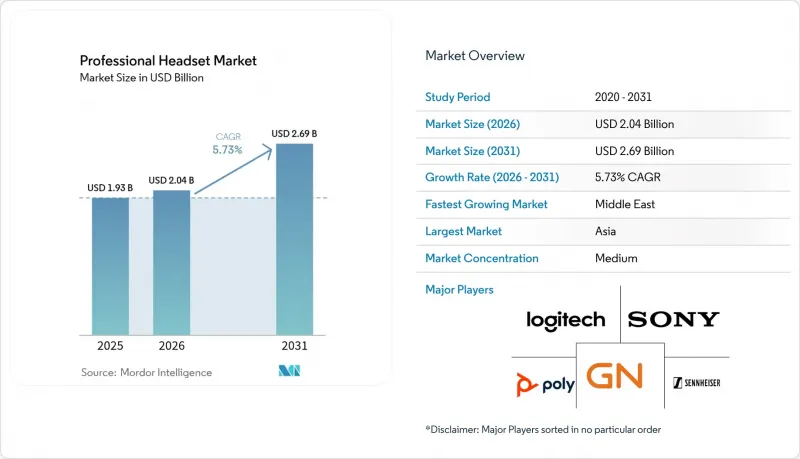
This report is Segmented by Type (Wired, and Wireless), Technology Type (USB, Bluetooth, DECT, and More), Wearing Style (On-Ear (Supra-Aural), and More), Noise Cancellation (Passive Noise Isolation, and Active Noise Cancellation), End-User (Corporate and Call Centers, and More), Distribution Channel (Online B2B Portals, and More), and Geography. The Market Forecasts are Provided in Terms of Value (USD).
Global Professional Headset Market Trends and Insights
Rapid Expansion of Hybrid Work Models in North America and Europe
Employee confidence gaps around collaboration tools are motivating IT teams to prioritize high-fidelity audio, shifting procurement from basic USB headsets toward AI-enabled devices that optimize acoustics dynamically. Seamless Bluetooth without dongles is gaining favor as enterprises cut desk clutter and simplify device management. Continued office-space reconfiguration reinforces demand for reliable, cross-environment performance, making the professional headset market a core enabler of hybrid productivity.
Pro-AV Upgrade Cycle Across Global Broadcast Studios
IBC 2024 highlighted large-scale moves to cloud-native audio workflows, pushing studios to refresh monitoring gear compatible with software-defined infrastructures. Sennheiser's Spectera wireless ecosystem and similar launches underscore the quest for robust encryption, multichannel capacity, and cable-free mobility. As 4K and 8K video pipelines harden, demand for headsets that maintain low latency and pristine fidelity rises, supporting stable growth in the professional headset market.
Supply-Chain Chip Constraints Limiting Bluetooth Audio SoC Availability
Lead times topping 54 weeks and component cost inflation of 10-20% squeeze production schedules, delaying wireless-product launches and nudging some buyers back toward wired SKUs. Freight-rate spikes aggravate pricing pressure, slowing adoption of premium Bluetooth models within the professional headset market.
Other drivers and restraints analyzed in the detailed report include:
- Surging ANC Adoption in Asia-Pacific Call Centers
- Government-Funded Digital-Learning Programs Boosting Education Demand
- Growing BYOD Trend Diluting Employer Budgets
For complete list of drivers and restraints, kindly check the Table Of Contents.
Segment Analysis
Wired solutions secured 63.02% professional headset market share in 2025 on the strength of predictable performance and security. Procurement teams value freedom from batteries and radio-interference risk, anchoring demand among finance, government, and regulated verticals. Yet wireless shipments climbed at 7.7% CAGR, aided by USB-C ubiquity and direct-to-PC Bluetooth that removes dongle overhead.
Advances such as Bluetooth LE Audio and WMAS multichannel schemes shorten latency and enhance encryption, narrowing the historic reliability gap. Mobility-driven workflows in broadcast control rooms and hybrid offices tilt sentiment toward cable-free designs, suggesting wireless volumes could approach parity with wired by decade-end as the professional headset market evolves.
USB connections held 48.05% of total revenue in 2025, providing plug-and-play clarity that resonates with help-desk teams. Enterprises appreciate deterministic audio paths and lower support tickets, keeping USB headsets central to bulk deployments within the professional headset market size for core communication roles.
Bluetooth, however, is pacing 6.21% CAGR as operating systems embed LE Audio and as multi-device roaming proves vital for desk-sharing. DECT maintains security-critical niches, while dual-mode designs that combine USB reliability with Bluetooth mobility become common, allowing users to toggle contexts without swapping hardware.
Complete Report Scope:
- By Connectivity
- Wired
- Wireless
- By Technology Type
- USB
- Bluetooth
- DECT
- Unified Communication (UC)
- By Wearing Style
- Over-ear (Circumaural)
- On-ear (Supra-aural)
- In-ear (Canal)
- By Noise Cancellation
- Passive Noise Isolation
- Active Noise Cancellation (ANC)
- By End-User
- Corporate and Call Centers
- Education and Digital Learning
- Broadcast and Media Production
- Gaming and Esports Arenas
- Music Recording and Live Sound
- Others
- By Distribution Channel
- Online B2B Portals
- Direct Sales
- Retail (Specialty and Mass)
- By Geography
- North America
- United States
- Canada
- Mexico
- Europe
- Germany
- United Kingdom
- France
- Nordics
- Rest of Europe
- South America
- Brazil
- Rest of South America
- Asia-Pacific
- China
- Japan
- India
- South-East Asia
- Rest of Asia-Pacific
- Middle East and Africa
- Middle East
- Gulf Cooperation Council Countries
- Turkey
- Rest of Middle East
- Africa
- South Africa
- Rest of Africa
- Middle East
- North America
Geography Analysis
Asia generated 31.08% of global revenue in 2025, propelled by enormous contact-center headcount and aggressive ANC uptake in China, India, and Japan. India's electronics-production surge and favorable PLI incentives further nurture local build-to-serve strategies, lowering landed costs and fostering regional OEM ecosystems. Government digital-education schemes add incremental volumes over the medium term.
North America and Europe together represent a mature but lucrative base where headset ASPs are highest. Nearly universal hybrid meeting formats, strict hearing-protection rules, and strong Microsoft Teams and Zoom adoption keep refresh intervals tight, sustaining the professional headset market. Enterprises in these regions favor AI-driven noise management and device-fleet analytics to optimize user experience and compliance.
The Middle East logs the fastest 6.01% CAGR as Riyadh and Dubai fund esports complexes and media hubs. Vision 2030 initiatives position technology and entertainment at the center of economic diversification, creating demand for premium audio. South America and Africa remain early-stage, with uptake paced by macro-economic stability and broadband penetration, but represent long-run whitespace once affordability improves.
- Logitech International S.A.
- HP Inc. (Poly/Plantronics)
- GN Store Nord A/S (Jabra)
- Sennheiser Electronic GmbH and Co. KG
- Sony Corporation
- Shure Inc.
- beyerdynamic GmbH
- Audio-Technica Corp.
- AKG Acoustics (Harman)
- Bose Corporation
- Razer Inc.
- SteelSeries ApS
- Turtle Beach Corporation
- Kingston Technology (HyperX)
- V-Moda LLC
- Bang and Olufsen A/S
- Creative Technology Ltd.
- Koss Corporation
- Klipsch Group Inc.
- Skullcandy Inc.
Additional Benefits:
- The market estimate (ME) sheet in Excel format
- 3 months of analyst support
TABLE OF CONTENTS
1 INTRODUCTION
- 1.1 Study Assumptions and Market Definition
- 1.2 Scope of the Study
2 RESEARCH METHODOLOGY
3 EXECUTIVE SUMMARY
4 MARKET LANDSCAPE
- 4.1 Market Overview
- 4.2 Market Drivers
- 4.2.1 Rapid Expansion of Hybrid Work Models in North America and Europe
- 4.2.2 Pro-AV Upgrade Cycle Across Global Broadcast Studios
- 4.2.3 Surging Adoption of ANC-Enabled Headsets in Asia-Pacific Call-Centers
- 4.2.4 Government-funded Digital?Learning Programs Boosting Education Headset Demand (India, ASEAN)
- 4.2.5 Esports Arena Construction Spurring Premium Gaming Headset Uptake (MENA and Nordics)
- 4.2.6 USB-C Port Standardization in Enterprise Laptops Accelerating Refresh Purchases
- 4.3 Market Restraints
- 4.3.1 Supply-Chain Chip Constraints Limiting Bluetooth Audio SoC Availability
- 4.3.2 Growing BYOD Trend Diluting Employer-Funded Procurement Budgets
- 4.3.3 Price-sensitive SMEs Switching to Low-cost Asian ODM Brands
- 4.3.4 Health and Safety Regulations on Continuous SPL Exposure Restricting Music Studio Volumes
- 4.4 Industry Ecosystem Analysis
- 4.5 Regulatory and Technological Outlook
- 4.6 Porter's Five Forces Analysis
- 4.6.1 Threat of New Entrants
- 4.6.2 Bargaining Power of Buyers
- 4.6.3 Bargaining Power of Suppliers
- 4.6.4 Threat of Substitutes
- 4.6.5 Intensity of Competitive Rivalry
5 Market Size and Growth Forecasts - (Value)
- 5.1 By Connectivity
- 5.1.1 Wired
- 5.1.2 Wireless
- 5.2 By Technology Type
- 5.2.1 USB
- 5.2.2 Bluetooth
- 5.2.3 DECT
- 5.2.4 Unified Communication (UC)
- 5.3 By Wearing Style
- 5.3.1 Over-ear (Circumaural)
- 5.3.2 On-ear (Supra-aural)
- 5.3.3 In-ear (Canal)
- 5.4 By Noise Cancellation
- 5.4.1 Passive Noise Isolation
- 5.4.2 Active Noise Cancellation (ANC)
- 5.5 By End-User
- 5.5.1 Corporate and Call Centers
- 5.5.2 Education and Digital Learning
- 5.5.3 Broadcast and Media Production
- 5.5.4 Gaming and Esports Arenas
- 5.5.5 Music Recording and Live Sound
- 5.5.6 Others
- 5.6 By Distribution Channel
- 5.6.1 Online B2B Portals
- 5.6.2 Direct Sales
- 5.6.3 Retail (Specialty and Mass)
- 5.7 By Geography
- 5.7.1 North America
- 5.7.1.1 United States
- 5.7.1.2 Canada
- 5.7.1.3 Mexico
- 5.7.2 Europe
- 5.7.2.1 Germany
- 5.7.2.2 United Kingdom
- 5.7.2.3 France
- 5.7.2.4 Nordics
- 5.7.2.5 Rest of Europe
- 5.7.3 South America
- 5.7.3.1 Brazil
- 5.7.3.2 Rest of South America
- 5.7.4 Asia-Pacific
- 5.7.4.1 China
- 5.7.4.2 Japan
- 5.7.4.3 India
- 5.7.4.4 South-East Asia
- 5.7.4.5 Rest of Asia-Pacific
- 5.7.5 Middle East and Africa
- 5.7.5.1 Middle East
- 5.7.5.1.1 Gulf Cooperation Council Countries
- 5.7.5.1.2 Turkey
- 5.7.5.1.3 Rest of Middle East
- 5.7.5.2 Africa
- 5.7.5.2.1 South Africa
- 5.7.5.2.2 Rest of Africa
- 5.7.5.1 Middle East
- 5.7.1 North America
6 COMPETITIVE LANDSCAPE
- 6.1 Market Concentration
- 6.2 Strategic Moves
- 6.3 Market Share Analysis
- 6.4 Company Profiles {(includes Global level Overview, Market level overview, Core Segments, Financials as available, Strategic Information, Market Rank/Share for key companies, Products and Services, and Recent Developments)}
- 6.4.1 Logitech International S.A.
- 6.4.2 HP Inc. (Poly/Plantronics)
- 6.4.3 GN Store Nord A/S (Jabra)
- 6.4.4 Sennheiser Electronic GmbH and Co. KG
- 6.4.5 Sony Corporation
- 6.4.6 Shure Inc.
- 6.4.7 beyerdynamic GmbH
- 6.4.8 Audio-Technica Corp.
- 6.4.9 AKG Acoustics (Harman)
- 6.4.10 Bose Corporation
- 6.4.11 Razer Inc.
- 6.4.12 SteelSeries ApS
- 6.4.13 Turtle Beach Corporation
- 6.4.14 Kingston Technology (HyperX)
- 6.4.15 V-Moda LLC
- 6.4.16 Bang and Olufsen A/S
- 6.4.17 Creative Technology Ltd.
- 6.4.18 Koss Corporation
- 6.4.19 Klipsch Group Inc.
- 6.4.20 Skullcandy Inc.
7 MARKET OPPORTUNITIES AND FUTURE OUTLOOK
- 7.1 White-space and Unmet-Need Assessment

