PUBLISHER: Mordor Intelligence | PRODUCT CODE: 2114606

PUBLISHER: Mordor Intelligence | PRODUCT CODE: 2114606
Thermoform Packaging - Market Share Analysis, Industry Trends & Statistics, Growth Forecasts (2026 - 2031)
According to Mordor Intelligence, thermoform packaging market size in 2026 is estimated at USD 49.55 billion, growing from 2025 value of USD 47.41 billion with 2031 projections showing USD 61.77 billion, growing at 4.51% CAGR over 2026-2031.
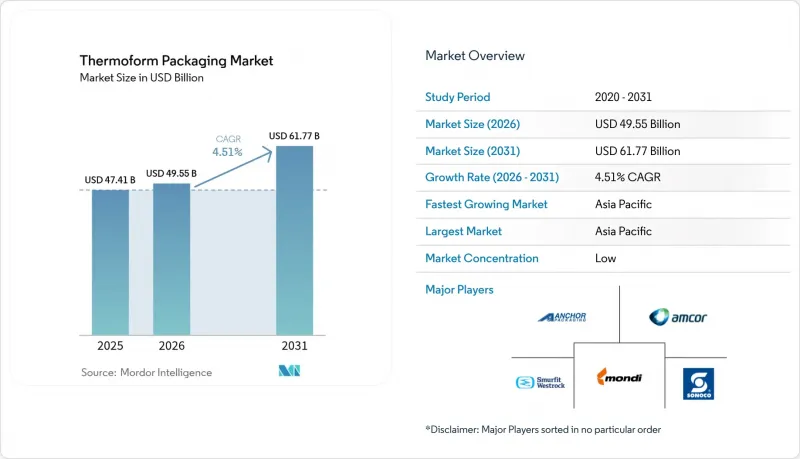
This report is Segmented by Material (Plastic, Paper, Aluminum, Bio-Based Polymers), Product Type (Blisters, Clamshells, Trays, Cups), Packaging Thickness (Up To 200 Mm, 200-500 Mm, Above 500 Mm), End-User Industry (Food, Pharmaceuticals, Personal Care, Electronics), Technology (Vacuum, Pressure, Mechanical, Plug-Assist Forming), and Geography. Market Forecasts in Value (USD).
Global Thermoform Packaging Market Trends and Insights
Surge in demand for mono-material recyclable trays
Circular-economy rules are steering converters toward PET- or PE-only tray structures that pass curbside sortation tests. Graphic Packaging International's Ecoflex(TM) PET line, for instance, meets the EU 2030 recyclability requirement while preserving top-seal integrity for chilled foods. Lower eco-modulated fees in Europe, coupled with brand owner commitments, boost the business case despite thicker walls needed to replicate multilayer barriers. ExxonMobil and Alpine jointly validated all-PE thermoforms that sustain oxygen barriers after nine recycling loops, underscoring material science advances.
Growth of fresh meal-kit delivery startups
HelloFresh and peer platforms have scaled to tens of millions of weekly servings, forcing packagers to optimize freshness over multiday transit, curb mass and hit carbon targets. Barrier-enhanced polypropylene trays paired with recyclable film lidding are proliferating, while vacuum-skin formats suppress drip loss and extend shelf life. Temperature sensors and QR-based provenance tags embedded into lids are emerging differentiators, fostering premium pricing.
Accelerating plastic-use taxation in EU and North America
Italy's levy of EUR 0.45/kg on virgin polymers joined the UK's recycled-content tax in 2024, slicing converter margins unless material mixes exceed 30% recyclate. Registered UK businesses remitted more than GBP 200 million in the first 18 months, highlighting fiscal bite.
Other drivers and restraints analyzed in the detailed report include:
- Per-capita rise in single-serve convenience foods
- Shift from glass vials to thermoform blister packs in injectables
- Sporadic supply of medical-grade PP and PET sheets
For complete list of drivers and restraints, kindly check the Table Of Contents.
Segment Analysis
Plastics delivered 62.07% of 2025 sales, equating to the largest slice of the thermoform packaging market. rPET trays and PP cups stay competitive on barrier metrics and line efficiency, while price spikes in prime resin strengthen recyclate economics. Bio-based polymers, led by PLA blends, chart an 8.21% CAGR and benefit from policy carrots such as EU compostability labeling. The thermoform packaging market size for bio-based grades is projected to triple between 2025 and 2030 as high-volume food service chains lock in low-carbon packaging contracts. Scaling hurdles persist around feedstock supply continuity and heat-distortion thresholds beyond 60 °C.
In contrast, paperboard thermoforms carve niche demand in bakery and ready-meal lids where grease resistance can be engineered with plant-based coatings. Aluminum retains service in airline catering owing to lightweight-to-strength ratios but its share inches downward on cost volatility and recycling energy load. Cascades' 100% rPET rolled-edge tray underlines how incumbent polymers evolve to satisfy rising recycled-content quotas.
Blister packs captured 37.05% of 2025 turnover, leveraging tamper evidence and unit-dose accuracy for OTC medicines and nutraceuticals. Volume growth aligns with ageing demographics and strict drug compliance rules. Trays and lids, however, are the fastest climber at 7.6% CAGR, with meal-kit firms standardizing portioned protein and produce cells. The thermoform packaging market size for trays surpassed USD 15.6 billion in 2026, supported by supermarket delis converting from EPS to clear PET. Pressure-formed dual-compartment inserts appeal to premium confectionery seeking elevated shelf presence without secondary cartons.
Blister innovators embed digital watermarking for authentication, while trays undergo design-for-recycling audits to shave EPR fees. Recloseable clip-on lids boost consumer convenience, encouraging reuse and aligning with brand waste-reduction pledges.
Complete Report Scope:
- By Material
- Plastic
- Paper and Paperboard
- Aluminum
- Bio-based/Biodegradable Polymers
- By Product Type
- Blisters
- Clamshells
- Trays and Lids
- Cups and Bowls
- Other Product Type
- By Packaging Thickness
- Up to 200 µm
- 200-500 µm
- Above 500 µm
- By End-user Industry
- Food and Beverage
- Pharmaceuticals and Medical
- Personal Care and Cosmetics
- Consumer Electronics
- Other End-user Industry
- By Thermoforming Technology
- Vacuum Forming
- Pressure Forming
- Mechanical Forming
- Plug-Assist Forming
- By Geography
- North America
- United States
- Canada
- Mexico
- Europe
- Germany
- United Kingdom
- France
- Italy
- Spain
- Russia
- Rest of Europe
- Asia-Pacific
- China
- India
- Japan
- South Korea
- Australia and New Zealand
- Rest of Asia-Pacific
- Middle East and Africa
- Middle East
- United Arab Emirates
- Saudi Arabia
- Turkey
- Rest of Middle East
- Africa
- South Africa
- Nigeria
- Egypt
- Rest of Africa
- Middle East
- South America
- Brazil
- Argentina
- Rest of South America
- North America
Geography Analysis
Asia-Pacific's 39.76% hold on the thermoform packaging market is fortified by vertically integrated resin hubs in China and India coupled with rising disposable incomes. Government-led pharma parks and e-commerce booms in tier-2 cities sustain a 7.05% regional CAGR. Indian converters leverage Extended Producer Responsibility credits to co-invest in PET flake plants, boosting rPET tray output for quick-service restaurants.
North America presents a mature but innovation-hungry landscape. Four US states have enacted EPR statutes compelling brand owners to bankroll end-of-life programs; converters thus pilot colorant-free PET and digital watermarks to ease sorting. FDA advanced manufacturing incentives accelerate domestic blister capacity, supporting on-shoring of critical drug packaging.
Europe enforces the strictest regime, with the 2030 recyclability rule and graduated recycled-content thresholds pushing rapid material reformulation. Plastic levies in Italy and Spain raise virgin-polymer costs by as much as USD 550/tonne equivalent, hastening adoption of recyclable PP and PET blends. Faerch's pledge to incorporate 100,000 t/yr of post-consumer PET into food trays exemplifies region-specific circularity scale-ups.
Latin America and the Middle East & Africa trail in market size yet post stable mid-single-digit growth on back of urbanization and food retail modernization. Local players invest in rPET sheet extrusion capacity to circumvent import tariffs and adhere to emerging regional waste policies.
- Amcor PLC
- Sonoco Products Company
- International Paper
- Placon Corporation
- Display Pack Inc.
- Smurfit WestRock
- Tekni-Plex Inc.
- Anchor Packaging Inc.
- D&W Fine Pack
- Sealed Air Corporation
- Mondi Group
- Huhtamaki Oyj
- Pactiv Evergreen Inc.
- Fabri-Kal LLC
- Dart Container Corp.
- Sabert Corporation
- Genpak LLC
- Silgan Plastics
- Rompa Group
Additional Benefits:
- The market estimate (ME) sheet in Excel format
- 3 months of analyst support
TABLE OF CONTENTS
1 INTRODUCTION
- 1.1 Study Assumptions and Market Definition
- 1.2 Scope of the Study
2 RESEARCH METHODOLOGY
3 EXECUTIVE SUMMARY
4 MARKET LANDSCAPE
- 4.1 Market Overview
- 4.2 Market Drivers
- 4.2.1 Surge in demand for mono-material recyclable trays
- 4.2.2 Growth of fresh meal-kit delivery startups
- 4.2.3 Per-capita rise in single-serve convenience foods
- 4.2.4 Shift from glass vials to thermoform blister packs in injectables
- 4.2.5 Automation lowering tooling?changeover cost (Industry 4.0 lines)
- 4.2.6 Government stimulus for on-shore pharmaceutical packaging
- 4.3 Market Restraints
- 4.3.1 Accelerating plastic-use taxation in EU and North America
- 4.3.2 Sporadic supply of medical-grade PP and PET sheets
- 4.3.3 High energy intensity vs. molded-fiber forming
- 4.3.4 Limited barrier performance for oxygen-sensitive SKUs
- 4.4 Supply-Chain Analysis
- 4.5 Regulatory Landscape
- 4.6 Technological Outlook
- 4.7 Porter's Five Forces Analysis
- 4.7.1 Threat of New Entrants
- 4.7.2 Bargaining Power of Buyers
- 4.7.3 Bargaining Power of Suppliers
- 4.7.4 Threat of Substitute Products
- 4.7.5 Intensity of Competitive Rivalry
5 MARKET SIZE AND GROWTH FORECASTS (VALUE)
- 5.1 By Material
- 5.1.1 Plastic
- 5.1.2 Paper and Paperboard
- 5.1.3 Aluminum
- 5.1.4 Bio-based/Biodegradable Polymers
- 5.2 By Product Type
- 5.2.1 Blisters
- 5.2.2 Clamshells
- 5.2.3 Trays and Lids
- 5.2.4 Cups and Bowls
- 5.2.5 Other Product Type
- 5.3 By Packaging Thickness
- 5.3.1 Up to 200 µm
- 5.3.2 200-500 µm
- 5.3.3 Above 500 µm
- 5.4 By End-user Industry
- 5.4.1 Food and Beverage
- 5.4.2 Pharmaceuticals and Medical
- 5.4.3 Personal Care and Cosmetics
- 5.4.4 Consumer Electronics
- 5.4.5 Other End-user Industry
- 5.5 By Thermoforming Technology
- 5.5.1 Vacuum Forming
- 5.5.2 Pressure Forming
- 5.5.3 Mechanical Forming
- 5.5.4 Plug-Assist Forming
- 5.6 By Geography
- 5.6.1 North America
- 5.6.1.1 United States
- 5.6.1.2 Canada
- 5.6.1.3 Mexico
- 5.6.2 Europe
- 5.6.2.1 Germany
- 5.6.2.2 United Kingdom
- 5.6.2.3 France
- 5.6.2.4 Italy
- 5.6.2.5 Spain
- 5.6.2.6 Russia
- 5.6.2.7 Rest of Europe
- 5.6.3 Asia-Pacific
- 5.6.3.1 China
- 5.6.3.2 India
- 5.6.3.3 Japan
- 5.6.3.4 South Korea
- 5.6.3.5 Australia and New Zealand
- 5.6.3.6 Rest of Asia-Pacific
- 5.6.4 Middle East and Africa
- 5.6.4.1 Middle East
- 5.6.4.1.1 United Arab Emirates
- 5.6.4.1.2 Saudi Arabia
- 5.6.4.1.3 Turkey
- 5.6.4.1.4 Rest of Middle East
- 5.6.4.2 Africa
- 5.6.4.2.1 South Africa
- 5.6.4.2.2 Nigeria
- 5.6.4.2.3 Egypt
- 5.6.4.2.4 Rest of Africa
- 5.6.4.1 Middle East
- 5.6.5 South America
- 5.6.5.1 Brazil
- 5.6.5.2 Argentina
- 5.6.5.3 Rest of South America
- 5.6.1 North America
6 COMPETITIVE LANDSCAPE
- 6.1 Market Concentration
- 6.2 Strategic Moves
- 6.3 Market Share Analysis
- 6.4 Company Profiles (includes Global level Overview, Market level Overview, Core Segments, Financials as available, Strategic Information, Market Rank/Share for key companies, Products and Services, and Recent Developments)
- 6.4.1 Amcor PLC
- 6.4.2 Sonoco Products Company
- 6.4.3 International Paper
- 6.4.4 Placon Corporation
- 6.4.5 Display Pack Inc.
- 6.4.6 Smurfit WestRock
- 6.4.7 Tekni-Plex Inc.
- 6.4.8 Anchor Packaging Inc.
- 6.4.9 D&W Fine Pack
- 6.4.10 Sealed Air Corporation
- 6.4.11 Mondi Group
- 6.4.12 Huhtamaki Oyj
- 6.4.13 Pactiv Evergreen Inc.
- 6.4.14 Fabri-Kal LLC
- 6.4.15 Dart Container Corp.
- 6.4.16 Sabert Corporation
- 6.4.17 Genpak LLC
- 6.4.18 Silgan Plastics
- 6.4.19 Rompa Group
7 MARKET OPPORTUNITIES AND FUTURE OUTLOOK
- 7.1 White-space and Unmet-need Assessment

