PUBLISHER: Mordor Intelligence | PRODUCT CODE: 2114607

PUBLISHER: Mordor Intelligence | PRODUCT CODE: 2114607
Intravenous (IV) Equipment - Market Share Analysis, Industry Trends & Statistics, Growth Forecasts (2026 - 2031)
According to Mordor Intelligence, the IV therapy devices market size is expected to grow from USD 16.34 billion in 2025 to USD 17.34 billion in 2026 and is forecast to reach USD 23.36 billion by 2031 at 6.13% CAGR over 2026-2031.
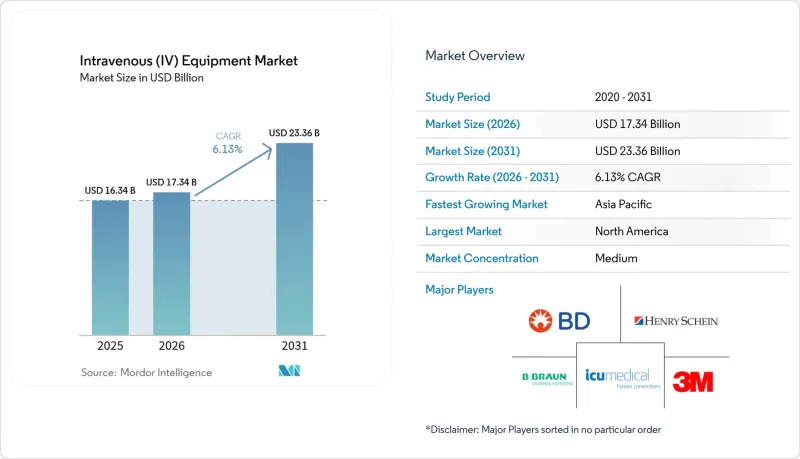
This report is Segmented by Type (IV Catheters, Infusion Pumps, Securement Devices, Administration Sets, Drip Chambers, and Others), End-User (Hospitals, Ambulatory Surgical Centers, and Others), and Geography (North America, Europe, Asia-Pacific, Middle East and Africa, and South America). The Report Offers the Value (in USD Million) for the Above Segments.
Global Intravenous (IV) Equipment Market Trends and Insights
Rising Prevalence of Chronic Diseases Requiring Long-Term IV Therapy
Diabetes affects 537 million adults and often necessitates intravenous intervention for complications, underpinning predictable demand across the IV therapy devices market. Aging populations in North America, Europe, and Japan further widen the chronic-care pool that relies on multi-drug regimens unsuitable for oral delivery. MIT's CLAUDIA system exemplifies the push toward closed-loop chemotherapy that automatically adjusts dosing every five minutes, illustrating how disease complexity spurs advanced infusion adoption. Payers support home-based IV services to curb readmissions, reinforcing a durable revenue stream for manufacturers that supply patient-centric delivery platforms. Together, these forces propel sustained growth momentum within the IV therapy devices market.
Growth in Home- and Ambulatory-Based Infusion Therapy
Veterans Affairs saved USD 10.2 million by substituting inpatient care with home infusion, validating an economic case that pressures providers to shift toward ambulatory models academic.oup.com. Portable pumps such as the Infonde unit record 95% patient-satisfaction rates, underscoring how mobility-friendly technology supports quality-of-life goals. Pending US legislation proposes stronger Medicare reimbursement, likely boosting patient volumes. During the COVID-19 pandemic, nurses operated pumps outside ICU rooms to reduce exposure risks, accelerating digital-monitoring upgrades. Oncology remains the prime home-care growth engine as patients favor familiar settings for lengthy chemotherapies, reinforcing upward momentum in the IV therapy devices market.
Product Recalls & Medication-Error Regulatory Scrutiny
The FDA initiated Class I recalls affecting more than 150,000 infusion devices in 2024, including ICU Medical's Medfusion line, intensifying oversight across the IV therapy devices market. New Quality Management System Regulation, effective February 2026, aligns US rules with ISO 13485:2016 and expands post-market surveillance. Fresenius Kabi's USD 240 million Ivenix buy-out swiftly encountered warning letters, illustrating compliance risk. Section 524B cybersecurity mandates now form part of pre-market submissions, raising barriers for smaller entrants. While these actions uplift safety, short-run cost spikes can dampen equipment turnover, tempering growth within the IV therapy devices market.
Other drivers and restraints analyzed in the detailed report include:
- Increasing Surgical Procedures & Hospitalization Rates
- Technological Advancements in Smart Infusion & Needle-Free Systems
- Shift Toward Subcutaneous/Oral Biologics Reducing IV Demand
For complete list of drivers and restraints, kindly check the Table Of Contents.
Segment Analysis
IV catheters controlled 37.78% of 2025 revenue as the foundational access tool across settings, securing the single-largest slice of the IV therapy devices market bbraunusa.com. Smart infusion pumps, however, represent the fastest growth at 6.67% CAGR thanks to AI dose-error reduction and cloud analytics. Baxter's Spectrum IQ earned its seventh Best-in-KLAS award with 97% drug-library compliance, illustrating the performance bar now expected in the IV therapy devices market. Consumables such as tubing and administration sets benefit from steady replacement cycles, ensuring recurring revenue. Needle-free connectors, securement devices, and advanced filters collectively add infection-prevention value, making them attractive add-on sales. Mature drip-chamber components grow modestly yet remain essential, preserving backbone demand throughout the IV therapy devices market.
Complete Report Scope:
- By Product Type
- Infusion Pumps
- IV Catheters (Peripheral & Central)
- Administration Sets & IV Tubing
- Securement & Stabilization Devices
- Needle-Free/Closed IV Connectors
- Drip Chambers & Filters
- By End User
- Hospitals & Clinics
- Ambulatory Surgical Centers
- Home-Care Settings
- Diagnostic & Specialty Centers
- By Application
- Medication Administration
- Fluid & Nutrition Therapy
- Blood-based Products & Transfusions
- By Geography
- North America
- United States
- Canada
- Mexico
- Europe
- Germany
- United Kingdom
- France
- Italy
- Spain
- Rest of Europe
- Asia-Pacific
- China
- Japan
- India
- South Korea
- Australia
- Rest of Asia-Pacific
- South America
- Brazil
- Argentina
- Rest of South America
- Middle East and Africa
- GCC
- South Africa
- Rest of Middle East and Africa
- North America
Geography Analysis
North America generated 41.85% of global revenue in 2025 owing to robust reimbursement and early technology adoption, reinforcing its anchor position in the IV therapy devices market. Yet Hurricane Helene exposed supply-chain risk, triggering federal initiatives to validate point-of-care fluid manufacturing and argue for broader supplier portfolios. Canada's universal system and Mexico's private-hospital build-out add incremental volumes, while a harmonizing regulatory backdrop facilitates cross-border trade.
Asia-Pacific is the fastest-growing region at an 7.96% CAGR, propelled by China's healthcare-spend trajectory toward RMB 205 trillion by 2030 and incentive schemes that fast-track innovative devices . Japan's super-aging society intensifies home-infusion uptake despite elevated complication rates, creating openings for safer vascular-access designs. India's hospital expansion and chronic-disease surge position it as a high-potential adopter once reimbursement barriers ease. South Korea and Australia, with advanced payer systems, foster premium-device adoption that often cascades into neighboring markets, reinforcing Asia-Pacific's strategic weight within the IV therapy devices market.
Europe delivers steady gains through stringent quality standards and sustainability mandates that spur eco-design innovation. Economic pressure in Southern markets dampens capital purchases, but Northern nations maintain high replacement cycles. Latin America and the Middle East & Africa contribute emerging-market upside: Brazil drives regional scale through public-hospital acquisitions, while GCC states channel oil revenues into specialty-care facilities requiring sophisticated IV infrastructure. South Africa acts as a distribution hub for sub-Saharan adoption. Collectively, these markets diversify revenue streams and cushion regional shocks for participants in the IV therapy devices market.
- Beckton Dickinson
- B. Braun
- Baxter
- Fresenius
- ICU Medical
- Smiths Group
- Terumo
- Medtronic
- Nipro
- Teleflex
- Cardinal Health
- Cook Group
- Vygon
- Argon Medical Devices
- Moog Inc. (Medical)
- Mindray
- Hospira (Pfizer)
- JMS Co., Ltd.
- Smiths Group
- Braun Medical USA
Additional Benefits:
- The market estimate (ME) sheet in Excel format
- 3 months of analyst support
TABLE OF CONTENTS
1 Introduction
- 1.1 Study Assumptions & Market Definition
- 1.2 Scope of the Study
2 Research Methodology
3 Executive Summary
4 Market Landscape
- 4.1 Market Overview
- 4.2 Market Drivers
- 4.2.1 Rising prevalence of chronic diseases requiring long-term IV therapy
- 4.2.2 Growth in home- and ambulatory-based infusion therapy
- 4.2.3 Increasing surgical procedures & hospitalization rates
- 4.2.4 Technological advancements in smart infusion & needle-free systems
- 4.2.5 Emergence of closed-loop AI drug-delivery algorithms
- 4.2.6 Decentralized clinical trials driving portable IV devices
- 4.3 Market Restraints
- 4.3.1 Product recalls & medication-error related regulatory scrutiny
- 4.3.2 High cost of advanced infusion systems in low-resource settings
- 4.3.3 Shortage of skilled infusion nurses raising complication risks
- 4.3.4 Shift toward subcutaneous/oral biologics reducing IV demand
- 4.4 Value / Supply-Chain Analysis
- 4.5 Regulatory Landscape
- 4.6 Technological Outlook
- 4.7 Porter's Five Forces Analysis
- 4.7.1 Threat of New Entrants
- 4.7.2 Bargaining Power of Suppliers
- 4.7.3 Bargaining Power of Buyers
- 4.7.4 Threat of Substitutes
- 4.7.5 Competitive Rivalry
5 Market Size & Growth Forecasts (Value)
- 5.1 By Product Type
- 5.1.1 Infusion Pumps
- 5.1.2 IV Catheters (Peripheral & Central)
- 5.1.3 Administration Sets & IV Tubing
- 5.1.4 Securement & Stabilization Devices
- 5.1.5 Needle-Free/Closed IV Connectors
- 5.1.6 Drip Chambers & Filters
- 5.2 By End User
- 5.2.1 Hospitals & Clinics
- 5.2.2 Ambulatory Surgical Centers
- 5.2.3 Home-Care Settings
- 5.2.4 Diagnostic & Specialty Centers
- 5.3 By Application
- 5.3.1 Medication Administration
- 5.3.2 Fluid & Nutrition Therapy
- 5.3.3 Blood-based Products & Transfusions
- 5.4 By Geography
- 5.4.1 North America
- 5.4.1.1 United States
- 5.4.1.2 Canada
- 5.4.1.3 Mexico
- 5.4.2 Europe
- 5.4.2.1 Germany
- 5.4.2.2 United Kingdom
- 5.4.2.3 France
- 5.4.2.4 Italy
- 5.4.2.5 Spain
- 5.4.2.6 Rest of Europe
- 5.4.3 Asia-Pacific
- 5.4.3.1 China
- 5.4.3.2 Japan
- 5.4.3.3 India
- 5.4.3.4 South Korea
- 5.4.3.5 Australia
- 5.4.3.6 Rest of Asia-Pacific
- 5.4.4 South America
- 5.4.4.1 Brazil
- 5.4.4.2 Argentina
- 5.4.4.3 Rest of South America
- 5.4.5 Middle East and Africa
- 5.4.5.1 GCC
- 5.4.5.2 South Africa
- 5.4.5.3 Rest of Middle East and Africa
- 5.4.1 North America
6 Competitive Landscape
- 6.1 Market Concentration
- 6.2 Market Share Analysis
- 6.3 Company Profiles (includes Global level Overview, Market level overview, Core Segments, Financials as available, Strategic Information, Market Rank/Share for key companies, Products & Services, and Recent Developments)
- 6.3.1 Becton, Dickinson and Company
- 6.3.2 B. Braun Melsungen AG
- 6.3.3 Baxter International Inc.
- 6.3.4 Fresenius SE & Co. KGaA
- 6.3.5 ICU Medical, Inc.
- 6.3.6 Smiths Medical
- 6.3.7 Terumo Corporation
- 6.3.8 Medtronic plc
- 6.3.9 Nipro Corporation
- 6.3.10 Teleflex Incorporated
- 6.3.11 Cardinal Health
- 6.3.12 Cook Medical
- 6.3.13 Vygon SA
- 6.3.14 Argon Medical Devices
- 6.3.15 Moog Inc. (Medical)
- 6.3.16 Mindray Medical International
- 6.3.17 Hospira (Pfizer)
- 6.3.18 JMS Co., Ltd.
- 6.3.19 Smiths Group plc
- 6.3.20 Braun Medical USA
7 Market Opportunities & Future Outlook
- 7.1 White-space & Unmet-Need Assessment

