PUBLISHER: Mordor Intelligence | PRODUCT CODE: 2114617

PUBLISHER: Mordor Intelligence | PRODUCT CODE: 2114617
Global HER-2 Negative Breast Cancer - Market Share Analysis, Industry Trends & Statistics, Growth Forecasts (2026 - 2031)
According to Mordor Intelligence, the HER-2 negative breast cancer market size is expected to grow from USD 1.82 billion in 2025 to USD 1.97 billion in 2026 and is forecast to reach USD 2.91 billion by 2031 at 8.12% CAGR over 2026-2031.
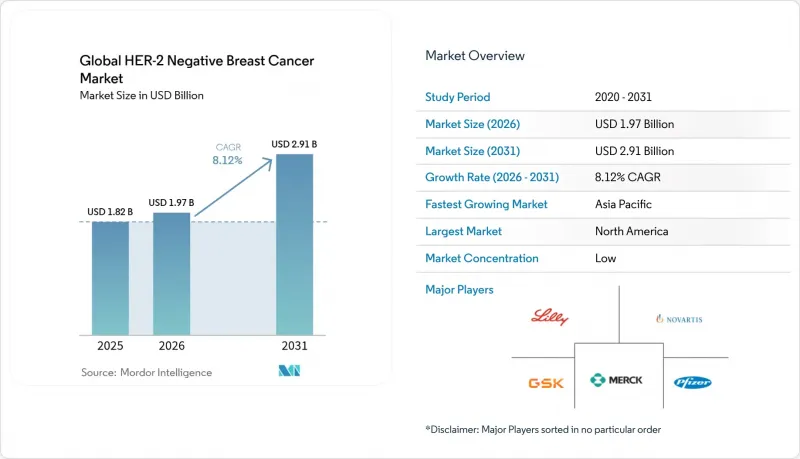
This report is Segmented by Therapy Type (Chemotherapy, Endocrine Therapy, Targeted Therapy, Immunotherapy), Biomarker Sub-Type (HR-Positive/HER2-Negative, Triple-Negative Breast Cancer), End User (Hospitals, Specialty Cancer Centers, Others), and Geography (North America, Europe, Asia-Pacific, South America, Middle East and Africa). The Market Forecasts are Provided in Terms of Value (USD).
Global HER-2 Negative Breast Cancer Market Trends and Insights
Precision-diagnostics uptake in early-stage disease
Routine genomic assays such as Oncotype DX changed treatment recommendations for 65% of early-stage patients in Brazil and cut chemotherapy use by 66%. Lombardy, Italy pioneered reimbursement, proving public-payer willingness to fund genomic testing when clinical utility is clear. Adoption is uneven; under-representation in validation cohorts reduces test accuracy for African American women. Artificial-intelligence models now predict treatment response with 91% accuracy, promising equitable performance across ancestries. Precision diagnostics therefore lower overtreatment, identify high-risk patients earlier, and expand the HER-2 negative breast cancer market by enabling targeted therapy in adjuvant settings.
Expanding approvals of PARP inhibitors in HR-positive disease
Olaparib's approval for high-risk early HER-2 negative breast cancer with BRCA mutation widened PARP inhibitor reach beyond metastatic TNBC. Homologous-recombination deficiency affects 20-30% of hormone-receptor-positive tumors, creating a larger addressable pool. Talazoparib proved cost-effective in China and the United States with incremental cost-effectiveness ratios of USD 2,484 and USD 6,815 per QALY, respectively. Trials testing PARP inhibitors with CDK4/6 inhibitors or immunotherapy show synergistic efficacy and could further lift adoption. As label expansions accumulate, PARP agents move from niche to foundational therapy, accelerating HER-2 negative breast cancer market growth.
High attrition of TNBC immunotherapy assets
Pembrolizumab plus chemotherapy improved survival only in PD-L1 positive TNBC patients, revealing the challenge of heterogeneity. Immune checkpoint inhibitors yield durable responses in fewer than 20% of cases, and toxicity escalates in combination regimens. The NIMBUS trial produced 20% objective-response rates overall, but 60% when tumor mutational burden exceeded 14 mutations per Mb. Combination approaches face 48.6% adverse-event rates versus 17.1% for monotherapy. As attrition curbs pipeline output, HER-2 negative breast cancer market expansion in TNBC slows.
Other drivers and restraints analyzed in the detailed report include:
- Growing reimbursement for antibody-drug conjugates
- Rising neoadjuvant therapy adoption
- Cost-efficacy concerns of ADCs in community settings
For complete list of drivers and restraints, kindly check the Table Of Contents.
Segment Analysis
Chemotherapy retained a 41.10% share of the HER-2 negative breast cancer market size in 2025, but targeted therapy is forecast to grow at 9.02% CAGR between 2026 and 2031. PARP inhibitors, CDK4/6 inhibitors, and ADCs deliver longer progression-free survival with fewer systemic toxicities, prompting clinicians to shift treatment algorithms. Olaparib's success in adjuvant BRCA-mutant disease extends PARP relevance beyond metastatic settings. CDK4/6 inhibitors combined with aromatase inhibitors provide median progression-free survival over 30 months, surpassing historical endocrine monotherapy. Immunotherapy is standard in PD-L1 positive TNBC after the KEYNOTE-522 trial. ADCs such as trastuzumab deruxtecan broaden reach to HER2-low tumors and re-define sequencing. The HER-2 negative breast cancer market therefore pivots toward mechanism-specific regimens that personalize benefit.
Endocrine therapy remains backbone treatment for hormone receptor-positive disease, yet resistance drives demand for next-generation agents. Selective estrogen-receptor degraders like imlunestrant improved progression-free survival in ESR1-mutant populations and foreshadow a new combination partner for CDK4/6 inhibitors. The influx of biosimilars in chemotherapy and HER2-targeted segments exerts price pressure, but advanced targeted regimes sustain premium pricing through differentiated efficacy. Cumulatively, targeted therapy adoption accelerates the HER-2 negative breast cancer market and relegates conventional chemotherapy to later-line or combination use.
Complete Report Scope:
- By Therapy Type (Value)
- Chemotherapy
- Endocrine Therapy
- Targeted Therapy (PARP, PI3K, AKT, ADCs)
- Immunotherapy
- By Biomarker Sub-Type (Value)
- HR-Positive / HER2-Negative
- Triple-Negative Breast Cancer (TNBC)
- By End User (Value)
- Hospitals
- Specialty Cancer Centers
- Others
- By Geography (Value)
- North America
- United States
- Canada
- Europe
- Germany
- United Kingdom
- France
- Italy
- Spain
- Rest of Europe
- Asia-Pacific
- China
- India
- Japan
- South Korea
- Australia
- Rest of Asia-Pacific
- South America
- Brazil
- Argentina
- Rest of South America
- Middle East and Africa
- GCC
- South Africa
- Rest of Middle East and Africa
- North America
Geography Analysis
North America captured 41.85% of 2025 revenue, driven by early adoption of precision diagnostics, robust clinical-trial ecosystems, and streamlined FDA approvals for datopotamab deruxtecan and trastuzumab deruxtecan. AI-guided trial-matching cuts screen-failure rates and accelerates first-patient-in timelines, reinforcing the region's leadership. Yet payers question ADC value as cost-effectiveness ratios exceed USD 296,873 per QALY, leading to step therapy protocols that slow uptake. Canada exemplifies cost management through de-escalated bone-targeted-agent schedules that reduce expenditures without compromising outcomes.
Europe follows with mature health-technology-assessment frameworks and pan-EU regulatory coordination. Lombardy's genomic-testing reimbursement paved the way for wider adoption, and CHMP backed trastuzumab deruxtecan for HER2-low disease in February 2025. However, dual-manufacturer combination regimens see lower reimbursement approval, reflecting payer concern over bundled pricing. Eastern-European markets still lack widespread biomarker-testing infrastructure, delaying entry of complex targeted therapies.
Asia-Pacific posts the highest growth rate at 10.35% CAGR as breast-cancer incidence rises from 1.25 million cases in 2021 to 1.68 million by 2030. Japan approved and launched datopotamab deruxtecan within 90 days, highlighting regulatory agility. China's projected breast-cancer cost surge from USD 8 billion in 2021 to USD 14 billion by 2030 underscores the economic weight of the HER-2 negative breast cancer market.Thailand's Pathum Raksa initiative shows how public-private models can extend testing capacity and could be replicated across emerging markets.
List of Companies Covered in this Report:
- Roche
- Pfizer
- Novartis
- AstraZeneca
- Eli Lilly and Company
- Merck
- Gilead Sciences
- Bristol-Myers Squibb
- Seagen
- Daiichi Sankyo
- Abbvie
- Amgen
- Sanofi
- Eisai
- Teva Pharmaceutical Industries
- MacroGenics
- Puma Biotechnology
- Genmab
- BeiGene
- Zentalis Pharma
Additional Benefits:
- The market estimate (ME) sheet in Excel format
- 3 months of analyst support
TABLE OF CONTENTS
1 Introduction
- 1.1 Study Assumptions & Market Definition
- 1.2 Scope of the Study
2 Research Methodology
3 Executive Summary
4 Market Landscape
- 4.1 Market Overview
- 4.2 Market Drivers
- 4.2.1 Precision-diagnostics uptake in early-stage disease
- 4.2.2 Expanding approvals of PARP inhibitors in HR-positive sub-segment
- 4.2.3 Growing reimbursement for antibody-drug conjugates
- 4.2.4 Rising neoadjuvant therapy adoption (mainstream)
- 4.2.5 Tumor-agnostic trial designs accelerating pipeline (under-radar)
- 4.2.6 AI-guided trial matching platforms improving enrollment (under-radar)
- 4.3 Market Restraints
- 4.3.1 High attrition of TNBC immunotherapy assets
- 4.3.2 Cost-efficacy concerns of ADCs in community settings
- 4.3.3 Limited biomarker testing rates in low-income markets (under-radar)
- 4.3.4 Emerging payer pressure on combination regimens (under-radar)
- 4.4 Value / Supply-Chain Analysis
- 4.5 Regulatory Landscape
- 4.6 Technological Outlook
- 4.7 Porter's Five Forces
- 4.7.1 Threat of New Entrants
- 4.7.2 Bargaining Power of Suppliers
- 4.7.3 Bargaining Power of Buyers
- 4.7.4 Threat of Substitutes
- 4.7.5 Industry Rivalry
5 Market Size & Growth Forecasts
- 5.1 By Therapy Type (Value)
- 5.1.1 Chemotherapy
- 5.1.2 Endocrine Therapy
- 5.1.3 Targeted Therapy (PARP, PI3K, AKT, ADCs)
- 5.1.4 Immunotherapy
- 5.2 By Biomarker Sub-Type (Value)
- 5.2.1 HR-Positive / HER2-Negative
- 5.2.2 Triple-Negative Breast Cancer (TNBC)
- 5.3 By End User (Value)
- 5.3.1 Hospitals
- 5.3.2 Specialty Cancer Centers
- 5.3.3 Others
- 5.4 By Geography (Value)
- 5.4.1 North America
- 5.4.1.1 United States
- 5.4.1.2 Canada
- 5.4.2 Europe
- 5.4.2.1 Germany
- 5.4.2.2 United Kingdom
- 5.4.2.3 France
- 5.4.2.4 Italy
- 5.4.2.5 Spain
- 5.4.2.6 Rest of Europe
- 5.4.3 Asia-Pacific
- 5.4.3.1 China
- 5.4.3.2 India
- 5.4.3.3 Japan
- 5.4.3.4 South Korea
- 5.4.3.5 Australia
- 5.4.3.6 Rest of Asia-Pacific
- 5.4.4 South America
- 5.4.4.1 Brazil
- 5.4.4.2 Argentina
- 5.4.4.3 Rest of South America
- 5.4.5 Middle East and Africa
- 5.4.5.1 GCC
- 5.4.5.2 South Africa
- 5.4.5.3 Rest of Middle East and Africa
- 5.4.1 North America
6 Competitive Landscape
- 6.1 Market Concentration
- 6.2 Market Share Analysis
- 6.3 Company Profiles (includes Global level Overview, Market level overview, Core Segments, Financials as available, Strategic Information, Market Rank/Share for key companies, Products & Services, and Recent Developments)
- 6.3.1 Roche
- 6.3.2 Pfizer
- 6.3.3 Novartis
- 6.3.4 AstraZeneca
- 6.3.5 Eli Lilly
- 6.3.6 Merck & Co.
- 6.3.7 Gilead Sciences
- 6.3.8 Bristol Myers Squibb
- 6.3.9 Seagen
- 6.3.10 Daiichi Sankyo
- 6.3.11 AbbVie
- 6.3.12 Amgen
- 6.3.13 Sanofi
- 6.3.14 Eisai
- 6.3.15 Teva
- 6.3.16 MacroGenics
- 6.3.17 Puma Biotechnology
- 6.3.18 Genmab
- 6.3.19 BeiGene
- 6.3.20 Zentalis Pharma
7 Market Opportunities & Future Outlook
- 7.1 White-space & Unmet-Need Assessment

