PUBLISHER: Mordor Intelligence | PRODUCT CODE: 2114619

PUBLISHER: Mordor Intelligence | PRODUCT CODE: 2114619
Burn Care - Market Share Analysis, Industry Trends & Statistics, Growth Forecasts (2026 - 2031)
According to Mordor Intelligence, burn care market size in 2026 is estimated at USD 3.06 billion, growing from 2025 value of USD 2.88 billion with 2031 projections showing USD 4.14 billion, growing at 6.24% CAGR over 2026-2031.
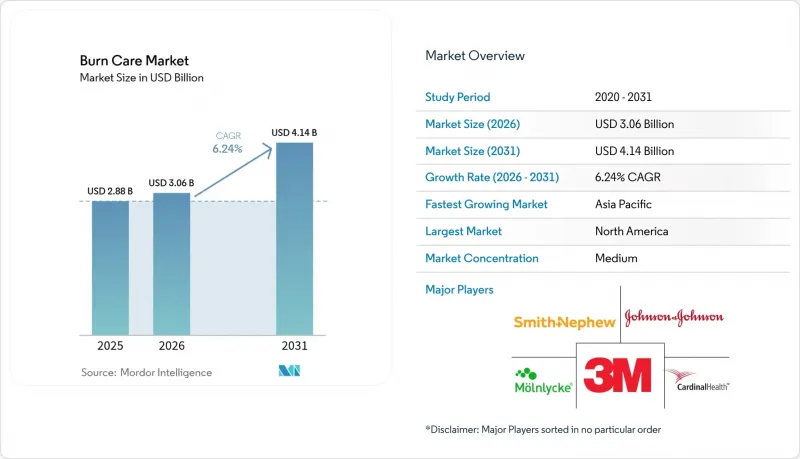
This report is Segmented by Product Type (Advanced Dressings, Traditional Dressings, Biologics, Therapy Devices, and More), Depth of Burn (Minor Burns, Partial-Thickness Burns, Full-Thickness Burns), End User (Hospitals & Clinics, Specialised Burn Centres, and More), and Geography (North America, Europe, Asia-Pacific, Middle East & Africa, South America). The Market Forecasts are Provided in Terms of Value (USD).
Global Burn Care Market Trends and Insights
High Incidence of Burn Injuries Worldwide
Wildfires in Central Canada burned 2.7 million hectares in 2025 and forced 33,000 evacuations, pushing emergency departments to an eightfold surge in burn-related visits. The January 2025 Los Angeles fires destroyed 16,250 structures and exposed 41,000 residents, illustrating the escalating clinical burden. Chronic wound management, including burns, carries an annual economic load surpassing USD 20 billion in the United States. Pediatric trials with non-thermal plasma cut skin-graft needs from 40% to 10%. These data point toward sustained allocation of resources across global health systems.
Increasing Adoption of Advanced Wound Dressings & Skin Grafts
Smith+Nephew posted 3.8% underlying growth in its Advanced Wound Management unit during Q1 2025, reflecting robust demand for foams and NPWT devices. The Red Dot-awarded RENASYS EDGE system addresses the needs of 8.2 million American chronic-wound patients at a USD 33 billion financial burden. Silver-nanoparticle and collagen matrices achieve 50-95% healing rates across diverse cohorts. Solventum's V.A.C. Peel & Place cut application time by 61% and costs by 41% while supporting seven-day wear. Healthcare purchasers therefore continue to favour clinically proven dressings that also reduce total cost of care.
High Cost of Advanced Burn-Care Products & Biologics
Medicare investigations into inflated skin-substitute pricing spotlight financial barriers in the burn care market. Integra LifeSciences saw Tissue Technologies revenue fall 15.3% in Q1 2024 due to production outages, underscoring supply risk. DOJ action against Vohra Wound Physicians accentuates compliance pressure. Accountable Care Organizations advocate stricter controls to safeguard budgets. High sticker prices thus temper biologic uptake, especially outside high-income economies.
Other drivers and restraints analyzed in the detailed report include:
- Rapid Technological Advances (NPWT, Antimicrobial Hydrogels, 3-D Bioprinting)
- Favourable Reimbursement & Government Safety Initiatives
- Limited Reimbursement & Skilled Staff in Emerging Economies
For complete list of drivers and restraints, kindly check the Table Of Contents.
Segment Analysis
Advanced dressings held 52.21% market share, of the burn care market in 2025. Iterative upgrades in hydrofiber foams, antimicrobial silver layers, and moisture-handling backings maintain clinician confidence and secure reimbursement. Smith+Nephew expanded its foam line in 2024, reinforcing stickiness within hospital formularies. Traditional dressings persist in budget-sensitive outpatient settings, sustaining baseline demand. Therapy devices, notably portable NPWT units, speed patient discharge and bolster outpatient revenue models. Topical antimicrobial gels remain standard prophylaxis for minor wounds.
Biologics, while smaller in absolute value, recorded 9.41% CAGR from 2026 to 2031, the highest across product categories. FDA clearance of AVITA Medical's Cohealyx dermal matrix in December 2024 widens indications and triples the firm's total addressable population. Bioengineered skin delivers outcomes similar to autografting without donor-site morbidity. However, the burn care market size for biologics stays curtailed by high manufacturing cost and complex cold-chain logistics. As payers refine coverage criteria, vendors that generate robust comparative-effectiveness data will gain share.
Complete Report Scope:
- By Product Type
- Advanced Dressings
- Foam Dressings
- Hydrocolloid Dressings
- Hydrogel Dressings
- Alginate Dressings
- Antimicrobial Silver Dressings
- Collagen & Silicone Dressings
- Traditional Dressings
- Biologics
- Therapy Devices
- Topical Agents
- Other Product Types
- Advanced Dressings
- By Depth of Burn
- Minor Burns
- Partial-Thickness Burns
- Full-Thickness Burns
- By End User
- Hospitals & Clinics
- Specialised Burn Centres
- Ambulatory Surgery Centres
- Home-Care Settings
- Military & Emergency Services
- By Geography
- North America
- United States
- Canada
- Mexico
- Europe
- Germany
- United Kingdom
- France
- Italy
- Spain
- Rest of Europe
- Asia-Pacific
- China
- Japan
- India
- Australia
- South Korea
- Rest of Asia-Pacific
- Middle East & Africa
- GCC
- South Africa
- Rest of Middle East & Africa
- South America
- Brazil
- Argentina
- Rest of South America
- North America
Geography Analysis
North America held 39.28% of global revenue in 2025. Federal investments, including the USD 650 million Military Burn Research allocation, promote basic and translational science. CMS updates on skin-substitute coverage effective April 2025 further incentivize technology uptake. The Los Angeles wildfires exposed 41,000 people and demonstrated the region's vulnerability. Canadian wildfires affected 2.7 million hectares and sent smoke toward 117 million Americans, indicating cross-border healthcare contingencies.
Europe combines strict regulatory oversight with rising wildfire activity around the Mediterranean. Healthcare systems focus on cost-effectiveness, prompting hospitals to adopt dressings that reduce total hospitalization days. Joint EU research programs foster collaboration between academic groups and device makers, accelerating approvals of smart hydrogel dressings.
Asia-Pacific is projected to achieve an 7.78% CAGR to 2031. Policymakers prioritize universal health coverage and invest in trauma infrastructure, creating strong tailwinds in the burn care market. A region-wide consensus issued new burn-assessment guidelines and emphasized workforce training. Private-equity interest grows as healthcare providers consolidate and seek digital-health partnerships.
Middle East & Africa and South America remain nascent yet show steady uptake of portable NPWT and silver dressings. Governments modernize emergency services to meet climate-related disaster demands. Multilateral aid and public-private collaborations introduce telehealth solutions for remote burn triage, gradually expanding the burn care market footprint in underserved regions.
- 3M
- Smiths Group
- Molnlycke Health Care
- ConvaTec Group plc
- Johnson & Johnson
- B. Braun
- Integra LifeSciences Corp.
- Medline Industries
- Cardinal Health
- Hollister
- DeRoyal Industries
- Avita Medical
- PolyNovo Ltd.
- Vericel
- Organogenesis
- Stratatech (Mallinckrodt)
- Stryker
- Coloplast
- Medtronic
Additional Benefits:
- The market estimate (ME) sheet in Excel format
- 3 months of analyst support
TABLE OF CONTENTS
1 Introduction
- 1.1 Study Assumptions & Market Definition
- 1.2 Scope of the Study
2 Research Methodology
3 Executive Summary
4 Market Landscape
- 4.1 Market Overview
- 4.2 Market Drivers
- 4.2.1 High Incidence of Burn Injuries Worldwide
- 4.2.2 Increasing Adoption of Advanced Wound Dressings & Skin Grafts
- 4.2.3 Rapid Technological Advances (NPWT, Antimicrobial Hydrogels, 3-D Bioprinting)
- 4.2.4 Favourable Reimbursement & Government Safety Initiatives
- 4.2.5 Rising Electrical-Vehicle & Lithium-Battery Fire Incidents
- 4.2.6 Wild-Fire Frequency Linked to Climate Change Boosting Severe Burn Cases
- 4.3 Market Restraints
- 4.3.1 High Cost of Advanced Burn-Care Products & Biologics
- 4.3.2 Limited Reimbursement & Skilled Staff in Emerging Economies
- 4.3.3 Stringent Regulatory Pathway for Skin-Substitute Biologics
- 4.3.4 Raw-Material Supply Volatility (Silver, Collagen) Impacting Production
- 4.4 Porter's Five Forces Analysis
- 4.4.1 Threat of New Entrants
- 4.4.2 Bargaining Power of Buyers
- 4.4.3 Bargaining Power of Suppliers
- 4.4.4 Threat of Substitutes
- 4.4.5 Intensity of Competitive Rivalry
5 Market Size & Growth Forecasts (Value in USD)
- 5.1 By Product Type
- 5.1.1 Advanced Dressings
- 5.1.1.1 Foam Dressings
- 5.1.1.2 Hydrocolloid Dressings
- 5.1.1.3 Hydrogel Dressings
- 5.1.1.4 Alginate Dressings
- 5.1.1.5 Antimicrobial Silver Dressings
- 5.1.1.6 Collagen & Silicone Dressings
- 5.1.2 Traditional Dressings
- 5.1.3 Biologics
- 5.1.4 Therapy Devices
- 5.1.5 Topical Agents
- 5.1.6 Other Product Types
- 5.1.1 Advanced Dressings
- 5.2 By Depth of Burn
- 5.2.1 Minor Burns
- 5.2.2 Partial-Thickness Burns
- 5.2.3 Full-Thickness Burns
- 5.3 By End User
- 5.3.1 Hospitals & Clinics
- 5.3.2 Specialised Burn Centres
- 5.3.3 Ambulatory Surgery Centres
- 5.3.4 Home-Care Settings
- 5.3.5 Military & Emergency Services
- 5.4 By Geography
- 5.4.1 North America
- 5.4.1.1 United States
- 5.4.1.2 Canada
- 5.4.1.3 Mexico
- 5.4.2 Europe
- 5.4.2.1 Germany
- 5.4.2.2 United Kingdom
- 5.4.2.3 France
- 5.4.2.4 Italy
- 5.4.2.5 Spain
- 5.4.2.6 Rest of Europe
- 5.4.3 Asia-Pacific
- 5.4.3.1 China
- 5.4.3.2 Japan
- 5.4.3.3 India
- 5.4.3.4 Australia
- 5.4.3.5 South Korea
- 5.4.3.6 Rest of Asia-Pacific
- 5.4.4 Middle East & Africa
- 5.4.4.1 GCC
- 5.4.4.2 South Africa
- 5.4.4.3 Rest of Middle East & Africa
- 5.4.5 South America
- 5.4.5.1 Brazil
- 5.4.5.2 Argentina
- 5.4.5.3 Rest of South America
- 5.4.1 North America
6 Competitive Landscape
- 6.1 Market Concentration
- 6.2 Market Share Analysis
- 6.3 Company Profiles (includes Global level Overview, Market level overview, Core Segments, Financials as available, Strategic Information, Market Rank/Share for key companies, Products & Services, and Recent Developments)
- 6.3.1 3M Company
- 6.3.2 Smith & Nephew plc
- 6.3.3 Molnlycke Health Care AB
- 6.3.4 ConvaTec Group plc
- 6.3.5 Johnson & Johnson (Ethicon)
- 6.3.6 B. Braun Melsungen AG
- 6.3.7 Integra LifeSciences Corp.
- 6.3.8 Medline Industries LP
- 6.3.9 Cardinal Health Inc.
- 6.3.10 Hollister Incorporated
- 6.3.11 DeRoyal Industries Inc.
- 6.3.12 Avita Medical
- 6.3.13 PolyNovo Ltd.
- 6.3.14 Vericel Corp.
- 6.3.15 Organogenesis Holdings Inc.
- 6.3.16 Stratatech (Mallinckrodt)
- 6.3.17 Stryker Corp.
- 6.3.18 Coloplast A/S
- 6.3.19 Medtronic
7 Market Opportunities & Future Outlook
- 7.1 White-Space & Unmet-Need Assessment

