PUBLISHER: Mordor Intelligence | PRODUCT CODE: 2114633

PUBLISHER: Mordor Intelligence | PRODUCT CODE: 2114633
Primary Biliary Cholangitis Therapeutics - Market Share Analysis, Industry Trends & Statistics, Growth Forecasts (2026 - 2031)
According to Mordor Intelligence, the primary biliary cholangitis therapeutics market size in 2026 is estimated at USD 0.93 billion, growing from 2025 value of USD 0.86 billion with 2031 projections showing USD 1.35 billion, growing at 7.86% CAGR over 2026-2031.
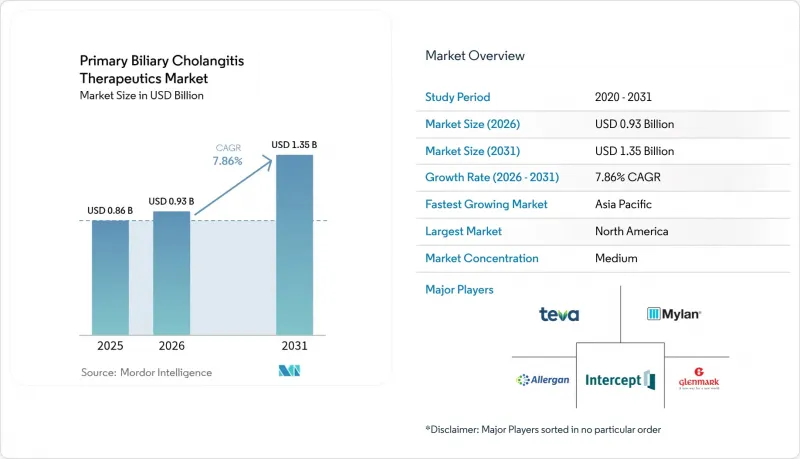
This report is Segmented by Drug Class (Ursodeoxycholic Acid, Obeticholic Acid, and More), Mechanism of Action (FXR Agonists, and More), Line of Therapy (First-Line, and More), Distribution Channel (Hospital Pharmacies, and More), and Geography (North America, Europe, Asia-Pacific, Middle East & Africa, South America). The Market Forecasts are Provided in Terms of Value (USD).
Global Primary Biliary Cholangitis Therapeutics Market Trends and Insights
Label Expansion of FXR Agonists into Compensated Cirrhosis
FXR agonists are moving beyond early-stage disease as regulators accept conditional evidence for cirrhotic PBC patients, a cohort representing roughly one-fifth of total cases. Hospitalization costs for compensated cirrhosis average USD 113,567 annually, more than double non-cirrhotic spending, establishing a strong pharmacoeconomic rationale for early FXR use. Real-world datasets indicate that biochemical improvements translate into better transplant-free survival, attracting payer endorsement. Uptake could be tempered by hepatic decompensation risks, necessitating structured monitoring programs and specialist oversight. As tertiary centers refine patient-selection algorithms, the primary biliary cholangitis therapeutics market gains a sizable incremental revenue stream.
Accelerated Approvals for PPAR Agonists
The 2024 FDA clearances for seladelpar and elafibranor shortened development cycles by relying on alkaline phosphatase normalization instead of long-term mortality endpoints. Seladelpar's 25% complete biochemical response and clinically significant itch reduction have redefined treatment goals, differentiating the class from FXR agonists. Premium U.S. pricing USD 12,606 per month for seladelpar and USD 11,500 for elafibranor supports robust revenue despite the orphan-sized patient base. European conditional authorizations mirror U.S. flexibility and establish a global commercial runway. Rapid label updates are expected once confirmatory trials mature, reinforcing the growth trajectory of the primary biliary cholangitis therapeutics market.
Pruritus Risk with High-Dose FXR Agonists
Severe itching affects 41% of obeticholic acid users and drives 17% discontinue. IL-31 overexpression is implicated, and current antipruritic regimens deliver incomplete relief. Asian populations show higher susceptibility, limiting regional uptake. Clinicians consequently weigh symptom burden against biochemical gains, slowing switching from UDCA. Ongoing trials of next-generation FXR agonists claim lower pruritus incidence, but any delay in commercial availability restrains the Primary Biliary Cholangitis Therapeutics market in the near term.
Other drivers and restraints analyzed in the detailed report include:
- Optimized UDCA Generics Penetrating Cost-Sensitive Markets
- Real-World Evidence Supporting Biochemical Responders
- Myopathy-Linked Discontinuation of Fibrates
For complete list of drivers and restraints, kindly check the Table Of Contents.
Segment Analysis
Ursodeoxycholic acid controlled 45.92% revenue in 2025, reflecting its entrenched first-line status and affordability. However, PPAR agonists are expanding at 9.98% CAGR, buoyed by dual biochemical and symptomatic gains that resonate with prescribers. Obeticholic acid retains a loyal niche for UDCA non-responders but confronts safety-label baggage that limits future momentum. Fibrates, though economical, remain constrained by myopathy vigilance. Other investigational classes, including anti-fibrotic and immunomodulatory agents, are unlikely to influence the Primary Biliary Cholangitis Therapeutics market size materially before 2030, given early-phase maturity.
Continued generic erosion keeps UDCA price points low, securing access across health-economically constrained regions while synergies with vitamin D formulations bolster response rates. In contrast, seladelpar's USD 12,606 monthly list supports premium positioning among refractory patients with debilitating itch, demonstrating the bifurcation of the Primary Biliary Cholangitis Therapeutics market between cost-sensitive and innovation-premium tiers. Combination therapy trials may ultimately blur drug-class demarcations, yet near-term dynamics remain shaped by UDCA's volume and PPAR's value contributions.
FXR agonists accounted for 38.75% of the primary biliary cholangitis therapeutics market size in 2025, propelled by obeticholic acid's earlier entry. Nonetheless, pruritus-driven discontinuations expose a vulnerability that PPAR a/δ agonists are exploiting with a forecast 9.12% CAGR. Bile-acid modulators, chiefly UDCA, deliver steady incremental growth, particularly in Asia-Pacific. Investigational pathways such as NADPH oxidase inhibition and IL-31 targeting promise longer-term diversification but lack near-commercial impact.
Mechanistic plurality is reshaping physician algorithms: FXR agonists deliver alkaline phosphatase declines, while PPAR agonists attenuate itch and fatigue. Real-world evidence advocates sequential or concurrent use, intensifying combination-therapy research. As safety-tuned next-generation FXR compounds enter phase 3, incumbents must refine risk-management protocols to defend share in the evolving primary biliary cholangitis therapeutics market.
Complete Report Scope:
- By Drug Class
- Ursodeoxycholic Acid
- Obeticholic Acid
- PPAR Agonists
- Fibrates
- Other Drug Class
- By Mechanism of Action
- FXR Agonists
- PPAR a/δ Agonists
- Bile-acid Modulators
- Anti-Fibrotic Agents
- Immunomodulators
- By Line of Therapy
- First-line
- Second-line
- Combination
- By Distribution Channel
- Hospital Pharmacies
- Retail Pharmacies
- Online Pharmacies
- By Geography
- North America
- United States
- Canada
- Mexico
- Europe
- Germany
- United Kingdom
- France
- Italy
- Spain
- Rest of Europe
- Asia-Pacific
- China
- Japan
- India
- Australia
- South Korea
- Rest of Asia-Pacific
- Middle East & Africa
- GCC
- South Africa
- Rest of Middle East & Africa
- South America
- Brazil
- Argentina
- Rest of South America
- North America
Geography Analysis
North America's 37.42% revenue share in 2025 stems from orphan-drug incentives, comprehensive insurance coverage, and rapid FDA accelerated approvals that expedited seladelpar and elafibranor launches. Widespread adoption of AI-powered diagnostic scoring in tertiary centers enhances early detection, further enlarging the treated cohort. Real-world registries such as the Canadian PBC Network validate effectiveness and inform reimbursement, tightening the evidence loop that fuels regional growth.
Europe follows with harmonized clinical guidelines and conditional marketing pathways that balance early access with post-authorization evidence demands. Approximately 163,000 diagnosed patients across the bloc provide scale for specialty-pharmacy programs. Health-technology-assessment bodies emphasize cost-utility, yet willingness-to-pay thresholds rise when therapies prevent future transplantation costs. Academic-industry collaboration remains prolific, accelerating combination-therapy trials that extend the franchise of approved agents.
Asia-Pacific is the fastest-growing territory, projected at 10.34% CAGR, driven by expanding universal health schemes and demographic aging that heightens autoimmune liver disease prevalence. Japan's mature reimbursement system enables swift penetration of premium PPAR agonists, while China's volume-based procurement favors optimized UDCA generics yet increasingly covers high-value orphan drugs. Regional acceptance of foreign pivotal data expedites entry timelines. The deployment of AI-enabled screening tools, especially in urban Chinese hospitals, amplifies patient capture, reinforcing long-term expansion of the Primary Biliary Cholangitis Therapeutics market.
- Intercept Pharmaceuticals
- Teva Pharmaceutical Industries
- Viatris (Mylan)
- Ipsen (pharma)
- Genfit
- CymaBay Therapeutics
- Dr Falk Pharma
- Albireo (now Ipsen)
- Mirum Pharmaceuticals
- Gilead Sciences
- Novartis
- Zydus LifeSciences
- Dr Reddy's Laboratories
- Pfizer
- Johnson & Johnson
- Abbvie
- Endo International
- Glenmark Pharmaceuticals
- Sumitomo Dainippon Pharma
- Eli Lilly and Company
Additional Benefits:
- The market estimate (ME) sheet in Excel format
- 3 months of analyst support
TABLE OF CONTENTS
1 Introduction
- 1.1 Study Assumptions & Market Definition
- 1.2 Scope of the Study
2 Research Methodology
3 Executive Summary
4 Market Landscape
- 4.1 Market Overview
- 4.2 Market Drivers
- 4.2.1 Label Expansion of FXR Agonists into Compensated Cirrhosis
- 4.2.2 Accelerated Approvals for PPAR Agonists
- 4.2.3 Optimized UDCA Generics Penetrating Cost-Sensitive Markets
- 4.2.4 Real-World Evidence Supporting Biochemical Responders
- 4.2.5 AI-Driven Early Diagnosis Driving Demand for Therapeutics
- 4.2.6 Growing Clinical Trial Activity in Combination Therapies
- 4.3 Market Restraints
- 4.3.1 Pruritus Risk with High-Dose FXR Agonists
- 4.3.2 Myopathy-Linked Discontinuation of Fibrates
- 4.3.3 Lack of Transplant-Free Survival Endpoints
- 4.3.4 Limited Awareness Among General Practitioners
- 4.4 Regulatory Landscape
- 4.5 Technological Outlook
- 4.6 Porter's Five Forces Analysis
- 4.6.1 Threat of New Entrants
- 4.6.2 Bargaining Power of Buyers
- 4.6.3 Bargaining Power of Suppliers
- 4.6.4 Threat of Substitutes
- 4.6.5 Competitive Rivalry
5 Market Size & Growth Forecasts (Value in USD)
- 5.1 By Drug Class
- 5.1.1 Ursodeoxycholic Acid
- 5.1.2 Obeticholic Acid
- 5.1.3 PPAR Agonists
- 5.1.4 Fibrates
- 5.1.5 Other Drug Class
- 5.2 By Mechanism of Action
- 5.2.1 FXR Agonists
- 5.2.2 PPAR a/δ Agonists
- 5.2.3 Bile-acid Modulators
- 5.2.4 Anti-Fibrotic Agents
- 5.2.5 Immunomodulators
- 5.3 By Line of Therapy
- 5.3.1 First-line
- 5.3.2 Second-line
- 5.3.3 Combination
- 5.4 By Distribution Channel
- 5.4.1 Hospital Pharmacies
- 5.4.2 Retail Pharmacies
- 5.4.3 Online Pharmacies
- 5.5 By Geography
- 5.5.1 North America
- 5.5.1.1 United States
- 5.5.1.2 Canada
- 5.5.1.3 Mexico
- 5.5.2 Europe
- 5.5.2.1 Germany
- 5.5.2.2 United Kingdom
- 5.5.2.3 France
- 5.5.2.4 Italy
- 5.5.2.5 Spain
- 5.5.2.6 Rest of Europe
- 5.5.3 Asia-Pacific
- 5.5.3.1 China
- 5.5.3.2 Japan
- 5.5.3.3 India
- 5.5.3.4 Australia
- 5.5.3.5 South Korea
- 5.5.3.6 Rest of Asia-Pacific
- 5.5.4 Middle East & Africa
- 5.5.4.1 GCC
- 5.5.4.2 South Africa
- 5.5.4.3 Rest of Middle East & Africa
- 5.5.5 South America
- 5.5.5.1 Brazil
- 5.5.5.2 Argentina
- 5.5.5.3 Rest of South America
- 5.5.1 North America
6 Competitive Landscape
- 6.1 Market Concentration
- 6.2 Market Share Analysis
- 6.3 Company Profiles (includes Global level Overview, Market level overview, Core Segments, Financials as available, Strategic Information, Market Rank/Share, Products & Services, Recent Developments)
- 6.3.1 Intercept Pharmaceuticals
- 6.3.2 Teva Pharmaceutical Industries
- 6.3.3 Viatris (Mylan)
- 6.3.4 Ipsen (pharma)
- 6.3.5 Genfit SA
- 6.3.6 CymaBay Therapeutics
- 6.3.7 Dr Falk Pharma
- 6.3.8 Albireo (now Ipsen)
- 6.3.9 Mirum Pharmaceuticals
- 6.3.10 Gilead Sciences
- 6.3.11 Novartis AG
- 6.3.12 Zydus LifeSciences
- 6.3.13 Dr Reddy's Laboratories
- 6.3.14 Pfizer Inc.
- 6.3.15 Johnson & Johnson (Janssen)
- 6.3.16 Allergan Inc.
- 6.3.17 Endo International
- 6.3.18 Glenmark Pharmaceuticals
- 6.3.19 Sumitomo Dainippon Pharma
- 6.3.20 Eli Lilly & Company
7 Market Opportunities & Future Outlook
- 7.1 White-space & Unmet-Need Assessment

