PUBLISHER: Mordor Intelligence | PRODUCT CODE: 2114634

PUBLISHER: Mordor Intelligence | PRODUCT CODE: 2114634
Myelodysplastic Syndrome (MDS) Treatment - Market Share Analysis, Industry Trends & Statistics, Growth Forecasts (2026 - 2031)
According to Mordor Intelligence, the myelodysplastic syndrome treatment market size is expected to grow from USD 3.4 billion in 2025 to USD 3.69 billion in 2026 and is forecast to reach USD 5.59 billion by 2031 at 8.63% CAGR over 2026-2031.
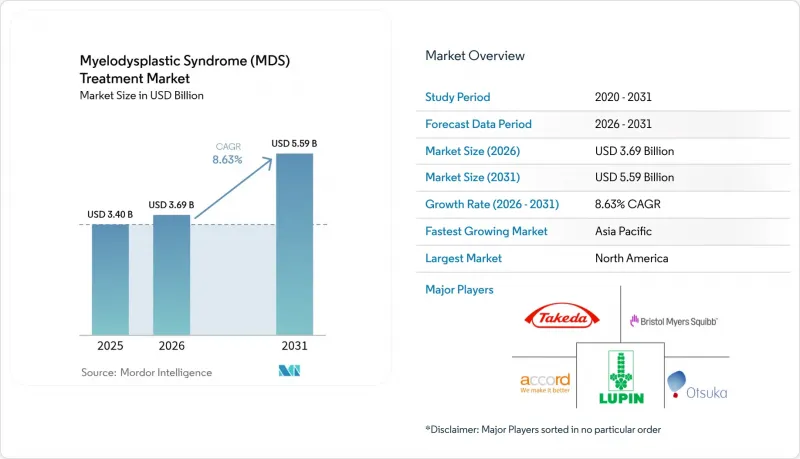
This report is Segmented by Treatment Type (Chemotherapy, Hypomethylating Agents, Immunomodulators, Targeted Therapy, and More), End User (Hospitals, Specialty Clinics, Academic & Research Centers, Homecare & Online Pharmacies), and Geography (North America, Europe, Asia-Pacific, and More). The Market Sizes and Forecasts are Provided in Terms of Value (USD).
Global Myelodysplastic Syndrome (MDS) Treatment Market Trends and Insights
High R&D Spending on Next-Generation Hypomethylating and Combination Regimens
Capital allocation into multi-agent regimens is accelerating after luspatercept delivered 58.5% transfusion independence versus 31.2% for epoetin alfa in the COMMANDS trial. Novartis is running a Phase III evaluation of MBG453 plus azacitidine, and Takeda licensed elritercept (TAK-226) to broaden its anemia pipeline. These programs target distinct mutational profiles, boosting response durability and underpinning the medium-term uplift in the Myelodysplastic syndrome treatment market.
Accelerated FDA/EMA Breakthrough & Orphan Designations
Fast-track pathways are compressing time-to-market. The FDA granted orphan designation to bexmarilimab in March 2025, while the EMA issued a positive CHMP opinion for imetelstat in December 2024 ahead of a March 2025 clearance. Such regulatory alignment is drawing biotechnology capital and accelerating global launches.
Severe Cytopenia-Related Adverse Events Limiting Drug Adherence
Thrombocytopenia and neutropenia required dose modifications in 40% of imetelstat recipients in pivotal trials. Similar issues arise with hypomethylating agents, leading to premature discontinuation that blunts therapeutic benefit. Developers are engineering antibody-drug conjugates and selective inhibitors with narrower marrow impact to offset this short-term drag on the Myelodysplastic syndrome treatment market.
Other drivers and restraints analyzed in the detailed report include:
- Ageing Population-Linked Incidence Surge
- Hospital-initiated molecular triage programs
- High Total-Care Cost Versus QALY Thresholds In Public Payor Systems
For complete list of drivers and restraints, kindly check the Table Of Contents.
Segment Analysis
Targeted therapy posted the fastest 11.72% CAGR to 2031, reshaping the competitive field even though hypomethylating agents still accounted for 27.65% of the Myelodysplastic syndrome treatment market share in 2025. The approval of imetelstat, the first telomerase inhibitor, validates mechanism-specific development. Venetoclax-based combinations reached 96% overall response, underscoring the clinical upside of biomarker-matched regimens.
Expanding molecular diagnostics that stratify patients by TP53, SF3B1, and IDH mutations are reinforcing demand for targeted agents and guiding drug choice. Although chemotherapeutic conditioning remains vital for HSCT candidates, oral high-selectivity compounds are gaining frontline positioning in lower-risk cohorts. Premium pricing is counterbalanced by improved transfusion independence, lowering supportive-care costs, and lifting the segment's contribution to the Myelodysplastic syndrome treatment market size over the forecast horizon.
Complete Report Scope:
- By Treatment Type
- Chemotherapy
- Hypomethylating Agents
- Immunomodulators
- Targeted Therapy
- Other Treatment Types
- By End User
- Hospitals
- Specialty Clinics
- Academic & Research Centers
- Homecare & Online Pharmacies
- Geography
- North America
- United States
- Canada
- Mexico
- Europe
- Germany
- United Kingdom
- France
- Italy
- Spain
- Rest of Europe
- Asia Pacific
- China
- Japan
- India
- South Korea
- Australia
- Rest of Asia Pacific
- Middle East & Africa
- GCC
- South Africa
- Rest of Middle East & Africa
- South America
- Brazil
- Argentina
- Rest of South America
- North America
Geography Analysis
North America led with a 38.95% share of the Myelodysplastic syndrome treatment market in 2025, owing to robust clinical-trial infrastructure, swift FDA pathways, and favorable reimbursement. Early uptake of imetelstat, luspatercept, and treosulfan-fludarabine illustrates the region's appetite for innovation. Europe follows, supported by universal healthcare and EMA alignment. Germany, France, and the United Kingdom quickly incorporated telomerase inhibition after the March 2025 approval, while cost-containment forces are steering payors toward oral agents with lower administration overheads.
Asia Pacific is the fastest-growing sub-region at 10.21% CAGR through 2031. China's younger median diagnosis age and distinct cytogenetics are driving domestic research and localized guidelines. Japan's aging population and sophisticated insurance coverage foster high drug adoption, whereas India's widening middle class and medical-tourism hubs are improving therapy access. Regulatory harmonization projects, such as ASEAN CTPP, are set to streamline approvals, providing further upside for the Myelodysplastic syndrome treatment market.
Emerging regions face infrastructure gaps. However, the United Arab Emirates opened a comprehensive HSCT center at Burjeel Medical City in 2024, and Egypt's transplant program surpassed 4,000 cumulative procedures, signaling capacity upgrades that will gradually expand the addressable patient pool.
- Bristol Myers Squibb (Celgene)
- Novartis
- Takeda Pharmaceuticals
- Abbvie
- Jazz Pharmaceuticals
- Otsuka Pharma
- Amgen
- AstraZeneca
- Geron Corp.
- Merck & Co. (Acceleron)
- Gilead Sciences
- Fate Therapeutics
- Onconova Therapeutics
- StemLine Therapeutics
- Keros Therapeutics
- Rigel Pharmaceuticals
- Faron Pharmaceuticals
- Astellas Pharma
- BeiGene Ltd.
- Suzhou ImmuneOnco
- additional firms as identified
Additional Benefits:
- The market estimate (ME) sheet in Excel format
- 3 months of analyst support
TABLE OF CONTENTS
1 Introduction
- 1.1 Study Assumptions & Market Definition
- 1.2 Scope of the Study
2 Research Methodology
3 Executive Summary
4 Market Landscape
- 4.1 Market Overview
- 4.2 Market Drivers
- 4.2.1 High R&D Spending On Novel Hypomethylating & Combination Regimens
- 4.2.2 Accelerated FDA/EMA Breakthrough & Orphan Designations
- 4.2.3 Ageing Population-Linked Incidence Surge In China & Western Europe
- 4.2.4 Hospital-Initiated Molecular Triage Programs Boosting Early Diagnosis
- 4.2.5 Venture-Capital Funding For Ex-Vivo Gene-Edited HSCT Platforms
- 4.2.6 AI-Driven Prognostic Scoring Tools Enabling Personalized Drug Dosing
- 4.3 Market Restraints
- 4.3.1 Severe Cytopenia-Related Adverse Events Limiting Drug Adherence
- 4.3.2 High Total-Care Cost Versus QALY Thresholds In Public Payor Systems
- 4.3.3 Donor-Matching Bottlenecks For Allogeneic HSCT In Emerging Markets
- 4.3.4 Limited Predictive Biomarkers For HMA-Refractory Patients
- 4.4 Supply Chain Analysis
- 4.5 Regulatory Landscape
- 4.6 Technological Outlook
- 4.7 Porter's Five Forces Analysis
- 4.7.1 Threat of New Entrants
- 4.7.2 Bargaining Power of Buyers
- 4.7.3 Bargaining Power of Suppliers
- 4.7.4 Threat of Substitute Products
- 4.7.5 Intensity of Competitive Rivalry
5 Market Size & Growth Forecasts (Value)
- 5.1 By Treatment Type
- 5.1.1 Chemotherapy
- 5.1.2 Hypomethylating Agents
- 5.1.3 Immunomodulators
- 5.1.4 Targeted Therapy
- 5.1.5 Other Treatment Types
- 5.2 By End User
- 5.2.1 Hospitals
- 5.2.2 Specialty Clinics
- 5.2.3 Academic & Research Centers
- 5.2.4 Homecare & Online Pharmacies
- 5.3 Geography
- 5.3.1 North America
- 5.3.1.1 United States
- 5.3.1.2 Canada
- 5.3.1.3 Mexico
- 5.3.2 Europe
- 5.3.2.1 Germany
- 5.3.2.2 United Kingdom
- 5.3.2.3 France
- 5.3.2.4 Italy
- 5.3.2.5 Spain
- 5.3.2.6 Rest of Europe
- 5.3.3 Asia Pacific
- 5.3.3.1 China
- 5.3.3.2 Japan
- 5.3.3.3 India
- 5.3.3.4 South Korea
- 5.3.3.5 Australia
- 5.3.3.6 Rest of Asia Pacific
- 5.3.4 Middle East & Africa
- 5.3.4.1 GCC
- 5.3.4.2 South Africa
- 5.3.4.3 Rest of Middle East & Africa
- 5.3.5 South America
- 5.3.5.1 Brazil
- 5.3.5.2 Argentina
- 5.3.5.3 Rest of South America
- 5.3.1 North America
6 Competitive Landscape
- 6.1 Market Concentration
- 6.2 Market Share Analysis
- 6.3 Company Profiles (includes Global level Overview, Market level overview, Core Segments, Financials as available, Strategic Information, Market Rank/Share for key companies, Products & Services, and Recent Developments)
- 6.3.1 Bristol Myers Squibb (Celgene)
- 6.3.2 Novartis AG
- 6.3.3 Takeda Pharmaceutical
- 6.3.4 AbbVie Inc.
- 6.3.5 Jazz Pharmaceuticals
- 6.3.6 Otsuka Pharma
- 6.3.7 Amgen Inc.
- 6.3.8 AstraZeneca plc
- 6.3.9 Geron Corp.
- 6.3.10 Merck & Co. (Acceleron)
- 6.3.11 Gilead Sciences
- 6.3.12 Fate Therapeutics
- 6.3.13 Onconova Therapeutics
- 6.3.14 StemLine Therapeutics
- 6.3.15 Keros Therapeutics
- 6.3.16 Rigel Pharmaceuticals
- 6.3.17 Faron Pharmaceuticals
- 6.3.18 Astellas Pharma
- 6.3.19 BeiGene Ltd.
- 6.3.20 Suzhou ImmuneOnco
- 6.3.21 additional firms as identified
7 Market Opportunities & Future Outlook
- 7.1 White-space & Unmet-Need Assessment

