PUBLISHER: Mordor Intelligence | PRODUCT CODE: 2114636

PUBLISHER: Mordor Intelligence | PRODUCT CODE: 2114636
Kidney Stone Retrieval Devices - Market Share Analysis, Industry Trends & Statistics, Growth Forecasts (2026 - 2031)
According to Mordor Intelligence, the kidney stone retrieval devices market size is expected to grow from USD 3.07 billion in 2025 to USD 3.21 billion in 2026 and is forecast to reach USD 4.03 billion by 2031 at 4.64% CAGR over 2026-2031.
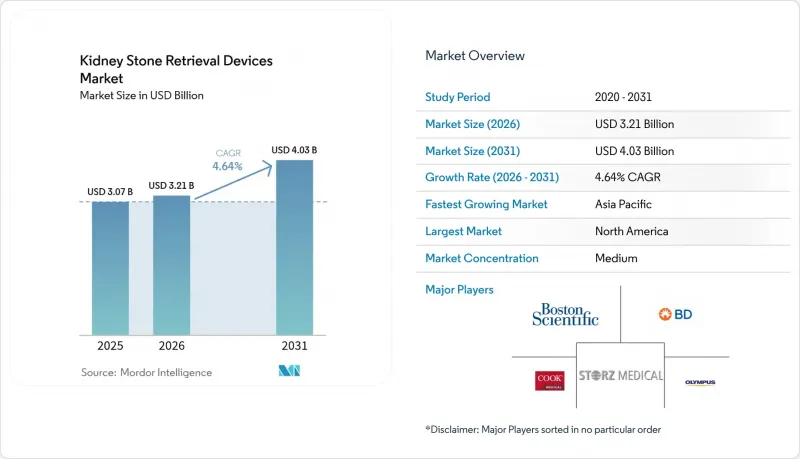
This report is Segmented by Device Type (Ureteroscopes, Retrieval Baskets & Forceps, Lithotripters, and More), End-User (Hospitals, Ambulatory Surgical Centers, Specialty & Urology Clinics), and Geography (North America, and More). The Market Forecasts are Provided in Terms of Value (USD).
Global Kidney Stone Retrieval Devices Market Trends and Insights
Shift toward single-use flexible ureteroscopes
Clinical evidence shows that single-use scopes remove reprocessing costs, cut cross-contamination risk, and deliver comparable stone-free outcomes to reusable equivalents. Per-case expenditure ranges from USD 1,300-3,180, making them economical for facilities handling fewer than 50 cases annually. Boston Scientific's LithoVue platform spearheads adoption, while Olympus will introduce its first single-use ureteroscope in Europe in H2 FY2025. CMS transitional pass-through payments under code C1747 bolster the kidney stone retrieval devices market by improving outpatient economics.
Wider reimbursement for minimally-invasive procedures
Medicare recognizes ureteroscopic lithotripsy as reasonable and necessary, and CMS recently assigned Category I CPT codes to Olympus's iTind system, signaling willingness to remunerate validated innovation. Field reimbursement managers and ROI calculators from Boston Scientific help providers navigate billing, smoothing adoption paths in the kidney stone retrieval devices market .
High capital cost of digital ureteroscopes
Reusable flexible scopes cost USD 50,000-150,000 and require supporting lasers and imaging stacks exceeding USD 200,000, delaying ROI for resource-constrained sites. Single-use scopes shift cost to operating budgets but can top USD 3,000 per case at low volume, complicating procurement decisions in the kidney stone retrieval devices market.
Other drivers and restraints analyzed in the detailed report include:
- Rapid adoption of thulium-fiber and burst-wave lithotripsy
- AI-assisted endoscopic navigation reducing OR time
- Device-related infection and encrustation risk
For complete list of drivers and restraints, kindly check the Table Of Contents.
Segment Analysis
The ureteroscope segment accounted for 33.92% of the kidney stone retrieval devices market share in 2025, which translated to roughly USD 1.04 billion of the 2025 kidney stone retrieval devices market size. Dominance stems from the instrument's essential role in visualising and accessing calculi throughout the urinary tract, while recent upgrades in digital imaging and smaller outer diameters improve manoeuvrability and patient safety. Single-use digital ureteroscopes accelerate volume growth because hospitals can eliminate repair downtime, reprocessing expense and cross-contamination risk. Reusable fleets remain relevant in high-volume academic centres that can amortise reprocessing infrastructure and secure multiyear service contracts. Retrieval baskets and guidewires move in parallel since every ureteroscopic case requires at least one ancillary tool for fragment extraction or device placement.
Lithotripters represent the fastest-growing device class with a projected 5.12% CAGR to 2031, led by thulium-fibre laser consoles that deliver faster fragmentation with lower retropulsion than holmium:YAG systems medical.olympusamerica.com. Compact footprint, standard-outlet power requirements and embedded safety controls allow smaller ambulatory sites to adopt high-energy lasers that once belonged only in tertiary theatres. Access sheaths with suction ports shorten operative time by lowering intrarenal pressure and clearing debris in real time, a benefit that dovetails with advanced laser performance. Manufacturers are layering artificial-intelligence algorithms on top of digital video streams to automate stone detection and propose optimal laser settings, adding another point of differentiation in the kidney stone retrieval devices market. Environmental sustainability also shapes buying criteria; vendors now highlight recyclable packaging and lower water consumption during scope cleaning to align with hospital ESG goals.
Complete Report Scope:
- By Device Type
- Ureteroscopes
- Retrieval Baskets & Forceps
- Lithotripters
- Ureteral Stents
- Dilators & Access Sheaths
- Guidewires
- By End-user
- Hospitals
- Ambulatory Surgical Centers
- Specialty & Urology Clinics
- By Geography
- North America
- United States
- Canada
- Mexico
- Europe
- Germany
- United Kingdom
- France
- Italy
- Spain
- Rest of Europe
- Asia-Pacific
- China
- Japan
- India
- South Korea
- Australia
- Rest of Asia-Pacific
- South America
- Brazil
- Argentina
- Rest of South America
- Middle East and Africa
- GCC
- South Africa
- Rest of Middle East & Africa
- North America
Geography Analysis
North America controlled 42.12 % of the kidney stone retrieval devices market in 2025, buoyed by comprehensive payer coverage and high surgeon density. Medicare reimbursement for transurethral lithotripsy and CMS pass-through payments for single-use scopes solidify procedural economics. Boston Scientific reported 23.5 % Urology segment growth in Q1 2025 as hospitals and ASCs upgraded to digital single-use platforms. Canada mirrors this trend under provincial funding, although capital constraints lengthen purchasing cycles for AI-ready consoles.
Asia-Pacific represents the fastest-growing region, expanding at a 6.86 % CAGR through 2031. Rising prevalence, urbanisation and improving insurance penetration fuel procedure volumes. China's national data show a decisive tilt toward ureteroscopic treatment; Japan leads in thulium-fiber laser utilisation, and India's private-insurance growth unlocks demand for cost-effective single-use scopes. Governments pursue Access-Capability-Trust frameworks to harmonise device approvals, upskill surgeons and build digital infrastructure-steps vital for sustained expansion of the kidney stone retrieval devices market.
Europe exhibits steady growth, supported by Medical Device Regulation compliance and ESG-weighted procurement criteria. Olympus is set to launch its first single-use ureteroscope in H2 FY2025, catering to hospitals aiming to reduce cross-infection and water consumption. Training deficits loom as the Simulator Availability Index for ureteroscopy trainers declined in recent surveys, hinting at potential workforce bottlenecks doi.org. South America and the Middle East participate through technology-transfer partnerships, whereas Africa faces financing hurdles and remains an untapped frontier of the kidney stone retrieval devices market.
- Boston Scientific
- Cook Group
- Olympus
- Stryker
- Karl Storz
- Dornier MedTech
- Coloplast
- Teleflex
- Richard Wolf
- Siemens Healthineers
- Lumenis
- Calyxo Inc.
- Becton Dickinson & Co.
- PENTAX Medical (HOYA)
- Taewoong Medical Co. Ltd.
- WIKKON
- Direx Group
- Allengers Medical Systems
- Bard Medical (BD)
- ConMed Corp.
Additional Benefits:
- The market estimate (ME) sheet in Excel format
- 3 months of analyst support
TABLE OF CONTENTS
1 Introduction
- 1.1 Study Assumptions & Market Definition
- 1.2 Scope of the Study
2 Research Methodology
3 Executive Summary
4 Market Landscape
- 4.1 Market Overview
- 4.2 Market Drivers
- 4.2.1 Shift Toward Single-Use Flexible Ureteroscopes
- 4.2.2 Growing Prevalence Of Urolithiasis In Ageing Populations
- 4.2.3 Wider Reimbursement For Minimally-Invasive Procedures
- 4.2.4 Rapid Adoption Of Thulium-Fiber & Burst-Wave Lithotripsy
- 4.2.5 AI-Assisted Endoscopic Navigation Reducing OR Time
- 4.2.6 ESG Pressure Favoring Low-Water, Low-Radiation Techniques
- 4.3 Market Restraints
- 4.3.1 High Capital Cost Of Digital Ureteroscopes
- 4.3.2 Device-Related Infection & Encrustation Concerns
- 4.3.3 Shortage Of Endourology Specialists In Low-Income Nations
- 4.3.4 Supply-Chain Dependence On Specialty Nitinol Suppliers
- 4.4 Value / Supply-Chain Analysis
- 4.5 Regulatory Landscape
- 4.6 Technological Outlook
- 4.7 Porter's Five Forces Analysis
- 4.7.1 Bargaining Power of Suppliers
- 4.7.2 Bargaining Power of Buyers
- 4.7.3 Threat of New Entrants
- 4.7.4 Threat of Substitutes
- 4.7.5 Competitive Rivalry
5 Market Size & Growth Forecasts (Value, USD)
- 5.1 By Device Type
- 5.1.1 Ureteroscopes
- 5.1.2 Retrieval Baskets & Forceps
- 5.1.3 Lithotripters
- 5.1.4 Ureteral Stents
- 5.1.5 Dilators & Access Sheaths
- 5.1.6 Guidewires
- 5.2 By End-user
- 5.2.1 Hospitals
- 5.2.2 Ambulatory Surgical Centers
- 5.2.3 Specialty & Urology Clinics
- 5.3 By Geography
- 5.3.1 North America
- 5.3.1.1 United States
- 5.3.1.2 Canada
- 5.3.1.3 Mexico
- 5.3.2 Europe
- 5.3.2.1 Germany
- 5.3.2.2 United Kingdom
- 5.3.2.3 France
- 5.3.2.4 Italy
- 5.3.2.5 Spain
- 5.3.2.6 Rest of Europe
- 5.3.3 Asia-Pacific
- 5.3.3.1 China
- 5.3.3.2 Japan
- 5.3.3.3 India
- 5.3.3.4 South Korea
- 5.3.3.5 Australia
- 5.3.3.6 Rest of Asia-Pacific
- 5.3.4 South America
- 5.3.4.1 Brazil
- 5.3.4.2 Argentina
- 5.3.4.3 Rest of South America
- 5.3.5 Middle East and Africa
- 5.3.5.1 GCC
- 5.3.5.2 South Africa
- 5.3.5.3 Rest of Middle East & Africa
- 5.3.1 North America
6 Competitive Landscape
- 6.1 Market Concentration
- 6.2 Market Share Analysis
- 6.3 Company Profiles (includes Global level Overview, Market level overview, Core Segments, Financials as available, Strategic Information, Market Rank/Share for key companies, Products & Services, and Recent Developments)
- 6.3.1 Boston Scientific Corporation
- 6.3.2 Cook Medical LLC
- 6.3.3 Olympus Corporation
- 6.3.4 Stryker Corporation
- 6.3.5 Karl Storz SE & Co. KG
- 6.3.6 Dornier MedTech
- 6.3.7 Coloplast A/S
- 6.3.8 Teleflex Inc.
- 6.3.9 Richard Wolf GmbH
- 6.3.10 Siemens Healthineers
- 6.3.11 Lumenis Ltd.
- 6.3.12 Calyxo Inc.
- 6.3.13 Becton Dickinson & Co.
- 6.3.14 PENTAX Medical (HOYA)
- 6.3.15 Taewoong Medical Co. Ltd.
- 6.3.16 WIKKON
- 6.3.17 Direx Group
- 6.3.18 Allengers Medical Systems
- 6.3.19 Bard Medical (BD)
- 6.3.20 ConMed Corp.
7 Market Opportunities & Future Outlook
- 7.1 White-space & Unmet-need Assessment

