PUBLISHER: Mordor Intelligence | PRODUCT CODE: 2114648

PUBLISHER: Mordor Intelligence | PRODUCT CODE: 2114648
Montelukast Sodium - Market Share Analysis, Industry Trends & Statistics, Growth Forecasts (2026 - 2031)
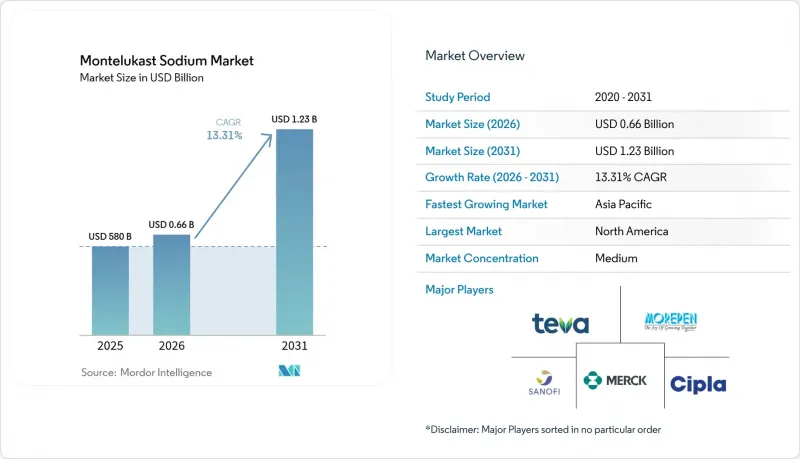
According to Mordor Intelligence, the montelukast sodium market size was valued at USD 580 million in 2025 and estimated to grow from USD 657.2 million in 2026 to reach USD 1.23 billion by 2031, at a CAGR of 13.31% during the forecast period (2026-2031).
This report is Segmented by Dosage Form (Tablets, Oral Solutions/Syrups, Oral Granules, Other Forms), Application (Asthma, Allergic Rhinitis, Urticaria, Exercise-Induced Bronchoconstriction, NSAID-Exacerbated Respiratory Disease, Other Applications), and Geography (North America, Europe, Asia-Pacific, Middle East & Africa, South America). The Market Forecasts are Provided in Terms of Value (USD).
Global Montelukast Sodium Market Trends and Insights
Escalating Global Asthma & Allergic-Rhinitis Prevalence
Exercise-induced bronchoconstriction affects up to 70% of competitive athletes and as high as 35% of children who engage in regular sports activity. Urban air pollution, sedentary living, and better diagnostics have pushed asthma case identification sharply upward, especially in rapidly industrializing Asian cities. Clinical guidelines increasingly endorse leukotriene-receptor antagonists as adjunct or first-line prevention in pediatric sports asthma, bolstering Montelukast Sodium market demand. Indian prescribing studies show 84.83% of otorhinolaryngologists favor montelukast-based combinations for allergic-rhinitis relief, confirming strong frontline acceptance in high-growth economies. Together, these epidemiological and practice-pattern shifts keep patient inflow on a steady upward slope.
Patent Expiries Driving Generic Penetration
The elimination of brand exclusivity has triggered a cascade of FDA approvals for cost-efficient generics from Aurobindo Pharma, Dr. Reddy's, Ajanta Pharma USA, and others. List-price erosion widened access in price-sensitive markets while also pushing producers toward process economies of scale. More than 98 API suppliers now compete globally, with 33 holding US Drug Master Files and 21 owning European certificates, underlining both opportunity and oversupply pressure. The net effect is a larger treated population, albeit at thinner per-unit margins, which nevertheless supports overall revenue expansion thanks to sheer volume growth.
Neuro-Psychiatric Boxed Warning Dampening Prescriptions
The FDA and MHRA ordered conspicuous boxed warnings in 2024 after pharmacovigilance data linked montelukast to depression, insomnia, and suicidality in select patients. Post-warning pharmacy claims reveal a temporary 12% volume dip as pediatricians switched to intranasal steroids or antihistamines. Although most adverse events resolve on discontinuation, heightened media attention has elevated medico-legal risk awareness. As clinicians recalibrate benefit-risk, new prescriptions are increasingly confined to cases unresponsive to alternative therapies, shaving near-term growth off the montelukast sodium market.
Other drivers and restraints analyzed in the detailed report include:
- Ageing Population with Chronic Respiratory Comorbidities
- Rapid Uptake of Pediatric-Friendly Fast-Dissolve Formats
- Biologic Inhalables Replacing LTRA in Severe Asthma
For complete list of drivers and restraints, kindly check the Table Of Contents.
Segment Analysis
Tablets delivered 81.88% of montelukast sodium market share in 2025, buoyed by cost-efficient high-volume manufacture, durable shelf stability, and clinician familiarity. Conventional film-coated tablets meet adult maintenance needs, while 5 mg chewables and 4 mg mini-chews satisfy school-age pediatric dosing. Oral solutions and syrups serve combination-therapy niches, particularly in levocetirizine co-formulations that have demonstrated superior symptom relief in pediatric allergic-rhinitis cohorts. Oral-granule sachets extend clinical reach to infants as young as 12 months, thereby maximizing early-life customer capture.
Dispersible and fast-dissolve tablets are set to expand at a 14.82% CAGR through 2031, the fastest among dosage forms. Rapid-disintegration technology improves adherence in both children and elderly populations who confront dysphagia. Bioequivalence studies show dissolution profiles on par with leading brand reference standards, confirming therapeutic interchangeability. Taste-masking micro-encapsulation, proprietary sweeteners, and moisture-resistant blister packs add value for caregivers and pharmacies. These features help producers defend modest price premiums even as generic list prices slide, reinforcing revenue resilience within the Montelukast Sodium market.
Complete Report Scope:
- By Dosage Form
- Tablets
- Film-coated Tablets
- Chewable Tablets
- Dispersible / Fast-dissolving Tablets
- Oral Solutions/Syrups
- Oral Granules
- Other Forms
- Tablets
- By Application
- Asthma
- Allergic Rhinitis
- Urticaria
- Exercise-Induced Bronchoconstriction
- NSAID-Exacerbated Respiratory Disease
- Other Applications
- By Geography
- North America
- United States
- Canada
- Mexico
- Europe
- Germany
- United Kingdom
- France
- Italy
- Spain
- Rest of Europe
- Asia-Pacific
- China
- Japan
- India
- Australia
- South Korea
- Rest of Asia-Pacific
- Middle East & Africa
- GCC
- South Africa
- Rest of Middle East & Africa
- South America
- Brazil
- Argentina
- Rest of South America
- North America
Geography Analysis
North America preserved 38.34% revenue share in 2025, underpinned by broad insurance coverage, established clinical protocols, and high disease prevalence. The United States accounts for more than four-fifths of regional demand, with Canada and Mexico supplying supplemental volume growth via favorable trade and parallel-import frameworks. Boxed-warning implementation shaved low-double-digit prescription counts in 2024, yet payer formularies continue to reimburse generics as first-line add-ons, anchoring the region's revenue base. Intensifying generic rivalry is pressuring average selling prices, but unit demand remains resilient as asthma incidence climbs among obese adolescents and smoke-exposed seniors.
Asia-Pacific is poised to deliver the fastest CAGR, 15.63%, between 2026-2031. China's pharmaceutical expenditure is rising 8.5% annually, aided by volume-based procurement that widens suburban and rural access. India's ENT specialists already deploy montelukast combinations in 84.83% of allergic-rhinitis cases, showcasing entrenched prescriber preference and large untapped rural patient pools. Japan's accelerated-approval pathway incentivizes child-friendly fixed-dose combos, while Australia and South Korea extend high per-capita spending and robust reimbursement. Lingering reliance on Chinese API, however, makes regional manufacturers vulnerable to supply-chain shocks, prompting dual-sourcing strategies.
Europe maintains stable, mature demand across the five largest markets, supported by coordinated procurement that balances affordability and quality. Aging demographics guarantee chronic-disease medication demand durability, while pediatric indications benefit from school-based asthma-awareness programs. Regulatory harmonization through EMA mutual-recognition simplifies multi-country launches for generic producers, though price caps limit upside. Middle East & Africa and South America furnish long-run optionality as private insurance penetration inches up and urban air-pollution trends accelerate respiratory diagnoses.
- Merck
- Teva Pharmaceutical Industries
- Dr. Reddy's Laboratories
- Cipla
- Sun Pharmaceuticals Industries
- Aurobindo Pharma
- Viatris (Mylan)
- Morepen
- Intas Pharmaceuticals
- Apotex (SK Capital)
- Glenmark Pharma
- Amneal Pharmaceuticals
- Sanofi
- Hikma
- Lonza Group
- Delmar Chemicals
- Sanyo Chemical Industries
- EuroAPI
- Metrochem API
- Faran Shimi Pharmaceutical
Additional Benefits:
- The market estimate (ME) sheet in Excel format
- 3 months of analyst support
TABLE OF CONTENTS
1 Introduction
- 1.1 Study Assumptions & Market Definition
- 1.2 Scope of the Study
2 Research Methodology
3 Executive Summary
4 Market Landscape
- 4.1 Market Overview
- 4.2 Market Drivers
- 4.2.1 Escalating Global Asthma & Allergic-Rhinitis Prevalence
- 4.2.2 Patent Expiries Driving Generic Penetration
- 4.2.3 Ageing Population with Chronic Respiratory Comorbidities
- 4.2.4 Rapid Uptake of Paediatric-Friendly Fast-Dissolve Formats
- 4.2.5 Drug-Repurposing Trials for Neuro-Inflammatory & Long-COVID Uses
- 4.2.6 Ai-Enabled Screening Revealing Antiviral Potential
- 4.3 Market Restraints
- 4.3.1 Neuro-Psychiatric Boxed Warning Dampening Prescriptions
- 4.3.2 Biologic Inhalables Replacing LTRA in Severe Asthma
- 4.3.3 Waste-Water Discharge Limits Raising EHS Compliance Cost
- 4.3.4 Tight Chinese Supply of Montelukast Sodium Intermediate
- 4.4 Porter's Five Forces Analysis
- 4.4.1 Threat of New Entrants
- 4.4.2 Bargaining Power of Buyers
- 4.4.3 Bargaining Power of Suppliers
- 4.4.4 Threat of Substitutes
- 4.4.5 Competitive Rivalry
5 Market Size & Growth Forecasts (Value in USD)
- 5.1 By Dosage Form
- 5.1.1 Tablets
- 5.1.1.1 Film-coated Tablets
- 5.1.1.2 Chewable Tablets
- 5.1.1.3 Dispersible / Fast-dissolving Tablets
- 5.1.2 Oral Solutions/Syrups
- 5.1.3 Oral Granules
- 5.1.4 Other Forms
- 5.1.1 Tablets
- 5.2 By Application
- 5.2.1 Asthma
- 5.2.2 Allergic Rhinitis
- 5.2.3 Urticaria
- 5.2.4 Exercise-Induced Bronchoconstriction
- 5.2.5 NSAID-Exacerbated Respiratory Disease
- 5.2.6 Other Applications
- 5.3 By Geography
- 5.3.1 North America
- 5.3.1.1 United States
- 5.3.1.2 Canada
- 5.3.1.3 Mexico
- 5.3.2 Europe
- 5.3.2.1 Germany
- 5.3.2.2 United Kingdom
- 5.3.2.3 France
- 5.3.2.4 Italy
- 5.3.2.5 Spain
- 5.3.2.6 Rest of Europe
- 5.3.3 Asia-Pacific
- 5.3.3.1 China
- 5.3.3.2 Japan
- 5.3.3.3 India
- 5.3.3.4 Australia
- 5.3.3.5 South Korea
- 5.3.3.6 Rest of Asia-Pacific
- 5.3.4 Middle East & Africa
- 5.3.4.1 GCC
- 5.3.4.2 South Africa
- 5.3.4.3 Rest of Middle East & Africa
- 5.3.5 South America
- 5.3.5.1 Brazil
- 5.3.5.2 Argentina
- 5.3.5.3 Rest of South America
- 5.3.1 North America
6 Competitive Landscape
- 6.1 Market Concentration
- 6.2 Market Share Analysis
- 6.3 Company Profiles (includes Global level Overview, Market level overview, Core Segments, Financials as available, Strategic Information, Market Rank/Share for key companies, Products & Services, and Recent Developments)
- 6.3.1 Merck & Co., Inc.
- 6.3.2 Teva Pharmaceutical Industries
- 6.3.3 Dr. Reddy's Laboratories
- 6.3.4 Cipla
- 6.3.5 Sun Pharmaceutical
- 6.3.6 Aurobindo Pharma
- 6.3.7 Viatris (Mylan)
- 6.3.8 Morepen Laboratories
- 6.3.9 Intas Pharmaceuticals
- 6.3.10 Apotex (SK Capital)
- 6.3.11 Glenmark Pharma
- 6.3.12 Amneal Pharmaceuticals
- 6.3.13 Sanofi
- 6.3.14 Hikma
- 6.3.15 Lonza Group
- 6.3.16 Delmar Chemicals
- 6.3.17 Sanyo Chemical Industries
- 6.3.18 EuroAPI
- 6.3.19 Metrochem API
- 6.3.20 Faran Shimi Pharmaceutical
7 Market Opportunities & Future Outlook
- 7.1 White-space & Unmet-Need Assessment

