PUBLISHER: Mordor Intelligence | PRODUCT CODE: 2114650

PUBLISHER: Mordor Intelligence | PRODUCT CODE: 2114650
Coated Fabric - Market Share Analysis, Industry Trends & Statistics, Growth Forecasts (2026 - 2031)
According to Mordor Intelligence, the coated fabric market size is expected to grow from USD 24.67 billion in 2025 to USD 25.92 billion in 2026 and is forecast to reach USD 33.21 billion by 2031 at 5.08% CAGR over 2026-2031.
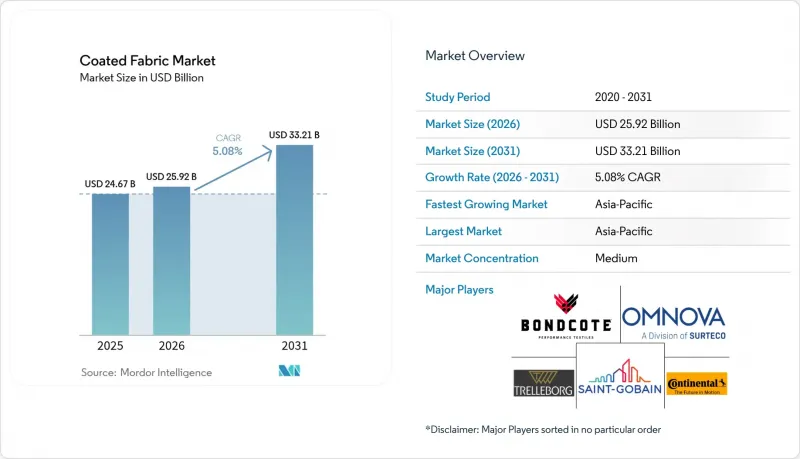
This report is Segmented by Coating Material (Polymer Coated, Rubber Coated, Fabric-Backed Wall Coverings), Fabric Substrate (Polyester, Nylon, Cotton & Blends, Other), Application (Automotive & Transportation, Protective Clothing, Furniture, and More), and Geography (Asia-Pacific, North America, Europe, South America, Middle East and Africa). The Market Forecasts are Provided in Terms of Value (USD).
Global Coated Fabric Market Trends and Insights
Surge in Automotive Air-Bag and Seat-Cover Volumes
Automotive safety laws and electric-vehicle design targets are boosting demand for heat-stable, lightweight coated fabrics. Autoliv introduced an airbag fabric made from 100% recycled polyester in 2024, showing that stringent crash-safety requirements can coexist with circular-economy goals. Lear Corporation's ComfortMax seat system, scheduled for 2025 launches, blends PU coatings with integrated heating to cut cabin-warm-up times and battery drain in electric cars. Covestro's thermoplastic PU films enable flexible sunroof shades that house embedded electronics, illustrating the materials shift toward smart interiors. These breakthroughs push the coated fabrics market toward high-value, multifunctional constructions that tolerate abrasion, extreme temperatures, and complex forming.
Expansion of Industrial Protective-Clothing Mandates
Updated EU standards such as EN ISO 11612 require certified flame and heat protection, strengthening demand for advanced coatings over untreated fabrics. Sioen Industries extended its SYNQ multi-hazard workwear into the UK and Ireland in 2025 to address stricter employer liability rules. Silver-ion finishes can now achieve greater than 99% bacterial reduction after 50 laundering cycles, combining hygiene and safety in a single garment. Manufacturers that secure multi-standard certifications convert regulation into durable revenue streams, particularly in chemicals, oil & gas, and utilities, where procurement cycles favor pre-approved vendors.
PVC Raw-Material Volatility & Disposal Scrutiny
The EU's proposal to restrict over 10,000 PFAS chemicals would directly affect vinyl-based coatings, as many formulations rely on fluorinated processing aids. Hanwha's bio-attributed PVC, incorporating plant oils and waste cooking oil, cuts cradle-to-gate CO2 by 58% yet carries higher feedstock costs that squeeze margins. Disposal fees and take-back schemes under the EU's Extended Producer Responsibility (EPR) framework raise life-cycle costs for legacy PVC items, prompting OEMs to switch to PU and silicone systems despite upfront price premiums.
Other drivers and restraints analyzed in the detailed report include:
- Increasing Demand for Antiviral and Antimicrobial Coatings for Public-Health Resilience
- Sensor-Integrated E-Textiles for Smart Interiors and Wearables
- Specialty-Polymer Supply-Chain Disruptions
For complete list of drivers and restraints, kindly check the Table Of Contents.
Segment Analysis
Polymer coatings commanded 80.12% of the coated fabrics market share in 2025 as their versatility spans automotive, industrial, and consumer applications. Within this group, polyurethane grades are on track for a 6.75% CAGR to 2031, a pace that underscores OEM preference for flexible, solvent-free alternatives to vinyl. PVC retains scale benefits in tarpaulins and advertising banners, yet EPR fees and landfill bans shrink its addressable volume in Europe. Silicone systems win in high-temperature gaskets, while acrylic dispersion coatings anchor breathable outdoor gear. BASF's 2024 launch of Haptex 4.0-a recyclable synthetic leather that co-recycles with PET-points to future formulations that streamline mechanical-recycling flows.
Continued R&D in bio-attributed polymers hints at fresh competition for incumbent chemistries. Rubber-coated fabrics meet niche demands for extreme abrasion yet face substitution by PU films that offer similar durability at lighter weights. Specialty nano-coatings that add conductivity or self-healing properties command premium margins, expanding the coated fabrics market into electronics and aerospace niches. Suppliers that master multi-layer co-casting and in-line curing stand to secure the highest returns as end-users seek turnkey solutions.
Complete Report Scope:
- By Coating Material
- Polymer Coated
- PVC Coated
- PU Coated
- PE Coated
- Other Polymer Coated Mterials (Acrylic Coated, Silicone Coated, etc.)
- Rubber Coated
- Fabric-Backed Wall Coverings
- Polymer Coated
- By Fabric Substrate
- Polyester
- Nylon
- Cotton and Blends
- Other (Wool, Rayon, etc.)
- By Application
- Automotive and Transportation
- Protective Clothing
- Furniture
- Industrial
- Other Applications (Banners, Packaging, etc.)
- By Geography
- Asia-Pacific
- China
- India
- Japan
- South Korea
- Rest of Asia-Pacific
- North America
- United States
- Canada
- Mexico
- Europe
- Germany
- United Kingdom
- Italy
- France
- Rest of Europe
- South America
- Brazil
- Argentina
- Rest of South America
- Middle East and Africa
- Saudi Arabia
- South Africa
- Rest of Middle East and Africa
- Asia-Pacific
Geography Analysis
Asia-Pacific retained 46.70% of global revenue in 2025 and is projected to expand at a 6.20% CAGR to 2031. China anchors regional heft with its end-to-end textile base and surging EV output, while India's expansion in technical-textile parks attracts fresh capital from multinationals like Saint-Gobain, which targets a three-fold local revenue lift by 2035. Japan and South Korea supply cutting-edge coating lines that enable haptic, sensor-rich fabrics, closing the loop between R&D and scaled manufacturing.
North America is a mature buyer emphasizing high-value niches. The United States dominates aerospace, defense, and medical bedding lines that demand strict traceability. Canada leads U.S. PVC-coated-fabric imports, benefiting from duty-free access and proximity, while Mexico widens capacity in automotive seating against a backdrop of near-shoring. Regional policy favors PFAS-free chemistries, spurring investment in water-borne PU dispersions.
Europe faces the world's tightest textile regulations but leverages them to spearhead sustainable-coating technologies. The Extended Producer Responsibility framework launching in January 2025 obliges separate textile-collection systems, raising compliance hurdles for non-recyclable laminates. Germany and Italy concentrate on machinery exports that enable solvent-free, multi-pass lines; France and the Netherlands pilot chemical-recycling loops for coated off-cuts. The bloc's looming PFAS curbs amplify demand for silicone and fluorine-free water barriers, giving EU producers a home-court edge in next-generation finishes.
- Continental AG
- Freudenberg Performance Materials Service GmbH
- Graniteville
- Haartz Corporation
- Herculite
- Heytex Gruppe
- OMNOVA North America Inc.
- Saint-Gobain
- Seaman Corporation
- Sioen Industries NV
- SRF Limited
- Trelleborg AB
Additional Benefits:
- The market estimate (ME) sheet in Excel format
- 3 months of analyst support
TABLE OF CONTENTS
1 Introduction
- 1.1 Study Assumptions and Market Definition
- 1.2 Scope of the Study
2 Research Methodology
3 Executive Summary
4 Market Landscape
- 4.1 Market Overview
- 4.2 Market Drivers
- 4.2.1 Surge in automotive airbag and seat-cover volumes
- 4.2.2 Expansion of industrial protective-clothing mandates
- 4.2.3 Increasing demand for Antiviral and antimicrobial coatings for public-health resilience
- 4.2.4 Sensor-integrated e-textiles for smart interiors and wearables
- 4.2.5 Growing demand for coated fabrics from healthcare industry
- 4.3 Market Restraints
- 4.3.1 PVC raw-material volatility and disposal scrutiny
- 4.3.2 Specialty-polymer supply-chain disruptions
- 4.3.3 Increasing demand for Bio-based, un-coated technical textiles
- 4.4 Value Chain Analysis
- 4.5 Porter's Five Forces
- 4.5.1 Bargaining Power of Suppliers
- 4.5.2 Bargaining Power of Buyers
- 4.5.3 Threat of New Entrants
- 4.5.4 Threat of Substitute Products
- 4.5.5 Degree of Competition
5 Market Size and Growth Forecasts (Value)
- 5.1 By Coating Material
- 5.1.1 Polymer Coated
- 5.1.1.1 PVC Coated
- 5.1.1.2 PU Coated
- 5.1.1.3 PE Coated
- 5.1.1.4 Other Polymer Coated Mterials (Acrylic Coated, Silicone Coated, etc.)
- 5.1.2 Rubber Coated
- 5.1.3 Fabric-Backed Wall Coverings
- 5.1.1 Polymer Coated
- 5.2 By Fabric Substrate
- 5.2.1 Polyester
- 5.2.2 Nylon
- 5.2.3 Cotton and Blends
- 5.2.4 Other (Wool, Rayon, etc.)
- 5.3 By Application
- 5.3.1 Automotive and Transportation
- 5.3.2 Protective Clothing
- 5.3.3 Furniture
- 5.3.4 Industrial
- 5.3.5 Other Applications (Banners, Packaging, etc.)
- 5.4 By Geography
- 5.4.1 Asia-Pacific
- 5.4.1.1 China
- 5.4.1.2 India
- 5.4.1.3 Japan
- 5.4.1.4 South Korea
- 5.4.1.5 Rest of Asia-Pacific
- 5.4.2 North America
- 5.4.2.1 United States
- 5.4.2.2 Canada
- 5.4.2.3 Mexico
- 5.4.3 Europe
- 5.4.3.1 Germany
- 5.4.3.2 United Kingdom
- 5.4.3.3 Italy
- 5.4.3.4 France
- 5.4.3.5 Rest of Europe
- 5.4.4 South America
- 5.4.4.1 Brazil
- 5.4.4.2 Argentina
- 5.4.4.3 Rest of South America
- 5.4.5 Middle East and Africa
- 5.4.5.1 Saudi Arabia
- 5.4.5.2 South Africa
- 5.4.5.3 Rest of Middle East and Africa
- 5.4.1 Asia-Pacific
6 Competitive Landscape
- 6.1 Market Concentration
- 6.2 Strategic Moves
- 6.3 Market Share(%)/Ranking Analysis
- 6.4 Company Profiles (includes Global level Overview, Market level overview, Core Segments, Financials as available, Strategic Information, Market Rank/Share for key companies, Products and Services, and Recent Developments)
- 6.4.1 Continental AG
- 6.4.2 Freudenberg Performance Materials Service GmbH
- 6.4.3 Graniteville
- 6.4.4 Haartz Corporation
- 6.4.5 Herculite
- 6.4.6 Heytex Gruppe
- 6.4.7 OMNOVA North America Inc.
- 6.4.8 Saint-Gobain
- 6.4.9 Seaman Corporation
- 6.4.10 Sioen Industries NV
- 6.4.11 SRF Limited
- 6.4.12 Trelleborg AB
7 Market Opportunities and Future Outlook
- 7.1 White-space and Unmet-Need Assessment
- 7.2 Rising Adoption of Advanced Technology

