PUBLISHER: Mordor Intelligence | PRODUCT CODE: 2114651

PUBLISHER: Mordor Intelligence | PRODUCT CODE: 2114651
Firefighting Foam - Market Share Analysis, Industry Trends & Statistics, Growth Forecasts (2026 - 2031)
According to Mordor Intelligence, the firefighting foam market size was valued at USD 0.87 billion in 2025 and is estimated to grow from USD 0.92 billion in 2026 to reach USD 1.18 billion by 2031, at a CAGR of 5.11% during the forecast period (2026-2031).
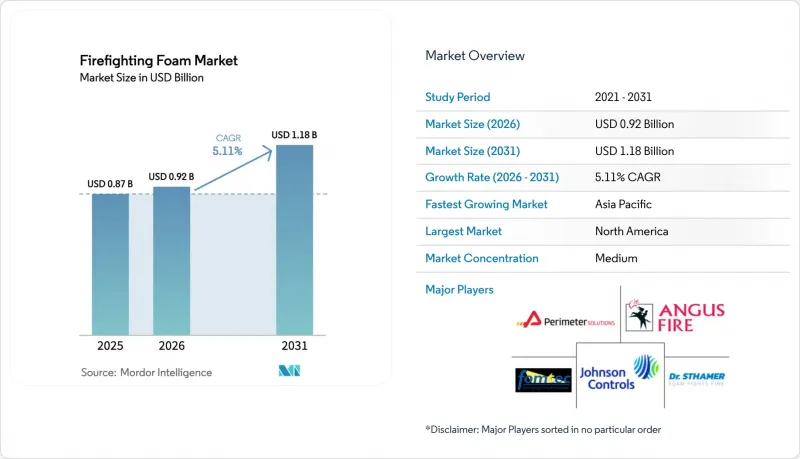
This report is Segmented by Foam Type (AFFF, AR-AFFF, Synthetic/Detergent, Protein, and Other Foam Types), Fluorine Content (PFAS-Containing and Fluorine-Free), End-User Industry (Oil and Gas, Chemical and Petrochemical, Mining, Transportation, and Other End-User Industries), and Geography (Asia-Pacific, North America, Europe, and More). The Market Forecasts are Provided in Terms of Value (USD).
Global Firefighting Foam Market Trends and Insights
Transition Toward Fluorine-Free Foams Accelerated by PFAS Regulations
Regulatory action intensified in 2025 and 2026 as the European Union finalized a binding PFAS phase-out for non-military foam applications by 2028, prompting airports in France, Germany, and the United Kingdom to convert early to avoid stranded assets. In the United States, the Federal Aviation Administration issued Advisory Circular 150/5210-6E in March 2025, opening the door for fluorine-free foams at 520 commercial airports formerly locked into AFFF procurement.. Australia's Civil Aviation Safety Authority followed in August 2025 with a similar directive covering new airport construction. Collectively, these measures shortened AFFF life cycles, forced manufacturers to accelerate portfolio reformulations, and required operators to budget for retrofits. In the United States, stakeholders face remediation liabilities at individual contaminated sites, a consequence of delayed actions under CERCLA enforcement.
Strict Government Mandates to Maintain Industrial Safety
In response to a series of high-profile incidents, regulators in the oil, gas, and petrochemical sectors worldwide tightened fire-protection codes between 2024 and 2025. In India, the Petroleum and Natural Gas Regulatory Board mandated the installation of fixed-foam systems at onshore oil terminals and LNG facilities with large capacities. This directive encompasses projects currently under construction across three coastal states.. Meanwhile, in June 2025, Saudi Aramco revised its internal engineering standards, stipulating foam-water deluge protection for hydrogen and blue-ammonia plants being developed in Jubail and Ras Al Khair. Over in the U.S., OSHA put forth a proposal for annual third-party testing of foam systems at chemical plants managing flammable liquids. This move impacts facilities and shifts procurement trends towards higher-performance, fluorine-free options, even with a premium on unit prices.
Environmental and Health Liabilities of PFAS-Bearing Foams
Starting January 2026, new U.S. drinking-water standards will limit PFOA and PFOS levels to minimal levels. This move has labeled numerous public water systems as non-compliant, with significant remediation costs anticipated. Manufacturers are feeling the pinch: a major settlement in 2024 underscored the escalating costs tied to legacy PFAS liabilities. Meanwhile, in Germany, authorities mandate producer-funded programs for take-back and destruction, inflating end-of-life expenses. In response, insurers have begun excluding PFAS coverage from general-liability policies, hastening the obsolescence of AFFF in the Firefighting Foam market.
Other drivers and restraints analyzed in the detailed report include:
- Rising Fire Risk at Expanding LNG Bunkering and Hydrogen Hubs
- Mandatory Fixed-Foam Systems in Mega-Warehouses and Automated Logistics Centers
- High Disposal, Cleanup, and Retrofit Costs for Legacy Systems
For complete list of drivers and restraints, kindly check the Table Of Contents.
Segment Analysis
AFFF maintained 41.55% of the Firefighting Foam market share in 2025, yet its grip weakened under growing regulatory bans and liability costs. Replacement cycles tightened as European airports eliminated AFFF procurement from January 2026, and Australia barred PFAS foams from new airfield projects. Meanwhile, other foam types posted a 6.31% CAGR, the fastest among foam types, as second-generation products such as SOLBERG RE-HEALING RF6 matched ICAO Level B benchmarks.
End-users now segment procurement. Military, aviation, and petrochemical operators still draw on AFFF inventories for mission-critical functions that require vapor-sealing films, but warehousing, data centers, and mining move decisively toward fluorine-free alternatives that leave minimal residue. Protein foams retain niche demand for tank-farm protection where fuel-shedding properties outweigh environmental concerns. Manufacturers are balancing their strategies: they maintain AFFF production lines for aftermarket refills, yet channel their research and development budget towards developing fluorine-free portfolios.
Complete Report Scope:
- By Foam Type
- Aqueous Film-Forming Foam (AFFF)
- Alcohol-Resistant (AR-AFFF)
- Synthetic/ Detergent Foam Concentrate
- Protein Foam Concentrate
- Other Foam Types (Fluorine-Free Synthetic (F3), etc.)
- By Fluorine Content
- PFAS-Containing
- Fluorine-Free
- By End-user Industry
- Oil and Gas
- Chemical and Petrochemical
- Mining
- Transportation
- Other End-User Industries (Military and Defense, Warehousing and Logistics, etc.)
- By Geography
- Asia-Pacific
- China
- India
- Japan
- South Korea
- ASEAN Countries
- Rest of Asia-Pacific
- North America
- United States
- Canada
- Mexico
- Europe
- Germany
- United Kingdom
- France
- Italy
- Spain
- NORDIC Countries
- Rest of Europe
- South America
- Brazil
- Argentina
- Rest of South America
- Middle-East and Africa
- Saudi Arabia
- South Africa
- Rest of Middle-East and Africa
- Asia-Pacific
Geography Analysis
North America retained 38.71% of 2025 revenue, anchored by a dense petrochemical corridor and the largest installed AFFF base worldwide. The U.S. military alone holds thousands of legacy systems slated for replacement, but supply shortages and compatibility tests push completion into 2027. Canada is catching up following Transport Canada's interim guidance that permits fluorine-free foams at airports subject to risk assessment, whereas Mexico remains constrained by budget and continues to rely on existing AFFF stockpiles.
Asia-Pacific is forecast to expand at a 6.04% CAGR and overtake Europe in absolute growth by 2030. China commands nearly half the regional Firefighting Foam market size, supported by rapid LNG import-terminal construction and coal-chemical investments that require fixed-foam protection. India's new safety code targets LNG facilities exceeding 50,000 m3 and accelerates procurement across planned terminals. Meanwhile, Japan and South Korea, driven by hydrogen-economy legislation, are transitioning to fluorine-free products, mandating foam suppression at production and dispensing sites.
Europe is at the forefront of policy innovation. Starting January 2026, Germany and the Netherlands will prohibit PFAS foams at civilian airports, while Nordic countries mandated zero-PFAS agents in all public facilities by 2025. This early adoption gives regional suppliers an edge to boost exports as other regions align with European standards. Upgrade cycles are also lifting demand in South America and the Middle East and Africa, supported by Brazilian ethanol terminals and hydrogen initiatives from Saudi Aramco.
- Albilad Fighting Systems Ltd.
- Angus Fire
- BIO EX
- Chemguard
- Dafo Fomtec AB
- Fire Safety Devices Pvt. Ltd. (FireChem)
- Foamtech
- Johnson Controls
- Kerr Fire
- Oil Technics Limited
- Perimeter Solutions
- SFFECO Global
- Shanghai Waysmos
- Sthamer
- Viking Group, Inc.
Additional Benefits:
- The market estimate (ME) sheet in Excel format
- 3 months of analyst support
TABLE OF CONTENTS
1 Introduction
- 1.1 Study Assumptions and Market Definition
- 1.2 Scope of the Study
2 Research Methodology
3 Executive Summary
4 Market Landscape
- 4.1 Market Overview
- 4.2 Market Drivers
- 4.2.1 Transition toward fluorine-free foams accelerated by PFAS regulations
- 4.2.2 Strict government mandates to maintain industrial safety
- 4.2.3 Rising fire risk at expanding LNG bunkering and hydrogen hubs
- 4.2.4 Mandatory fixed-foam systems in mega-warehouses and automated logistics centers
- 4.2.5 Increased military and aviation fire-protection retrofits
- 4.3 Market Restraints
- 4.3.1 Environmental and health liabilities of PFAS-bearing foams
- 4.3.2 High disposal, cleanup and retrofit costs for legacy systems
- 4.3.3 Performance gap and compatibility limits in some fluorine-free alternatives
- 4.4 Value Chain Analysis
- 4.5 Porter's Five Forces Analysis
- 4.5.1 Threat of New Entrants
- 4.5.2 Bargaining Power of Buyers
- 4.5.3 Bargaining Power of Suppliers
- 4.5.4 Threat of Substitute Products
- 4.5.5 Degree of Competition
5 Market Size and Growth Forecasts (Value)
- 5.1 By Foam Type
- 5.1.1 Aqueous Film-Forming Foam (AFFF)
- 5.1.2 Alcohol-Resistant (AR-AFFF)
- 5.1.3 Synthetic/ Detergent Foam Concentrate
- 5.1.4 Protein Foam Concentrate
- 5.1.5 Other Foam Types (Fluorine-Free Synthetic (F3), etc.)
- 5.2 By Fluorine Content
- 5.2.1 PFAS-Containing
- 5.2.2 Fluorine-Free
- 5.3 By End-user Industry
- 5.3.1 Oil and Gas
- 5.3.2 Chemical and Petrochemical
- 5.3.3 Mining
- 5.3.4 Transportation
- 5.3.5 Other End-User Industries (Military and Defense, Warehousing and Logistics, etc.)
- 5.4 By Geography
- 5.4.1 Asia-Pacific
- 5.4.1.1 China
- 5.4.1.2 India
- 5.4.1.3 Japan
- 5.4.1.4 South Korea
- 5.4.1.5 ASEAN Countries
- 5.4.1.6 Rest of Asia-Pacific
- 5.4.2 North America
- 5.4.2.1 United States
- 5.4.2.2 Canada
- 5.4.2.3 Mexico
- 5.4.3 Europe
- 5.4.3.1 Germany
- 5.4.3.2 United Kingdom
- 5.4.3.3 France
- 5.4.3.4 Italy
- 5.4.3.5 Spain
- 5.4.3.6 NORDIC Countries
- 5.4.3.7 Rest of Europe
- 5.4.4 South America
- 5.4.4.1 Brazil
- 5.4.4.2 Argentina
- 5.4.4.3 Rest of South America
- 5.4.5 Middle-East and Africa
- 5.4.5.1 Saudi Arabia
- 5.4.5.2 South Africa
- 5.4.5.3 Rest of Middle-East and Africa
- 5.4.1 Asia-Pacific
6 Competitive Landscape
- 6.1 Market Concentration
- 6.2 Strategic Moves
- 6.3 Market Share(%)/Ranking Analysis
- 6.4 Company Profiles (includes Global level Overview, Market level overview, Core Segments, Financials as available, Strategic Information, Products and Services, and Recent Developments)
- 6.4.1 Albilad Fighting Systems Ltd.
- 6.4.2 Angus Fire
- 6.4.3 BIO EX
- 6.4.4 Chemguard
- 6.4.5 Dafo Fomtec AB
- 6.4.6 Fire Safety Devices Pvt. Ltd. (FireChem)
- 6.4.7 Foamtech
- 6.4.8 Johnson Controls
- 6.4.9 Kerr Fire
- 6.4.10 Oil Technics Limited
- 6.4.11 Perimeter Solutions
- 6.4.12 SFFECO Global
- 6.4.13 Shanghai Waysmos
- 6.4.14 Sthamer
- 6.4.15 Viking Group, Inc.
7 Market Opportunities and Future Outlook
- 7.1 White-space and Unmet-Need Assessment

