PUBLISHER: Mordor Intelligence | PRODUCT CODE: 2114652

PUBLISHER: Mordor Intelligence | PRODUCT CODE: 2114652
Metal Cleaning Chemicals - Market Share Analysis, Industry Trends & Statistics, Growth Forecasts (2026 - 2031)
According to Mordor Intelligence, metal cleaning chemicals market size in 2026 is estimated at USD 16.47 Billion, growing from 2025 value of USD 15.73 Billion with 2031 projections showing USD 20.74 Billion, growing at 4.72% CAGR over 2026-2031.
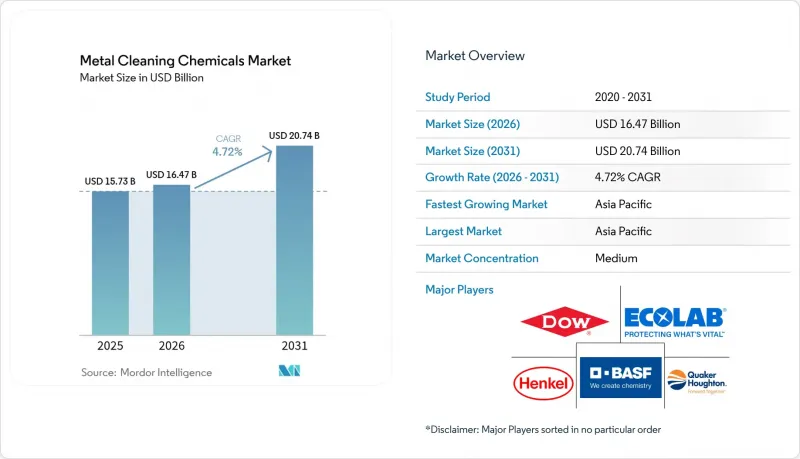
This report is Segmented by Type (Acidic, Basic, and Neutral), Form (Aqueous and Solvent), Metal Type (Steel & Ferrous Alloys, Aluminum & Light Alloys, and More), End-User Industry (Aerospace, Electrical & Electronics, Oil & Gas, and More), and Geography (Asia-Pacific, North America, Europe, South America, and Middle East and Africa). The Market Forecasts are Provided in Terms of Value (USD).
Global Metal Cleaning Chemicals Market Trends and Insights
Surging Demand from Precision Manufacturing
Global tolerance targets continue to tighten, especially in semiconductor packaging, electric-vehicle drivetrain assemblies, and high-speed medical devices. Newer machining lines integrate closed-loop feedback systems that detect surface contamination at sub-micron levels; as a result, consumption of ultra-pure alkaline and acidic blends has surged. Manufacturers also demand low-foaming, no-residue chemistries that remain effective in ultrasonic tanks to avoid redeposition and to improve first-pass yield. Precision medical parts, which cannot tolerate chloride residues, are increasingly cleaned with hydrogen-peroxide-activated solutions that leave no ionic trace and meet International Organization for Standardization (ISO) 13485 validation requirements.
Shift Toward Aqueous & Low-Volatile Organic Compound (VOC) Formulations
Environmental regulations accelerate the transition from solvent-based to aqueous cleaning systems, fundamentally altering market dynamics and competitive positioning. The Environmental Protection Agency (EPA)'s December 2024 perchloroethylene ban eliminates a cornerstone solvent within three years, forcing manufacturers to adopt water-based alternatives despite higher energy requirements and process complexity. BASF's EcoBalanced grades of cocoamidopropyl betaine illustrate the trend; biomass balance accounting trims product carbon footprints without compromising detergency . Although energy use rises in heated spray washers, line operators report 22% reductions in reportable Volatile Organic Compounds (VOCs), sufficient to avoid Title V permitting in several United States states.
Worker Exposure Limits on Certain Solvents
Tighter occupational exposure limits on trichloroethylene and other halogenated solvents compress margins because alternate chemistries often require longer dwell times and higher process temperatures. Facilities that retain solvent lines must install local exhaust ventilation, personal monitoring, and medical surveillance, raising compliance expenditure. The January 2025 inclusion of additional hazardous substances in the European REACH Candidate List introduces authorization fees for several glycol-ether ingredients, forcing formulators to redesign blends . State-level per- and polyfluoroalkyl substances (PFAS) bans on cleaning products in Minnesota and California, effective 2025, further fragment the United States regulatory landscape and complicate inventory management for multinational suppliers.
Other drivers and restraints analyzed in the detailed report include:
- Expansion of Aerospace Maintenance, Repair, and Overhaul (MRO) Capacity
- Increase in Automated Parts-washing in Industry
- Volatile Raw-material Prices
For complete list of drivers and restraints, kindly check the Table Of Contents.
Segment Analysis
Acidic formulations controlled 37.68% of the Metal Cleaning Chemicals market share in 2025, driven largely by hydrochloric-acid-based pickling solutions for carbon-steel strip lines. The segment is projected to advance at a 5.56% CAGR, underpinned by new regeneration technologies that reclaim free acid and remove iron salts, slashing sludge output by up to 90%. Nonetheless, operators confront tighter air-emission caps; many have added mist eliminators and hydrogen-peroxide-boost systems that cut nitrogen-oxide formation. Neutral and basic cleaners fill process gaps where pH-sensitive alloys or multi-material assemblies require gentler action, but their growth lags partially because alkaline solutions generate higher wastewater-neutralization costs.
Advanced acidic blends now incorporate corrosion inhibitors and low-foaming surfactants that extend bath life, enabling mills to stretch campaigns between changeovers and reduce downtime. In aerospace finishing lines, phosphoric blends preceded by alkaline pre-strips ensure adhesion uniformity for anodizing, while in automotive plants citric-acid cleaners help eliminate hexavalent chromium from pretreatment stages. The Metal Cleaning Chemicals market therefore continues to depend on acidic technology as a productivity anchor even while sustainability pressures drive incremental substitution with chelant-buffered low-hazard alternatives.
Aqueous solutions captured 54.62% of 2025 revenue and are forecast to compound at 5.34% through 2031, maintaining clear leadership in the metal cleaning chemicals market. The higher share rests on dual pillars: regulatory mandates curbing VOC emissions and corporate ESG targets that favor worker safety. Enzyme catalysts, biodegradable surfactants, and low-temperature builders now allow aqueous products to equal solvent performance on diverse soils, allowing many processors to decommission vapor-degreasing units. However, water-based systems demand robust evaporation capacity; some users report 15% energy-input increases to drive drying tunnels after parts exit wash stages.
Solvent formulations retain niche status where rapid drying and superior solvency for cutting oils prove critical, for instance, in hermetically sealed aerospace actuators or precision hydraulic valves. Hybrid processes that combine aqueous pre-wash with controlled vapor rinse are gaining traction, offering balanced throughput and compliance. Product-differentiation narratives now center on circular-economy compatibility for formulators, such as reclaiming rinse water for boiler feed or integrating renewable electricity certificates to present cradle-to-gate carbon savings. Consequently, the Metal Cleaning Chemicals industry positions aqueous platforms not merely as environmentally necessary but also as production-efficiency enablers.
Complete Report Scope:
- By Type
- Acidic
- Basic
- Neutral
- By Form
- Aqueous
- Solvent
- By Metal Type
- Steel & Ferrous Alloys
- Aluminum & Light Alloys
- Copper & Brass
- Other Non-ferrous Metals
- By End-user Industry
- Aerospace
- Automotive & Transportation
- Electrical & Electronics
- Chemical & Pharmaceuticals
- Oil & Gas
- Other End-users (Marine, Power Genation, etc.)
- By Geography
- Asia-Pacific
- China
- Japan
- India
- South Korea
- ASEAN Countries
- Rest of Asia-Pacific
- North America
- United States
- Canada
- Mexico
- Europe
- Germany
- United Kingdom
- France
- Italy
- Spain
- Russia
- NORDIC Countries
- Rest of Europe
- South America
- Brazil
- Argentina
- Rest of South America
- Middle East and Africa
- Saudi Arabia
- South Africa
- Rest of Middle East and Africa
- Asia-Pacific
Geography Analysis
Asia-Pacific accounted for 41.88% of 2025 global revenue, a position it will reinforce with a 5.18% CAGR through 2031. China dominates regional demand because its continuous pickling lines and advanced wafer-fabrication plants rely on large-volume acidic and ultrapure chemistries. Government incentives under "Made in China 2025" prompted acquisitions of tetramethylammonium hydroxide producers, locking in domestic control over a critical photoresist-developer ingredient vital to the metal cleaning chemicals market. South Korea's semiconductor majors, Japan's precision-machining SMEs, and India's burgeoning MRO corridors compound regional traction. Rising labor costs spur automation, directly boosting uptake of sensor-rich aqueous cleaners tuned for conveyorized washers.
North America represents a technologically mature yet compliance-stringent arena. Stringent VOC caps under the United States National Emission Standards for Hazardous Air Pollutants have accelerated solvent-to-water conversions, especially within automotive paint pre-treatment. The Creating Helpful Incentives to Produce Semiconductors (CHIPS) and Science Act has triggered USD 200 billion in foundry announcements, driving localized demand for sub-10 parts per thousand (ppt) purity acids and low-metal alkaline blends. Mexico benefits from near-shoring; new battery-component plants in Nuevo Leon require dual-metal cleaning protocols for steel and aluminum sub-assemblies. Nonetheless, the region's overall growth rate lags Asia-Pacific because existing installed capacity is high and facility expansions are incremental rather than greenfield.
Europe's market is steadied by a sophisticated automotive and aerospace backbone but tempered by high energy prices and Registration, Evaluation, Authorization and Restriction of Chemicals (REACH) compliance costs. German OEMs are transitioning to neutral-pH cleaners with boron-free buffering agents to meet anticipated 2026 wastewater regulations, and Italian appliance makers increasingly specify enzyme-activated degreasers to support corporate carbon-neutrality pledges. Eastern European steel and white-goods plants supply intra-European Union (EU) value chains, creating incremental cleaning-chemical demand but at lower per-unit profitability than Western Europe. The forthcoming PFAS essential-use criteria will likely propel further R&D spending as formulators seek drop-in replacements that maintain surface-tension performance for capillary penetration in complex assemblies.
- Arrow Solutions
- BASF
- Chautauqua Chemical Company
- Clariant AG
- Crest Chemicals
- Delstar Metal Finishing Inc.
- Dow
- DST-Chemicals
- Eastman Chemical Company
- Ecolab Inc.
- Elmer Wallace Ltd.
- Evonik Industries AG
- Henkel AG & Co. KGaA
- Hubbard-Hall
- ICL
- JELMAR
- KYZEN Corporation
- Lincoln Chemical Corporation
- Luster-On Products Inc.
- Modern Chemical Inc.
- Nouryon
- Parker Hannifin Corp.
- PCC Group
- Quaker Chemical Corporation
- Rochester Midland Corp.
- S. Freedman & Sons, LLC.
- SAFECHEM Europe GmbH
- Solugen
- Stepan Company
- The Chemours Company
- Zavenir Daubert
Additional Benefits:
- The market estimate (ME) sheet in Excel format
- 3 months of analyst support
TABLE OF CONTENTS
1 Introduction
- 1.1 Study Assumptions & Market Definition
- 1.2 Scope of the Study
2 Research Methodology
3 Executive Summary
4 Market Landscape
- 4.1 Market Overview
- 4.2 Market Drivers
- 4.2.1 Surging Demand from Precision Manufacturing
- 4.2.2 Shift Toward Aqueous & Low-Volatile Organic Compound (VOC) Formulations
- 4.2.3 Expansion of Aerospace Maintenance, Repair, and Overhaul (MRO) Capacity
- 4.2.4 Increase in Automated Parts-washing in Industry
- 4.2.5 Original Equipment Manufacturer (OEM)-backed Switch to Hydrogen-based Steel Pickling
- 4.3 Market Restraints
- 4.3.1 Worker Exposure Limits on Certain Solvents
- 4.3.2 Volatile Raw-material Prices
- 4.3.3 Ultrapure Water Scarcity in Semiconductor Hubs
- 4.4 Value Chain Analysis
- 4.5 Porter's Five Forces
- 4.5.1 Bargaining Power of Suppliers
- 4.5.2 Bargaining Power of Buyers
- 4.5.3 Threat of New Entrants
- 4.5.4 Threat of Substitutes
- 4.5.5 Degree of Competition
5 Market Size & Growth Forecasts (Value)
- 5.1 By Type
- 5.1.1 Acidic
- 5.1.2 Basic
- 5.1.3 Neutral
- 5.2 By Form
- 5.2.1 Aqueous
- 5.2.2 Solvent
- 5.3 By Metal Type
- 5.3.1 Steel & Ferrous Alloys
- 5.3.2 Aluminum & Light Alloys
- 5.3.3 Copper & Brass
- 5.3.4 Other Non-ferrous Metals
- 5.4 By End-user Industry
- 5.4.1 Aerospace
- 5.4.2 Automotive & Transportation
- 5.4.3 Electrical & Electronics
- 5.4.4 Chemical & Pharmaceuticals
- 5.4.5 Oil & Gas
- 5.4.6 Other End-users (Marine, Power Genation, etc.)
- 5.5 By Geography
- 5.5.1 Asia-Pacific
- 5.5.1.1 China
- 5.5.1.2 Japan
- 5.5.1.3 India
- 5.5.1.4 South Korea
- 5.5.1.5 ASEAN Countries
- 5.5.1.6 Rest of Asia-Pacific
- 5.5.2 North America
- 5.5.2.1 United States
- 5.5.2.2 Canada
- 5.5.2.3 Mexico
- 5.5.3 Europe
- 5.5.3.1 Germany
- 5.5.3.2 United Kingdom
- 5.5.3.3 France
- 5.5.3.4 Italy
- 5.5.3.5 Spain
- 5.5.3.6 Russia
- 5.5.3.7 NORDIC Countries
- 5.5.3.8 Rest of Europe
- 5.5.4 South America
- 5.5.4.1 Brazil
- 5.5.4.2 Argentina
- 5.5.4.3 Rest of South America
- 5.5.5 Middle East and Africa
- 5.5.5.1 Saudi Arabia
- 5.5.5.2 South Africa
- 5.5.5.3 Rest of Middle East and Africa
- 5.5.1 Asia-Pacific
6 Competitive Landscape
- 6.1 Market Concentration
- 6.2 Strategic Moves
- 6.3 Market Share(%)/Ranking Analysis
- 6.4 Company Profiles (includes Global level Overview, Market level overview, Core Segments, Financials, Strategic Info, Market Rank/Share, Products & Services, Recent Developments)
- 6.4.1 Arrow Solutions
- 6.4.2 BASF
- 6.4.3 Chautauqua Chemical Company
- 6.4.4 Clariant AG
- 6.4.5 Crest Chemicals
- 6.4.6 Delstar Metal Finishing Inc.
- 6.4.7 Dow
- 6.4.8 DST-Chemicals
- 6.4.9 Eastman Chemical Company
- 6.4.10 Ecolab Inc.
- 6.4.11 Elmer Wallace Ltd.
- 6.4.12 Evonik Industries AG
- 6.4.13 Henkel AG & Co. KGaA
- 6.4.14 Hubbard-Hall
- 6.4.15 ICL
- 6.4.16 JELMAR
- 6.4.17 KYZEN Corporation
- 6.4.18 Lincoln Chemical Corporation
- 6.4.19 Luster-On Products Inc.
- 6.4.20 Modern Chemical Inc.
- 6.4.21 Nouryon
- 6.4.22 Parker Hannifin Corp.
- 6.4.23 PCC Group
- 6.4.24 Quaker Chemical Corporation
- 6.4.25 Rochester Midland Corp.
- 6.4.26 S. Freedman & Sons, LLC.
- 6.4.27 SAFECHEM Europe GmbH
- 6.4.28 Solugen
- 6.4.29 Stepan Company
- 6.4.30 The Chemours Company
- 6.4.31 Zavenir Daubert
7 Market Opportunities & Future Outlook
- 7.1 White-space & Unmet-Need Assessment
- 7.2 Development of Bio-based Cleaning Chemicals

