PUBLISHER: Mordor Intelligence | PRODUCT CODE: 2114653

PUBLISHER: Mordor Intelligence | PRODUCT CODE: 2114653
High-flow Nasal Cannula - Market Share Analysis, Industry Trends & Statistics, Growth Forecasts (2026 - 2031)
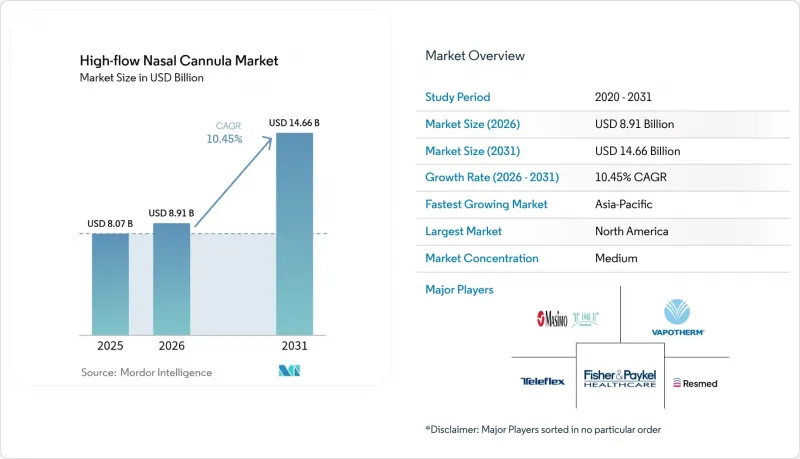
According to Mordor Intelligence, the high-flow nasal cannula market size was valued at USD 8.07 billion in 2025 and estimated to grow from USD 8.91 billion in 2026 to reach USD 14.66 billion by 2031, at a CAGR of 10.45% during the forecast period (2026-2031).
This report is Segmented by Component (Air/Oxygen Blender, Active Humidifier, Single Heated Tube, and More), End-User (Hospitals & Intensive Care Units, and More), Application (Acute Respiratory Failure, and More), Patient Age Group (Neonatal & Pediatric, Adult, and More), and Geography (North America, Europe, Asia-Pacific, and More). The Market Forecasts are Provided in Terms of Value (USD).
Global High-flow Nasal Cannula Market Trends and Insights
Rising Global Prevalence of Acute & Chronic Respiratory Diseases
The burden of COPD, which affected 200 million people and caused 3.2 million deaths in 2024, is pushing clinicians to escalate beyond conventional oxygen delivery methods. Asthma cases exceeded 350 million worldwide, while seasonal influenza remained the most detected pathogen in northern hemisphere surveillance. These epidemiological pressures have elevated demand for high-flow therapy that lowers readmissions and improves health-related quality-of-life scores, positioning the high-flow nasal cannula market as an essential pillar of modern respiratory care.
Technological Advancements in Heated Humidification & Integrated Flow Monitoring
Bench studies comparing leading devices showed that AIRVO 2, bellavista 1000, and HUMID-BH delivered closer to nominal dew-point at 37 °C, enhancing mucosal protection and secretion clearance. Computational fluid-dynamics modeling confirmed that optimized cannula geometry supports near-100% relative humidity in the nasopharynx, limiting airway obstruction. These innovations allow real-time titration of flow and FiO2, extend therapy beyond ICU walls, and differentiate offerings within the high-flow nasal cannula market.
High Capital & Operating Costs Versus Conventional Oxygen Delivery
Initial HFNC system investment can be 3-5 times the price of standard oxygen, and disposable circuits add recurring expenses. Cost-utility analysis in pediatric bronchiolitis showed CPAP costing USD 17,574 versus USD 29,421 for HFNC while yielding marginally higher QALYs. Budget constraints and infrastructure gaps, such as erratic power supply, slow uptake in developing economies and temper the high-flow nasal cannula market trajectory.
Other drivers and restraints analyzed in the detailed report include:
- Expanding Applications of HFNC Beyond ICU into Emergency & Peri-operative Settings
- Growing Adoption of Home-based Oxygen Therapy & Tele-respiratory Care
- Limited Skilled Personnel & Training Gaps in Developing Regions
For complete list of drivers and restraints, kindly check the Table Of Contents.
Segment Analysis
Active Humidifiers captured 33.82% of component revenue in 2025 thanks to their critical role in delivering gas at body-temperature humidity that protects mucosa. The high-flow nasal cannula market size for Active Humidifiers is set to rise at a steady 9.03% CAGR through 2031 as next-generation units embed algorithm-based dew-point control. Air/Oxygen Blenders follow, driven by demand for precise FiO2 titration compatible with electronic health-record integration. Nasal Cannula components will pace the segment with a 13.33% CAGR, reflecting design improvements that reduce pressure ulcers and support pediatric sizing. Manufacturers increasingly lock these components into proprietary ecosystems, reinforcing stickiness within the high-flow nasal cannula market.
Design refinements stem from computational fluid-dynamics work demonstrating smoother gas distribution and reduced interface shear. Single Heated Tubes gain traction as they minimize condensation, which can trigger alarms and therapy interruptions. Integrative product strategies that combine humidifier, blender, circuit, and cannula under a single brand umbrella are helping major vendors defend pricing and margins within the high-flow nasal cannula market.
Hospitals & Intensive Care Units commanded 47.30% of global revenue in 2025 as HFNC became standard in escalation algorithms from nasal prongs to ventilation. Meta-analysis of 10,230 patients confirmed a relative risk of 0.85 for subsequent invasive ventilation versus conventional oxygen, reinforcing hospital demand. Long-term Care Centers are adding HFNC to manage chronic hypoxemia in elderly residents, aided by portable trolley-mounted units.
Home-care Settings are projected to expand at a 12.57% CAGR, the fastest across end-users, buoyed by evidence of fewer COPD readmissions and advances in tele-respiratory dashboards. The high-flow nasal cannula market size for domiciliary use is expected to climb from USD 1.1 billion in 2025 to USD 2.23 billion by 2031. Pediatric retrospective data reveal low complication rates in children discharged on HFNC for upper-airway obstruction and CO2 clearance. Emerging payor models that reimburse remote monitoring further stimulate adoption, diversifying revenue streams in the high-flow nasal cannula market.
Complete Report Scope:
- By Component
- Air/Oxygen Blender
- Active Humidifier
- Single Heated Tube
- Nasal Cannula
- Other Consumables
- By End-user
- Hospitals & Intensive Care Units
- Long-term Care Centers
- Home-care Settings
- Other End-users
- By Application
- Acute Respiratory Failure
- Chronic Obstructive Pulmonary Disease
- Acute Heart Failure
- Other Applications
- By Patient Age Group
- Neonatal & Pediatric (0-17 yrs)
- Adult (18-64 yrs)
- Geriatric (65 yrs +)
- Geography
- North America
- United States
- Canada
- Mexico
- Europe
- Germany
- United Kingdom
- France
- Italy
- Spain
- Rest of Europe
- Asia-Pacific
- China
- Japan
- India
- Australia
- South Korea
- Rest of Asia-Pacific
- Middle East & Africa
- GCC
- South Africa
- Rest of Middle East & Africa
- South America
- Brazil
- Argentina
- Rest of South America
- North America
Geography Analysis
North America led with 37.45% revenue share in 2025, buoyed by advanced reimbursement and 25 million diagnosed asthma cases in the United States. High-flow therapy migrated from ICUs to general wards, as bronchiolitis support successes drove a 4.8-fold rise in pediatric HFNC utilization between 2013 and 2022. The high-flow nasal cannula market size for home-care in the region is on track to exceed USD 1.58 billion by 2031 amid insurer acceptance of tele-respiratory bundles.
Asia Pacific is set for the fastest 10.86% CAGR, propelled by rising respiratory disease incidence, infrastructure investment, and localization by global vendors. WHO's 2024 compendium highlighted low-cost solutions such as PremieBreathe aimed at neonatal wards in low-resource hospitals. Government programs in China and India that subsidize non-invasive ventilation equipment will likely spur wider adoption in secondary-tier facilities.
Europe continues to adopt HFNC across Western health systems where robust clinical trials validate outcomes. Eastern European uptake is growing thanks to EU funding for respiratory care modernization. The Middle East & Africa and South America remain nascent yet promising; targeted clinician-training initiatives and modular HFNC systems suited to erratic electricity supply are expected to accelerate the high-flow nasal cannula market over the forecast horizon.
- Fisher & Paykel Healthcare
- Teleflex
- Resmed
- Vapotherm Inc.
- Masimo Corp. (TNI medical AG)
- Hamilton Medical
- Smiths Group
- Flexicare Medical
- Devatec S.A.
- Great Group Medical Co., Ltd.
- Medline Industries
- FisherBiotech GmbH
- Teijin Pharma Ltd.
- HEYER Medical AG
- BD (Becton, Dickinson & Co.)
- Cardinal Health
- GE HealthCare Technologies Inc.
- Koninklijke Philips
Additional Benefits:
- The market estimate (ME) sheet in Excel format
- 3 months of analyst support
TABLE OF CONTENTS
1 Introduction
- 1.1 Study Assumptions & Market Definition
- 1.2 Scope of the Study
2 Research Methodology
3 Executive Summary
4 Market Landscape
- 4.1 Market Overview
- 4.2 Market Drivers
- 4.2.1 Rising Global Prevalence of Acute & Chronic Respiratory Diseases
- 4.2.2 Technological Advancements in Heated Humidification & Integrated Flow Monitoring
- 4.2.3 Expanding Applications of HFNC Beyond ICU into Emergency & Peri-operative Settings
- 4.2.4 Growing Adoption of Home-based Oxygen Therapy & Tele-respiratory Care
- 4.2.5 Favorable Reimbursement & Clinical Guidelines Supporting Non-invasive Oxygenation
- 4.2.6 Increase in Pre-term Birth Rates Necessitating Neonatal HFNC
- 4.3 Market Restraints
- 4.3.1 High Capital & Operating Costs Versus Conventional Oxygen Delivery
- 4.3.2 Limited Skilled Personnel & Training Gaps in Developing Regions
- 4.3.3 Infection-Control & Aerosol-Generation Concerns During Pandemics
- 4.3.4 Competitive Pressure from Alternative Non-invasive Ventilation (CPAP/BiPAP)
- 4.4 Regulatory Outlook
- 4.5 Porter's Five Forces Analysis
- 4.5.1 Threat of New Entrants
- 4.5.2 Bargaining Power of Buyers
- 4.5.3 Bargaining Power of Suppliers
- 4.5.4 Threat of Substitutes
- 4.5.5 Intensity of Competitive Rivalry
5 Market Size & Growth Forecasts (Value, USD)
- 5.1 By Component
- 5.1.1 Air/Oxygen Blender
- 5.1.2 Active Humidifier
- 5.1.3 Single Heated Tube
- 5.1.4 Nasal Cannula
- 5.1.5 Other Consumables
- 5.2 By End-user
- 5.2.1 Hospitals & Intensive Care Units
- 5.2.2 Long-term Care Centers
- 5.2.3 Home-care Settings
- 5.2.4 Other End-users
- 5.3 By Application
- 5.3.1 Acute Respiratory Failure
- 5.3.2 Chronic Obstructive Pulmonary Disease
- 5.3.3 Acute Heart Failure
- 5.3.4 Other Applications
- 5.4 By Patient Age Group
- 5.4.1 Neonatal & Pediatric (0-17 yrs)
- 5.4.2 Adult (18-64 yrs)
- 5.4.3 Geriatric (65 yrs +)
- 5.5 Geography
- 5.5.1 North America
- 5.5.1.1 United States
- 5.5.1.2 Canada
- 5.5.1.3 Mexico
- 5.5.2 Europe
- 5.5.2.1 Germany
- 5.5.2.2 United Kingdom
- 5.5.2.3 France
- 5.5.2.4 Italy
- 5.5.2.5 Spain
- 5.5.2.6 Rest of Europe
- 5.5.3 Asia-Pacific
- 5.5.3.1 China
- 5.5.3.2 Japan
- 5.5.3.3 India
- 5.5.3.4 Australia
- 5.5.3.5 South Korea
- 5.5.3.6 Rest of Asia-Pacific
- 5.5.4 Middle East & Africa
- 5.5.4.1 GCC
- 5.5.4.2 South Africa
- 5.5.4.3 Rest of Middle East & Africa
- 5.5.5 South America
- 5.5.5.1 Brazil
- 5.5.5.2 Argentina
- 5.5.5.3 Rest of South America
- 5.5.1 North America
6 Competitive Landscape
- 6.1 Market Concentration
- 6.2 Strategic Moves
- 6.3 Market Share Analysis
- 6.4 Company Profiles (includes Global level Overview, Market level overview, Core Business Segments, Financials, Headcount, Key Information, Market Rank, Market Share, Products and Services, and analysis of Recent Developments)
- 6.4.1 Fisher & Paykel Healthcare Ltd.
- 6.4.2 Teleflex Incorporated
- 6.4.3 ResMed Inc.
- 6.4.4 Vapotherm Inc.
- 6.4.5 Masimo Corp. (TNI medical AG)
- 6.4.6 Hamilton Medical AG
- 6.4.7 Smiths Medical (ICU Medical)
- 6.4.8 Flexicare Medical Ltd.
- 6.4.9 Devatec S.A.
- 6.4.10 Great Group Medical Co., Ltd.
- 6.4.11 Medline Industries LP
- 6.4.12 FisherBiotech GmbH
- 6.4.13 Teijin Pharma Ltd.
- 6.4.14 HEYER Medical AG
- 6.4.15 BD (Becton, Dickinson & Co.)
- 6.4.16 Cardinal Health Inc.
- 6.4.17 GE HealthCare Technologies Inc.
- 6.4.18 Koninklijke Philips N.V.
7 Market Opportunities & Future Outlook
- 7.1 White-Space & Unmet-Need Assessment

