PUBLISHER: Mordor Intelligence | PRODUCT CODE: 2114654

PUBLISHER: Mordor Intelligence | PRODUCT CODE: 2114654
Demineralized Bone Matrix - Market Share Analysis, Industry Trends & Statistics, Growth Forecasts (2026 - 2031)
According to Mordor Intelligence, the demineralized bone matrix market size is expected to grow from USD 1.31 billion in 2025 to USD 1.39 billion in 2026 and is forecast to reach USD 1.85 billion by 2031 at 5.94% CAGR over 2026-2031.
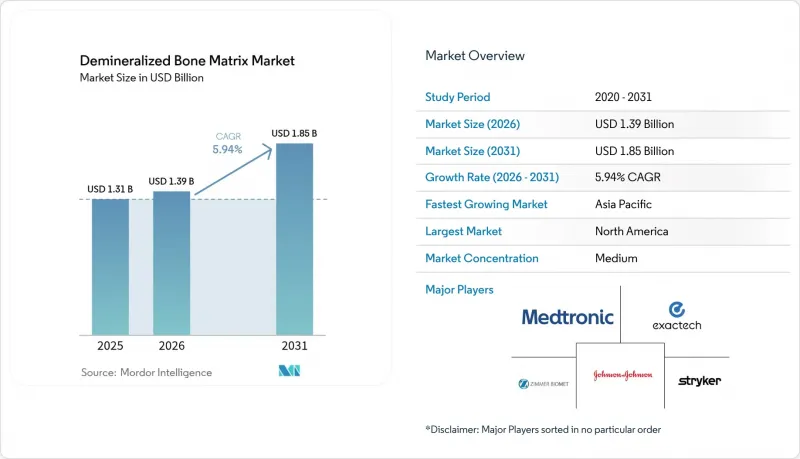
This report is Segmented by Product (Gel, Putty, and More), Form (Allograft (Cortical), and More), Application (Spinal Fusion, Dental, and More), End-User (Hospitals, Specialty Orthopedic Centers, and More), Geography (North America, Europe, Asia-Pacific, The Middle East and Africa, and South America). The Market Forecasts are Provided in Terms of Value (USD).
Global Demineralized Bone Matrix Market Trends and Insights
Rising Musculoskeletal Disease Prevalence
Osteoporosis-related fractures are projected to top 60,000 annually in Australia by 2050, illustrating how aging populations anchor long-range demand for grafting biomaterials. Posterior cervical fusion for deformity expanded at fastest CAGR, highlighting a sustained need for biologically active grafts to secure arthrodesis in compromised bone. Manufacturers respond with osteoporotic-specific putties that incorporate carriers enhancing protein release in low-density scaffolds. Health systems, facing higher fragility fracture admissions, increasingly reimburse DBM when autograft harvest adds morbidity and cost, embedding the demineralized bone matrix market into geriatric orthopedic care pathways.
Increasing Volume of Reconstructive Surgeries
Lumbar degenerative spondylolisthesis fusion procedures rose 387.1% from 2010-2022, whereas decompression-only growth lagged at 79.6%, underscoring surgeon preference for fusion-enhancing biologics. Shoulder arthroplasty prevalence reached 0.258% of the U.S. population in 2017, and revisions climbed 392% over 15 years, compounding DBM demand in hardware exchange and bone-loss management. Minimally invasive techniques favor injectable DBM gels that fill confined defects without extending incision length. As procedure counts rise across orthopedics and sports medicine, hospitals adopt standardized DBM kits, cementing the demineralized bone matrix market as a staple rather than an exception.
High Cost of Demineralized Bone Matrix Products
Medicare payment erosion creates scrutiny on per-case costs, pressing hospitals to quantify outcome gains over less costly synthetics. DBM also carries logistics expenses for cryostorage, validated shipping, and donor serology. In lower-income markets, surgeons default to calcium phosphate blocks when budgets are fixed, delaying penetration of the demineralized bone matrix industry.
Other drivers and restraints analyzed in the detailed report include:
- Expanding Adoption of Dental Implants
- Broadening Reimbursement Coverage for Biologic Grafts
- Innovation in Patient-Specific Demineralized Bone Constructs
- Potential for Immunogenic Response and Infection
For complete list of drivers and restraints, kindly check the Table Of Contents.
Segment Analysis
Putty held 40.96% of 2025 revenue, cementing the demineralized bone matrix market share lead by virtue of moldability and wash-out resistance during irrigation. Surgeons pack the cohesive mass against decorticated bone, trusting carrier polymers to retain proteins at the fusion site. Demineralized cortical fibers, although only emerging, post an 8.02% CAGR thanks to interlocking fibrils that mimic autograft chips and flow through MIS cannulas without clogging. In trauma cases, fibers mixed with autologous marrow shorten graft prep time and offset limited iliac crest volume. Gel syringes still appeal in dental sockets where flow fills voids under thin cortical plates. Strips and sheets fill cranial vault reconstructions, yet remain niche.
A parallel trend is carrier upgrade. Recent formulations swap glycerol for hyaluronic acid, increasing protein stability at room temperature and cutting thaw time in the operating room. Vendors promoting putty now co-package PRP activators, nudging procedure-average selling prices upward. Such differentiation keeps putty at the center of the demineralized bone matrix market even as fibers chase MIS share.
Cancellous morsels captured 44.15% of 2025 sales, buoyed by trabecular porosity that speeds vascular ingrowth and cell migration-traits critical when surgeons bridge long-segment thoracolumbar constructs. The demineralized bone matrix market size for these cancellous products is forecast to climb steadily as hybrid graft packs pair morsels with collagen-rich DBM putty, allowing immediate structural bulk plus osteoinductive signal. Combined allograft-synthetic formats grow fastest at a 7.21% CAGR because ceramic granules lend compressive strength and resist resorption where load sharing is high.
Cortical dowels retain value in revision hip arthroplasty where diaphyseal voids need column support. Yet, adoption is limited due to machining costs and screw fixation complexity. Cryopreserved viable matrices-containing native mesenchymal progenitors-entered the market following Enovis's 2024 distribution deal and target foot-and-ankle charcot arthropathy, offering live-cell remodeling without autograft harvest. Form diversification thus helps suppliers appeal to sub-specialty nuances, reinforcing the demineralized bone matrix market's resilience against single-format obsolescence.
Complete Report Scope:
- By Product Type
- Gel
- Putty
- Demineralized Cortical Fibers
- Other Product Types
- By Form
- Allograft (Cortical)
- Allograft (Cancellous)
- Combined Allograft & Synthetics
- By Application
- Spinal Fusion
- Dental
- Joint Reconstruction
- Craniomaxillofacial
- Trauma & Extremities
- Other Applications
- By End-User
- Hospitals
- Specialty Orthopedic Centers
- Dental Clinics
- Other End-Users
- Geography
- North America
- United States
- Canada
- Mexico
- Europe
- Germany
- United Kingdom
- France
- Italy
- Spain
- Rest of Europe
- Asia-Pacific
- China
- Japan
- India
- Australia
- South Korea
- Rest of Asia-Pacific
- Middle East & Africa
- GCC
- South Africa
- Rest of Middle East & Africa
- South America
- Brazil
- Argentina
- Rest of South America
- North America
Geography Analysis
North America contributed 50.74% of 2025 revenue, supported by well-defined reimbursement codes, 25-year product familiarity, and a dense network of AATB-accredited tissue banks. Yet falling Medicare joint replacement fees pressure hospital margins, forcing procurement teams to scrutinize biologic premiums and encouraging price negotiations inside the demineralized bone matrix market. FDA guidance effective February 2025 further elevates compliance hurdles, a shift expected to consolidate volume into large processors possessing in-house nucleic acid testing.
Asia-Pacific is the fastest-growing geography at 7.29% CAGR through 2031. Hip fracture incidence in China is projected to double between 2020-2035, while Japan faces a median age above 48 years, heightening orthopedic caseloads. Governments adding universal health coverage improve access to spinal procedures, yet reimbursement caps still favor competitively priced putty vials. Multinationals are partnering with domestic tissue banks in South Korea and India to localize supply and navigate diverse regulatory filings. These collaborations enlarge the demineralized bone matrix market while laying the groundwork for future personalized constructs.
Europe delivers steady single-digit growth as aging demographics offset slower procedural adoption curves. Variation in tissue directives among EU members complicates cross-border distribution, prompting suppliers to establish redundant processing hubs in Germany and Italy. Post-Brexit UK regulators align closely with MHRA guidance, mirroring FDA documentation requirements and favoring suppliers who already operate in North America. Meanwhile, Middle East & Africa and South America remain nascent but promising; Colombia's lower-limb arthroplasty CAGR of 5.54% signals rising Latin American orthopedic volumes. Currency volatility and tender-driven purchasing temper immediate uptake, yet tier-two hospitals show interest where synthetic options underperform.
- Medtronic
- Stryker
- Johnson & Johnson
- Zimmer Biomet
- Exactech
- RTI Surgical
- Seaspine
- Xtant Medical
- Straumann Group
- Halma
- Hans Biomed
- Orthofix
- AlloSource
- Royal Biologics
- Bone Bank Allografts
- Kuros Biosciences
- Smiths Group
- Bioventus
- Lattice Biologics
- Vanguard Surgical
Additional Benefits:
- The market estimate (ME) sheet in Excel format
- 3 months of analyst support
TABLE OF CONTENTS
1 Introduction
- 1.1 Study Assumptions & Market Definition
- 1.2 Scope Of The Study
2 Research Methodology
3 Executive Summary
4 Market Landscape
- 4.1 Market Overview
- 4.2 Market Drivers
- 4.2.1 Rising Musculoskeletal Disease Prevalence
- 4.2.2 Increasing Volume of Reconstructive Surgeries
- 4.2.3 Expanding Adoption of Dental Implants
- 4.2.4 Broadening Reimbursement Coverage for Biologic Grafts (Under The Radar)
- 4.2.5 Innovation in Patient-Specific Demineralized Bone Constructs (Under The Radar)
- 4.3 Market Restraints
- 4.3.1 High Cost of Demineralized Bone Matrix Products
- 4.3.2 Potential For Immunogenic Response And Infection
- 4.3.3 Intensifying Regulatory Oversight of Donor Tissue (Under The Radar)
- 4.3.4 Growing Competition from Synthetic Bone Graft Alternatives (Under The Radar)
- 4.4 Regulatory Landscape
- 4.5 Porter's Five Forces Analysis
- 4.5.1 Threat Of New Entrants
- 4.5.2 Bargaining Power Of Buyers
- 4.5.3 Bargaining Power Of Suppliers
- 4.5.4 Threat Of Substitutes
- 4.5.5 Competitive Rivalry
5 Market Size & Growth Forecasts (Value, USD)
- 5.1 By Product Type
- 5.1.1 Gel
- 5.1.2 Putty
- 5.1.3 Demineralized Cortical Fibers
- 5.1.4 Other Product Types
- 5.2 By Form
- 5.2.1 Allograft (Cortical)
- 5.2.2 Allograft (Cancellous)
- 5.2.3 Combined Allograft & Synthetics
- 5.3 By Application
- 5.3.1 Spinal Fusion
- 5.3.2 Dental
- 5.3.3 Joint Reconstruction
- 5.3.4 Craniomaxillofacial
- 5.3.5 Trauma & Extremities
- 5.3.6 Other Applications
- 5.4 By End-User
- 5.4.1 Hospitals
- 5.4.2 Specialty Orthopedic Centers
- 5.4.3 Dental Clinics
- 5.4.4 Other End-Users
- 5.5 Geography
- 5.5.1 North America
- 5.5.1.1 United States
- 5.5.1.2 Canada
- 5.5.1.3 Mexico
- 5.5.2 Europe
- 5.5.2.1 Germany
- 5.5.2.2 United Kingdom
- 5.5.2.3 France
- 5.5.2.4 Italy
- 5.5.2.5 Spain
- 5.5.2.6 Rest of Europe
- 5.5.3 Asia-Pacific
- 5.5.3.1 China
- 5.5.3.2 Japan
- 5.5.3.3 India
- 5.5.3.4 Australia
- 5.5.3.5 South Korea
- 5.5.3.6 Rest of Asia-Pacific
- 5.5.4 Middle East & Africa
- 5.5.4.1 GCC
- 5.5.4.2 South Africa
- 5.5.4.3 Rest of Middle East & Africa
- 5.5.5 South America
- 5.5.5.1 Brazil
- 5.5.5.2 Argentina
- 5.5.5.3 Rest of South America
- 5.5.1 North America
6 Competitive Landscape
- 6.1 Market Concentration
- 6.2 Market Share Analysis
- 6.3 Company Profiles (includes Global level Overview, Market level overview, Core Business Segments, Financials, Headcount, Key Information, Market Rank, Market Share, Products and Services, and analysis of Recent Developments)
- 6.3.1 Medtronic
- 6.3.2 Stryker
- 6.3.3 Johnson & Johnson (DePuy Synthes)
- 6.3.4 Zimmer Biomet
- 6.3.5 Exactech, Inc.
- 6.3.6 RTI Surgical
- 6.3.7 SeaSpine
- 6.3.8 Xtant Medical
- 6.3.9 Institut Straumann AG
- 6.3.10 Halma (Novabone)
- 6.3.11 Hans Biomed
- 6.3.12 Orthofix Medical
- 6.3.13 AlloSource
- 6.3.14 Royal Biologics
- 6.3.15 Bone Bank Allografts
- 6.3.16 Kuros Biosciences
- 6.3.17 Smith & Nephew
- 6.3.18 Bioventus
- 6.3.19 Lattice Biologics
- 6.3.20 Vanguard Surgical
7 Market Opportunities & Future Outlook
- 7.1 White-Space & Unmet-Need Assessment

