PUBLISHER: Mordor Intelligence | PRODUCT CODE: 2114655

PUBLISHER: Mordor Intelligence | PRODUCT CODE: 2114655
Blood Pressure Cuffs - Market Share Analysis, Industry Trends & Statistics, Growth Forecasts (2026 - 2031)
According to Mordor Intelligence, the blood pressure cuffs market size was valued at USD 586.74 million in 2025 and estimated to grow from USD 620.88 million in 2026 to reach USD 823.71 million by 2031, at a CAGR of 5.82% during the forecast period (2026-2031).
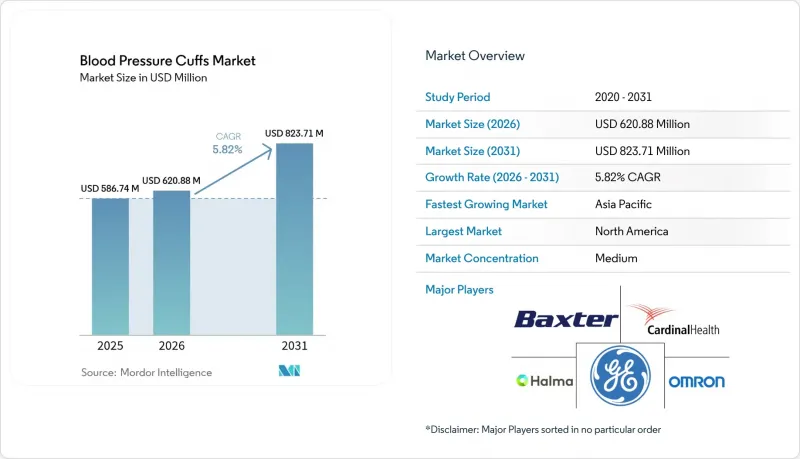
This report is Segmented by Usage Type (Reusable Cuffs, Disposable Cuffs, and D-Ring/Specialty Cuffs), Age Group (Adult, Pediatric and Neonatal), Technology (Manual, Automated, and Bluetooth/Connected Cuffs), End User (Hospitals, Clinics, Ambulatory Surgical Centers, and More), and Geography (North America, Europe, Asia-Pacific, and More). The Market Forecasts are Provided in Terms of Value (USD).
Global Blood Pressure Cuffs Market Trends and Insights
Hypertension Prevalence & Screening Programmes
The rising global prevalence of hypertension has prompted large-scale screening initiatives, such as the WHO SEAHEARTS program, which aims to achieve 50% treatment coverage by 2025. U.S. quality measure #317 requires providers to document blood pressure for all adults and outline follow-up plans for elevated readings, incorporating blood pressure cuff checks into routine encounters.European guidelines updated in 2024 now recommend out-of-office monitoring, expanding demand for clinically validated home devices. Uniform protocols are compressing diagnostic variability, making cuff accuracy pivotal for reimbursement claims. As regulators favor longitudinal data, health systems standardize equipment fleets to ensure comparable readings across care settings.
Ageing Population and Chronic-Care Burden
Older adults already comprise 20% of Hong Kong's residents and will reach 32% by 2041, pushing health spending to HKD 284.1 billion (USD 36.4 billion) in 2025. Comparable demographic shifts in North America and Europe sustain home-based monitoring programs that cut 30-day readmissions by up to 76%, with blood pressure the most tracked parameter. User-friendly cuffs with large displays and guided inflation sequences reduce training needs for seniors managing multiple chronic conditions. Vendors able to certify devices for extended use cycles and seamless data transfer secure preferred-supplier status within remote-patient-monitoring contracts.
Non-Uniform Cuff-Size Standards Causing Mis-Readings
American Heart Association protocols require bladder width equal to 40% of arm circumference and length at 80%, yet manufacturer templates vary, producing errors above 10 mmHg when sizes are mismatched. Pediatric and bariatric populations face the greatest discrepancies, forcing providers to stock wide size inventories. Procurement complexity raises training burdens and can slow workflow if the correct cuff is not immediately available. Harmonized sizing matrices proposed by the International Organization for Standardization are still voluntary, so interoperability gaps persist across brands.
Other drivers and restraints analyzed in the detailed report include:
- Shift Toward Disposable Cuffs to Curb HAIs
- Expansion of Home-Health & Telemonitoring
- Rise of Cuff-Less Wearable BP Technologies
For complete list of drivers and restraints, kindly check the Table Of Contents.
Geography Analysis
Reusable devices held 50.23% market share in 2025 due to their durability and lower per-patient cost; however, disposable units are growing at a rate of 6.51% annually, which is double the overall blood pressure cuffs market pace. Hospitals that experienced COVID-19 outbreaks quickly adopted single-use cuffs to minimize surface contamination. The blood pressure cuffs market size for disposables is forecast to expand faster than any other product category, supported by Medicare quality metrics that financially reward infection prevention.
Implementation is strongest in critical-care wards, where cross-patient exposure risk is highest, and procurement teams are increasingly evaluating total cost-of-ownership models that factor in sterilization labor and cleaning chemicals. Suppliers now offer biodegradable polymers to address PVC disposal mandates, reducing environmental concerns while retaining soft-touch ergonomics important for patient comfort. Hybrid portfolios that combine bulk reusable lines with premium single-patient SKUs enable vendors to satisfy divergent budget and safety priorities across integrated delivery networks.
Adults dominate with 69.51% revenue, but pediatric demand is rising 7.01% per year as clinicians recognize childhood hypertension's link to lifelong cardiovascular risk. Neonatal-specific projects, such as the NIH-funded "neoBP," highlight unmet needs for micro-cuffs calibrated for preterm infants. In 2024, the American Heart Association highlighted the limited pediatric validation of commercially marketed devices, creating a competitive opportunity for manufacturers that conduct rigorous age-stratified trials.
The blood pressure cuffs market share attributable to children remains small in absolute terms; however, higher average selling prices for specialized cuffs disproportionately lift revenue. Telehealth programs now enable parents to transmit home readings that correlate well with clinic results, thereby bolstering demand for easy-to-use pediatric kits. Vendors that bundle gamified mobile apps with colorful cuff designs are differentiating on user engagement, an increasingly important purchasing criterion for pediatric hospitals.
The automated cuffs segment accounts for 58.22% of 2025 shipments, primarily due to their consistent inflation algorithms that minimize operator variability. Bluetooth-enabled models, however, are registering a 9.18% CAGR, mirroring the expansion of home monitoring contracts. Omron's FDA-authorized AFib detection illustrates how AI features transform a commodity cuff into a clinical decision tool, justifying higher reimbursement tiers.
The blood pressure cuffs market size linked to smart devices is growing as providers invest in dashboards that aggregate data across various vital signs. Manual aneroid and mercury columns persist in niche settings, such as dialysis units, although environmental regulations are accelerating the retirement of mercury. Partnerships between hardware firms and digital-health software vendors are now central to competitive strategy as purchasers seek turnkey solutions that feed predictive analytics engines.
Hospitals still hold 36.17% of sales thanks to central purchasing agreements, but home-care settings exhibit the strongest 7.79% CAGR as RPM codes (CPT 99453/54/57) reimburse device provisioning and data review. Medicare's policy clarity has prompted insurers to waive copays for qualified self-measured blood pressure devices, accelerating adoption among seniors managing comorbidities.
Connected cuffs integrated with voice prompts and automatic cloud uploads fit seamlessly into tele-nursing workflows. Manufacturers are investing in smartphone-agnostic companion apps to avoid platform lock-in, appealing to health systems that operate mixed device fleets. Clinics and ambulatory centers remain stable customers, prioritizing cost-efficient automated units that streamline high-volume screening days without compromising accuracy.
- Baxter
- GE Healthcare
- Cardinal Health
- Koninklijke Philips
- OMRON
- Smiths Group
- SunTech Medical (Halma)
- Welch Allyn
- Nihon Kohden
- Mindray
- Microlife Corp.
- American Diagnostic
- Spacelabs Healthcare
- Beurer
- Rossmax
- Midmark
- Vyaire Medical
- Riester GmbH
- Yuwell Jiangsu
- Contec Medical Systems
Additional Benefits:
- The market estimate (ME) sheet in Excel format
- 3 months of analyst support
TABLE OF CONTENTS
1 Introduction
- 1.1 Study Assumptions & Market Definition
- 1.2 Scope of the Study
2 Research Methodology
3 Executive Summary
4 Market Landscape
- 4.1 Market Overview
- 4.2 Market Drivers
- 4.2.1 Hypertension Prevalence & Screening Programmes
- 4.2.2 Ageing Population and Chronic-Care Burden
- 4.2.3 Shift Toward Disposable Cuffs to Curb HAIs
- 4.2.4 Expansion of Home-Health & Telemonitoring
- 4.2.5 AI-driven EMR Analytics Need Standardized Data
- 4.2.6 Reimbursement Boost for Single-Patient Cuffs
- 4.3 Market Restraints
- 4.3.1 Latex-Free Material Supply Bottlenecks
- 4.3.2 Non-Uniform Cuff-Size Standards
- 4.3.3 Tightening PVC-Waste Rules
- 4.3.4 Rise of Cuff-Less Wearable BP Technologies
- 4.4 Technological Outlook
- 4.5 Porter's Five Forces Analysis
- 4.5.1 Bargaining Power of Suppliers
- 4.5.2 Bargaining Power of Buyers
- 4.5.3 Threat of New Entrants
- 4.5.4 Threat of Substitutes
- 4.5.5 Intensity of Competitive Rivalry
5 Market Size & Growth Forecasts (Value in USD)
- 5.1 By Usage Type
- 5.1.1 Reusable Cuffs
- 5.1.2 Disposable Cuffs
- 5.1.3 D-ring/Specialty Cuffs
- 5.2 By Age Group
- 5.2.1 Adult
- 5.2.2 Pediatric
- 5.2.3 Neonatal
- 5.3 By Technology
- 5.3.1 Manual Cuffs
- 5.3.2 Automated Cuffs
- 5.3.3 Bluetooth/Connected Cuffs
- 5.4 By End User
- 5.4.1 Hospitals
- 5.4.2 Clinics
- 5.4.3 Ambulatory Surgical Centers
- 5.4.4 Home-care Settings
- 5.4.5 Other End Users
- 5.5 By Geography
- 5.5.1 North America
- 5.5.1.1 United States
- 5.5.1.2 Canada
- 5.5.1.3 Mexico
- 5.5.2 Europe
- 5.5.2.1 Germany
- 5.5.2.2 United Kingdom
- 5.5.2.3 France
- 5.5.2.4 Italy
- 5.5.2.5 Spain
- 5.5.2.6 Rest of Europe
- 5.5.3 Asia-Pacific
- 5.5.3.1 China
- 5.5.3.2 Japan
- 5.5.3.3 India
- 5.5.3.4 Australia
- 5.5.3.5 South Korea
- 5.5.3.6 Rest of Asia-Pacific
- 5.5.4 Middle East & Africa
- 5.5.4.1 GCC
- 5.5.4.2 South Africa
- 5.5.4.3 Rest of Middle East & Africa
- 5.5.5 South America
- 5.5.5.1 Brazil
- 5.5.5.2 Argentina
- 5.5.5.3 Rest of South America
- 5.5.1 North America
6 Competitive Landscape
- 6.1 Market Concentration
- 6.2 Market Share Analysis
- 6.3 Company Profiles (includes Global level Overview, Market Level Overview, Core Segments, Financials as Available, Strategic Information, Market Rank/Share for Key Companies, Products & Services, and Recent Developments)
- 6.3.1 Baxter (Hillrom)
- 6.3.2 GE Healthcare
- 6.3.3 Cardinal Health
- 6.3.4 Philips Healthcare
- 6.3.5 Omron Healthcare
- 6.3.6 Smiths Medical
- 6.3.7 SunTech Medical (Halma)
- 6.3.8 Welch Allyn
- 6.3.9 Nihon Kohden
- 6.3.10 Shenzhen Mindray
- 6.3.11 Microlife Corp.
- 6.3.12 American Diagnostic Corporation
- 6.3.13 Spacelabs Healthcare
- 6.3.14 Beurer GmbH
- 6.3.15 Rossmax International
- 6.3.16 Midmark Corp.
- 6.3.17 Vyaire Medical
- 6.3.18 Riester GmbH
- 6.3.19 Yuwell Jiangsu
- 6.3.20 Contec Medical
7 Market Opportunities & Future Outlook
- 7.1 White-space & Unmet-need Assessment

