PUBLISHER: Mordor Intelligence | PRODUCT CODE: 2114666

PUBLISHER: Mordor Intelligence | PRODUCT CODE: 2114666
Antimicrobial Textile - Market Share Analysis, Industry Trends & Statistics, Growth Forecasts (2026 - 2031)
According to Mordor Intelligence, the antimicrobial textile market size is estimated at USD 14.29 billion in 2026, and is expected to reach USD 17.25 billion by 2031, at a CAGR of 3.84% during the forecast period (2026-2031).
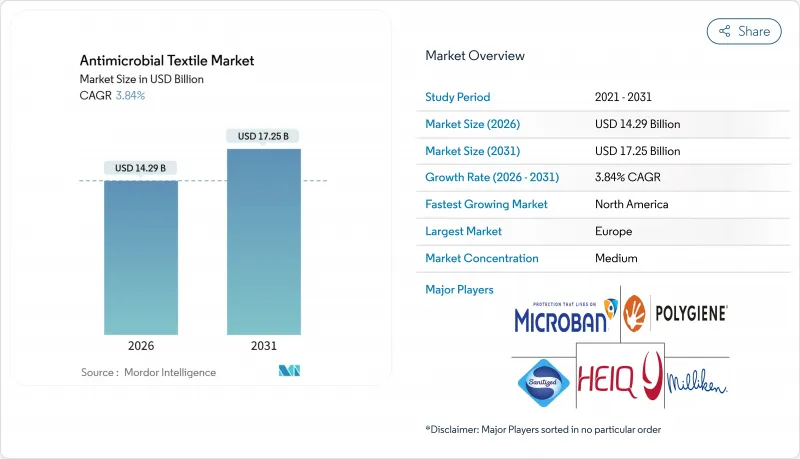
This report is Segmented by Type (Quaternary Ammonium, Triclosan, and More), Fabric Type (Cotton, Polyester, and More), Application (Medical Textiles, Apparels, and More), End-User Industry (Healthcare, Sports and Leisure and More), and Geography (Asia-Pacific, North America, Europe, South America, and Middle-East and Africa). The Market Forecasts are Provided in Terms of Value (USD).
Global Antimicrobial Textile Market Trends and Insights
Healthcare-Associated Infection Prevention Mandates
ISO 20743 now underpins hospital tenders, obliging suppliers to verify log-3 bacterial-reduction performance against Staphylococcus aureus and Klebsiella pneumoniae, the pathogens driving 42% of 2024 bloodstream infections in the CDC network. Procurement teams favor mills that maintain in-house AATCC 100 and ASTM E2149 capability, shrinking opportunities for job-dyers dependent on external certification. The U.K. NHS mandated 71 °C, 3-minute thermal disinfection in 2025, a practice that degrades topical quats yet leaves silver-bonded polyamide intact, prompting a pivot to inherently antimicrobial synthetics in drapes and gowns. Comparable durability requirements entered Japan's JIS L 1902, driving consolidation around masterbatch solutions. Similar stringency now applies to ISO 13629-2 cleanroom garments and FDA 510(k) wound dressings, reinforcing demand for proven, wash-resilient fabrics.
Athletic-Odor Management Demand in Premium Sportswear
Nike's February 2025 Aero-FIT base layers introduced silver-polymer masterbatch in recycled polyester, addressing the USD 12 billion performance-apparel segment where malodor accounts for 23% of returns. A Textile Research Journal study found untreated polyester emitted 4.7 times more methanethiol than wool, yet matched wool once dosed with 0.8 wt% silver ion. Adidas, Under Armour, and Lululemon have since specified antimicrobial polyamide in compression zones, extending garment life and reducing wash frequency. Fulgar's Q-SKIN polyamide retains 94% efficacy after 100 household washes, meeting OEKO-TEX Class I safety limits. Brands also lean on REACH Annex XVII entry 72, which caps silver release at 0.1 mg/kg per wash, guiding chemistry selection.
Tightening Nanoparticle Discharge Restrictions (EU REACH, US EPA)
ECHA placed nano-silver on its SVHC Candidate List in March 2024, forcing importers of articles with more than 0.1 wt% nano-silver to submit Article 7 notices and pay dossier fees ranging from EUR 50,000 to EUR 150,000. The move has already reduced European antimicrobial-finish formulators from 47 to 29 between 2022 and 2025. In parallel, the U.S. TSCA Section 8(a) nanomaterial rule, active January 2025, mandates production-volume and exposure reports for sub-100 nm silver particles with penalties up to USD 50,000 per day. Because polymer-bound silver is exempt, mills are racing to install twin-screw lines for masterbatch integration, extending development cycles by a year or more.
Other drivers and restraints analyzed in the detailed report include:
- Smart-Wearables Using Antimicrobial Sensor Fabrics
- Public Transport and Shared-Mobility Upholstery Hygiene Upgrades
- Premium Cost Delta Vs. Untreated Textiles
For complete list of drivers and restraints, kindly check the Table Of Contents.
Segment Analysis
Quaternary ammonium held 32.56% of 2025 antimicrobial textile market share, reflecting its broad-spectrum activity and favorable economics in workwear and hospitality linen. Yet California's Safer Consumer Products list now flags benzalkonium chlorides, adding compliance costs that erode its advantage. Triclosan persists only in niche surgical scrubs after FDA bans on OTC antiseptics. Chitosan is forecast to grow at a 5.81% CAGR, benefiting from GRAS status under FDA 21 CFR 184 and biocompatibility that eases ISO 10993 cytotoxicity hurdles. Studies in Carbohydrate Polymers confirm log-3 reductions at 1 wt% loading, competitive with silver at a fraction of the material cost.
Durability expectations amplify these shifts. EPA FIFRA registration requires public-health claims for quats, yet chitosan marketed for odor control can bypass pesticide status, allowing quicker commercialization. Hybrid formulations blending chitosan with low-dose silver aim to balance cost, safety, and wash resistance. Meanwhile, copper and zinc pyrithione fill specialist gaps in diabetic socks and mildew-resistant outdoor gear.
Cotton kept 44.71% of 2025 volume, driven by home-textile and hospital-linen comfort requirements, but its topical finishes lose efficacy after 30-40 industrial washes, raising lifecycle costs. Polyamide, forecast to grow at 5.94%, integrates silver ions during melt-spinning, locking them within the polymer matrix and retaining 94% activity after 100 domestic washes, thus commanding a premium in compression hosiery and surgical garments.
Blends such as 65/35 polyester-cotton meet NFPA 1999 EMS garment codes and provide a midway option where comfort and durability must coexist. Aramid and modacrylic variants serve flame-retardant military uses, with Milliken enlarging capacity via its January 2025 Two Rivers acquisition to supply Artemis mission garments. Across all fabrics, ISO 6330 wash-test compliance and REACH Annex XVII silver-release caps govern chemistry choices.
Complete Report Scope:
- By Type
- Quaternary Ammonium
- Triclosan
- Chitosan
- Cyclodextrin
- Other Types
- By Fabric Type
- Cotton
- Polyester
- Polyamide
- Blended and Composite
- Other Fabric Types
- By Application
- Medical Textiles
- Apparels
- Home Textiles
- Industrial Textiles
- Other Applications (Protective Clothing, etc.)
- By End-user Industry
- Healthcare
- Sports and Leisure
- Residential
- Industrial and Manufacturing
- Military and Defense
- Food Processing
- Transportation
- Other End-user Industries
- By Geography
- Asia-Pacific
- China
- India
- Japan
- South Korea
- ASEAN Countries
- Rest of Asia-Pacific
- North America
- United States
- Canada
- Mexico
- Europe
- Germany
- United Kingdom
- France
- Italy
- Rest of Europe
- South America
- Brazil
- Argentina
- Rest of South America
- Middle-East and Africa
- Saudi Arabia
- South Africa
- Rest of Middle-East and Africa
- Asia-Pacific
Geography Analysis
Europe led the antimicrobial textile market with 35.01% of 2025 revenue, driven by stringent REACH Annex XVII controls that push mills toward masterbatch solutions, eliminating leachable nanoparticle finishes. Germany's machinery suppliers, notably Oerlikon, enable in-line silver dosing, while the U.K. NHS laundry protocol favors polyamide surgical packs, lifting demand in Britain and Ireland. France's ANSM requires MDR 2017/745 CE marking for antimicrobial dressings, consolidating the supplier base among vertically integrated firms. Italy's Prato district is shifting into polyamide-cotton blends to mitigate finish degradation on traditional wool lines.
North America is set to grow at a 4.77% CAGR through 2031 as TSCA rules encourage polymer-bound silver, prompting domestic spinning investments and reducing reliance on Asian imports subject to nanoparticle reporting. Health Canada harmonized its PMRA guidance with EPA FIFRA in late 2024, cutting registration delays for cross-border suppliers. Mexico's maquiladoras supply antimicrobial workwear under USMCA origin rules, benefiting from proximity to U.S. clients.
In Asia-Pacific, China's GB/T 20944 revision aligns to ISO 20743, making exports smoother, while Japan's 50-wash JIS L 1902 durability test favors Toray and Unitika masterbatches. South Korea's MFDS fast-tracked chitosan wound dressings in 2025, and ASEAN's regulatory patchwork slows uptake outside Thailand and Malaysia. South America and the Middle East and Africa remain nascent, though Brazil's ANVISA instituted hospital antimicrobial-textile registration in 2024.
- 1888 Mills, LLC
- Ahlstrom
- BioCote Limited
- Birlacril
- HeiQ Materials AG
- Herculite
- Indorama Ventures Public Company Limited
- Microban International
- Milliken
- Noble Biomaterials
- Polygiene Group AB
- PurThread
- SANITIZED AG
- Sciessent LLC
- Toray Industries, Inc.
- UNITIKA LTD.
Additional Benefits:
- The market estimate (ME) sheet in Excel format
- 3 months of analyst support
TABLE OF CONTENTS
1 Introduction
- 1.1 Study Assumptions and Market Definition
- 1.2 Scope of the Study
2 Research Methodology
3 Executive Summary
4 Market Landscape
- 4.1 Market Overview
- 4.2 Market Drivers
- 4.2.1 Healthcare-Associated Infection (HAI) Prevention Mandates
- 4.2.2 Athletic-Odor Management Demand in Premium Sportswear
- 4.2.3 Smart-Wearables Using Antimicrobial Sensor Fabrics
- 4.2.4 Public Transport and Shared-Mobility Upholstery Hygiene Upgrades
- 4.2.5 Recycling-Ready Silver-Ion Masterbatch Adoption
- 4.3 Market Restraints
- 4.3.1 Tightening Nanoparticle Discharge Restrictions (EU REACH, US EPA)
- 4.3.2 Premium Cost Delta Vs. Untreated Textiles
- 4.3.3 Silver Price Volatility and Supply-Chain Concentration
- 4.4 Value Chain Analysis
- 4.5 Porter's Five Forces
- 4.5.1 Threat of New Entrants
- 4.5.2 Bargaining Power of Buyers
- 4.5.3 Bargaining Power of Suppliers
- 4.5.4 Threat of Substitutes
- 4.5.5 Degree of Competition
5 Market Size and Growth Forecasts (Value)
- 5.1 By Type
- 5.1.1 Quaternary Ammonium
- 5.1.2 Triclosan
- 5.1.3 Chitosan
- 5.1.4 Cyclodextrin
- 5.1.5 Other Types
- 5.2 By Fabric Type
- 5.2.1 Cotton
- 5.2.2 Polyester
- 5.2.3 Polyamide
- 5.2.4 Blended and Composite
- 5.2.5 Other Fabric Types
- 5.3 By Application
- 5.3.1 Medical Textiles
- 5.3.2 Apparels
- 5.3.3 Home Textiles
- 5.3.4 Industrial Textiles
- 5.3.5 Other Applications (Protective Clothing, etc.)
- 5.4 By End-user Industry
- 5.4.1 Healthcare
- 5.4.2 Sports and Leisure
- 5.4.3 Residential
- 5.4.4 Industrial and Manufacturing
- 5.4.5 Military and Defense
- 5.4.6 Food Processing
- 5.4.7 Transportation
- 5.4.8 Other End-user Industries
- 5.5 By Geography
- 5.5.1 Asia-Pacific
- 5.5.1.1 China
- 5.5.1.2 India
- 5.5.1.3 Japan
- 5.5.1.4 South Korea
- 5.5.1.5 ASEAN Countries
- 5.5.1.6 Rest of Asia-Pacific
- 5.5.2 North America
- 5.5.2.1 United States
- 5.5.2.2 Canada
- 5.5.2.3 Mexico
- 5.5.3 Europe
- 5.5.3.1 Germany
- 5.5.3.2 United Kingdom
- 5.5.3.3 France
- 5.5.3.4 Italy
- 5.5.3.5 Rest of Europe
- 5.5.4 South America
- 5.5.4.1 Brazil
- 5.5.4.2 Argentina
- 5.5.4.3 Rest of South America
- 5.5.5 Middle-East and Africa
- 5.5.5.1 Saudi Arabia
- 5.5.5.2 South Africa
- 5.5.5.3 Rest of Middle-East and Africa
- 5.5.1 Asia-Pacific
6 Competitive Landscape
- 6.1 Market Concentration
- 6.2 Strategic Moves
- 6.3 Market Share(%)/Ranking Analysis
- 6.4 Company Profiles {(includes Global level Overview, Market level overview, Core Segments, Financials as available, Strategic Information, Products and Services, and Recent Developments)}
- 6.4.1 1888 Mills, LLC
- 6.4.2 Ahlstrom
- 6.4.3 BioCote Limited
- 6.4.4 Birlacril
- 6.4.5 HeiQ Materials AG
- 6.4.6 Herculite
- 6.4.7 Indorama Ventures Public Company Limited
- 6.4.8 Microban International
- 6.4.9 Milliken
- 6.4.10 Noble Biomaterials
- 6.4.11 Polygiene Group AB
- 6.4.12 PurThread
- 6.4.13 SANITIZED AG
- 6.4.14 Sciessent LLC
- 6.4.15 Toray Industries, Inc.
- 6.4.16 UNITIKA LTD.
7 Market Opportunities and Future Outlook
- 7.1 White-space and Unmet-Need Assessment
- 7.2 Development of Non-Toxic and Bio-Compatible Products

