PUBLISHER: Mordor Intelligence | PRODUCT CODE: 2114668

PUBLISHER: Mordor Intelligence | PRODUCT CODE: 2114668
Meperidine Drugs - Market Share Analysis, Industry Trends & Statistics, Growth Forecasts (2026 - 2031)
According to Mordor Intelligence, the meperidine drugs market size is expected to grow from USD 585.35 million in 2025 to USD 608.18 million in 2026 and is forecast to reach USD 736.58 million by 2031 at 3.90% CAGR over 2026-2031.
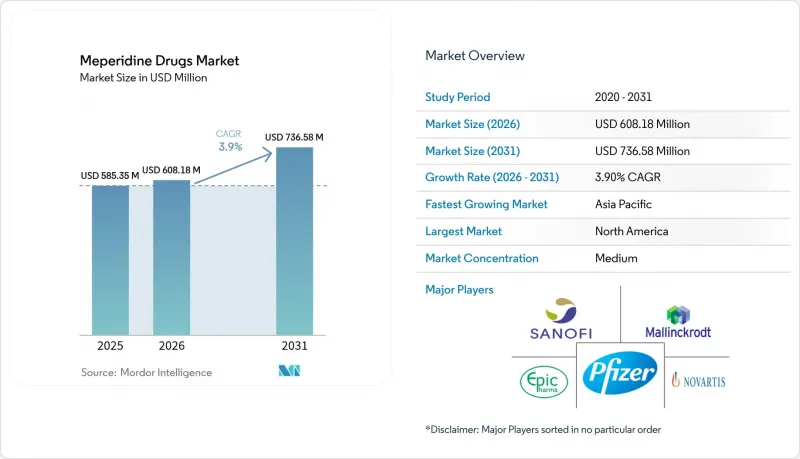
This report is Segmented by Route of Administration (Oral, Parenteral [Intravenous, Intramuscular]), Application (Pain Relief, Anesthesia, Cough Suppression, Diarrhea Suppression, De-addiction/Detox Support, Post-Operative Shivering), and Geography (North America, Europe, Asia-Pacific, Middle East & Africa, South America). The Market Forecasts are Provided in Terms of Value (USD).
Global Meperidine Drugs Market Trends and Insights
Expanding Palliative and End-of-Life Opioid Utilization
Cancer incidence continues to climb, and multidisciplinary palliative-care teams increasingly select meperidine when mixed nociceptive-neuropathic pain resists first-line morphine or fentanyl. Intrathecal regimens show meaningful reductions in breakthrough pain episodes, improving quality-of-life metrics that national oncology societies now track closely. Long-term demand is therefore partly insulated from routine surgical fluctuations, reinforcing baseline purchasing volumes at large oncology centers.
Surging Need for Rapid-Onset, Short-Duration Peri-Operative Analgesia
Outpatient surgeries in Asia-Pacific and Latin America are rising briskly, and anesthesiologists prefer an agent that wears off quickly enough to permit same-day discharge without respiratory-depression risk overnight. Meperidine's 3-5 hour activity window outperforms longer-acting opioids in enhanced-recovery protocols, helping hospitals shorten recovery-room stays and optimize operating-room throughput.
Increasing Formulary Exclusions and Prescribing Restrictions
The American Geriatrics Society Beers Criteria highlights neurotoxicity risks tied to normeperidine metabolites. Electronic medical-record alerts now flag meperidine orders, triggering peer review or prior authorization that slows dispensing workflows. These administrative hurdles compress daily volumes even in hospitals that otherwise value the drug.
Other drivers and restraints analyzed in the detailed report include:
- Lower Cost Profile Compared with Newer Synthetic Opioids
- Niche Clinical Applications Such as Anti-Shivering Management
- Rising Clinical Substitution by Safer Opioids
For complete list of drivers and restraints, kindly check the Table Of Contents.
Segment Analysis
Parenteral formulations captured 65.12% of the meperidine drugs market in 2025 and are projected to advance at 6.56% through 2031, a pace that outstrips overall industry growth. This sustained edge stems from meperidine's first-line role in operating theaters, emergency departments, and critical-care units where rapid onset is non-negotiable. Sterile-injectable production remains technically demanding, providing incumbents with regulatory and capital barriers that discourage new entrants and support stable price realization. The meperidine drugs market size for parenteral products is therefore expected to widen its revenue gap over oral presentations as day-surgery volumes and ER admissions continue rising.
Hospital formularies persistently favor parenteral meperidine for shivering control, and recent supply disruptions have underscored the formulation's indispensability. Pfizer's 2024-2025 manufacturing delays tightened availability, but they also validated procurement strategies that diversify sources among Mallinckrodt, Hikma, and regional sterile-injectable specialists. Because injectable products must comply with Schedule II controlled-substance logistics, wholesalers and group-purchasing organizations give preferential contracts to partners with proven cold-chain integrity and real-time serialization, reinforcing the competitive moat around parenteral offerings.
Complete Report Scope:
- By Route of Administration
- Oral
- Parenteral
- Intravenous
- Intramuscular
- By Application
- Pain Relief
- Anesthesia
- Cough Suppression
- Diarrhea Suppression
- De-addiction / Detox Support
- Post-operative Shivering
- By Geography
- North America
- United States
- Canada
- Mexico
- Europe
- Germany
- United Kingdom
- France
- Italy
- Spain
- Rest of Europe
- Asia-Pacific
- China
- Japan
- India
- Australia
- South Korea
- Rest of Asia-Pacific
- Middle East & Africa
- GCC
- South Africa
- Rest of Middle East & Africa
- South America
- Brazil
- Argentina
- Rest of South America
- North America
Geography Analysis
North America led the meperidine drugs market with 43.12% revenue in 2025. Hospital stewardship dashboards now track meperidine days-of-therapy separately from other opioids, preserving access for anti-shivering and select palliative applications yet constraining routine post-surgical use. Because national distributors allocate inventory against strict Schedule II ledger controls, any manufacturer outage can ripple quickly, and provider contracts increasingly hinge on supply-assurance clauses.
Asia-Pacific stands out with a 6.92% CAGR driven by elective-surgery expansion, medical tourism, and domestic pharmaceutical capacity growth. Regulatory harmonization initiatives in China and India streamline dossier reviews and encourage local API production, strengthening the regional supply chain. Indian firms earning USFDA and EU-GMP approvals are exporting finished doses to Southeast Asia, shortening lead times and compressing landed costs. Rising adoption of U.S.-style enhanced-recovery protocols pushes tertiary hospitals in Thailand, Malaysia, and Vietnam to stock meperidine for shivering control, accelerating market penetration.
Europe presents mid-single-digit growth as guidelines tilt toward newer agents. EMA centralization expedites assessment, but member-state formularies often restrict meperidine to anesthesia departments with clear written protocols. Middle East and Africa show latent demand tied to the gradual roll-out of cancer centers and trauma units. South American uptake is episodic; Brazil and Chile demonstrate steady volumes while Argentina and Venezuela struggle with economic headwinds. Collectively, emerging geographies provide volume growth that counterbalances plateauing demand in mature Western markets, cementing a stable global outlook for the meperidine drugs market.
- Pfizer
- Teva Pharmaceutical Industries
- Mallinckrodt Pharmaceuticals
- Hikma Pharmaceuticals
- Epic Pharma LLC
- Vintage Pharmaceuticals (Qualitest)
- Sandoz (Novartis AG)
- Sun Pharmaceuticals Industries
- Sanofi
- Fresenius
- Amneal Pharmaceuticals
- Aurobindo Pharma Ltd.
- Apotex
- Mylan
- Endo International
- Intas Pharmaceutical
- Lupin
- Taj Pharmaceuticals Ltd.
- Abbott Laboratories
- Baxter
Additional Benefits:
- The market estimate (ME) sheet in Excel format
- 3 months of analyst support
TABLE OF CONTENTS
1 Introduction
- 1.1 Study Assumptions & Market Definition
- 1.2 Scope of the Study
2 Research Methodology
3 Executive Summary
4 Market Landscape
- 4.1 Market Overview
- 4.2 Market Drivers
- 4.2.1 Expanding Palliative and End-of-Life Opioid Utilization
- 4.2.2 Surging Need for Rapid-Onset, Short-Duration Peri-Operative Analgesia
- 4.2.3 Lower Cost Profile Compared to Newer Synthetic Opioids
- 4.2.4 Niche Clinical Applications Such as Anti-Shivering Management
- 4.2.5 Renewed Adoption as a Combined Opioid and Local Anesthetic Agent
- 4.2.6 Limited Global Regulatory Bans
- 4.3 Market Restraints
- 4.3.1 Increasing Formulary Exclusions and Prescribing Restrictions
- 4.3.2 Rising Clinical Substitution by Safer Opioids
- 4.3.3 Persistent Global Shortages of Active Pharmaceutical Ingredient (API)
- 4.3.4 Toxicity Concerns with Repeated Dosing
- 4.4 Regulatory Landscape
- 4.5 Porter's Five Forces Analysis
- 4.5.1 Threat of New Entrants
- 4.5.2 Bargaining Power of Buyers
- 4.5.3 Bargaining Power of Suppliers
- 4.5.4 Threat of Substitutes
- 4.5.5 Intensity of Competitive Rivalry
5 Market Size & Growth Forecasts (Value in USD)
- 5.1 By Route of Administration
- 5.1.1 Oral
- 5.1.2 Parenteral
- 5.1.2.1 Intravenous
- 5.1.2.2 Intramuscular
- 5.2 By Application
- 5.2.1 Pain Relief
- 5.2.2 Anesthesia
- 5.2.3 Cough Suppression
- 5.2.4 Diarrhea Suppression
- 5.2.5 De-addiction / Detox Support
- 5.2.6 Post-operative Shivering
- 5.3 By Geography
- 5.3.1 North America
- 5.3.1.1 United States
- 5.3.1.2 Canada
- 5.3.1.3 Mexico
- 5.3.2 Europe
- 5.3.2.1 Germany
- 5.3.2.2 United Kingdom
- 5.3.2.3 France
- 5.3.2.4 Italy
- 5.3.2.5 Spain
- 5.3.2.6 Rest of Europe
- 5.3.3 Asia-Pacific
- 5.3.3.1 China
- 5.3.3.2 Japan
- 5.3.3.3 India
- 5.3.3.4 Australia
- 5.3.3.5 South Korea
- 5.3.3.6 Rest of Asia-Pacific
- 5.3.4 Middle East & Africa
- 5.3.4.1 GCC
- 5.3.4.2 South Africa
- 5.3.4.3 Rest of Middle East & Africa
- 5.3.5 South America
- 5.3.5.1 Brazil
- 5.3.5.2 Argentina
- 5.3.5.3 Rest of South America
- 5.3.1 North America
6 Competitive Landscape
- 6.1 Market Concentration
- 6.2 Market Share Analysis
- 6.3 Company Profiles (includes Global level Overview, Market level overview, Core Segments, Financials as available, Strategic Information, Market Rank/Share for key companies, Products & Services, and Recent Developments)
- 6.3.1 Pfizer Inc.
- 6.3.2 Teva Pharmaceutical Industries Ltd.
- 6.3.3 Mallinckrodt Pharmaceuticals
- 6.3.4 Hikma Pharmaceuticals PLC
- 6.3.5 Epic Pharma LLC
- 6.3.6 Vintage Pharmaceuticals (Qualitest)
- 6.3.7 Sandoz (Novartis AG)
- 6.3.8 Sun Pharmaceutical Industries Ltd.
- 6.3.9 Sanofi S.A.
- 6.3.10 Fresenius Kabi
- 6.3.11 Amneal Pharmaceuticals LLC
- 6.3.12 Aurobindo Pharma Ltd.
- 6.3.13 Apotex Inc.
- 6.3.14 Mylan (Viatris Inc.)
- 6.3.15 Endo International plc
- 6.3.16 Intas Pharmaceuticals Ltd.
- 6.3.17 Lupin Ltd.
- 6.3.18 Taj Pharmaceuticals Ltd.
- 6.3.19 Abbott Laboratories
- 6.3.20 Baxter International Inc.
7 Market Opportunities & Future Outlook
- 7.1 White-space & Unmet-need Assessment

