PUBLISHER: Mordor Intelligence | PRODUCT CODE: 2114671

PUBLISHER: Mordor Intelligence | PRODUCT CODE: 2114671
Gemcitabine Hydrochloride - Market Share Analysis, Industry Trends & Statistics, Growth Forecasts (2026 - 2031)
According to Mordor Intelligence, gemcitabine hydrochloride market size in 2026 is estimated at USD 885.44 million, growing from 2025 value of USD 0.83 billion with 2031 projections showing USD 1.22 billion, growing at 6.68% CAGR over 2026-2031.
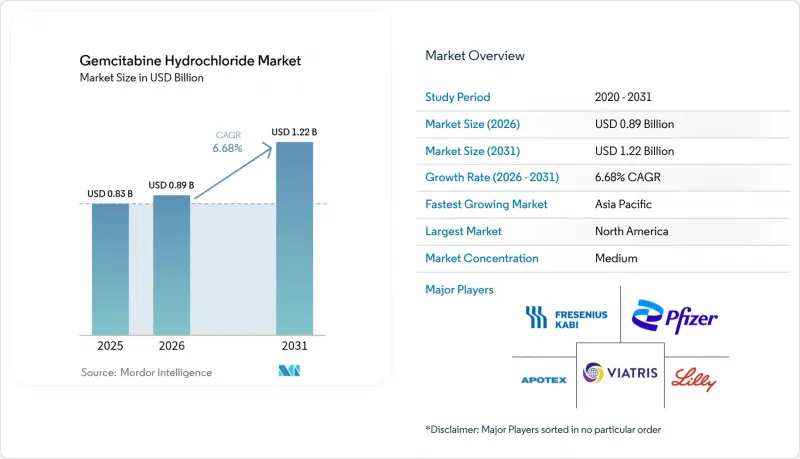
This report is Segmented by Product Type (Injection, Ready-To-Use IV Solution), Indication (Pancreatic Cancer, Non-Small Cell Lung Cancer, Breast Cancer, Others), Patient Age Group (Adults, Geriatric, Pediatric), and Geography (North America, Europe, Asia-Pacific, Middle East and Africa, South America). The Market Forecasts are Provided in Terms of Value (USD).
Global Gemcitabine Hydrochloride Market Trends and Insights
Growing Burden of Solid-Tumor Cancers
Rising incidence of pancreatic, lung, breast and bladder cancers is widening the addressable population for gemcitabine, especially in low- and middle-income countries undergoing rapid urbanisation. The compound's proven efficacy across these tumors keeps it embedded in first-line and adjuvant protocols, and recent approvals pairing gemcitabine with novel checkpoint inhibitors further cement its role in multimodal therapy. Younger patient cohorts in Asia and Africa are contributing incremental volume, driving demand for paediatric-friendly dosing formats and protocols that mitigate haematological toxicity.
Intensifying Oncology R&D Pipelines & Label-Expansion Trials
More than 700 active or planned studies globally are exploring gemcitabine combinations, leveraging its well-characterised safety record to accelerate development timelines . Roche's Phase III STARGLO trial showed a 41% reduction in mortality when Columvi was combined with gemcitabine-oxaliplatin, securing European approval in April 2025 . Such successes illustrate how synergistic regimens can extend the molecule's lifecycle, open orphan indications, and justify premium pricing even after base-compound patent expiry.
Stringent Pharmacovigilance & Cytotoxic Handling Regulations
FDA crack-downs on sterile injectables led to 30 ANDA withdrawals in 2024, underscoring scrutiny on manufacturing controls for cytotoxics. Hospitals must invest in closed-system transfer devices, negative-pressure rooms and specialised waste streams, raising total treatment costs and discouraging smaller facilities in Latin America and Africa from stocking gemcitabine. Compliance heterogeneity across jurisdictions complicates multi-site production and forces generic entrants to allocate significant capex before first revenue.
Other drivers and restraints analyzed in the detailed report include:
- Rapid Genericisation Driving Price Elasticity in Emerging Markets
- Use in Novel Nano-Liposomal and Depot Delivery Platforms
- Competitive Displacement by Immune Checkpoint Inhibitors
For complete list of drivers and restraints, kindly check the Table Of Contents.
Segment Analysis
In 2025 injections dominated with a 71.56% gemcitabine hydrochloride market share, supported by universal familiarity in oncology pharmacies. Ready-to-use solutions, although niche, are forecast to advance at 7.71% CAGR, riding workflow efficiency, reduced error risk and lower exposure events for pharmacy staff. The launch of Infugem showed that hospitals will pay a premium for reconstitution-free bags, especially amid persistent staff shortages. Manufacturing sterility and shelf-life hurdles deter rapid generic entry, allowing innovators to defend price differentials and capture incremental value even in tender markets.
Workflow data from large US oncology networks show a 28% cut in compounding time when ready-to-use bags replace powder vials, freeing infusion chairs for higher throughput and raising revenue per square foot of clinic space. This operational upside, combined with lower hazardous waste volumes, resonates with value-analysis committees struggling to reconcile staff safety mandates with budget ceilings. As more hospital groups bundle drug acquisition costs with total labour savings, premium ready-to-use formats are expected to gain ground, lifting the overall gemcitabine hydrochloride market.
Complete Report Scope:
- By Product Type
- Injection
- Ready-to-use IV Solution
- By Indication
- Pancreatic Cancer
- Non-Small Cell Lung Cancer
- Breast Cancer
- Others
- By Patient Age Group
- Adults
- Geriatric
- Pediatric
- By Geography
- North America
- United States
- Canada
- Mexico
- Europe
- Germany
- United Kingdom
- France
- Italy
- Spain
- Rest of Europe
- Asia-Pacific
- China
- Japan
- India
- Australia
- South Korea
- Rest of Asia-Pacific
- Middle East and Africa
- GCC
- South Africa
- Rest of Middle East and Africa
- South America
- Brazil
- Argentina
- Rest of South America
- North America
Geography Analysis
North America commanded 40.58% of the gemcitabine hydrochloride market in 2025 on the back of premium branded pricing, extensive clinical trial pipelines and payer coverage that cushions hospital formulary budgets. Continued domestic manufacturing investment-exemplified by Lilly's USD 50 billion multi-site expansion-reinforces supply security and keeps the region a priority launch market. Nonetheless, chronic shortages of companion agents such as cisplatin have spotlighted gemcitabine as a substitution backbone, driving episodic demand spikes and creating openings for agile suppliers.
Asia-Pacific is forecast to deliver the most robust 7.82% CAGR through 2031 as cancer incidence climbs and regional governments court API self-sufficiency. India's three Bulk Drug Parks and China's 169-acre WuXi STA site illustrate policy-backed scale advantages that translate to cost-competitive exports. Concurrently, local regulatory harmonisation with ICH guidelines is elevating quality benchmarks, shrinking the trust gap between Western buyers and Asian producers and accelerating ANDA approvals for APAC-sourced injectables.
Europe maintains a sizeable share owing to high per-patient spending and early adoption of innovative combinations such as Columvi-gemcitabine-oxaliplatin authorised in April 2025. Stringent pharmacovigilance keeps average selling prices above global means, offsetting lower procedure volumes compared with the US and China. Moreover, collaborative procurement under the EU Joint Clinical Assessment is expected to expand access while safeguarding margins for quality-verified suppliers, preserving a stable revenue pillar for multinational and specialty firms alike.
- Eli Lilly and Company
- Pfizer
- Teva Pharmaceutical Industries
- Accord Healthcare
- Fresenius
- Apotex
- Gland Pharma
- Sagent Pharmaceuticals
- Jiangsu Hansoh Pharm.
- Hebei Changshan
- Cheplapharm Arzneimittel
- Dr Reddy's Laboratories
- Viatris
- Cipla
- Sun Pharmaceuticals Industries
- Intas Pharmaceuticals
- STADA Arzneimittel
- Hikma Pharmaceuticals
- Baxter
- Lupin
Additional Benefits:
- The market estimate (ME) sheet in Excel format
- 3 months of analyst support
TABLE OF CONTENTS
1 Introduction
- 1.1 Study Assumptions & Market Definition
- 1.2 Scope of the Study
2 Research Methodology
3 Executive Summary
4 Market Landscape
- 4.1 Market Overview
- 4.2 Market Drivers
- 4.2.1 Growing burden of solid-tumor cancers
- 4.2.2 Intensifying oncology R&D pipelines & label-expansion trials
- 4.2.3 Rapid genericisation driving price elasticity in emerging markets
- 4.2.4 Adoption of high-dose, cisplatin-sparing regimens
- 4.2.5 Localised API manufacturing incentives in India & China
- 4.2.6 Use in novel nano-liposomal and depot delivery platforms
- 4.3 Market Restraints
- 4.3.1 Stringent pharmacovigilance & cytotoxic handling regulations
- 4.3.2 Severe haematological toxicity limiting dose intensity
- 4.3.3 Price-erosion from tender-based hospital procurement
- 4.3.4 Competitive displacement by immune checkpoint inhibitors
- 4.4 Value / Supply-Chain Analysis
- 4.5 Regulatory Landscape
- 4.6 Porters Five Forces Analysis
- 4.6.1 Threat of New Entrants
- 4.6.2 Bargaining Power of Buyers
- 4.6.3 Bargaining Power of Suppliers
- 4.6.4 Threat of Substitutes
- 4.6.5 Competitive Rivalry
5 Market Size & Growth Forecasts (Value, USD)
- 5.1 By Product Type
- 5.1.1 Injection
- 5.1.2 Ready-to-use IV Solution
- 5.2 By Indication
- 5.2.1 Pancreatic Cancer
- 5.2.2 Non-Small Cell Lung Cancer
- 5.2.3 Breast Cancer
- 5.2.4 Others
- 5.3 By Patient Age Group
- 5.3.1 Adults
- 5.3.2 Geriatric
- 5.3.3 Pediatric
- 5.4 By Geography
- 5.4.1 North America
- 5.4.1.1 United States
- 5.4.1.2 Canada
- 5.4.1.3 Mexico
- 5.4.2 Europe
- 5.4.2.1 Germany
- 5.4.2.2 United Kingdom
- 5.4.2.3 France
- 5.4.2.4 Italy
- 5.4.2.5 Spain
- 5.4.2.6 Rest of Europe
- 5.4.3 Asia-Pacific
- 5.4.3.1 China
- 5.4.3.2 Japan
- 5.4.3.3 India
- 5.4.3.4 Australia
- 5.4.3.5 South Korea
- 5.4.3.6 Rest of Asia-Pacific
- 5.4.4 Middle East and Africa
- 5.4.4.1 GCC
- 5.4.4.2 South Africa
- 5.4.4.3 Rest of Middle East and Africa
- 5.4.5 South America
- 5.4.5.1 Brazil
- 5.4.5.2 Argentina
- 5.4.5.3 Rest of South America
- 5.4.1 North America
6 Competitive Landscape
- 6.1 Market Concentration
- 6.2 Market Share Analysis
- 6.3 Company Profiles (includes Global level Overview, Market level overview, Core Segments, Financials as available, Strategic Information, Market Rank/Share for key companies, Products & Services, Recent Developments)
- 6.3.1 Eli Lilly & Co.
- 6.3.2 Pfizer Inc. (Hospira)
- 6.3.3 Teva Pharmaceuticals
- 6.3.4 Accord Healthcare
- 6.3.5 Fresenius Kabi
- 6.3.6 Apotex Inc.
- 6.3.7 Gland Pharma
- 6.3.8 Sagent Pharmaceuticals
- 6.3.9 Jiangsu Hansoh Pharm.
- 6.3.10 Hebei Changshan
- 6.3.11 Cheplapharm Arzneimittel
- 6.3.12 Dr Reddy's Laboratories
- 6.3.13 Viatris
- 6.3.14 Cipla Ltd.
- 6.3.15 Sun Pharma
- 6.3.16 Intas Pharmaceuticals
- 6.3.17 STADA Arzneimittel
- 6.3.18 Hikma Pharmaceuticals
- 6.3.19 Baxter International
- 6.3.20 Lupin Ltd.
7 Market Opportunities & Future Outlook
- 7.1 White-space & Unmet-need Assessment

