PUBLISHER: Mordor Intelligence | PRODUCT CODE: 2114679

PUBLISHER: Mordor Intelligence | PRODUCT CODE: 2114679
Morphine - Market Share Analysis, Industry Trends & Statistics, Growth Forecasts (2026 - 2031)
According to Mordor Intelligence, the morphine market size was valued at USD 32.85 billion in 2025 and estimated to grow from USD 35.39 billion in 2026 to reach USD 51.39 billion by 2031, at a CAGR of 7.74% during the forecast period (2026-2031).
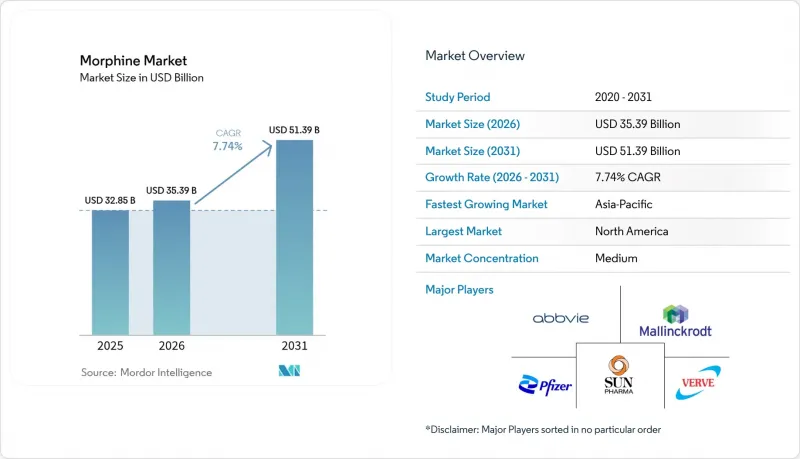
This report is Segmented by Dosage Form (Injection, Oral Tablets, and More), Release Type (Immediate-Release and Extended-Release), Route of Administration (Intravenous, Intramuscular, and More), Application (Pain Management, Diarrhoea Suppression, and More), End-User (Hospitals, Retail Pharmacies, and More), and Geography (North America, Europe, and More). The Market Forecasts are Provided in Terms of Value (USD).
Global Morphine Market Trends and Insights
Launch Of Abuse-Deterrent Extended-Release (ER) Formulations
FDA approval of RoxyBond's updated REMS in November 2024 set a safety benchmark that now covers all ER opioids, morphine included. SentryBond technology, validated across 2,000 tamper-tests, curtails intranasal and intravenous misuse, giving manufacturers a competitive edge. Hospitals and insurers accept premium prices because liability risk falls when prescribers choose abuse-deterrent products. Early uptake improves revenue per dose and raises barriers for low-tech rivals. As regulatory authorities in Asia-Pacific adopt similar labeling rules, global diffusion accelerates near-term sales momentum.
Rapid Expansion Of Hospice & Palliative-Care Beds In Various Regions Globally
CMS lifted hospice payments 2.6% for FY 2025, injecting USD 705 million into end-of-life care budgets. Uzbekistan opened its first children's hospice, signaling demand in lower-income settings. A Chinese survey scored home hospice care needs at 115.70 points, underscoring unmet demand in the world's second-largest economy. The WHO's May 2025 guideline urging wider controlled-medicine access may prompt regulatory reform that smooths supply chains. These structural shifts broaden the morphine market as palliative beds multiply and prescribers standardize opioid protocols.
Prescription Opioid Diversion & Black-Market Resale
DEA seized 2.7 million fentanyl pills in New Mexico in April 2025, reflecting the scale of illicit trades that suppress legitimate prescriptions. Prosecutions of clinicians for theft raise professional liability fears and reduce prescribing enthusiasm. The DOJ links more than 110,000 overdose deaths to opioids, prompting quota tightening and reporting burdens that delay distribution. Higher compliance cost slows shipments, shaving near-term growth from the morphine market.
Other drivers and restraints analyzed in the detailed report include:
- Digitally-Enabled PCA Pumps Driving Injectable Demand In Hospitals
- Escalating Global Hip & Knee Replacement Procedures
- Supply Bottlenecks In Poppy Raw-Material Cultivation
For complete list of drivers and restraints, kindly check the Table Of Contents.
Segment Analysis
Injectable products commanded 45.10% of morphine market share in 2025 on the strength of rapid onset and fine-tuned dose control essential in operating rooms and emergency wards. Smart infusion-pump interoperability trimmed medication-error rates by 15.4% to 90.5%, adding clinical justification for high-value injectable contracts. Oral solutions, supported by hospice expansion, are projected to post an 8.14% CAGR through 2031, closing part of the accessibility gap in palliative settings.
Rising shortages of injectable opioids compel hospital pharmacists to shift some patients to oral formats, indirectly accelerating oral adoption. Nonetheless, sustained surgical growth keeps the injectables line firmly ahead in absolute dollars, ensuring the morphine market retains a balanced product mix.
Immediate-release formulations held 60.05% share in 2025 due to deep prescriber familiarity and insurance ease. Yet extended-release drugs, fortified with abuse-deterrent layers, are set for 9.22% CAGR, the highest among release categories. The morphine market size for extended-release products is projected to climb markedly as health insurers view lower diversion risk as cost-saving over the therapy cycle.
FDA-monitored REMS intensify training and record-keeping. Manufacturers willing to invest in nano-carrier or microsphere technologies can price at a premium while aligning with REMS goals. Flexible licensing paths encourage regional players to partner with global innovators, enriching the formulation pipeline across the morphine market.
Complete Report Scope:
- By Dosage Form
- Injection
- Oral Tablets / Capsules
- Oral Solution / Drops
- Suppositories
- By Release Type
- Immediate-Release (IR)
- Extended-Release (ER) / Controlled-Release
- By Route of Administration
- Intravenous
- Intramuscular / Sub-cutaneous
- Epidural
- Intrathecal
- By Application
- Pain Management
- Cancer Pain
- Neuropathic Pain
- Osteoarthritis & Musculoskeletal Pain
- Other Pain Segments
- Diarrhoea Suppression
- Cough Suppression
- Adjunct to Anaesthesia
- Pain Management
- By End-User
- Hospitals
- Retail Pharmacies
- Home-Care / Hospice Centres
- Online Pharmacies
- Geography
- North America
- United States
- Canada
- Mexico
- Europe
- Germany
- United Kingdom
- France
- Italy
- Spain
- Rest of Europe
- Asia-Pacific
- China
- Japan
- India
- South Korea
- Australia
- Rest of Asia-Pacific
- Middle East and Africa
- GCC
- South Africa
- Rest of Middle East and Africa
- South America
- Brazil
- Argentina
- Rest of South America
- North America
Geography Analysis
North America anchored 34.45% of the morphine market in 2025 due to robust insurance coverage, advanced surgical volume, and stringent yet transparent FDA and DEA oversight. Abuse-deterrent uptake is highest here, aligning public-health mandates with manufacturer innovation. Digital PCA pumps see early adoption, further consolidating morphine's clinical foothold.
Europe maintains a balanced regulatory climate under EMA coordination. Cross-country reimbursement frameworks vary, yet broad palliative-care availability safeguards baseline demand. Manufacturers leverage intra-EU supply channels to offset Afghan raw-material volatility, tempering cost spikes that ripple through the morphine market.
Asia-Pacific registers the swiftest rise at 9.48% CAGR, benefiting from large-scale hospital construction, aging demographics, and policy moves to loosen opioid access barriers. Malaysia recorded a 993.18% jump in overall opioid consumption, though fentanyl dominates; in Thailand and Vietnam, morphine remains the staple analgesic. WHO guidelines should accelerate approvals and procurement funding, expanding the morphine market size across lower-income segments.
- Mallinckrodt Pharmaceuticals
- Pfizer
- Sun Pharma Industries Ltd
- Abbvie
- Teva Pharmaceutical Industries
- Hikma Pharmaceuticals
- Viatris
- Daiichi Sankyo Co.
- Johnson & Johnson
- Purdue Pharma
- Amneal Pharmaceuticals
- Dr Reddy's Laboratories Ltd
- Aurobindo Pharma
- Alcaliber S.A.
- Sanofi
- Verve Health Care
- Cadila Healthcare (Zydus)
- Kaleo Inc. (Naloxone co-formulation)
- Gruppo Farma-Vita
- Sandoz Group
Additional Benefits:
- The market estimate (ME) sheet in Excel format
- 3 months of analyst support
TABLE OF CONTENTS
1 Introduction
- 1.1 Study Assumptions & Market Definition
- 1.2 Scope of the Study
2 Research Methodology
3 Executive Summary
4 Market Landscape
- 4.1 Market Overview
- 4.2 Market Drivers
- 4.2.1 Escalating Global Hip & Knee Replacement Procedures
- 4.2.2 Rapid Expansion of Hospice & Palliative-Care Beds in Various Regions Globally
- 4.2.3 Launch of Abuse-Deterrent Extended-Release (ER) Formulations
- 4.2.4 Digitally-Enabled PCA Pumps Driving Injectable Demand in Hospitals
- 4.2.5 Emerging Micro-Spherical Depot R&D to Prolong Analgesia
- 4.3 Market Restraints
- 4.3.1 Prescription Opioid Diversion & Black-Market Resale
- 4.3.2 National-Level REMS and Tighter FDA and EMA Labeling Requirements
- 4.3.3 Supply Bottlenecks in Poppy Raw-Material (Papaver Somniferum) Cultivation
- 4.4 Porter's Five Forces
- 4.4.1 Threat of New Entrants
- 4.4.2 Bargaining Power of Buyers
- 4.4.3 Bargaining Power of Suppliers
- 4.4.4 Threat of Substitutes
- 4.4.5 Competitive Rivalry
5 Market Size & Growth Forecasts (Value, USD)
- 5.1 By Dosage Form
- 5.1.1 Injection
- 5.1.2 Oral Tablets / Capsules
- 5.1.3 Oral Solution / Drops
- 5.1.4 Suppositories
- 5.2 By Release Type
- 5.2.1 Immediate-Release (IR)
- 5.2.2 Extended-Release (ER) / Controlled-Release
- 5.3 By Route of Administration
- 5.3.1 Intravenous
- 5.3.2 Intramuscular / Sub-cutaneous
- 5.3.3 Epidural
- 5.3.4 Intrathecal
- 5.4 By Application
- 5.4.1 Pain Management
- 5.4.1.1 Cancer Pain
- 5.4.1.2 Neuropathic Pain
- 5.4.1.3 Osteoarthritis & Musculoskeletal Pain
- 5.4.1.4 Other Pain Segments
- 5.4.2 Diarrhoea Suppression
- 5.4.3 Cough Suppression
- 5.4.4 Adjunct to Anaesthesia
- 5.4.1 Pain Management
- 5.5 By End-User
- 5.5.1 Hospitals
- 5.5.2 Retail Pharmacies
- 5.5.3 Home-Care / Hospice Centres
- 5.5.4 Online Pharmacies
- 5.6 Geography
- 5.6.1 North America
- 5.6.1.1 United States
- 5.6.1.2 Canada
- 5.6.1.3 Mexico
- 5.6.2 Europe
- 5.6.2.1 Germany
- 5.6.2.2 United Kingdom
- 5.6.2.3 France
- 5.6.2.4 Italy
- 5.6.2.5 Spain
- 5.6.2.6 Rest of Europe
- 5.6.3 Asia-Pacific
- 5.6.3.1 China
- 5.6.3.2 Japan
- 5.6.3.3 India
- 5.6.3.4 South Korea
- 5.6.3.5 Australia
- 5.6.3.6 Rest of Asia-Pacific
- 5.6.4 Middle East and Africa
- 5.6.4.1 GCC
- 5.6.4.2 South Africa
- 5.6.4.3 Rest of Middle East and Africa
- 5.6.5 South America
- 5.6.5.1 Brazil
- 5.6.5.2 Argentina
- 5.6.5.3 Rest of South America
- 5.6.1 North America
6 Competitive Landscape
- 6.1 Market Concentration
- 6.2 Market Share Analysis
- 6.3 Company Profiles (includes Global level Overview, Market level overview, Core Business Segments, Financials, Headcount, Key Information, Market Rank, Market Share, Products and Services, and analysis of Recent Developments)
- 6.3.1 Mallinckrodt Pharmaceuticals
- 6.3.2 Pfizer Inc.
- 6.3.3 Sun Pharma Industries Ltd
- 6.3.4 AbbVie Inc.
- 6.3.5 Teva Pharmaceutical Industries Ltd
- 6.3.6 Hikma Pharmaceuticals PLC
- 6.3.7 Viatris Inc.
- 6.3.8 Daiichi Sankyo Co.
- 6.3.9 Johnson & Johnson (Janssen)
- 6.3.10 Purdue Pharma L.P.
- 6.3.11 Amneal Pharmaceuticals
- 6.3.12 Dr Reddy's Laboratories Ltd
- 6.3.13 Aurobindo Pharma
- 6.3.14 Alcaliber S.A.
- 6.3.15 Sanofi S.A.
- 6.3.16 Verve Health Care Ltd
- 6.3.17 Cadila Healthcare (Zydus)
- 6.3.18 Kaleo Inc. (Naloxone co-formulation)
- 6.3.19 Gruppo Farma-Vita
- 6.3.20 Sandoz Canada Inc.
7 Market Opportunities & Future Outlook
- 7.1 White-space & Unmet-Need Assessment

