PUBLISHER: Mordor Intelligence | PRODUCT CODE: 2114680

PUBLISHER: Mordor Intelligence | PRODUCT CODE: 2114680
Activated Charcoal Supplements - Market Share Analysis, Industry Trends & Statistics, Growth Forecasts (2026 - 2031)
According to Mordor Intelligence, the activated charcoal supplements market size was valued at USD 5.40 billion in 2025 and estimated to grow from USD 5.99 billion in 2026 to reach USD 10.02 billion by 2031, at a CAGR of 10.84% during the forecast period (2026-2031).
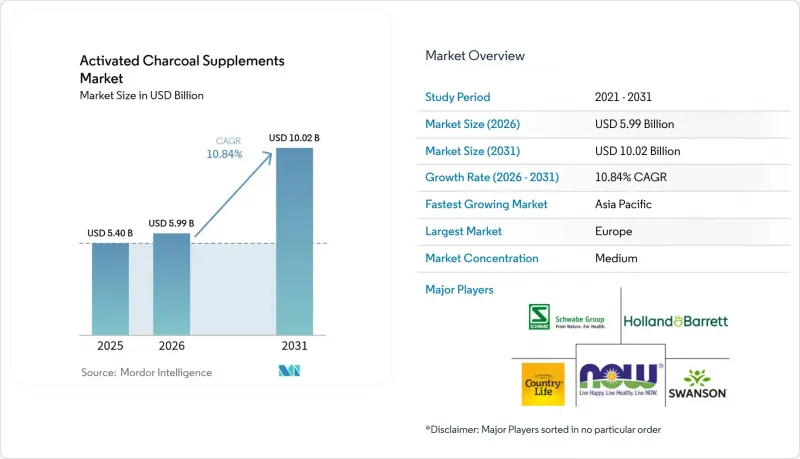
This report is Segmented by Form (Capsules, Powders, Others), by Application (Detoxification and Poisoning Treatment, Gut Health, Others), by Distribution Channel (Supermarkets/Hypermarkets, Specialty and Health Stores, Online Retailers, Other Distribution Channels), and by Geography (North America and More). The Market Forecasts are Provided in Terms of Value (USD).
Global Activated Charcoal Supplements Market Trends and Insights
Consumer preference for natural detoxification solutions stimulates market growth
The shift toward natural wellness solutions is fundamentally reshaping the activated charcoal supplements market as consumers increasingly seek non-synthetic detoxification options. This preference is particularly pronounced among health-conscious millennials and Gen X consumers who are driving demand for products perceived as "clean" and minimally processed. The clean label movement has extended beyond ingredient transparency to encompass sourcing practices, with retailers like Whole Foods and Holland & Barrett enforcing stringent standards that favor activated charcoal derived from sustainable sources. This driver is creating premium-segment opportunities for brands that can authenticate their natural credentials through third-party certifications and transparent supply chain documentation.
Product innovation through enhanced formulations strengthens market position
Formulation advancements are revolutionizing activated charcoal supplements, with ozonated activated charcoal emerging as a breakthrough innovation that increases toxin-binding capacity by a factor of ten. This technological leap addresses historical efficacy concerns while enabling reduced dosage requirements, creating both premium pricing opportunities and improved consumer experiences. The American Chiropractor has highlighted Global Healing's Ozonated Activated Charcoal, priced at USD 29.95, as a product that leverages this advanced ozonation process to increase surface area and binding capacity for toxins, positioning it as superior to standard activated charcoal. Beyond ozonation, manufacturers are developing targeted formulations that combine activated charcoal with complementary ingredients like probiotics and digestive enzymes to address specific health concerns, particularly in the fast-growing gut health segment. These innovations are creating distinct market tiers, with basic products facing commoditization pressure while enhanced formulations command premium pricing and build brand loyalty.
Growing popularity of natural detox alternatives intensifies market competition
The proliferation of alternative natural detoxification products is creating significant competitive pressure in the activated charcoal supplements market, particularly as consumers experiment with options like zeolite, bentonite clay, and chlorella. This diversification of detoxification approaches is fragmenting consumer spending and challenging activated charcoal's historical position as the primary detoxification supplement. The trend toward multi-ingredient formulations further complicates the competitive landscape, as activated charcoal increasingly appears as one component in comprehensive detoxification blends rather than as a standalone solution. This restraint is particularly impactful in mature markets where consumer sophistication drives experimentation with diverse wellness approaches, requiring activated charcoal brands to clearly articulate their unique benefits and scientific validation to maintain market position.
Other drivers and restraints analyzed in the detailed report include:
- Social media influence drives gen Z demand for internal cleansing products
- Increased awareness of digestive health benefits fuels supplement adoption
- Raw material constraints and supply chain issues affect market operations
For complete list of drivers and restraints, kindly check the Table Of Contents.
Segment Analysis
Capsules command a dominant 60.62% market share in 2025, benefiting from consumer preference for convenient, precise dosing and minimal taste interaction. This format's popularity stems from its ability to mask activated charcoal's inherently unpleasant taste while providing standardized dosing that aligns with growing consumer demand for supplementation convenience. Powders, while currently holding a smaller market share, are experiencing the fastest growth with a 15.96% CAGR from 2026-2031, driven by their versatility in formulation and higher absorption rates that appeal to performance-focused consumers.
The powder segment's growth is further accelerated by innovative flavoring technologies that overcome traditional palatability challenges, with brands introducing naturally flavored options that can be mixed into beverages or foods. The scientific advancement is enabling manufacturers to develop next-generation capsule formulations with enhanced efficacy and reduced side effects. These technological advancements are creating opportunities for premium positioning in both segments, with scientifically validated improvements in bioavailability justifying higher price points and building brand differentiation in an increasingly competitive market.
Complete Report Scope:
- By Form
- Capsules
- Powders
- Others
- By Application
- Detoxification and Poisoning Treatment
- Gut Health
- Others
- By Distribution Channel
- Supermarkets/Hypermarkets
- Specialty and Health Stores
- Online Retailers
- Other Distribution Channels
- By Geography
- North America
- United States
- Canada
- Mexico
- Rest of North America
- Europe
- United Kingdom
- Germany
- France
- Italy
- Spain
- Netherlands
- Poland
- Belgium
- Sweden
- Rest of Europe
- Asia-Pacific
- China
- Japan
- India
- Australia
- Indonesia
- South Korea
- Thailand
- Singapore
- Rest of Asia-Pacific
- South America
- Brazil
- Argentina
- Colombia
- Chile
- Peru
- Rest of South America
- Middle East and Africa
- South Africa
- Saudi Arabia
- United Arab Emirates
- Nigeria
- Egypt
- Morocco
- Turkey
- Rest of Middle East and Africa
- North America
Geography Analysis
Europe dominates the activated charcoal supplements market with a commanding 43.85% share in 2025, driven by a sophisticated consumer base with high awareness of preventive healthcare and natural wellness solutions. Germany, France, Italy, and the United Kingdom represent the largest European markets, with Germany leading consumption of herbal and food supplements, including activated charcoal products. Regulatory clarity and consumer trust in supplement efficacy create favorable conditions for premium positioning, while the shift toward organic and sustainably sourced products is particularly pronounced, with European consumers prioritizing organic labels. The region's growth is further supported by strong retail infrastructure and healthcare practitioner involvement in supplement recommendations, creating multiple trusted channels for consumer education and product discovery.
Asia-Pacific is emerging as the growth engine of the global activated charcoal supplements market with an impressive 17.75% CAGR projected for 2026-2031, fueled by rising health consciousness, growing middle-class populations, and increasing awareness of preventive healthcare approaches. The region's growth is accelerated by digital adoption that enables rapid consumer education and e-commerce penetration, particularly in urban centers. Kirin Holdings is strategically expanding its Health Science business in Japan and China, leveraging increased health consciousness to drive growth in dietary supplements, including those with detoxification properties.
North America represents a mature but still-expanding market for activated charcoal supplements, characterized by high consumer awareness and sophisticated retail channels that support premium product positioning. The United States leads regional consumption, benefiting from a regulatory environment that allows for relatively straightforward market entry while maintaining basic safety standards. The FDA's ongoing reforms to modernize the OTC monograph system aim to reduce the time for monograph updates . The region's growth is increasingly driven by specific application segments rather than general market expansion, with digestive health and targeted detoxification protocols gaining traction among health-conscious consumers.
- Country Life LLC
- Dr. Schwabe Holding
- Holland & Barrett Retail Ltd
- Swanson Health Products
- NOW Foods
- Bulletproof 360 Inc
- Schizandu Organics
- Source Naturals, Inc.
- Nutricost
- Nature's Answer, Inc.
- Amy Myers MD
- Enzymedica
- Better Being Company
- Sona Nutrition
- Piping Rock Health Products, Inc
- Mason Vitamins
- Bio Nutrition, Inc.
- Purely Beneficial
- Nestle SA
- MRO MaryRuth, LLC
Additional Benefits:
- The market estimate (ME) sheet in Excel format
- 3 months of analyst support
TABLE OF CONTENTS
1 INTRODUCTION
- 1.1 Study Assumptions and Market Definition
- 1.2 Scope of the Study
2 RESEARCH METHODOLOGY
3 EXECUTIVE SUMMARY
4 MARKET LANDSCAPE
- 4.1 Market Overview
- 4.2 Market Drivers
- 4.2.1 Consumer preference for natural detoxification solutions stimulates market growth of activated charcoal supplements
- 4.2.2 Product innovation through enhanced formulations strengthens market position
- 4.2.3 Social media influence drives gen z demand for internal cleansing products
- 4.2.4 Increased awareness of digestive health benefits, such as reducing bloating and gas, fuels supplement adoption
- 4.2.5 Functional ingredient in oral health supplement
- 4.2.6 Accelerated use in skin and beauty supplement
- 4.3 Market Restraints
- 4.3.1 Growing popularity of natural detox alternatives intensifies market competition
- 4.3.2 Raw material constraints and supply chain issues affect market operations
- 4.3.3 Stringent advertising and labeling regulations
- 4.3.4 Short shelf life when premixes in liquid
- 4.4 Supply Chain Analysis
- 4.5 Regulatory and Technological Outlook
- 4.6 Porter's Five Forces
- 4.6.1 Threat of New Entrants
- 4.6.2 Bargaining Power of Buyers
- 4.6.3 Bargaining Power of Suppliers
- 4.6.4 Threat of Substitutes
- 4.6.5 Competitive Rivalry
5 MARKET SIZE AND GROWTH FORECASTS (VALUE)
- 5.1 By Form
- 5.1.1 Capsules
- 5.1.2 Powders
- 5.1.3 Others
- 5.2 By Application
- 5.2.1 Detoxification and Poisoning Treatment
- 5.2.2 Gut Health
- 5.2.3 Others
- 5.3 By Distribution Channel
- 5.3.1 Supermarkets/Hypermarkets
- 5.3.2 Specialty and Health Stores
- 5.3.3 Online Retailers
- 5.3.4 Other Distribution Channels
- 5.4 By Geography
- 5.4.1 North America
- 5.4.1.1 United States
- 5.4.1.2 Canada
- 5.4.1.3 Mexico
- 5.4.1.4 Rest of North America
- 5.4.2 Europe
- 5.4.2.1 United Kingdom
- 5.4.2.2 Germany
- 5.4.2.3 France
- 5.4.2.4 Italy
- 5.4.2.5 Spain
- 5.4.2.6 Netherlands
- 5.4.2.7 Poland
- 5.4.2.8 Belgium
- 5.4.2.9 Sweden
- 5.4.2.10 Rest of Europe
- 5.4.3 Asia-Pacific
- 5.4.3.1 China
- 5.4.3.2 Japan
- 5.4.3.3 India
- 5.4.3.4 Australia
- 5.4.3.5 Indonesia
- 5.4.3.6 South Korea
- 5.4.3.7 Thailand
- 5.4.3.8 Singapore
- 5.4.3.9 Rest of Asia-Pacific
- 5.4.4 South America
- 5.4.4.1 Brazil
- 5.4.4.2 Argentina
- 5.4.4.3 Colombia
- 5.4.4.4 Chile
- 5.4.4.5 Peru
- 5.4.4.6 Rest of South America
- 5.4.5 Middle East and Africa
- 5.4.5.1 South Africa
- 5.4.5.2 Saudi Arabia
- 5.4.5.3 United Arab Emirates
- 5.4.5.4 Nigeria
- 5.4.5.5 Egypt
- 5.4.5.6 Morocco
- 5.4.5.7 Turkey
- 5.4.5.8 Rest of Middle East and Africa
- 5.4.1 North America
6 COMPETITIVE LANDSCAPE
- 6.1 Market Concentration
- 6.2 Strategic Moves
- 6.3 Market Ranking
- 6.4 Company Profiles (includes Global level Overview, Market level overview, Core Segments, Financials (if available), Strategic Information, Market Rank/Share, Products and Services, Recent Developments)
- 6.4.1 Country Life LLC
- 6.4.2 Dr. Schwabe Holding
- 6.4.3 Holland & Barrett Retail Ltd
- 6.4.4 Swanson Health Products
- 6.4.5 NOW Foods
- 6.4.6 Bulletproof 360 Inc
- 6.4.7 Schizandu Organics
- 6.4.8 Source Naturals, Inc.
- 6.4.9 Nutricost
- 6.4.10 Nature's Answer, Inc.
- 6.4.11 Amy Myers MD
- 6.4.12 Enzymedica
- 6.4.13 Better Being Company
- 6.4.14 Sona Nutrition
- 6.4.15 Piping Rock Health Products, Inc
- 6.4.16 Mason Vitamins
- 6.4.17 Bio Nutrition, Inc.
- 6.4.18 Purely Beneficial
- 6.4.19 Nestle SA
- 6.4.20 MRO MaryRuth, LLC
7 MARKET OPPORTUNITIES AND FUTURE OUTLOOK

