PUBLISHER: Mordor Intelligence | PRODUCT CODE: 2114684

PUBLISHER: Mordor Intelligence | PRODUCT CODE: 2114684
Lysosomal Storage Disease Treatment - Market Share Analysis, Industry Trends & Statistics, Growth Forecasts (2026 - 2031)
According to Mordor Intelligence, the lysosomal storage disease treatment market size was valued at USD 4.76 billion in 2025 and estimated to grow from USD 5.12 billion in 2026 to reach USD 7.39 billion by 2031, at a CAGR of 7.65% during the forecast period (2026-2031).
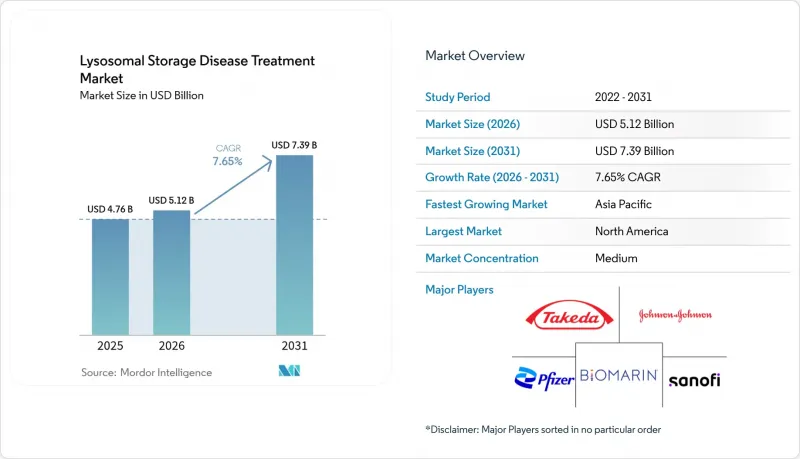
This report is Segmented by Therapy Type (Enzyme Replacement Therapy, and More), Modality (Intravenous Biologics, and More), Disease Type (Gaucher Disease, and More), Route of Administration (Hospital-Based IV Infusion, and More), End User (Tertiary Hospitals, and More), and Geography (North America, Europe, and More). The Market Forecasts are Provided in Terms of Value (USD).
Global Lysosomal Storage Disease Treatment Market Trends and Insights
Rising Global Prevalence of Lysosomal Storage Disorders
Newborn genomic screening in Shanghai identified LSD incidence of 1 in 1,856 live births, materially above historical estimates and confirming the value of proactive testing. The Chinese National Medical Products Administration's CARE program encourages orphan-drug filings and has increased investigational new drug submissions by 32% since 2024. Similar prevalence up-ticks are appearing in South Korea's national registry, underscoring the shift from anecdotal diagnosis to population-wide screening. As registries expand, demand for early-stage intervention grows, shortening diagnostic delay from six years to fewer than six weeks in leading tertiary centers. Therapeutic pipelines are therefore recalibrated toward infant-onset indications where clinical benefit is most pronounced.
Advancements in Diagnostic Technologies and Early Screening
Second-generation tandem mass spectrometry now screens for up to eight LSDs in a single assay with under 0.5% false positives, outperforming enzyme-activity panels. Integration of next-generation sequencing confirms pathogenic variants and guides precision therapy, such as selecting migalastat for Fabry patients with amenable mutations. Turn-around times for confirmatory genotyping have fallen below seven days, enabling treatment initiation during neonatal intensive-care stays. Health-system adoption is fastest in Canada and Germany where government reimbursement covers both biochemical and genomic assays. Early diagnosis is catalyzing payer acceptance of high-value gene therapies by evidencing long-term cost offsets from avoided disability.
High Treatment Costs and Reimbursement Challenges
Lenmeldy lists at USD 4.25 million, positioning it as the world's most expensive therapy and forcing payers to adopt outcomes-based contracts tying reimbursement to motor-function end-points. In Germany, mean annual enzyme-replacement expenditure for Fabry disease is EUR 369,047 (USD 405,952) per patient, 94% of which is drug acquisition cost. Medicaid programs are carving out gene-therapy bundles from capitation payments to mitigate one-time financial shocks. Private insurers restrict coverage to genetically confirmed cases and require longitudinal biomarker data, prolonging access in 17 U.S. states. Innovative annuity-style payment models are progressing slowly due to unresolved regulatory guidance on multi-year amortization.
Other drivers and restraints analyzed in the detailed report include:
- Emerging Gene and Cell Therapies for Neuropathic LSDs
- Strategic Collaborations and Rare-Disease Investment Surge
- Limited Blood-Brain Barrier Penetration of Current Therapies
For complete list of drivers and restraints, kindly check the Table Of Contents.
Segment Analysis
The lysosomal storage disease treatment market size for enzyme replacement therapy stood at USD 3.1 billion in 2025, equal to 65.10% of total revenue, and remains pivotal for Gaucher, Fabry, and Pompe care. Competitive positioning centers on second-generation enzymes such as avalglucosidase alfa, which offers higher muscle uptake versus predecessor alglucosidase. However, gene therapy's 10.22% CAGR reflects its one-time-dose value proposition. Lenmeldy's approval showcases durable neurologic benefit, while Ultragenyx's UX111 heads the 2025 FDA review queue for Sanfilippo syndrome. Substrate reduction and pharmacological chaperones deliver incremental gains for mutation-specific cohorts, reinforcing precision-medicine trajectories within the lysosomal storage disease treatment market. Pipeline convergence toward combination regimens, such as Pombiliti plus Opfolda, aims to amplify intracellular trafficking and prolong treatment intervals.
Intravenous biologics retained 55.20% revenue in 2025, anchored by weekly infusions of imiglucerase, agalsidase beta, and alglucosidase alfa. Oral small-molecule substrate reducers-venglustat, lucerastat, and the approved Cerdelga-record the highest growth at 10.12% CAGR, driven by adherence benefits and absence of infusion reactions. The modality mix is tilting further as oral chaperone migalastat expands into additional Fabry genotypes. Intrathecal and intracerebroventricular deliveries are reserved for neuronopathic syndromes; devices such as SmartFlow Neuro enable precise cannula placement for Kebilidi gene transfer. PEGylation and Fc-fusion technologies extend half-life of ERTs like ELFABRIO, trimming infusion frequency to monthly. Patient-centric dosing aligns with home-infusion expansion and underscores payers' focus on total-cost-of-care reduction within the lysosomal storage disease treatment market.
Complete Report Scope:
- By Therapy Type
- Enzyme Replacement Therapy (ERT)
- Substrate Reduction Therapy (SRT)
- Gene Therapy
- Pharmacological Chaperone Therapy
- Hematopoietic Stem-Cell Transplantation
- By Modality
- Intravenous Biologics
- Oral Small-molecule
- Intrathecal/ICV Delivery
- By Disease Type
- Gaucher Disease (Type I-III)
- Fabry Disease
- Pompe Disease
- Mucopolysaccharidoses (I, II, III, IV, VI, VII)
- Niemann-Pick Disease (Type A/B & C)
- Other Disease Types
- By Route of Administration
- Hospital-based IV Infusion
- Home-infusion IV
- Oral
- Intrathecal/ICV
- By End-user
- Tertiary Hospitals
- Specialty/Rare-disease Clinics
- Home-care Settings
- Geography
- North America
- United States
- Canada
- Mexico
- Europe
- Germany
- United Kingdom
- France
- Italy
- Spain
- Rest of Europe
- Asia-Pacific
- China
- Japan
- India
- Australia
- South Korea
- Rest of Asia-Pacific
- Middle East & Africa
- GCC
- South Africa
- Rest of Middle East & Africa
- South America
- Brazil
- Argentina
- Rest of South America
- North America
Geography Analysis
North America delivered 42.10% of 2025 revenue, guided by the FDA's Rare Pediatric Disease Priority Review Voucher program and expansive commercial insurance coverage. More than 20 active gene-therapy trials are recruiting across the United States, cementing the region's innovation dominance. State-level disparity persists: California covers travel and lodging for out-of-state Lenmeldy recipients, whereas six Midwestern states limit gene therapies to Medicaid carve-outs, elongating access timelines. Canada's universal system reimburses five ERTs on a designated orphan-drug list, although approval-to-funding lags average 14 months.
Asia-Pacific is the fastest-growing territory at 9.15% CAGR. China's updated Rare Disease List, now 207 conditions, has cut regulatory review time for imported agents to 9 months, down from 24 months pre-2023. Shanghai's genomic screening pilot uncovered LSD incidence far above global averages, prompting national scale-up grants. Japan leverages its Sakigake fast-track to draw foreign biotech filings, while South Korea's National Health Insurance captures over 90% Fabry treatment coverage, demonstrating advanced payer readiness. India's rare-disease policy subsidizes up to INR 2 million (USD 2.2 million) per patient for gene therapy, though disbursement remains sporadic.
Europe holds a stable share driven by the European Reference Network for Hereditary Metabolic Disorders that coordinates cross-border care. Germany validates home-infusion cost parity and supports monthly prescription refills to minimize clinic visits. Italy's Lombardy region mandates LSD newborn screening, expanding early-diagnosis uptake. France favors outcome-linked reimbursement models for high-cost gene therapies, piloting five-year warranty clauses. The U.K.'s NHS is negotiating subscription payments modeled on its antimicrobial "Netflix" contract, aiming to cap annual LSD therapy spend while guaranteeing supplier volume.
- Sanofi
- Takeda Pharmaceuticals
- Pfizer
- BioMarin
- Johnson & Johnson
- Amicus Therapeutics
- Alexion Pharmaceuticals
- Sigilon Therapeutics
- GC Biopharma
- Orchard Therapeutics
- Cyclo Therapeutics
- IntraBio
- Chiesi Farmaceutici
- Freeline Therapeutics
- Rocket Pharmaceuticals
- Forge Biologics
- Polaryx Therapeutics
- M6P Therapeutics
- Sarepta Therapeutics
- Krystal Biotech
Additional Benefits:
- The market estimate (ME) sheet in Excel format
- 3 months of analyst support
TABLE OF CONTENTS
1 Introduction
- 1.1 Study Assumptions & Market Definition
- 1.2 Scope of the Study
2 Research Methodology
3 Executive Summary
4 Market Landscape
- 4.1 Market Overview
- 4.2 Market Drivers
- 4.2.1 Rising Global Prevalence of Lysosomal Storage Disorders
- 4.2.2 Increasing Orphan Drug Designations and Incentives
- 4.2.3 Advancements in Diagnostic Technologies and Early Screening
- 4.2.4 Expansion of Enzyme Replacement Therapy Product Approvals
- 4.2.5 Emerging Gene and Cell Therapies for Neuropathic LSDs
- 4.2.6 Strategic Collaborations and Rare-Disease Investment Surge
- 4.3 Market Restraints
- 4.3.1 High Treatment Costs and Reimbursement Challenges
- 4.3.2 Limited Blood-Brain Barrier Penetration of Current Therapies
- 4.3.3 Manufacturing Scalability and Supply Constraints
- 4.3.4 Long-Term Safety and Immunogenicity Concerns
- 4.4 Regulatory Landscape
- 4.5 Porter's Five Forces Analysis
- 4.5.1 Threat of New Entrants
- 4.5.2 Bargaining Power of Buyers/Consumers
- 4.5.3 Bargaining Power of Suppliers
- 4.5.4 Threat of Substitute Products
- 4.5.5 Intensity of Competitive Rivalry
5 Market Size & Growth Forecasts (Value, USD)
- 5.1 By Therapy Type
- 5.1.1 Enzyme Replacement Therapy (ERT)
- 5.1.2 Substrate Reduction Therapy (SRT)
- 5.1.3 Gene Therapy
- 5.1.4 Pharmacological Chaperone Therapy
- 5.1.5 Hematopoietic Stem-Cell Transplantation
- 5.2 By Modality
- 5.2.1 Intravenous Biologics
- 5.2.2 Oral Small-molecule
- 5.2.3 Intrathecal/ICV Delivery
- 5.3 By Disease Type
- 5.3.1 Gaucher Disease (Type I-III)
- 5.3.2 Fabry Disease
- 5.3.3 Pompe Disease
- 5.3.4 Mucopolysaccharidoses (I, II, III, IV, VI, VII)
- 5.3.5 Niemann-Pick Disease (Type A/B & C)
- 5.3.6 Other Disease Types
- 5.4 By Route of Administration
- 5.4.1 Hospital-based IV Infusion
- 5.4.2 Home-infusion IV
- 5.4.3 Oral
- 5.4.4 Intrathecal/ICV
- 5.5 By End-user
- 5.5.1 Tertiary Hospitals
- 5.5.2 Specialty/Rare-disease Clinics
- 5.5.3 Home-care Settings
- 5.6 Geography
- 5.6.1 North America
- 5.6.1.1 United States
- 5.6.1.2 Canada
- 5.6.1.3 Mexico
- 5.6.2 Europe
- 5.6.2.1 Germany
- 5.6.2.2 United Kingdom
- 5.6.2.3 France
- 5.6.2.4 Italy
- 5.6.2.5 Spain
- 5.6.2.6 Rest of Europe
- 5.6.3 Asia-Pacific
- 5.6.3.1 China
- 5.6.3.2 Japan
- 5.6.3.3 India
- 5.6.3.4 Australia
- 5.6.3.5 South Korea
- 5.6.3.6 Rest of Asia-Pacific
- 5.6.4 Middle East & Africa
- 5.6.4.1 GCC
- 5.6.4.2 South Africa
- 5.6.4.3 Rest of Middle East & Africa
- 5.6.5 South America
- 5.6.5.1 Brazil
- 5.6.5.2 Argentina
- 5.6.5.3 Rest of South America
- 5.6.1 North America
6 Competitive Landscape
- 6.1 Market Concentration
- 6.2 Market Share Analysis
- 6.3 Company Profiles (includes Global level Overview, Market level overview, Core Business Segments, Financials, Headcount, Key Information, Market Rank, Market Share, Products and Services, and analysis of Recent Developments)
- 6.3.1 Sanofi (Genzyme Corporation)
- 6.3.2 Takeda Pharmaceutical Company Limited (Shire Plc)
- 6.3.3 Pfizer, Inc.
- 6.3.4 BioMarin
- 6.3.5 Johnson & Johnson (Actelion Pharmaceuticals Ltd)
- 6.3.6 Amicus Therapeutics
- 6.3.7 Alexion Pharmaceuticals
- 6.3.8 Sigilon Therapeutics
- 6.3.9 GC Biopharma
- 6.3.10 Orchard Therapeutics
- 6.3.11 Cyclo Therapeutics
- 6.3.12 IntraBio
- 6.3.13 Chiesi Farmaceutici
- 6.3.14 Freeline Therapeutics
- 6.3.15 Rocket Pharmaceuticals
- 6.3.16 Forge Biologics
- 6.3.17 Polaryx Therapeutics
- 6.3.18 M6P Therapeutics
- 6.3.19 Sarepta Therapeutics
- 6.3.20 Krystal Biotech
7 Market Opportunities & Future Outlook
- 7.1 White-space & Unmet-need Assessment

