PUBLISHER: Mordor Intelligence | PRODUCT CODE: 2114689

PUBLISHER: Mordor Intelligence | PRODUCT CODE: 2114689
Herpes Simplex Virus Treatment - Market Share Analysis, Industry Trends & Statistics, Growth Forecasts (2026 - 2031)
According to Mordor Intelligence, the herpes simplex virus treatment market size in 2026 is estimated at USD 3.09 billion, growing from 2025 value of USD 2.88 billion with 2031 projections showing USD 4.41 billion, growing at 7.37% CAGR over 2026-2031.
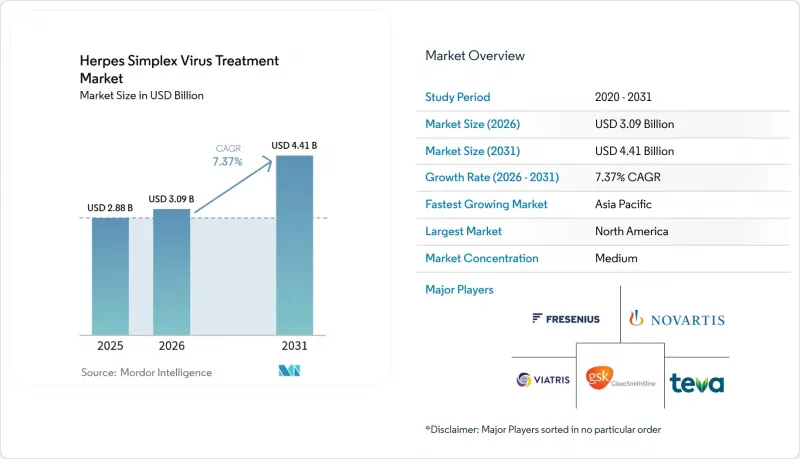
This report is Segmented by Virus Type (HSV-1 and HSV-2), Drug (Acyclovir, Valacyclovir, and More), Route of Administration (Oral, Injectable/IV, and More), Distribution Channel (Hospital Pharmacies, Retail Pharmacies & Drug Stores, and Online Pharmacies), and Geography (North America, Europe, Asia-Pacific, and More). The Market Forecasts are Provided in Terms of Value (USD).
Global Herpes Simplex Virus Treatment Market Trends and Insights
Rising Acyclovir Resistance Fuels Demand for New Mechanisms
Resistance rates to acyclovir now reach 14% among immunocompromised patients, compared with<1% in healthy adults. Mutations in the UL23 thymidine-kinase gene drive this trend, prompting drug developers to test helicase-primase inhibitors such as pritelivir and ABI-5366. The CHARMD database has catalogued the accelerating mutation spectrum, underlining the need to diversify antiviral targets. A citizen petition filed with the FDA seeks expanded access to pritelivir, illustrating clinician urgency.
Telemedicine Shortens Time-To-Treatment and Boosts Prescription Counts
Virtual platforms such as Lemonaid Health and Wisp provide discreet consultations that bypass stigma barriers. Patients secure same-day scripts for valacyclovir suppressive therapy or outbreak packs, often completing the care loop in under 24 hours. The format is especially valuable for uninsured users who avoid in-office visits; early data from telehealth providers show a double-digit year-on-year jump in HSV consultations, which translates to higher antiviral volumes and more consistent adherence.
Stringent EMA Virologic Benchmarks Prolong Approvals
European regulators now insist on durable suppression metrics in HSV trials, a bar that requires prolonged follow-up and larger cohorts. Assembly Biosciences must first complete Phase 1b shedding-rate read-outs for ABI-5366 before entering pivotal studies, extending launch timing by roughly two years. Smaller biotech firms face capital-intensive extensions that can stall programs or push them toward partnership deals.
Other drivers and restraints analyzed in the detailed report include:
- OTC Switches Widen the Retail Funnel
- CRISPR-Enabled Programs Reshape the Long-Term Vision
- Wide Generic Availability Compresses Brand Economics
For complete list of drivers and restraints, kindly check the Table Of Contents.
Segment Analysis
The Herpes Simplex Virus Treatment market size for HSV-1 is underpinned by 3.7 billion carriers, making it the dominant treatment universe. Although many infections are subclinical, periodic reactivations sustain topical-therapy sales and motivate suppressive oral prescriptions among high-outbreak patients. Education campaigns in Asia and Africa are lifting recognition of ocular and neonatal sequelae, which historically went untreated.
HSV-2, while infecting a smaller absolute pool of 846 million adults, generates stronger forward momentum because the virus remains a co-factor in HIV acquisition and produces more symptomatic recurrences. Rising syndromic testing uptake among sexually transmitted infection (STI) clinics in South-East Asia enriches the diagnosis funnel, translating to faster prescription growth. Clinical associations now recommend starting suppressive therapy after the second annual episode, an update that widens eligibility.
First-line therapy continues to revolve around valacyclovir, whose favorable bioavailability profile supports twice-daily dosing, a key adherence advantage over five-times-daily acyclovir tablets. In practice, prescribers reserve famciclovir for patients with mild renal impairment because it maintains efficacy at lower renal-clearance thresholds.
Pipeline attention is shifting toward helicase-primase inhibitors, led by ABI-1179 and ABI-5366, which showed plasma half-lives of about four days in early studies. A weekly-pill schedule could materially raise adherence and reduce pill burden for chronic suppressive users. Gene-editing therapeutics may eventually displace chronic antivirals, but consensus among investigators places curative timelines at least five years out, given delivery-vector and immunogenicity hurdles.
Complete Report Scope:
- By Virus Type
- HSV-1
- HSV-2
- By Drug
- Acyclovir
- Valacyclovir
- Famciclovir
- Other Drugs
- By Route of Administration
- Oral
- Injectable / IV
- Topical / Dermal
- Ocular
- By Distribution Channel
- Hospital Pharmacies
- Retail Pharmacies & Drug Stores
- Online Pharmacies
- Geography
- North America
- United States
- Canada
- Mexico
- Europe
- Germany
- United Kingdom
- France
- Italy
- Spain
- Rest of Europe
- Asia-Pacific
- China
- Japan
- India
- Australia
- South Korea
- Rest of Asia-Pacific
- Middle East & Africa
- GCC
- South Africa
- Rest of Middle East & Africa
- South America
- Brazil
- Argentina
- Rest of South America
- North America
Geography Analysis
North America remains the revenue leader in the Herpes Simplex Virus Treatment market because of high insurance coverage, widespread HSV testing and large specialty-care networks. The NIH's 2023-2028 strategic plan earmarks multi-year grants for curative approaches, reinforcing a deep discovery pipeline. Generic pricing pressure persists, but branded spend holds steady among suppressive-therapy users seeking convenience packs that bundle refills with telehealth follow-ups.
Asia Pacific is the fastest-growing territory. Urban populations in China and India are turning to smartphone-based teleconsultations for STI management, partly offsetting the shortage of infectious-disease specialists. Local manufacturers produce low-cost acyclovir and valacyclovir, but multinational firms are scaling co-marketing deals to introduce branded long-acting tablets as disposable incomes climb. Government-backed public-health campaigns have also broadened HSV awareness, lifting testing rates in tertiary hospitals.
Europe represents a mature but innovation-oriented landscape. EMA requirements lengthen trial timelines, yet the region hosts advanced virology labs focusing on ApoE-mediated viral-cell interactions and next-generation capsid inhibitors. Cost-effectiveness protocols drive high generic use, but national systems reimburse premium-priced options where superior suppression or adherence data exist.
- GlaxoSmithKline
- Teva Pharmaceutical Industries
- Viatris
- Novartis
- Fresenius
- Glenmark Pharmaceuticals
- Zydus Lifesciences Ltd.
- Emcure Pharmaceuticals
- Apotex
- AiCuris
- Agenus
- Moderna
- Rational Vaccines Inc.
- Sun Pharmaceuticals Industries
Additional Benefits:
- The market estimate (ME) sheet in Excel format
- 3 months of analyst support
TABLE OF CONTENTS
1 Introduction
- 1.1 Study Assumptions & Market Definition
- 1.2 Scope of the Study
2 Research Methodology
3 Executive Summary
4 Market Landscape
- 4.1 Market Overview
- 4.2 Market Drivers
- 4.2.1 Rising Incidence of Antiviral-Resistant HSV Strains Catalyzing Demand for Novel Therapeutics
- 4.2.2 Surge in Telemedicine-Facilitated Herpes Diagnosis Increasing Prescription Volume
- 4.2.3 OTC Switches for Low-Dose Topicals Expanding Retail Channel Revenue
- 4.2.4 Strategic Licensing of CRISPR-Based Gene-Editing Approaches Accelerating Future Curative Therapies
- 4.2.5 Collaboration Between Sexual-Health Apps & Pharma Enhancing Patient Adherence
- 4.2.6 Federal NIH Funding Spike for mRNA-based HSV Vaccines Boosting U.S. Clinical Pipeline
- 4.3 Market Restraints
- 4.3.1 Stringent EMA Guidelines on Viral Load End-points Lengthening Approval Timelines
- 4.3.2 High Generic Penetration Driving Down Brand Profit Margins in Mature Markets
- 4.3.3 Persistent Social Stigma Curtailing Testing Uptake in Middle East & Africa
- 4.3.4 Cold-Chain Logistics Constraints Limiting Vaccine Rollout in Rural Asia
- 4.4 Regulatory Outlook
- 4.5 Porter's Five Forces Analysis
- 4.5.1 Bargaining Power of Suppliers
- 4.5.2 Bargaining Power of Buyers
- 4.5.3 Threat of New Entrants
- 4.5.4 Threat of Substitutes
- 4.5.5 Intensity of Competitive Rivalry
5 Market Size & Growth Forecasts (Value, USD)
- 5.1 By Virus Type
- 5.1.1 HSV-1
- 5.1.2 HSV-2
- 5.2 By Drug
- 5.2.1 Acyclovir
- 5.2.2 Valacyclovir
- 5.2.3 Famciclovir
- 5.2.4 Other Drugs
- 5.3 By Route of Administration
- 5.3.1 Oral
- 5.3.2 Injectable / IV
- 5.3.3 Topical / Dermal
- 5.3.4 Ocular
- 5.4 By Distribution Channel
- 5.4.1 Hospital Pharmacies
- 5.4.2 Retail Pharmacies & Drug Stores
- 5.4.3 Online Pharmacies
- 5.5 Geography
- 5.5.1 North America
- 5.5.1.1 United States
- 5.5.1.2 Canada
- 5.5.1.3 Mexico
- 5.5.2 Europe
- 5.5.2.1 Germany
- 5.5.2.2 United Kingdom
- 5.5.2.3 France
- 5.5.2.4 Italy
- 5.5.2.5 Spain
- 5.5.2.6 Rest of Europe
- 5.5.3 Asia-Pacific
- 5.5.3.1 China
- 5.5.3.2 Japan
- 5.5.3.3 India
- 5.5.3.4 Australia
- 5.5.3.5 South Korea
- 5.5.3.6 Rest of Asia-Pacific
- 5.5.4 Middle East & Africa
- 5.5.4.1 GCC
- 5.5.4.2 South Africa
- 5.5.4.3 Rest of Middle East & Africa
- 5.5.5 South America
- 5.5.5.1 Brazil
- 5.5.5.2 Argentina
- 5.5.5.3 Rest of South America
- 5.5.1 North America
6 Competitive Landscape
- 6.1 Market Concentration
- 6.2 Strategic Moves
- 6.3 Market Share Analysis
- 6.4 Company Profiles (includes Global level Overview, Market level overview, Core Business Segments, Financials, Headcount, Key Information, Market Rank, Market Share, Products and Services, and analysis of Recent Developments)
- 6.4.1 GlaxoSmithKline plc
- 6.4.2 Teva Pharmaceutical Industries Ltd.
- 6.4.3 Viatris Inc.
- 6.4.4 Novartis AG
- 6.4.5 Fresenius SE & Co. KGaA
- 6.4.6 Glenmark Pharmaceuticals Ltd.
- 6.4.7 Zydus Lifesciences Ltd.
- 6.4.8 Emcure Pharmaceuticals Ltd.
- 6.4.9 Apotex Inc.
- 6.4.10 AiCuris GmbH & Co. KG
- 6.4.11 Agenus Inc.
- 6.4.12 Moderna Inc.
- 6.4.13 Rational Vaccines Inc.
- 6.4.14 Sun Pharmaceutical Industries Ltd.
7 Market Opportunities & Future Outlook
- 7.1 White-Space & Unmet-Need Assessment

