PUBLISHER: Mordor Intelligence | PRODUCT CODE: 2114693

PUBLISHER: Mordor Intelligence | PRODUCT CODE: 2114693
Endometrial Ablation Devices - Market Share Analysis, Industry Trends & Statistics, Growth Forecasts (2026 - 2031)
According to Mordor Intelligence, the endometrial ablation devices market size was valued at USD 1.20 billion in 2025 and estimated to grow from USD 1.26 billion in 2026 to reach USD 1.62 billion by 2031, at a CAGR of 5.14% during the forecast period (2026-2031).
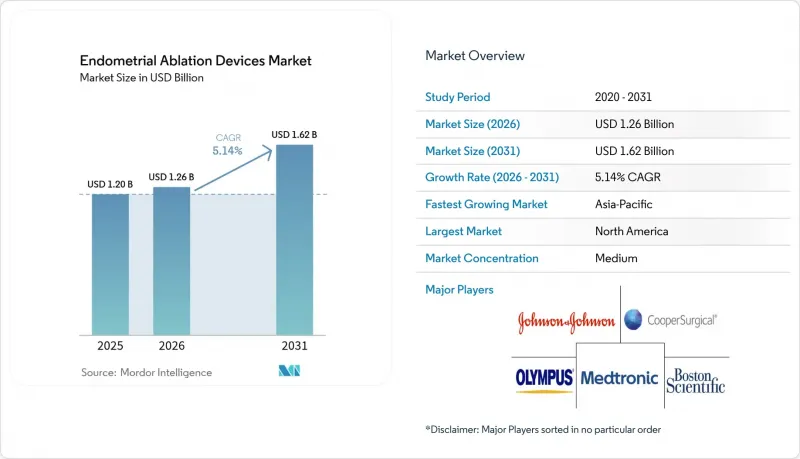
This report is Segmented by Device Technology (Thermal Ablation and Non-Thermal Ablation), Device Type (Hysteroscopy Devices, Radiofrequency Endometrial Ablation Devices and More), Access Approach (Hysteroscopic Systems, and More), End-User (Ambulatory Surgical Centers, Hospitals, and More), and Geography (North America, Europe, and More). The Market Forecasts are Provided in Terms of Value (USD).
Global Endometrial Ablation Devices Market Trends and Insights
Rising Prevalence of Abnormal Uterine Bleeding (AUB)
AUB affects 14-25% of reproductive-age women, and incidence climbs in the 40-50 age group. Recent findings flag heavy menstrual bleeding as an independent cardiovascular risk factor, pushing clinicians toward definitive therapy earlier in the care pathway. Greater awareness widens the treatable population and sustains demand for ablation, enlarging the endometrial ablation devices market.
Growing Demand for Minimally-Invasive Gynecologic Procedures
Enhanced imaging, such as indocyanine-green fluorescence, lowers complication rates, while novel manipulation methods shorten operating time by 25%. Office-based ablation cuts per-patient costs by USD 1,498, making minimally invasive care compelling for payers and providers alike.
Unfavorable or Heterogeneous Regulatory Pathways
Divergent rules extend approval timelines and inflate compliance costs. The FDA's draft guidance on thermal effects adds premarket data burdens, and India's evolving framework creates uncertainty for foreign entrants.
Other drivers and restraints analyzed in the detailed report include:
- Rapid Outpatient Migration to ASCs
- AI-Guided Imaging Improving Procedural Accuracy
- High Capital Cost of Advanced RF & HIFU Platforms
For complete list of drivers and restraints, kindly check the Table Of Contents.
Segment Analysis
Thermal platforms generated 55.10% of 2025 revenue, confirming their role as the clinical mainstay of the endometrial ablation devices market. Proven safety and surgeon familiarity underpin this lead. Meanwhile, non-thermal modalities are forecast to grow at 9.12% CAGR. Cryoablation is gaining share through expanded European adoption, and MRI-guided focused ultrasound secured five new therapeutic indications in 2024.
Competitive dynamics now hinge on specialty applications where thermal limits arise-for instance, cases requiring ultra-precise tissue sparing. That shift widens the clinical footprint of non-thermal solutions without immediately eroding thermal revenue streams.
Radiofrequency systems represented 44.10% revenue in 2025, and their broad utility keeps them central to procedure volumes. Balloon ablators, however, are set for an 8.05% CAGR to 2031 as simplified, single-use models reduce infection risk and learning curve. Hologic's smart-depth technology and cavity-integrity assessment continue to anchor RF's popularity, whereas Minerva's silicone-mesh array illustrates how design differentiation propels balloon adoption.
The endometrial ablation devices market size for balloon technologies is projected to expand at the fastest clip within the device-type hierarchy, emphasising an industry-wide pivot to outpatient-friendly tools.
Complete Report Scope:
- By Device Technology
- Thermal Ablation
- Non-Thermal Ablation
- By Device Type
- Hysteroscopy Devices
- Thermal Balloon Ablators
- Radiofrequency Endometrial Ablation Devices
- Hydrothermal Ablators
- Electrical Ablators
- Cryoablation Systems
- Microwave Ablation Probes
- By Access Approach
- Hysteroscopic Systems
- Transcervical Non-hysteroscopic (RF, Balloons)
- Image-Guided Extra-uterine (MRI-/US-guided HIFU)
- By End-User
- Hospitals
- Ambulatory Surgical Centers
- Specialty Clinics
- Office-based Gynecology Practices
- Geography
- North America
- United States
- Canada
- Mexico
- Europe
- Germany
- United Kingdom
- France
- Italy
- Spain
- Rest of Europe
- Asia-Pacific
- China
- Japan
- India
- South Korea
- Australia
- Rest of Asia-Pacific
- Middle East and Africa
- GCC
- South Africa
- Rest of Middle East and Africa
- South America
- Brazil
- Argentina
- Rest of South America
- North America
Geography Analysis
North America commanded 41.35% of 2025 revenue, underwritten by comprehensive reimbursement, dense specialist networks, and patient awareness. The endometrial ablation devices market size in the region will advance at mid-single-digit rates as AI guidance and disposable scopes deepen penetration.
Europe remains an innovation center that values evidence-based adoption. Structured procurement favors proven technologies, yet ASC migration in the United Kingdom, France, and Germany should accelerate growth.
Asia-Pacific, advancing at an 8.10% CAGR, benefits from widening insurance coverage, urban middle-class expansion, and government incentives for women's health. Local manufacturing partnerships in India and export-oriented Chinese players broaden device availability.
Emerging markets in South America, the Middle East, and Africa exhibit early-stage demand. Investments in tertiary hospitals and specialty centers gradually unlock procedure capacity, though economic volatility tempers near-term volume.
- Hologic
- Boston Scientific
- Medtronic
- The Cooper Companies
- Johnson & Johnson
- Olympus
- Minerva Surgical
- AngioDynamics
- Richard Wolf
- AEGEA Medical, Inc.
- Veldana Medical
- LiNA Medical ApS
- Stryker
- Besmed Health Business
- Idoman Teoranta
- Shenzhen Huikang Medical
- Wallach Surgical Devices
- Karl Storz
- Jiomax Medical
Additional Benefits:
- The market estimate (ME) sheet in Excel format
- 3 months of analyst support
TABLE OF CONTENTS
1 Introduction
- 1.1 Study Assumptions & Market Definition
- 1.2 Scope of the Study
2 Research Methodology
3 Executive Summary
4 Market Landscape
- 4.1 Market Overview
- 4.2 Market Drivers
- 4.2.1 Rising Prevalence Of Abnormal Uterine Bleeding (AUB)
- 4.2.2 Growing Demand For Minimally-Invasive Gynecologic Procedures
- 4.2.3 Rapid Outpatient Migration To Ambulatory Surgery Centers
- 4.2.4 Increasing Reimbursement Coverage For Office-Based Ablation
- 4.2.5 AI-Guided Imaging Improving Procedural Accuracy
- 4.2.6 Emergence Of Single-Use Hysteroscopic Systems Lowering Infection Risk
- 4.3 Market Restraints
- 4.3.1 Unfavorable Or Heterogeneous Regulatory Pathways
- 4.3.2 High Capital Cost Of Advanced RF & HIFU Platforms
- 4.3.3 Shortage Of Trained Hysteroscopists In Emerging Markets
- 4.3.4 Slow Procedural Adoption Due To Fertility-Preservation Concerns
- 4.4 Technological Outlook
- 4.5 Porter's Five Forces Analysis
- 4.5.1 Threat of New Entrants
- 4.5.2 Bargaining Power of Buyers
- 4.5.3 Bargaining Power of Suppliers
- 4.5.4 Threat of Substitutes
- 4.5.5 Intensity of Competitive Rivalry
5 Market Size & Growth Forecasts (Value, USD)
- 5.1 By Device Technology
- 5.1.1 Thermal Ablation
- 5.1.2 Non-Thermal Ablation
- 5.2 By Device Type
- 5.2.1 Hysteroscopy Devices
- 5.2.2 Thermal Balloon Ablators
- 5.2.3 Radiofrequency Endometrial Ablation Devices
- 5.2.4 Hydrothermal Ablators
- 5.2.5 Electrical Ablators
- 5.2.6 Cryoablation Systems
- 5.2.7 Microwave Ablation Probes
- 5.3 By Access Approach
- 5.3.1 Hysteroscopic Systems
- 5.3.2 Transcervical Non-hysteroscopic (RF, Balloons)
- 5.3.3 Image-Guided Extra-uterine (MRI-/US-guided HIFU)
- 5.4 By End-User
- 5.4.1 Hospitals
- 5.4.2 Ambulatory Surgical Centers
- 5.4.3 Specialty Clinics
- 5.4.4 Office-based Gynecology Practices
- 5.5 Geography
- 5.5.1 North America
- 5.5.1.1 United States
- 5.5.1.2 Canada
- 5.5.1.3 Mexico
- 5.5.2 Europe
- 5.5.2.1 Germany
- 5.5.2.2 United Kingdom
- 5.5.2.3 France
- 5.5.2.4 Italy
- 5.5.2.5 Spain
- 5.5.2.6 Rest of Europe
- 5.5.3 Asia-Pacific
- 5.5.3.1 China
- 5.5.3.2 Japan
- 5.5.3.3 India
- 5.5.3.4 South Korea
- 5.5.3.5 Australia
- 5.5.3.6 Rest of Asia-Pacific
- 5.5.4 Middle East and Africa
- 5.5.4.1 GCC
- 5.5.4.2 South Africa
- 5.5.4.3 Rest of Middle East and Africa
- 5.5.5 South America
- 5.5.5.1 Brazil
- 5.5.5.2 Argentina
- 5.5.5.3 Rest of South America
- 5.5.1 North America
6 Competitive Landscape
- 6.1 Market Concentration
- 6.2 Market Share Analysis
- 6.3 Company Profiles (includes Global level Overview, Market level overview, Core Segments, Financials as available, Strategic Information, Market Rank/Share for key companies, Products & Services, and Recent Developments)
- 6.3.1 Hologic, Inc.
- 6.3.2 Boston Scientific Corporation
- 6.3.3 Medtronic plc
- 6.3.4 CooperSurgical, Inc.
- 6.3.5 Johnson & Johnson (Ethicon)
- 6.3.6 Olympus Corporation
- 6.3.7 Minerva Surgical, Inc.
- 6.3.8 AngioDynamics, Inc.
- 6.3.9 Richard Wolf GmbH
- 6.3.10 AEGEA Medical, Inc.
- 6.3.11 Veldana Medical SA
- 6.3.12 LiNA Medical ApS
- 6.3.13 Stryker Corporation
- 6.3.14 Besmed Health Business Corp.
- 6.3.15 Idoman Teoranta
- 6.3.16 Shenzhen Huikang Medical
- 6.3.17 Wallach Surgical Devices
- 6.3.18 Karl Storz SE & Co. KG
- 6.3.19 Jiomax Medical
7 Market Opportunities & Future Outlook
- 7.1 White-Space & Unmet-Need Assessment

