PUBLISHER: Mordor Intelligence | PRODUCT CODE: 2114700

PUBLISHER: Mordor Intelligence | PRODUCT CODE: 2114700
Deflectable Catheters - Market Share Analysis, Industry Trends & Statistics, Growth Forecasts (2026 - 2031)
According to Mordor Intelligence, deflectable catheters market size in 2026 is estimated at USD 2.16 billion, growing from 2025 value of USD 2.05 billion with 2031 projections showing USD 2.81 billion, growing at 5.38% CAGR over 2026-2031.
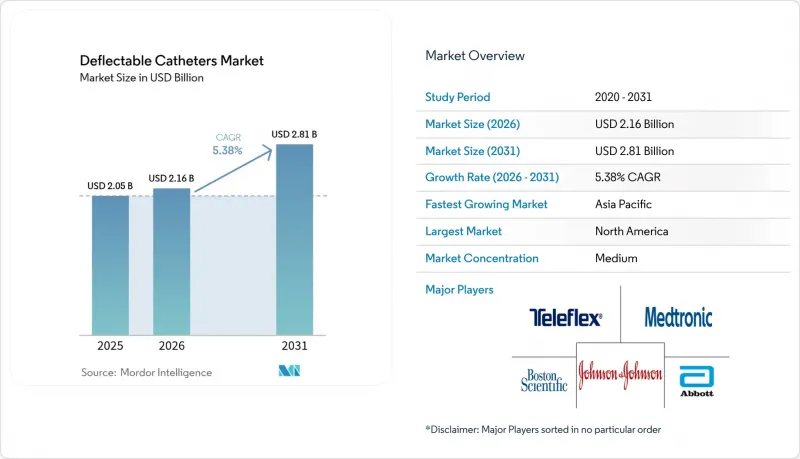
This report is Segmented by Product Type (Uni-Directional Catheters, Bi-Directional Catheters, Multi-Directional Catheters), by Application (Coronary Interventions, Diagnostic Imaging, and More), by Material (Polyurethane Blends, and More), by End User (Ambulatory Surgery Centers, Hospitals & Cardiac Centers, and Others), and Geography. The Market Sizes and Forecasts are Provided in Terms of Value (USD).
Global Deflectable Catheters Market Trends and Insights
High CVD Prevalence & Aging Population
The rising global cardiovascular burden keeps procedure volumes high, but aging anatomy introduces tortuous vasculature and calcified lesions that demand agile shaft response and refined tip control. Variable stiffness zones, segmented braid layers, and micro-marker feedback facilitate safe navigation in frail vessels, reducing fluoroscopy time and contrast use in elderly cohorts.
Rising Uptake of Minimally-Invasive EP Ablation Procedures
EP labs now perform higher case counts as single-shot technologies shorten workflow and enable day-case ablations. Ambulatory surgery centers executed 1.8% of percutaneous coronary interventions in 2024 with hospital-equivalent safety, prompting catheter makers to emphasize fast exchange transitions and durable lesion quality even in resource-light settings. Boston Scientific's FARAPULSE platform illustrates demand for steerable delivery sheaths that align precisely and limit collateral damage .
Device-Related Infection & Thrombus Risks
Clinical vigilance around catheter-associated thrombosis prompts regulators to spotlight material coatings and intraprocedural anticoagulation. Direct oral agents lower systemic clot burden, yet bleeding events hike reintervention rates, nudging engineers toward heparin-bonded surfaces and smoother junction geometries. Multiple recalls in 2024 amplified hospital purchasing committees' focus on proven safety records.
Other drivers and restraints analyzed in the detailed report include:
- Rapid Material Innovation (Pebax Blends, Low-Profile Nitinol Braids)
- Hospital Cap-ex Shift Toward Catheter-Lab Automation
- Pulsed-Field Ablation Platforms Require Next-Gen Steerability
- AI-Assisted Mapping Catheters Unlocking Complex Left-Atrium Cases
- Stringent FDA & MDR Evidence Requirements Raise Time-to-Market
- Tight Global Supply of Micro-Braided Nitinol Wire
For complete list of drivers and restraints, kindly check the Table Of Contents.
Segment Analysis
The multi-directional cohort grows at 6.08% CAGR to 2031 while bi-directional catheters preserve 45.02% leadership in the deflectable catheter market. High-angle articulation and twist-free torque transfer unlock access to posterior pulmonary veins and ventricular septal targets, boosting adoption in complex EP and TAVI support cases. Johnson & Johnson's OMNYPULSE 12 mm tip with integrated contact-force telemetry exemplifies the pivot toward smart multi-vector navigation.
Complex ergonomics and premium sensor arrays elevate average selling prices, yet OEMs offset costs through modular platform designs that share handle assemblies across product lines. Meanwhile, uni-directional shafts cater to diagnostic flow mapping and remain viable in cost-sensitive geographies. The deflectable catheter market size for multi-directional designs is projected to expand 98 basis points in share by 2031, reflecting sustained substitution momentum.
Structural heart and TAVI support posts a 6.47% CAGR, dwarfing mature electrophysiology growth rates even though EP controls 52.01% of 2025 revenue. Valve-delivery sheaths need consistent curve retention under dynamic aortic loading, motivating R&D into kink-resistant nitinol braids and low-friction liners. Clinical data confirm reduced paravalvular leak rates when steerable deflectors ensure coaxial alignment during deployment.
EP mapping and ablation retains scale thanks to expanding atrial fibrillation prevalence and guideline shifts endorsing early rhythm control. However, pricing pressure intensifies as commoditized bi-directional shafts face new entrants. Peripheral vascular and coronary support segments supply diversifying revenue, while imaging catheters sustain diagnostic throughput across all modalities.
Complete Report Scope:
- By Product Type
- Uni-directional Catheters
- Bi-directional Catheters
- Multi-directional Catheters
- By Application
- Coronary Interventions
- Electrophysiology (EP) Mapping & Ablation
- Diagnostic Imaging
- Peripheral Interventions
- Structural Heart & TAVI Support
- By Material
- Pebax / Polyurethane Blends
- PTFE & ePTFE
- Nitinol-reinforced Composites
- By End User
- Hospitals & Cardiac Centers
- Ambulatory Surgery Centers
- Others
- By Geography
- North America
- United States
- Canada
- Mexico
- Europe
- Germany
- United Kingdom
- France
- Italy
- Spain
- Rest of Europe
- Asia-Pacific
- China
- Japan
- India
- Australia
- South Korea
- Rest of Asia-Pacific
- Middle East & Africa
- GCC
- South Africa
- Rest of Middle East & Africa
- South America
- Brazil
- Argentina
- Rest of South America
- North America
Geography Analysis
North America held 43.08% of 2025 revenue as mature reimbursement pathways and high EP penetration support steady replacement cycles for legacy shafts. Provider consolidation fosters bulk purchasing, favoring suppliers with integrated platforms covering mapping, ablation, and imaging.
Asia-Pacific delivers the fastest 7.26% CAGR as public-private partnerships build EP labs and governments expand insurance coverage for catheter-based procedures. Samsung Medical Center operates the region's first ventricular arrhythmia training hub, performing more than 100 complex cases each year with 85% success, catalyzing regional skill transfer. China's NMPA has streamlined device approvals, spurring joint ventures between multinationals and local OEMs to co-produce Pebax shafts close to demand centers. Europe demonstrates measured expansion fueled by guideline-driven adoption and MDR-driven quality upgrades. National health systems balance cost with outcome data, giving incremental advantage to products with strong real-world evidence. The European Heart Rhythm Association's accredited sites anchor clinician training and promote uniform practice standards . In South America and the Middle East & Africa, deflectable catheter uptake trails infrastructure build-outs, though urban cardiac hubs increasingly solicit turnkey EP suites from global vendors.
- Abbott Laboratories
- Biosense Webster (Johnson & Johnson)
- Boston Scientific
- Medtronic
- Teleflex
- Biomerics
- Terumo
- Cook Group
- Merit Medical Systems
- Cordis
- Acutus Medical
- Biocardia
- AtriCure
- Baylis Medical (Boston Scientific)
- OSYPKA
- CathRx
- Stryker Neurovascular
- Confluent Medical
- Hansen Medical / Auris Health
- BIOTRONIK
Additional Benefits:
- The market estimate (ME) sheet in Excel format
- 3 months of analyst support
TABLE OF CONTENTS
1 Introduction
- 1.1 Study Assumptions & Market Definition
- 1.2 Scope of the Study
2 Research Methodology
3 Executive Summary
4 Market Landscape
- 4.1 Market Overview
- 4.2 Market Drivers
- 4.2.1 High CVD prevalence & ageing population
- 4.2.2 Rising uptake of minimally-invasive EP ablation procedures
- 4.2.3 Rapid material innovation (Pebax blends, low-profile nitinol braids)
- 4.2.4 Hospital cap-ex shift toward catheter-lab automation
- 4.2.5 Pulsed-Field Ablation platforms require next-gen steerability
- 4.2.6 AI-assisted mapping catheters unlocking complex left-atrium cases
- 4.3 Market Restraints
- 4.3.1 Device-related infection & thrombus risks
- 4.3.2 Stringent FDA & MDR evidence requirements raise time-to-market
- 4.3.3 Shortage of trained electrophysiologists in emerging markets
- 4.3.4 Tight global supply of micro-braided nitinol wire
- 4.4 Value / Supply-Chain Analysis
- 4.5 Regulatory Landscape
- 4.6 Technological Outlook
- 4.7 Porter's Five Forces Analysis
- 4.7.1 Threat of New Entrants
- 4.7.2 Bargaining Power of Buyers
- 4.7.3 Bargaining Power of Suppliers
- 4.7.4 Threat of Substitutes
- 4.7.5 Intensity of Rivalry
5 Market Size & Growth Forecasts (Value)
- 5.1 By Product Type
- 5.1.1 Uni-directional Catheters
- 5.1.2 Bi-directional Catheters
- 5.1.3 Multi-directional Catheters
- 5.2 By Application
- 5.2.1 Coronary Interventions
- 5.2.2 Electrophysiology (EP) Mapping & Ablation
- 5.2.3 Diagnostic Imaging
- 5.2.4 Peripheral Interventions
- 5.2.5 Structural Heart & TAVI Support
- 5.3 By Material
- 5.3.1 Pebax / Polyurethane Blends
- 5.3.2 PTFE & ePTFE
- 5.3.3 Nitinol-reinforced Composites
- 5.4 By End User
- 5.4.1 Hospitals & Cardiac Centers
- 5.4.2 Ambulatory Surgery Centers
- 5.4.3 Others
- 5.5 By Geography
- 5.5.1 North America
- 5.5.1.1 United States
- 5.5.1.2 Canada
- 5.5.1.3 Mexico
- 5.5.2 Europe
- 5.5.2.1 Germany
- 5.5.2.2 United Kingdom
- 5.5.2.3 France
- 5.5.2.4 Italy
- 5.5.2.5 Spain
- 5.5.2.6 Rest of Europe
- 5.5.3 Asia-Pacific
- 5.5.3.1 China
- 5.5.3.2 Japan
- 5.5.3.3 India
- 5.5.3.4 Australia
- 5.5.3.5 South Korea
- 5.5.3.6 Rest of Asia-Pacific
- 5.5.4 Middle East & Africa
- 5.5.4.1 GCC
- 5.5.4.2 South Africa
- 5.5.4.3 Rest of Middle East & Africa
- 5.5.5 South America
- 5.5.5.1 Brazil
- 5.5.5.2 Argentina
- 5.5.5.3 Rest of South America
- 5.5.1 North America
6 Competitive Landscape
- 6.1 Market Concentration
- 6.2 Market Share Analysis
- 6.3 Company Profiles (includes Global level Overview, Market level overview, Core Segments, Financials as available, Strategic Information, Market Rank/Share for key companies, Products & Services, and Recent Developments)
- 6.3.1 Abbott
- 6.3.2 Biosense Webster (Johnson & Johnson)
- 6.3.3 Boston Scientific
- 6.3.4 Medtronic
- 6.3.5 Teleflex
- 6.3.6 Biomerics
- 6.3.7 Terumo
- 6.3.8 Cook Medical
- 6.3.9 Merit Medical
- 6.3.10 Cordis
- 6.3.11 Acutus Medical
- 6.3.12 Biocardia
- 6.3.13 AtriCure
- 6.3.14 Baylis Medical (Boston Scientific)
- 6.3.15 Osypka
- 6.3.16 CathRx
- 6.3.17 Stryker Neurovascular
- 6.3.18 Confluent Medical
- 6.3.19 Hansen Medical / Auris Health
- 6.3.20 Biotronik
7 Market Opportunities & Future Outlook
- 7.1 White-space & Unmet-need Assessment

