PUBLISHER: Mordor Intelligence | PRODUCT CODE: 2114704

PUBLISHER: Mordor Intelligence | PRODUCT CODE: 2114704
Medical Radiation Shielding - Market Share Analysis, Industry Trends & Statistics, Growth Forecasts (2026 - 2031)
According to Mordor Intelligence, the medical radiation shielding market size is projected to be USD 1.59 billion in 2025, USD 1.69 billion in 2026, and reach USD 2.32 billion by 2031, growing at a CAGR of 6.54% from 2026 to 2031.
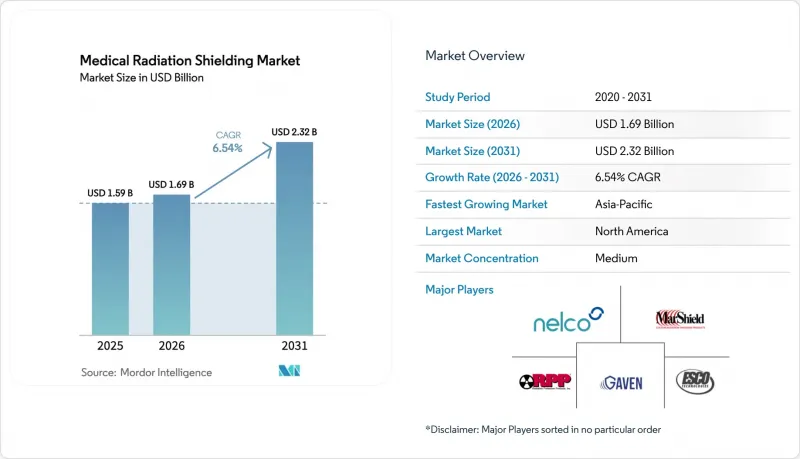
This report is Segmented by Material (Lead, Lead Composite, and Non-Lead), Imaging/Therapy Modality (Diagnostic Radiology, Nuclear Medicine/PET, External Beam Radiation Therapy, and Proton & Heavy Ion Therapy), End User (Hospitals, and More), and Geography (North America, Europe, Asia-Pacific, Middle East & Africa, and South America). The Market Forecasts are Provided in Terms of Value (USD).
Global Medical Radiation Shielding Market Trends and Insights
Rising Global Cancer Incidence Elevating Radiotherapy and Imaging Installations
Cancer remains the second-leading cause of death worldwide, and 50-60% of patients need radiotherapy during treatment. Twenty-three Sub-Saharan countries still lack radiotherapy devices, so the IAEA's Rays of Hope program is deploying linear accelerators and cobalt-60 units in these regions. Each new vault requires 2-4 mm of lead-equivalent shielding for walls, ceilings, and floors, which necessitates several metric tons of material. The growing adoption of CT and fluoroscopy in emerging markets further accelerates shielding demand for technician protection. Continued screening initiatives and universal coverage pledges are maintaining a robust global pipeline of shielding projects, which is expected to crest in the next four years.
Adoption of Advanced Radiation Modalities Necessitating Enhanced Shielding
The number of global proton therapy centers rose to 114 by 2025, with an additional 40 centers slated for completion by 2030. These facilities require 3 m neutron-attenuating concrete walls complemented by borated polyethylene layers. Image-guided and intensity-modulated linear accelerators also require tighter control over scatter radiation, driving the need for retrofits of existing bunkers. Vendors such as Hitachi bundle vault design with equipment supply, compressing schedules but pushing project costs over USD 100 million for a two-gantry proton suite. Integrated suppliers that manage civil works, shielding physics, and approvals are positioned to win these long-cycle contracts.
High Capital Expenditure for Shielded Facilities and Bunker Construction
External-beam vaults cost USD 1.5-3 million each, while proton centers exceed USD 100 million, with shielding accounting for up to 30% of the expenditure. Many public hospitals in low-income regions rely on annual appropriations, stretching procurement cycles beyond 18 months. The U.S. EPA classifies waste as hazardous, adding USD 200-400 per metric ton in disposal fees and deterring retrofits. Prefabricated barriers and 3D-printed composites offer relief but still need code validation, prolonging decision timelines in cash-constrained markets.
Other drivers and restraints analyzed in the detailed report include:
- Expansion of Nuclear Medicine and Radiopharmaceutical Manufacturing
- Government-Funded Oncology Infrastructure in Emerging Markets
- Volatile Prices of Lead, Tungsten, and Non-Lead Alloys
For complete list of drivers and restraints, kindly check the Table Of Contents.
Geography Analysis
North America generated 35.65% of 2025 revenue, buoyed by high healthcare spending and stringent FDA oversight that mandates certified shielding materials. Replacement cycles for aging vaults sustain projects in urban markets, while proton therapy expansions in Connecticut and Tampa require premium neutron protection. EPA waste rules are accelerating the adoption of non-lead alternatives, encouraging closed-loop recycling.
The Asia-Pacific region is the growth engine, with a projected 7.23% CAGR through 2031, driven by public-sector build-outs in China and India. China surpassed 3,000 radiotherapy machines in 2024, thanks to provincial subsidies that cover up to 60% of the costs. India's USD 1.5 billion cancer-center program prefers modular panels to compress timelines. Private chains, such as Apollo Hospitals, are adding proton centers in Chennai and Kolkata, thereby amplifying demand for neutron-grade concrete.
Europe emphasizes lead-free solutions under the Restriction of Hazardous Substances (RoHS) directive, spurring research and development in bismuth and tungsten composites. The Middle East funds centers of excellence in the United Arab Emirates and Saudi Arabia to stem the flow of outbound medical tourism. Sub-Saharan Africa remains underserved, but the IAEA Rays of Hope initiative is opening a multi-year pipeline of external-beam vaults. South America's first proton therapy unit commenced operations in Buenos Aires in 2025, signaling a rising demand for premium shielding.
- A&L Shielding
- Alpha Source Group
- AmRay Group
- Barrier Technologies
- ETS-Lindgren
- Esco Technologies Inc.
- Gaven Industries
- Global Partners In Shielding Inc.
- JL Goslar GmbH
- Kemper Medical
- Lite Tech Inc.
- MarShield
- MAVIG GmbH
- Mirion Technologies Inc.
- Nelco
- Radiation Protection Products
- Ray-Bar Engineering
- Shandong EM Radiation Protection Materials
- Veritas Medical Solutions
- Wardray Premise Ltd.
Additional Benefits:
- The market estimate (ME) sheet in Excel format
- 3 months of analyst support
TABLE OF CONTENTS
1 Introduction
- 1.1 Study Assumptions & Market Definition
- 1.2 Scope of the Study
2 Research Methodology
3 Executive Summary
4 Market Landscape
- 4.1 Market Overview
- 4.2 Market Drivers
- 4.2.1 Rising Global Cancer Incidence Elevating Radiotherapy & Diagnostic Imaging Installations
- 4.2.2 Adoption of Advanced Radiation Modalities Necessitating Enhanced Shielding
- 4.2.3 Expansion of Nuclear Medicine & Radiopharmaceutical Manufacturing Capacity
- 4.2.4 Government-Funded Oncology Infrastructure Programs in Emerging Markets
- 4.2.5 Rapid Uptake of Intraoperative Radiation Therapy Suites
- 4.2.6 Use of 3-D Printed Polymer/Tungsten Composite Shielding for Cost-Effective Retrofits
- 4.3 Market Restraints
- 4.3.1 High Capital Expenditure for Shielded Facilities and Bunker Construction
- 4.3.2 Volatile Prices of Lead, Tungsten, and Non-Lead Alloys
- 4.3.3 Environmental Liability from Lead-Contaminated Waste Streams
- 4.3.4 Limited Availability of Certified Radiation Shielding Engineers in Developing Regions
- 4.4 Regulatory & Technological Outlook
- 4.5 Porter's Five Forces Analysis
- 4.5.1 Threat Of New Entrants
- 4.5.2 Bargaining Power Of Buyers
- 4.5.3 Bargaining Power Of Suppliers
- 4.5.4 Threat Of Substitutes
- 4.5.5 Competitive Rivalry
5 Market Size & Growth Forecasts (Value, USD)
- 5.1 By Material
- 5.1.1 Lead
- 5.1.2 Lead Composite
- 5.1.3 Non-Lead (Bismuth, Tungsten, Antimony, Borated PE)
- 5.2 By Imaging / Therapy Modality
- 5.2.1 Diagnostic Radiology (X-ray, CT, Fluoroscopy)
- 5.2.2 Nuclear Medicine / PET
- 5.2.3 External Beam Radiation Therapy (LINAC, IMRT, IGRT)
- 5.2.4 Proton & Heavy Ion Therapy
- 5.3 By End User
- 5.3.1 Hospitals
- 5.3.2 Diagnostic Imaging Centers
- 5.3.3 Ambulatory Surgery Centers
- 5.3.4 Other End Users
- 5.4 Geography
- 5.4.1 North America
- 5.4.1.1 United States
- 5.4.1.2 Canada
- 5.4.1.3 Mexico
- 5.4.2 Europe
- 5.4.2.1 Germany
- 5.4.2.2 United Kingdom
- 5.4.2.3 France
- 5.4.2.4 Italy
- 5.4.2.5 Spain
- 5.4.2.6 Rest Of Europe
- 5.4.3 Asia-Pacific
- 5.4.3.1 China
- 5.4.3.2 Japan
- 5.4.3.3 India
- 5.4.3.4 South Korea
- 5.4.3.5 Australia
- 5.4.3.6 Rest Of Asia-Pacific
- 5.4.4 Middle-East And Africa
- 5.4.4.1 GCC
- 5.4.4.2 South Africa
- 5.4.4.3 Rest Of Middle East And Africa
- 5.4.5 South America
- 5.4.5.1 Brazil
- 5.4.5.2 Argentina
- 5.4.5.3 Rest Of South America
- 5.4.1 North America
6 Competitive Landscape
- 6.1 Market Concentration
- 6.2 Market Share Analysis
- 6.3 Company Profiles (Includes Global Level Overview, Market Level Overview, Core Segments, Financials As Available, Strategic Information, Market Rank/Share For Key Companies, Products & Services, And Recent Developments)
- 6.3.1 A&L Shielding
- 6.3.2 Alpha Source Group
- 6.3.3 AmRay Group
- 6.3.4 Barrier Technologies
- 6.3.5 ETS-Lindgren
- 6.3.6 Esco Technologies Inc.
- 6.3.7 Gaven Industries Inc.
- 6.3.8 Global Partners In Shielding Inc.
- 6.3.9 JL Goslar GmbH
- 6.3.10 Kemper Medical Inc.
- 6.3.11 Lite Tech Inc.
- 6.3.12 MarShield
- 6.3.13 MAVIG GmbH
- 6.3.14 Mirion Technologies Inc.
- 6.3.15 Nelco Inc.
- 6.3.16 Radiation Protection Products Inc.
- 6.3.17 Ray-Bar Engineering Corp.
- 6.3.18 Shandong EM Radiation Protection Materials
- 6.3.19 Veritas Medical Solutions LLC
- 6.3.20 Wardray Premise Ltd.
7 Market Opportunities & Future Outlook
- 7.1 White-Space & Unmet-Need Assessment

