PUBLISHER: Mordor Intelligence | PRODUCT CODE: 2114705

PUBLISHER: Mordor Intelligence | PRODUCT CODE: 2114705
Colposcopy Devices - Market Share Analysis, Industry Trends & Statistics, Growth Forecasts (2026 - 2031)
According to Mordor Intelligence, the colposcopy devices market size was valued at USD 625.21 million in 2025 and estimated to grow from USD 658.6 million in 2026 to reach USD 854.28 million by 2031, at a CAGR of 5.34% during the forecast period (2026-2031).
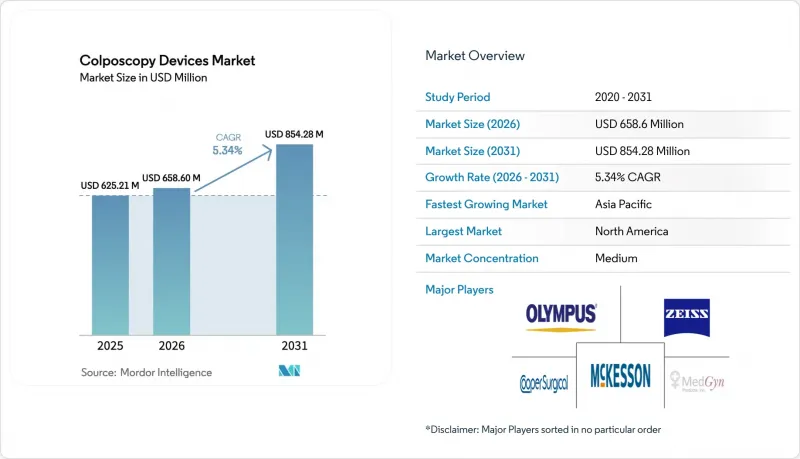
This report is Segmented by Modality (Optical, Digital/Video, AI-Enhanced Digital), Portability (Stationary, Mobile-Trolley, Handheld), Application (Cervical, Vaginal, Vulvar, Oral), and Geography (North America, Europe, Asia-Pacific, Middle East & Africa, South America). The Market Forecasts are Provided in Terms of Value (USD).
Global Colposcopy Devices Market Trends and Insights
Rising Cervical Cancer Incidence & Screening Uptake
Expanding disease burden fuels device demand, especially where screening coverage remains sparse. China's goal of 70% coverage by 2030 highlights large-scale procurement prospects. South Asia's projected mortality rise reinforces the urgency, and Brazil's structured network illustrates how systematic programs quickly lift utilization. Updated WHO guidelines recommending immediate colposcopy for dual-stain positive HPV cases further enlarge the eligible patient pool
Accelerating Shift from Optical to Digital/Video Systems
Digital platforms allow remote reading, standardized documentation and seamless data storage. Community clinics in the United States reported CIN2+ detection jumps when dynamic spectral imaging was deployed. Commercial launches such as Casio's DZ-C100 COLPOCAMERA underscore mainstream acceptance. Evidence from Nature-backed trials shows automated systems reaching 94.6% sensitivity, validating payers' willingness to fund higher-priced digital solutions.
Scarce Reimbursement & Budget Limits in Developing Nations
Health budgets in low-resource settings often favor basic Pap tests over capital-intensive colposcopy systems. Cost-effectiveness analyses in China show economic benefits for HPV triage, yet budget ceilings hamper nationwide adoption. South Africa's public sector treats 85% of citizens but contends with limited device allocations. Such constraints perpetuate a two-tier market split.
Other drivers and restraints analyzed in the detailed report include:
- AI-Enabled Spectral Imaging Raises Diagnostic Accuracy
- Tele-Colposcopy Roll-Outs for Remote Clinics
- Shortage of Trained Colposcopists & Skill Variability
For complete list of drivers and restraints, kindly check the Table Of Contents.
Segment Analysis
The colposcopy devices market posted a 55.52% optical share in 2025, yet AI-driven digital systems are set to compound at 6.86% annually. Digital platforms bridge documentation, remote consultation and algorithmic triage, motivating hospitals to upgrade legacy optics. Notably, automated spectral imaging improved CIN2+ detection from 31.25% to 87.50% in US community clinics, a clinical gain that translates into budget approval for premium products.
Rising AI capability also counterbalances the global shortfall of skilled operators. While optical scopes remain favored in resource-constrained sites, hybrid video systems increasingly represent an attainable mid-price option. Across both tiers, the colposcopy devices market continues to migrate toward data-rich ecosystems that support longitudinal patient records and centralized quality audits.
Complete Report Scope:
- By Modality
- Optical
- Digital/Video
- AI-enhanced Digital
- By Portability
- Stationary
- Mobile-trolley
- Handheld
- By Application
- Cervical
- Vaginal
- Vulvar
- Oral
- By Geography
- North America
- United States
- Canada
- Mexico
- Europe
- Germany
- United Kingdom
- France
- Italy
- Spain
- Rest of Europe
- Asia-Pacific
- China
- Japan
- India
- Australia
- South Korea
- Rest of Asia-Pacific
- Middle East & Africa
- GCC
- South Africa
- Rest of Middle East & Africa
- South America
- Brazil
- Argentina
- Rest of South America
- North America
Geography Analysis
North America contributed 37.96% of 2025 revenue, reflecting mature reimbursement and rapid uptake of AI digital systems. Health networks increasingly embed cloud-linked scopes that feed centralized pathology review, driving steady replacement demand. FDA clearances for AI cytology and dynamic spectral imaging support continued premium pricing.
Asia-Pacific registers the highest growth at 7.93% CAGR. China's 70% screening target underpins mass procurements, while India leverages blended models pairing self-sampling with referral colposcopy. Japan favors repeat HPV testing over immediate referral, yet still upgrades to digital optics to standardize archival images. Donor-backed tele-colposcopy pilots in Vietnam and Indonesia demonstrate scalable pathways for rural screening.
Europe prioritizes quality harmonization through federation guidelines, spurring conversions from analog to digital systems. In the Middle East, training shortfalls restrain volume despite rising device budgets.
Sub-Saharan Africa faces stark resource gaps, though battery-operated handhelds are now entering provincial clinics under global health grants. Latin America benefits from Brazil's mature control network, adopting portable thermal ablation alongside diagnostics to enhance care continuity.
- The Cooper Companies
- Olympus
- Mckesson
- Carl Zeiss
- DYSIS Medical
- Hologic
- Karl Kaps GmbH & Co. KG
- ATMOS MedizinTechnik GmbH
- Gynex Corporation
- Seiler Instrument
- MedGyn Products
- MobileODT Ltd.
- Shenzhen Mindray Bio-Medical
- Dytronix Medical
- Kernel Medical Equipment
- Welch Allyn (Hillrom/Baxter)
- Xuzhou Zhonglian Medical
- Optomic Spain
- Leisegang Feinmechanik Optik
- Lutech Industries
- Shenzhen Succeeder Tech
Additional Benefits:
- The market estimate (ME) sheet in Excel format
- 3 months of analyst support
TABLE OF CONTENTS
1 Introduction
- 1.1 Study Assumptions & Market Definition
- 1.2 Scope of the Study
2 Research Methodology
3 Executive Summary
4 Market Landscape
- 4.1 Market Overview
- 4.2 Market Drivers
- 4.2.1 Rising Cervical Cancer Incidence & Screening Uptake
- 4.2.2 Accelerating Shift from Optical to Digital/Video Systems
- 4.2.3 AI-Enabled Spectral Imaging Raises Diagnostic Accuracy
- 4.2.4 Harmonised Screening Guidelines in Emerging Economies
- 4.2.5 Tele-Colposcopy Roll-Outs for Remote Clinics
- 4.2.6 Donor-Funded Handheld Device Procurement in LMICs
- 4.3 Market Restraints
- 4.3.1 Scarce Reimbursement & Budget Limits in Developing Nations
- 4.3.2 Shortage of Trained Colposcopists & Skill Variability
- 4.3.3 Regulatory Pushback on Overdiagnosis/Biopsy Rates
- 4.3.4 Supply-Chain Volatility for High-Grade Optics & Chips
- 4.4 Technological Outlook
- 4.5 Porter's Five Forces Analysis
- 4.5.1 Threat of New Entrants
- 4.5.2 Bargaining Power of Buyers
- 4.5.3 Bargaining Power of Suppliers
- 4.5.4 Threat of Substitutes
- 4.5.5 Competitive Rivalry
5 Market Size & Growth Forecasts (Value in USD)
- 5.1 By Modality
- 5.1.1 Optical
- 5.1.2 Digital/Video
- 5.1.3 AI-enhanced Digital
- 5.2 By Portability
- 5.2.1 Stationary
- 5.2.2 Mobile-trolley
- 5.2.3 Handheld
- 5.3 By Application
- 5.3.1 Cervical
- 5.3.2 Vaginal
- 5.3.3 Vulvar
- 5.3.4 Oral
- 5.4 By Geography
- 5.4.1 North America
- 5.4.1.1 United States
- 5.4.1.2 Canada
- 5.4.1.3 Mexico
- 5.4.2 Europe
- 5.4.2.1 Germany
- 5.4.2.2 United Kingdom
- 5.4.2.3 France
- 5.4.2.4 Italy
- 5.4.2.5 Spain
- 5.4.2.6 Rest of Europe
- 5.4.3 Asia-Pacific
- 5.4.3.1 China
- 5.4.3.2 Japan
- 5.4.3.3 India
- 5.4.3.4 Australia
- 5.4.3.5 South Korea
- 5.4.3.6 Rest of Asia-Pacific
- 5.4.4 Middle East & Africa
- 5.4.4.1 GCC
- 5.4.4.2 South Africa
- 5.4.4.3 Rest of Middle East & Africa
- 5.4.5 South America
- 5.4.5.1 Brazil
- 5.4.5.2 Argentina
- 5.4.5.3 Rest of South America
- 5.4.1 North America
6 Competitive Landscape
- 6.1 Market Concentration
- 6.2 Market Share Analysis
- 6.3 Company Profiles (includes Global level Overview, Market level overview, Core Segments, Financials as available, Strategic Information, Market Rank/Share for key companies, Products & Services, and Recent Developments)
- 6.3.1 CooperSurgical Inc.
- 6.3.2 Olympus Corporation
- 6.3.3 McKesson Medical-Surgical Inc.
- 6.3.4 Carl Zeiss Meditec AG
- 6.3.5 DYSIS Medical
- 6.3.6 Hologic Inc.
- 6.3.7 Karl Kaps GmbH & Co. KG
- 6.3.8 ATMOS MedizinTechnik GmbH
- 6.3.9 Gynex Corporation
- 6.3.10 Seiler Instrument Inc.
- 6.3.11 MedGyn Products Inc.
- 6.3.12 MobileODT Ltd.
- 6.3.13 Shenzhen Mindray Bio-Medical
- 6.3.14 Dytronix Medical
- 6.3.15 Kernel Medical Equipment
- 6.3.16 Welch Allyn (Hillrom/Baxter)
- 6.3.17 Xuzhou Zhonglian Medical
- 6.3.18 Optomic Spain
- 6.3.19 Leisegang Feinmechanik Optik
- 6.3.20 Lutech Industries
- 6.3.21 Shenzhen Succeeder Tech
7 Market Opportunities & Future Outlook
- 7.1 White-space & Unmet-Need Assessment

