PUBLISHER: Mordor Intelligence | PRODUCT CODE: 2114706

PUBLISHER: Mordor Intelligence | PRODUCT CODE: 2114706
Cosmetic Implants - Market Share Analysis, Industry Trends & Statistics, Growth Forecasts (2026 - 2031)
According to Mordor Intelligence, the cosmetic implants market size is expected to grow from USD 12.75 billion in 2025 to USD 13.65 billion in 2026 and is forecast to reach USD 19.16 billion by 2031 at 7.03% CAGR over 2026-2031.
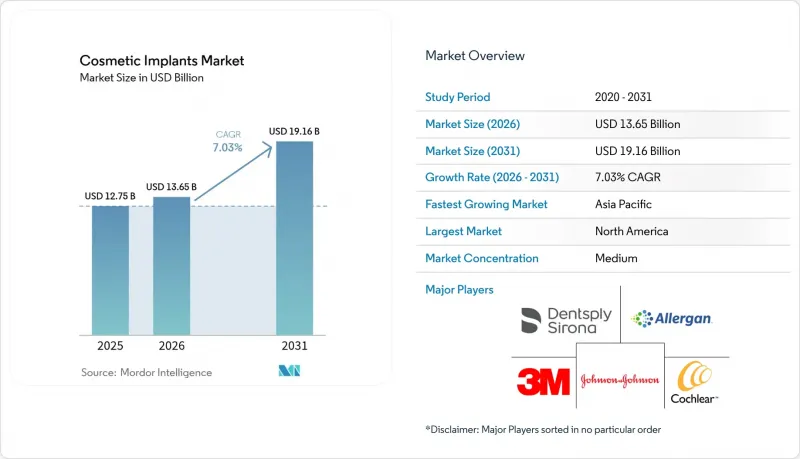
This report is Segmented by Raw Material (Polymer Implants, Ceramic Implants, Metal Implants, Biological Material Implants), Application (Dental, Breast, Facial, Body Contouring), End User (Hospitals, Specialty & Aesthetic Clinics, Ambulatory Surgical Centers, Dental Clinics), and Geography (North America, Europe, Asia-Pacific, and More). The Market Forecasts are Provided in Terms of Value (USD).
Global Cosmetic Implants Market Trends and Insights
Escalating Interest in Aesthetic Procedures for Personal and Social Confidence
The shift from corrective to enhancement-focused motivations has positioned the cosmetic implants market as a routine component of self-care for many consumers. Survey data show that 85% of medical aesthetic clients intend to sustain or increase spending on procedures, a sentiment now spanning multiple age cohorts. Gender dynamics are also evolving, with a marked rise in male participation and a growing emphasis on gender-affirming implant surgeries. Social-media exposure normalizes aesthetic treatments, eroding stigma and reinforcing aspirational standards. Younger demographics increasingly pursue "preventive" implants to delay visible aging, suggesting a structural expansion of lifetime demand. Clinics that tailor messaging to confidence, career advancement, and wellness capture higher patient retention rates while fostering long-term growth.
Breakthroughs in Biomaterials and 3D Printing Enabling Precision and Innovation
Additive manufacturing and advanced biomaterials underpin the latest wave of patient-specific solutions. Researchers at the University of Sydney demonstrated nanoscale 3D printing for synthetic bone substitutes with 300 nm resolution that supports robust bone regeneration. Shape-memory scaffolds combining polylactic acid and polycaprolactone now deliver dual tumor-ablation and bone-regrowth functionality on near-infrared activation. CollPlant's partnership with Stratasys targets 200 cc regenerative breast implants manufactured from plant-based collagen, aligning with biodegradability and biocompatibility priorities. These advances address longstanding concerns over capsular contracture, implant rupture, and revision surgeries. Personalized design shortens operative time and improves aesthetic outcomes, reinforcing premium-pricing potential and competitive differentiation within the cosmetic implants market.
Premium Pricing of Surgical Implants and Associated Medical Services
Full-cycle procedure costs frequently surpass USD 17,000 when anesthesia, facility fees, and post-operative care are included, creating affordability barriers for a broad segment of potential patients. Heightened price sensitivity drives consumers toward minimally invasive fillers and thread-lift procedures that promise visible improvements with lower financial outlays and minimal downtime. Providers respond by migrating suitable interventions to ambulatory surgical centers, which achieve lean operating structures through streamlined staffing and shorter patient turnover times. Widening adoption of in-house financing and subscription-based maintenance plans offers partial mitigation but does not fully offset cost-related attrition.
Other drivers and restraints analyzed in the detailed report include:
- Rising Influx of Medical Tourists into Cost-Effective Treatment Hubs
- Increasing Disposable Income Among Middle-Class Consumers Worldwide
- Ongoing Safety Issues, Product Recalls, and Legal Disputes
For complete list of drivers and restraints, kindly check the Table Of Contents.
Segment Analysis
Polymer implants accounted for 35.42% cosmetic implants market share in 2025, underpinned by decades of clinical familiarity with silicone elastomers. These materials support a spectrum of breast, facial, and body contouring procedures, making them indispensable within current surgical workflows. However, concerns over long-term degradation and environmental impact motivate research into next-generation polymers with enhanced durability and recyclability. Biodegradable polydioxanone meshes and bioresorbable polycaprolactone screws exemplify the transition to eco-friendly options that lessen revision risk.
Biological material implants, although representing a smaller revenue base, advance at a 9.12% CAGR through 2031 and embody the frontier of regenerative aesthetics. Collagen-based scaffolds sourced from tobacco plants bypass zoonotic contamination worries while facilitating tissue ingrowth. Early trials report accelerated healing, lower inflammatory profiles, and improved tactile sensation. As 3D bioprinting platforms mature, patient-specific constructs can integrate vasculature and cellular components, potentially eliminating conventional prostheses for select indications over the long term. Ceramic and metal solutions maintain niche relevance in dental and craniofacial reconstruction thanks to compressive strength and osseointegration, yet their share is expected to recede as hybrid polymer-ceramic composites reach clinical readiness.
Complete Report Scope:
- By Raw Material
- Polymer Implants
- Ceramic Implants
- Metal Implants
- Biological Material Implants
- By Application
- Dental
- Breast
- Facial
- Body Contouring
- By End User
- Hospitals
- Specialty & Aesthetic Clinics
- Ambulatory Surgical Centers
- Dental Clinics
- By Geography
- North America
- United States
- Canada
- Mexico
- Europe
- Germany
- United Kingdom
- France
- Italy
- Spain
- Rest of Europe
- Asia-Pacific
- China
- Japan
- India
- Australia
- South Korea
- Rest of Asia-Pacific
- Middle East & Africa
- GCC
- South Africa
- Rest of Middle East & Africa
- South America
- Brazil
- Argentina
- Rest of South America
- North America
Geography Analysis
North America retained a dominant 41.78% share of cosmetic implants market revenue in 2025, supported by advanced procedural expertise, robust payer coverage for reconstructive indications, and a high-income consumer base willing to pay premiums for novel solutions. Market expansion is also visible in Canada, where streamlined import pathways and favorable exchange rates attract inbound medical tourists. Mexico's private clinics increasingly serve cross-border patients from the southern United States, driving upgrades in facility accreditation and infection-control protocols.
Europe positions safety as a competitive advantage, channeling stringent MDR compliance to reinforce patient trust. GC Aesthetics received the first MDR-certified breast implant, setting a benchmark for rivals. Germany and France lead regional procedure volumes, while Italy and Spain show pronounced growth in dental and body contouring applications. Sustainability directives accelerate investment in recyclable silicone supply chains, with New Dawn Silicones pioneering solvent-based depolymerization that achieves virgin-grade recovery. Post-Brexit regulatory divergence prompts multinational firms to establish separate conformity assessment strategies for the United Kingdom, raising costs but preserving market continuity.
Asia-Pacific ranks as the fastest-growing zone, expanding at 9.45% CAGR through 2031, and is projected to contribute more than 35% of incremental global revenue over the period. Japan spearheads high-tech implant research, including titanium lattice structures fabricated via electron-beam melting for craniofacial reconstruction. South Korea's government-supported tourism clusters combine medical, hospitality, and cultural experiences that appeal to intra-regional travelers. China's large urban middle class fuels demand for premium dental implants, and continued e-commerce penetration lifts awareness in Tier 2 and Tier 3 cities. India advances domestic manufacturing under its "Make in India" initiative, focusing on cost-effective polymer implants that target domestic patients and neighboring markets. Australia maintains rigorous Therapeutic Goods Administration evaluations, often acting as an early-adopter test bed before broader Asia-Pacific rollouts. Collectively, these trends underscore the region's transition from volume-driven imports to innovation-led, locally adapted product development.
- 3M
- Abbvie
- Cochlear
- Dentsply Sirona
- GC Aesthetics
- Henry Schein
- Implantech
- Johnson & Johnson (Mentor)
- Sientra
- Zimmer Biomet
- Straumann Group
- Establishment Labs
- Polytech Health & Aesthetics
- Silimed
- Danaher (Nobel Biocare)
- BioHorizons
- Osstem Implant
- RTI Surgical
- Hansbiomed (MegaGen)
- Medartis
Additional Benefits:
- The market estimate (ME) sheet in Excel format
- 3 months of analyst support
TABLE OF CONTENTS
1 Introduction
- 1.1 Study Assumptions & Market Definition
- 1.2 Scope of the Study
2 Research Methodology
3 Executive Summary
4 Market Landscape
- 4.1 Market Overview
- 4.2 Market Drivers
- 4.2.1 Escalating Interest in Aesthetic Procedures for Personal and Social Confidence
- 4.2.2 Breakthroughs in Biomaterials and 3d-Printing Enabling Precision and Innovation
- 4.2.3 Rising Influx of Medical Tourists into Cost-Effective Treatment Hubs
- 4.2.4 Increasing Disposable Income Among Middle-Class Consumers Worldwide
- 4.2.5 AR Beauty Filters Driving Aspirational Standards and Reshaping Self-Image Norms
- 4.2.6 Growing Demand for Gender-Affirming Surgeries Creating Specialized Segments
- 4.3 Market Restraints
- 4.3.1 Premium Pricing of Surgical Implants and Associated Medical Services
- 4.3.2 Ongoing Safety Issues, Product Recalls, and Legal Disputes
- 4.3.3 Sustainability Concerns Due to Silicone and Polymer Waste Disposal
- 4.3.4 Rising Preference for Non-Surgical Alternatives Like Dermal Fillers and Thread Lifts
- 4.4 Regulatory Landscape
- 4.5 Porter's Five Forces Analysis
- 4.5.1 Threat of New Entrants
- 4.5.2 Bargaining Power of Buyers/Consumers
- 4.5.3 Bargaining Power of Suppliers
- 4.5.4 Threat of Substitute Products
- 4.5.5 Intensity of Competitive Rivalry
5 Market Size & Growth Forecasts (Value in USD)
- 5.1 By Raw Material
- 5.1.1 Polymer Implants
- 5.1.2 Ceramic Implants
- 5.1.3 Metal Implants
- 5.1.4 Biological Material Implants
- 5.2 By Application
- 5.2.1 Dental
- 5.2.2 Breast
- 5.2.3 Facial
- 5.2.4 Body Contouring
- 5.3 By End User
- 5.3.1 Hospitals
- 5.3.2 Specialty & Aesthetic Clinics
- 5.3.3 Ambulatory Surgical Centers
- 5.3.4 Dental Clinics
- 5.4 By Geography
- 5.4.1 North America
- 5.4.1.1 United States
- 5.4.1.2 Canada
- 5.4.1.3 Mexico
- 5.4.2 Europe
- 5.4.2.1 Germany
- 5.4.2.2 United Kingdom
- 5.4.2.3 France
- 5.4.2.4 Italy
- 5.4.2.5 Spain
- 5.4.2.6 Rest of Europe
- 5.4.3 Asia-Pacific
- 5.4.3.1 China
- 5.4.3.2 Japan
- 5.4.3.3 India
- 5.4.3.4 Australia
- 5.4.3.5 South Korea
- 5.4.3.6 Rest of Asia-Pacific
- 5.4.4 Middle East & Africa
- 5.4.4.1 GCC
- 5.4.4.2 South Africa
- 5.4.4.3 Rest of Middle East & Africa
- 5.4.5 South America
- 5.4.5.1 Brazil
- 5.4.5.2 Argentina
- 5.4.5.3 Rest of South America
- 5.4.1 North America
6 Competitive Landscape
- 6.1 Market Concentration
- 6.2 Market Share Analysis
- 6.3 Company Profiles (includes Global level Overview, Market level overview, Core Segments, Financials as available, Strategic Information, Market Rank/Share for key companies, Products & Services, and Recent Developments)
- 6.3.1 3M
- 6.3.2 Allergan (AbbVie)
- 6.3.3 Cochlear Ltd
- 6.3.4 Dentsply Sirona
- 6.3.5 GC Aesthetics
- 6.3.6 Henry Schein Inc.
- 6.3.7 Implantech
- 6.3.8 Johnson & Johnson (Mentor)
- 6.3.9 Sientra Inc.
- 6.3.10 Zimmer Biomet
- 6.3.11 Straumann Group
- 6.3.12 Establishment Labs
- 6.3.13 Polytech Health & Aesthetics
- 6.3.14 Silimed
- 6.3.15 Danaher (Nobel Biocare)
- 6.3.16 BioHorizons
- 6.3.17 Osstem Implant
- 6.3.18 RTI Surgical
- 6.3.19 Hansbiomed (MegaGen)
- 6.3.20 Medartis
7 Market Opportunities & Future Outlook
- 7.1 White-space & Unmet-Need Assessment

