PUBLISHER: Mordor Intelligence | PRODUCT CODE: 2114707

PUBLISHER: Mordor Intelligence | PRODUCT CODE: 2114707
Corneal Pachymetry - Market Share Analysis, Industry Trends & Statistics, Growth Forecasts (2026 - 2031)
According to Mordor Intelligence, the corneal pachymetry market size is expected to grow from USD 319.71 million in 2025 to USD 334.48 million in 2026 and is forecast to reach USD 419.2 million by 2031 at 4.62% CAGR over 2026-2031.
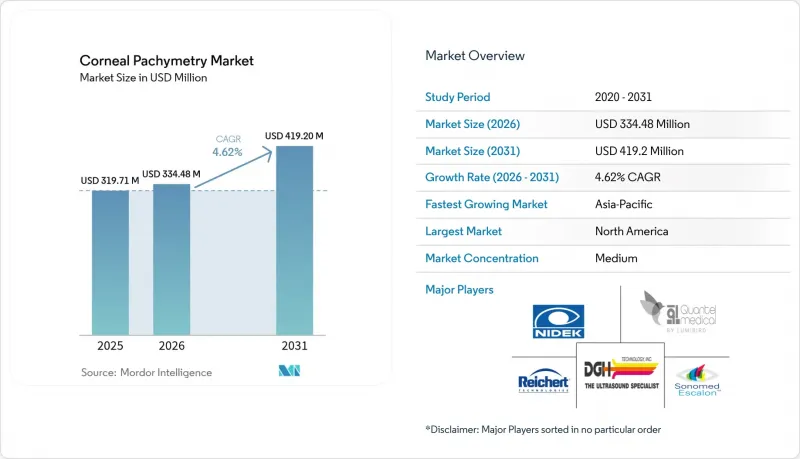
This report is Segmented by Type (Ultrasonic Method, Optical Method), Application (Glaucoma Diagnostics, Refractive Surgery Planning, Keratoconus & Ectasia Screening, and More), End User (Hospitals, Ophthalmology & Optometry Clinics, and More), and Geography (North America, Europe, Asia-Pacific, Middle East & Africa, South America). The Market Forecasts are Provided in Terms of Value (USD).
Global Corneal Pachymetry Market Trends and Insights
Rise in Prevalence of Glaucoma & Ocular Hypertension
Central corneal thickness (CCT) is now accepted as a critical risk factor for glaucoma, after the Ocular Hypertension Treatment Study showed a 71% rise in conversion risk for every 40 µm reduction in CCT. Routine pachymetry screening of adults over 50, therefore, becomes a non-negotiable element of preventive eye care. Health systems in North America and Europe reimburse pachymetry when combined with tonometry, which pushes device uptake in primary and specialist settings. Ongoing monitoring also matters because CCT changes skew intraocular-pressure readings and can lead to mismanaged therapy. As the pool of glaucoma patients doubles each decade after 40, demand for accurate thickness data will keep rising, securing a steady pipeline for the corneal pachymetry market.
Growing Cataract & Refractive-Surgery Volumes
Cataract and laser vision-correction procedures continue to climb, with Asia-Pacific contributing the largest incremental volume. Surgical guidelines treat pachymetry as mandatory since corneal biomechanics steer lens selection, incision planning and postoperative healing. Alcon's premium intraocular-lens portfolio illustrates how precise corneal metrics lift refractive outcomes. Similarly, refractive candidates undergo corneal mapping to avoid ectasia, making thickness profiling essential for screening out high-risk eyes. AI-driven surgical planners such as ZEISS VERACITY now import pachymetry data automatically, cutting chair time and lowering complication rates. These workflow linkages add repeat purchase drivers for advanced pachymeters.
Inadequate Reimbursement for Pachymetry Procedures
Coverage gaps hinder routine use because many payers only reimburse pachymetry when linked to specific diagnoses. Medicare contractors vary widely in their local rules, and some private insurers tag pachymetry as investigational for screening, forcing providers to self-pay or forego testing. The financial uncertainty discourages primary-care clinics from including pachymetry in comprehensive eye exams, especially in emerging markets where out-of-pocket spending remains high. Without consistent payment codes the corneal pachymetry market cannot reach its full preventive-care potential.
Other drivers and restraints analyzed in the detailed report include:
- Rapid Adoption of AS-OCT & Scheimpflug Non-Contact Systems
- Expansion of Eye-Care Services in Middle-Income Countries
- Stringent Device & Data-Privacy Regulations
For complete list of drivers and restraints, kindly check the Table Of Contents.
Segment Analysis
Ultrasonic pachymeters generated the majority of revenue, holding 55.62% of the corneal pachymetry market in 2025. Clinics appreciate their low price point and proven performance in edematous or scarred corneas. However, optical systems outpace them with a 6.89% CAGR, underscoring a clear pivot toward non-contact care. Occuity's PM1 handheld device illustrates the user pull; clinical validation shows sub-5 µm repeatability without topical anesthesia. Optical units also deliver pachymetric maps, keratometry, and angle analysis in a single scan, enriching surgical planning.
Optical platforms pair naturally with telemedicine because technicians can capture scans and send raw data to remote experts for interpretation. AI overlays flag thinning zones and suggests keratoconus probability scores, which elevates diagnostic precision in high-throughput settings. As clinician confidence grows, and as service contracts bundle cloud analytics, optical share will keep expanding. Nevertheless, ultrasound retains a foothold for intraoperative measurement, especially in cases with corneal opacity where light-based devices struggle. The coexistence of both technologies therefore broadens the total corneal pachymetry market size without immediate cannibalization.
Complete Report Scope:
- By Type
- Ultrasonic Method
- Optical Method
- By Application
- Glaucoma Diagnostics
- Refractive Surgery Planning
- Keratoconus & Ectasia Screening
- Post-operative Corneal Edema Monitoring
- Corneal Transplant Evaluation
- By End User
- Hospitals
- Ophthalmology & Optometry Clinics
- Ambulatory Surgical Centres
- Academic & Research Institutes
- By Geography
- North America
- United States
- Canada
- Mexico
- Europe
- Germany
- United Kingdom
- France
- Italy
- Spain
- Rest of Europe
- Asia-Pacific
- China
- Japan
- India
- Australia
- South Korea
- Rest of Asia-Pacific
- Middle East & Africa
- GCC
- South Africa
- Rest of Middle East & Africa
- South America
- Brazil
- Argentina
- Rest of South America
- North America
Geography Analysis
North America accounted for 38.21% of global revenue in 2025, anchored by high disposable income, insurance coverage, and established glaucoma screening guidelines. Medicare reimburses pachymetry linked to tonometry under CPT 76514, and private insurers follow similar rules, sustaining baseline demand. Clinics routinely upgrade to OCT-based platforms for integrated anterior-segment imaging, making the region a reliable early adopter of AI-enhanced workflows. FDA guidance is stringent but predictable, giving suppliers a clear development path and plenty of post-market feedback for product refinement.
Europe offers a mature but innovation-friendly landscape. Aging demographics increase cataract load, while public health systems prefer preventive checks that delay costly vision loss. CE-marked pachymeters gain access across member states, although compliance with the European Medical Device Regulation adds paperwork and cybersecurity safeguards. EssilorLuxottica's acquisition of Heidelberg Engineering underscores the strategic value of imaging within integrated eye-care portfolios. University hospitals in Germany and Italy spearhead research on tomography-based keratoconus screening, keeping the region at the forefront of clinical evidence generation.
Asia-Pacific is expanding fastest, clocking a 7.32% CAGR. China funds ophthalmology chains to widen service reach, with investment banks noting steady deal flow in the sector. Rising myopia among children and young adults lifts demand for corneal assessment in refractive-surgery planning. Government insurance schemes in Japan cover pachymetry when used for glaucoma management, while private hospitals in India advertise LASIK packages that bundle complete corneal mapping. Training programs sponsored by multinationals accelerate device literacy, ensuring that local clinicians can extract full value from advanced pachymeters. The region, therefore, shapes the longer-term revenue shift within the corneal pachymetry market.
- Topcon
- Carl Zeiss
- DGH Technology
- NIDEK Co. Ltd.
- Reichert Inc. (AMETEK)
- TOMEY Corporation
- Lumibird Group
- Sonomed Escalon
- Heidelberg Engineering
- OCULUS Optikgerate GmbH
- Accutome (Halma plc)
- HAAG-Streit
- Micro Medical Devices
- Optovue Inc.
- Canon
- Optikon S.p.A.
- Occuity Ltd.
- Sonostar Technologies
- Keeler Ltd.
- Alcon
Additional Benefits:
- The market estimate (ME) sheet in Excel format
- 3 months of analyst support
TABLE OF CONTENTS
1 Introduction
- 1.1 Study Assumptions & Market Definition
- 1.2 Scope of the Study
2 Research Methodology
3 Executive Summary
4 Market Landscape
- 4.1 Market Overview
- 4.2 Market Drivers
- 4.2.1 Rise In Prevalence of Glaucoma & Ocular Hypertension
- 4.2.2 Growing Cataract & Refractive-Surgery Volumes
- 4.2.3 Rapid Adoption of AS-OCT & Scheimpflug Non-Contact Systems
- 4.2.4 Expansion of Eye-Care Services in Middle-Income Countries
- 4.2.5 Tele-Ophthalmology Push for Handheld Pachymeters
- 4.2.6 AI-Driven IOP-Correction Algorithms Needing Real-Time CCT
- 4.3 Market Restraints
- 4.3.1 Inadequate Reimbursement for Pachymetry Procedures
- 4.3.2 Stringent Device & Data-Privacy Regulations
- 4.3.3 Lack of Interoperability Across Imaging Platforms
- 4.3.4 Emergence of Corneal-Biomechanics Devices as a Substitute
- 4.4 Porter's Five Forces Analysis
- 4.4.1 Threat of New Entrants
- 4.4.2 Bargaining Power of Buyers/Consumers
- 4.4.3 Bargaining Power of Suppliers
- 4.4.4 Threat of Substitute Products
- 4.4.5 Intensity of Competitive Rivalry
5 Market Size & Growth Forecasts (Value in USD)
- 5.1 By Type
- 5.1.1 Ultrasonic Method
- 5.1.2 Optical Method
- 5.2 By Application
- 5.2.1 Glaucoma Diagnostics
- 5.2.2 Refractive Surgery Planning
- 5.2.3 Keratoconus & Ectasia Screening
- 5.2.4 Post-operative Corneal Edema Monitoring
- 5.2.5 Corneal Transplant Evaluation
- 5.3 By End User
- 5.3.1 Hospitals
- 5.3.2 Ophthalmology & Optometry Clinics
- 5.3.3 Ambulatory Surgical Centres
- 5.3.4 Academic & Research Institutes
- 5.4 By Geography
- 5.4.1 North America
- 5.4.1.1 United States
- 5.4.1.2 Canada
- 5.4.1.3 Mexico
- 5.4.2 Europe
- 5.4.2.1 Germany
- 5.4.2.2 United Kingdom
- 5.4.2.3 France
- 5.4.2.4 Italy
- 5.4.2.5 Spain
- 5.4.2.6 Rest of Europe
- 5.4.3 Asia-Pacific
- 5.4.3.1 China
- 5.4.3.2 Japan
- 5.4.3.3 India
- 5.4.3.4 Australia
- 5.4.3.5 South Korea
- 5.4.3.6 Rest of Asia-Pacific
- 5.4.4 Middle East & Africa
- 5.4.4.1 GCC
- 5.4.4.2 South Africa
- 5.4.4.3 Rest of Middle East & Africa
- 5.4.5 South America
- 5.4.5.1 Brazil
- 5.4.5.2 Argentina
- 5.4.5.3 Rest of South America
- 5.4.1 North America
6 Competitive Landscape
- 6.1 Market Concentration
- 6.2 Market Share Analysis
- 6.3 Company Profiles (includes Global level Overview, Market level overview, Core Segments, Financials as available, Strategic Information, Market Rank/Share for key companies, Products & Services, and Recent Developments)
- 6.3.1 Topcon Corporation
- 6.3.2 Carl Zeiss Meditec AG
- 6.3.3 DGH Technology Inc.
- 6.3.4 NIDEK Co. Ltd.
- 6.3.5 Reichert Inc. (AMETEK)
- 6.3.6 TOMEY Corporation
- 6.3.7 Lumibird Group (Quantel Medical)
- 6.3.8 Sonomed Escalon
- 6.3.9 Heidelberg Engineering GmbH
- 6.3.10 OCULUS Optikgerate GmbH
- 6.3.11 Accutome (Halma plc)
- 6.3.12 Haag-Streit Group
- 6.3.13 Micro Medical Devices
- 6.3.14 Optovue Inc.
- 6.3.15 Canon Medical Systems
- 6.3.16 Optikon S.p.A.
- 6.3.17 Occuity Ltd.
- 6.3.18 Sonostar Technologies
- 6.3.19 Keeler Ltd.
- 6.3.20 Alcon Inc.
7 Market Opportunities & Future Outlook
- 7.1 White-space & Unmet-need Assessment

