PUBLISHER: Mordor Intelligence | PRODUCT CODE: 2114712

PUBLISHER: Mordor Intelligence | PRODUCT CODE: 2114712
Analytical Standards - Market Share Analysis, Industry Trends & Statistics, Growth Forecasts (2026 - 2031)
According to Mordor Intelligence, the analytical standards market size was valued at USD 1.52 billion in 2025 and estimated to grow from USD 1.61 billion in 2026 to reach USD 2.13 billion by 2031, at a CAGR of 5.82% during the forecast period (2026-2031).
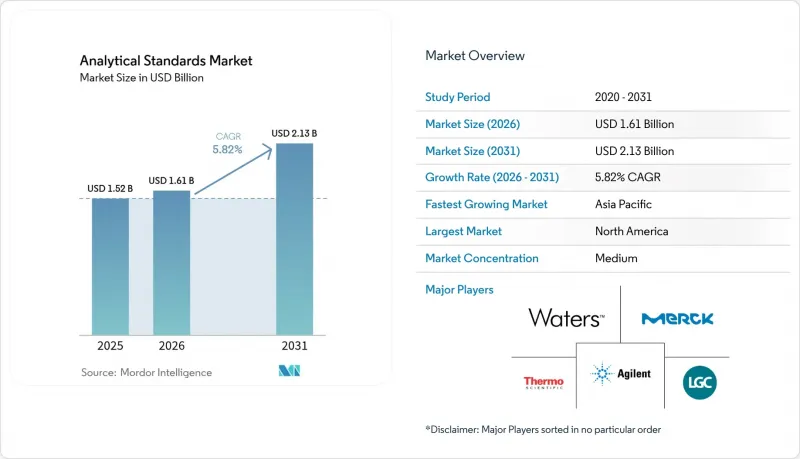
This report is Segmented by Technique (Chromatography, Spectroscopy, and More), Product Type (Organic Standards, Inorganic Standards, and More), Application (Bioanalytical Testing, and More), End-User (Pharmaceutical & Biotechnology, and More), and Geography (North America, Europe, Asia-Pacific, Middle East & Africa, South America). The Market Forecasts are Provided in Terms of Value (USD).
Global Analytical Standards Market Trends and Insights
Global Pharmaceutical and Biotechnology Spend Escalation
Pharmaceutical outlays touched USD 1.64 trillion in 2024 and remain on track to reach USD 2.25 trillion by 2028, a trend that multiplies analytical runs needed for drug development, release and stability testing. Biotechnology outsourcing widens the effect as sponsors require CRO partners to maintain extensive CRM libraries for each study phase. The U.S. Food and Drug Administration cleared 50 new drugs in 2024 and anticipates roughly 70 approvals in 2025, each reliant on validated methods anchored by traceable reference materials. Oncology leads therapeutics value and demands ultra-high-purity standards to qualify complex biologics. Collectively these factors power sustained growth across the analytical standards market.
Stringent International Quality and Safety Regulations
ICH Q2(R2) and Q14 introduced lifecycle thinking to analytical procedure validation, mandating periodic revalidation whenever methods transfer between sites. Laboratories now require additional CRMs to demonstrate robustness across matrix, range and linearity assessments. Europe complements the shift through guidance on environmental risk and artificial-intelligence applications in medicines, expanding testing breadth. Fifty-two authorities participating in the Pharmaceutical Inspection Co-operation Scheme (PIC/S) are aligning good-manufacturing-practice audits, creating unified demand for high-quality reference materials. In the United States, the FDA's Quality Management Maturity program underscores automation, further tightening calibration and verification needs that only certified standards can meet.
High Cost of High-Purity Standards and Instrumentation
Premium CRMs entail multi-stage purification, isotopic characterization and ISO 17034 audits, elevating unit prices beyond many small laboratories' budgets. Advanced LC-MS, GC-MS and ICP-MS platforms needed to exploit those standards have list prices easily topping USD 1 million, stretching capital allocations. Tariff discussions related to semiconductor supply add additional cost uncertainty for detectors and optics. As a result, some labs defer upgrades or lengthen CRM replacement cycles, tempering growth in the analytical standards market.
Other drivers and restraints analyzed in the detailed report include:
- Expansion of Contract Research and Testing Organizations
- Technological Advances in Analytical Instrumentation
- Shortage of Skilled Analytical Personnel
For complete list of drivers and restraints, kindly check the Table Of Contents.
Segment Analysis
Chromatography retained 38.05% of analytical standards market share in 2025 thanks to its cross-sector versatility. Meanwhile, mass spectrometry is projected to log a 7.38% CAGR to 2031, buoyed by Orbitrap, time-of-flight and ion-mobility advances that improve speed and sensitivity. The analytical standards market size attached to mass-spectrometry methods is anticipated to expand steadily as oncology, neurology and metabolomics studies demand ever lower limits of detection. New platforms such as Orbitrap Astral Zoom deliver 10 Hz scan rates while cutting solvent use, magnifying laboratories' demand for multianalyte CRMs that streamline calibration. Spectroscopy and titrimetry maintain niche relevance; Karl Fischer titration remains irreplaceable for moisture assays of drug substances and depends on traceable water standards certified to 0.1% uncertainty.
Organic CRMs covered 60.72% of total revenues in 2025, yet the fastest expanding slice is matrix-matched materials with an 7.66% CAGR forecast. Environmental authorities insist on standards blended into wastewater, soil or serum backgrounds to replicate ion-suppression effects. That need pushes CRM producers to master homogenization and long-term stability studies across complex matrices. Inorganic standards keep a foothold through heavy-metal surveillance in food, soil and recycled plastics. Distinct classification between CRMs and working standards grows sharper as ISO 17034 proliferates; only CRMs offer legally defensible traceability, making them indispensable for regulated submissions.
Complete Report Scope:
- By Technique
- Chromatography
- Spectroscopy
- Mass Spectrometry
- Titrimetry
- Physical-Properties Tests
- Other Techniques
- By Product Type
- Organic Standards
- Inorganic Standards
- Matrix-Matched/Certified Reference Materials
- By Application
- Bioanalytical Testing
- Stability Testing
- Raw-Material & Batch-Release Testing
- Microbial & Environmental Testing
- Other Applications
- By End-User
- Pharmaceutical & Biotechnology
- Food & Beverage
- Environmental & Water
- Forensics & Toxicology
- Chemicals & Petrochemicals
- Academic & Contract Labs
- Geography
- North America
- United States
- Canada
- Mexico
- Europe
- Germany
- United Kingdom
- France
- Italy
- Spain
- Rest of Europe
- Asia-Pacific
- China
- Japan
- India
- Australia
- South Korea
- Rest of Asia-Pacific
- Middle East & Africa
- GCC
- South Africa
- Rest of Middle East & Africa
- South America
- Brazil
- Argentina
- Rest of South America
- Rest of Middle East
- North America
Geography Analysis
North America held 39.20% revenue share in 2025 thanks to entrenched pharma manufacturing and a mature regulatory climate. Laboratories across the United States are early adopters of ICH Q2(R2) lifecycle validation, accelerating CRM refresh cycles.
Europe sustains high penetration via EMA-driven harmonization and a strong culture of accredited reference materials. The analytical standards market size in Asia-Pacific is primed for a 6.36% CAGR through 2031, underpinned by China and India scaling GMP facilities and embracing PIC/S membership. Singapore's biopharma clusters and South Korea's push into cell-and-gene therapy add incremental pull.
South America and the Middle East witness rising investment in food safety and petrochemical testing, creating entry points for CRM suppliers that can localize inventory and technical support.
- Agilent Technologies
- Merck
- Waters Corporation
- Thermo Fisher Scientific
- LGC Group
- Spex Certiprep
- Restek
- Mallinckrodt Pharmaceuticals
- GFS Chemicals
- Chiron
- Cytiva
- AccuStandard Inc.
- Dr. Ehrenstorfer GmbH
- TRC (Toronto Research Chemicals)
- Absolute Standards Inc.
- Phenomenex Inc.
- PerkinElmer (Revvity)
- Bruker
- Honeywell - Fluka Analytical
- TraceCERT (Sigma-Aldrich)
Additional Benefits:
- The market estimate (ME) sheet in Excel format
- 3 months of analyst support
TABLE OF CONTENTS
1 Introduction
- 1.1 Study Assumptions & Market Definition
- 1.2 Scope of the Study
2 Research Methodology
3 Executive Summary
4 Market Landscape
- 4.1 Market Overview
- 4.2 Market Drivers
- 4.2.1 Increasing Global Pharmaceutical and Biotechnology Expenditure
- 4.2.2 Stringent International Quality and Safety Regulations
- 4.2.3 Growth in Contract Research and Testing Organizations
- 4.2.4 Emergence of Personalized Medicine and Complex Biologics Requiring Advanced Reference Standards
- 4.2.5 Technological Advancements in Analytical Instrumentation
- 4.2.6 Rising Adoption of Certified Reference Materials Across Industries
- 4.3 Market Restraints
- 4.3.1 High Cost of High-Purity Standards And Instrumentation
- 4.3.2 Shortage of Skilled Analytical Personnel
- 4.3.3 Complex Multijurisdictional Regulatory Compliance
- 4.3.4 Supply Chain Vulnerabilities for Specialty Chemicals
- 4.4 Regulatory Landscape
- 4.5 Porter's Five Forces Analysis
- 4.5.1 Threat of New Entrants
- 4.5.2 Bargaining Power of Buyers
- 4.5.3 Bargaining Power of Suppliers
- 4.5.4 Threat of Substitute Products
- 4.5.5 Intensity of Competitive Rivalry
5 Market Size & Growth Forecasts (Value, USD)
- 5.1 By Technique
- 5.1.1 Chromatography
- 5.1.2 Spectroscopy
- 5.1.3 Mass Spectrometry
- 5.1.4 Titrimetry
- 5.1.5 Physical-Properties Tests
- 5.1.6 Other Techniques
- 5.2 By Product Type
- 5.2.1 Organic Standards
- 5.2.2 Inorganic Standards
- 5.2.3 Matrix-Matched/Certified Reference Materials
- 5.3 By Application
- 5.3.1 Bioanalytical Testing
- 5.3.2 Stability Testing
- 5.3.3 Raw-Material & Batch-Release Testing
- 5.3.4 Microbial & Environmental Testing
- 5.3.5 Other Applications
- 5.4 By End-User
- 5.4.1 Pharmaceutical & Biotechnology
- 5.4.2 Food & Beverage
- 5.4.3 Environmental & Water
- 5.4.4 Forensics & Toxicology
- 5.4.5 Chemicals & Petrochemicals
- 5.4.6 Academic & Contract Labs
- 5.5 Geography
- 5.5.1 North America
- 5.5.1.1 United States
- 5.5.1.2 Canada
- 5.5.1.3 Mexico
- 5.5.2 Europe
- 5.5.2.1 Germany
- 5.5.2.2 United Kingdom
- 5.5.2.3 France
- 5.5.2.4 Italy
- 5.5.2.5 Spain
- 5.5.2.6 Rest of Europe
- 5.5.3 Asia-Pacific
- 5.5.3.1 China
- 5.5.3.2 Japan
- 5.5.3.3 India
- 5.5.3.4 Australia
- 5.5.3.5 South Korea
- 5.5.3.6 Rest of Asia-Pacific
- 5.5.4 Middle East & Africa
- 5.5.4.1 GCC
- 5.5.4.2 South Africa
- 5.5.4.3 Rest of Middle East & Africa
- 5.5.5 South America
- 5.5.5.1 Brazil
- 5.5.5.2 Argentina
- 5.5.5.3 Rest of South America
- 5.5.5.4 Rest of Middle East
- 5.5.1 North America
6 Competitive Landscape
- 6.1 Market Concentration
- 6.2 Market Share Analysis
- 6.3 Company Profiles (includes Global level Overview, Market level overview, Core Business Segments, Financials, Headcount, Key Information, Market Rank, Market Share, Products and Services, and analysis of Recent Developments)
- 6.3.1 Agilent Technologies
- 6.3.2 Merck KGaA (Sigma-Aldrich)
- 6.3.3 Waters Corporation
- 6.3.4 Thermo Fisher Scientific, Inc.
- 6.3.5 LGC Group
- 6.3.6 Spex Certiprep (Antylia Scientific)
- 6.3.7 Restek Corporation
- 6.3.8 Mallinckrodt Pharmaceuticals
- 6.3.9 GFS Chemicals
- 6.3.10 Chiron AS
- 6.3.11 Cytiva (Danaher)
- 6.3.12 AccuStandard Inc.
- 6.3.13 Dr. Ehrenstorfer GmbH
- 6.3.14 TRC (Toronto Research Chemicals)
- 6.3.15 Absolute Standards Inc.
- 6.3.16 Phenomenex Inc.
- 6.3.17 PerkinElmer (Revvity)
- 6.3.18 Bruker Corporation
- 6.3.19 Honeywell - Fluka Analytical
- 6.3.20 TraceCERT (Sigma-Aldrich)
7 Market Opportunities & Future Outlook
- 7.1 White-space & Unmet-need Assessment

