PUBLISHER: Mordor Intelligence | PRODUCT CODE: 2114717

PUBLISHER: Mordor Intelligence | PRODUCT CODE: 2114717
Synthetic Latex Polymers - Market Share Analysis, Industry Trends & Statistics, Growth Forecasts (2026 - 2031)
According to Mordor Intelligence, the synthetic latex polymers market size in 2026 is estimated at USD 39.89 billion, growing from 2025 value of USD 38.71 billion with 2031 projections showing USD 46.34 billion, growing at 3.04% CAGR over 2026-2031.
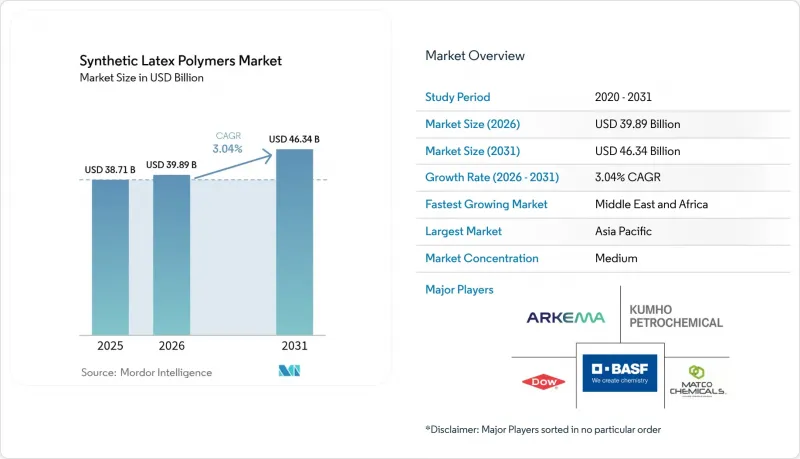
This report Segments the Industry by Polymer Type (Styrene-Butadiene, Acrylic, and More), Application (Paints and Coatings, Adhesives and Sealants, Paper and Paperboard, and More), and Geography (Asia-Pacific, North America, Europe, South America, and Middle East and Africa). The Market Forecasts are Provided in Terms of Value (USD).
Global Synthetic Latex Polymers Market Trends and Insights
Rising Demand from Paints & Coatings Industry
Architectural reformulations continue to accelerate uptake in the synthetic latex polymers market as coating makers align with VOC caps that now range from 50 g/L to 250 g/L in jurisdictions such as California's South Coast AQMD Rule 1168. Global suppliers respond with next-generation acrylic dispersions, typified by BASF's 2025 industrial portfolio, which eliminates reportable VOCs and integrates bio-based feedstock while retaining film strength and weatherability. A widening gap between solvent and water-based systems reinforces the long-term shift toward synthetic latex, particularly in interior architectural finishes where odor, drying time, and indoor-air benchmarks converge.
Construction Boom Driving Adhesives & Sealants Usage
Emerging-market infrastructure cycles sustain another pillar of growth for the synthetic latex polymers market. Saudi Arabia's Vision 2030 blueprint, for example, doubles national petrochemical capacity to more than 140 million tons by 2030 and prioritizes specialty polymers geared to construction chemistry. Public procurement rules echo this direction: Washington State DOT 2024 specifications require latex-modified concrete overlays on critical bridge decks, guaranteeing baseline demand for styrene-butadiene dispersions.
Raw-Material (Butadiene) Cost Volatility
Butadiene swings continue to squeeze latex margins. Q1 2025 spot prices reacted sharply to soft automotive tire demand and selective cracker turnarounds. The American Chemistry Council estimates styrene-butadiene latex consumes 8% of total butadiene, exposing producers to every upstream rally. Further pressure stems from LyondellBasell's review of European olefin assets, which clouds forward supply visibility.
Other drivers and restraints analyzed in the detailed report include:
- VOC Regulations Favouring Synthetic Latex Over Solvent Systems
- Increasing Utilization in Medical and Healthcare Applications
- Carpet Demand Decline in Developed Markets
For complete list of drivers and restraints, kindly check the Table Of Contents.
Segment Analysis
Acrylics hold 35.62% of the synthetic latex polymers market share in 2025 and are expanding at a 3.42% CAGR, reinforced by excellent film-forming, weather resistance, and low-VOC compliance. Within the broader synthetic latex polymers market size, acrylic dispersions routinely serve as the default binder in premium zero-odor wall paints that meet indoor-air programs such as LEED and BREEAM. Suppliers also advance self-crosslinking technology that boosts scrub resistance without external coalescents. Styrene-butadiene grades remain competitive in paper, carpet, and cementitious admixtures because of favorable cost-performance ratios, yet the segment must navigate feedstock volatility. Vinyl acetate and polyvinyl acetate niches persist in woodworking and textile finishing where flexibility outweighs water-whitening concerns. Nitrile butadiene latex commands loyal demand in protective gloves due to chemical resistance and puncture strength. Government research grants, typified by the USD 51 million Sustainable Polymers Tech Hub in Akron, aim to commercialize bio-based butadiene, ultimately reshuffling cost structures and carbon metrics across polymer types.
Acrylic dominance looks durable, although incremental innovation will likely unfold along bio-acrylic monomers, recyclability, and circular feedstock sourcing. As regulations tighten microplastic release and carbon disclosure, the superior compliance record of acrylics positions them to preserve leadership, while producers of styrene-heavy chemistries may invest in hybrid formulations or mass-balance certification to stay relevant.
Complete Report Scope:
- By Polymer Type
- Styrene-Butadiene
- Acrylic
- Vinyl Acetate
- Polyvinyl Acetate
- Others (Nitrile Butadiene, etc.)
- By Application
- Paints and Coatings
- Adhesives and Sealants
- Paper and Paperboard
- Textiles and Non-woven Fabrics
- Other Applications (Construction Additives, Synthetic Leather and Misc., etc.)
- By Geography
- Asia-Pacific
- China
- India
- Japan
- South Korea
- Rest of Asia-Pacific
- North America
- United States
- Canada
- Mexico
- Europe
- Germany
- United Kingdom
- France
- Italy
- Rest of Europe
- South America
- Brazil
- Argentina
- Rest of South America
- Middle East and Africa
- Saudi Arabia
- South Africa
- Rest of Middle East and Africa
- Asia-Pacific
Geography Analysis
Asia-Pacific holds 48.10% of the synthetic latex polymers market size in 2025, reflecting its deep manufacturing base, abundant labor, and rapid urbanization. China drives a large portion of regional coating and adhesive consumption, even as plant rationalizations and ethane-based feedstock shifts redefine competitiveness in petrochemicals. India adds momentum through public housing schemes and expanding packaging demand for e-commerce. Still, the region's growth curve is flattening as installed capacity catches up with prior surges and as ESG auditing gains traction among multinational buyers, favoring suppliers that can document low carbon intensity and circular practices.
The Middle East & Africa currently contributes a smaller volume but is the fastest mover, with a 4.05% CAGR anticipated to 2031. Gulf Cooperation Council economies bankroll mega-infrastructure under Vision 2030, underpinned by competitive feedstock and integrated refinery-to-polymer complexes. Saudi Arabia's plan to more than double petrochemical output to 140 million t annually underscores commitment to downstream value capture, including synthetic latex raw materials Cross-border partnerships-such as the Sadara venture between Saudi Aramco and Dow-reinforce scale and market access.
North America and Europe represent mature demand centers where the synthetic latex polymers market is shaped more by regulation than volume spikes. The US Department of Energy calculates that the chemicals and refining segment requires USD 90-120 billion in decarbonization investment by 2030, prodding latex producers to green electricity, heat integration, and mass-balance certified feedstocks. Europe follows a similar path, embedding polymer taxation, extended producer responsibility, and zero-pollution roadmaps into industrial policy. Suppliers with legacy solvent footprints face the most significant transformation costs, while integrated players redirect R&D to bio-acrylics, mechanical recycling, and emission-free drying ovens.
- Apcotex
- Arkema
- ARLANXEO
- Ashland
- BASF
- DIC Corporation
- Dow
- Jubilant Agri and Consumer Products Limited (JACPL)
- Kumho Petrochemical
- LANXESS
- LG Chem
- Lion Elastomers
- Matco Chemicals Group
- SIBUR
- Sumitomo Chemical Advanced Technologies
- ZEON CORPORATION
Additional Benefits:
- The market estimate (ME) sheet in Excel format
- 3 months of analyst support
TABLE OF CONTENTS
1 Introduction
- 1.1 Study Assumptions & Market Definition
- 1.2 Scope of the Study
2 Research Methodology
3 Executive Summary
4 Market Landscape
- 4.1 Market Overview
- 4.2 Market Drivers
- 4.2.1 Rising demand from paints & coatings industry
- 4.2.2 Construction boom driving adhesives & sealants usage
- 4.2.3 VOC regulations favouring synthetic latex over solvent systems
- 4.2.4 Increasing utilization in medical and healthcare application
- 4.2.5 3-D printable concrete admixtures using latex for rheology
- 4.3 Market Restraints
- 4.3.1 Raw-material (butadiene) cost volatility
- 4.3.2 Carpet demand decline in developed markets
- 4.3.3 C4 refinery shutdowns limiting butadiene supply
- 4.4 Value Chain Analysis
- 4.5 Porter's Five Forces
- 4.5.1 Threat of New Entrants
- 4.5.2 Bargaining Power of Buyers
- 4.5.3 Bargaining Power of Suppliers
- 4.5.4 Threat of Substitutes
- 4.5.5 Degree of Competion
5 Market Size & Growth Forecasts (Value)
- 5.1 By Polymer Type
- 5.1.1 Styrene-Butadiene
- 5.1.2 Acrylic
- 5.1.3 Vinyl Acetate
- 5.1.4 Polyvinyl Acetate
- 5.1.5 Others (Nitrile Butadiene, etc.)
- 5.2 By Application
- 5.2.1 Paints and Coatings
- 5.2.2 Adhesives and Sealants
- 5.2.3 Paper and Paperboard
- 5.2.4 Textiles and Non-woven Fabrics
- 5.2.5 Other Applications (Construction Additives, Synthetic Leather and Misc., etc.)
- 5.3 By Geography
- 5.3.1 Asia-Pacific
- 5.3.1.1 China
- 5.3.1.2 India
- 5.3.1.3 Japan
- 5.3.1.4 South Korea
- 5.3.1.5 Rest of Asia-Pacific
- 5.3.2 North America
- 5.3.2.1 United States
- 5.3.2.2 Canada
- 5.3.2.3 Mexico
- 5.3.3 Europe
- 5.3.3.1 Germany
- 5.3.3.2 United Kingdom
- 5.3.3.3 France
- 5.3.3.4 Italy
- 5.3.3.5 Rest of Europe
- 5.3.4 South America
- 5.3.4.1 Brazil
- 5.3.4.2 Argentina
- 5.3.4.3 Rest of South America
- 5.3.5 Middle East and Africa
- 5.3.5.1 Saudi Arabia
- 5.3.5.2 South Africa
- 5.3.5.3 Rest of Middle East and Africa
- 5.3.1 Asia-Pacific
6 Competitive Landscape
- 6.1 Market Concentration
- 6.2 Strategic Moves
- 6.3 Market Share (%)/Ranking Analysis
- 6.4 Company Profiles (includes Global level Overview, Market level overview, Core Segments, Financials as available, Strategic Information, Market Rank/Share for key companies, Products & Services, and Recent Developments)
- 6.4.1 Apcotex
- 6.4.2 Arkema
- 6.4.3 ARLANXEO
- 6.4.4 Ashland
- 6.4.5 BASF
- 6.4.6 DIC Corporation
- 6.4.7 Dow
- 6.4.8 Jubilant Agri and Consumer Products Limited (JACPL)
- 6.4.9 Kumho Petrochemical
- 6.4.10 LANXESS
- 6.4.11 LG Chem
- 6.4.12 Lion Elastomers
- 6.4.13 Matco Chemicals Group
- 6.4.14 SIBUR
- 6.4.15 Sumitomo Chemical Advanced Technologies
- 6.4.16 ZEON CORPORATION
7 Market Opportunities & Future Outlook
- 7.1 White-space & Unmet-Need Assessment

