PUBLISHER: Mordor Intelligence | PRODUCT CODE: 2114722

PUBLISHER: Mordor Intelligence | PRODUCT CODE: 2114722
Polyvinylidene Difluoride (PVDF) Membrane - Market Share Analysis, Industry Trends & Statistics, Growth Forecasts (2026 - 2031)
According to Mordor Intelligence, the polyvinylidene difluoride membrane market size is expected to increase from 3.23 kilotons in 2025 to 3.35 kilotons in 2026 and reach 4.01 kilotons by 2031, growing at a CAGR of 3.65% over 2026-2031.
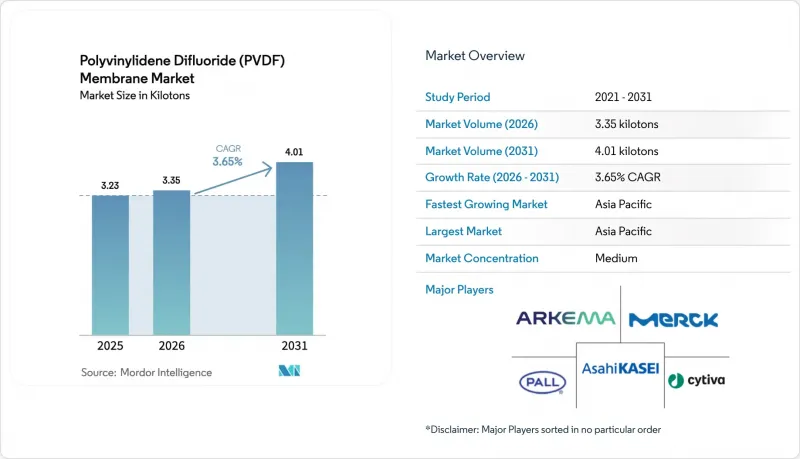
This report is Segmented by Membrane Type (Hydrophobic and Hydrophilic), Technology (Microfiltration, Ultrafiltration, and More), Application (Filtration, Blotting, Separation, and More), End-User Industry (Biopharmaceutical, Pharmaceutical, and More), and Geography (Asia-Pacific, North America, Europe, and More). Market Forecasts are Provided in Terms of Volume (Tons).
Global Polyvinylidene Difluoride (PVDF) Membrane Market Trends and Insights
Rapid Growth of Bioprocessing Demand
Single-use tangential-flow cassettes now arrive pre-irradiated and serialized, eliminating on-site integrity testing and reducing campaign turnaround from days to hours. Biocon Biologics invested approximately USD 1.2 billion in a new Bengaluru biosimilar manufacturing plant between 2022 and 2025 that embeds advanced continuous harvest and purification processes, tripling membrane consumption per kilogram of drug substance compared with legacy lines. Cell- and gene-therapy developers require residual host-cell DNA below 10 nanograms per dose, steering them toward 0.2-micrometer hydrophilic PVDF that balances sterile retention and flux. Capacity additions remain lengthy; Asahi Kasei broke ground in July 2026 on its fourth Planova virus-removal filter plant that will open in 2030, underscoring structural supply tightness. Both brand owners and CDMOs lock in multi-year supply contracts, reinforcing volume visibility and underpinning the PVDF membrane market outlook. The resulting demand pull lifts average plant utilization rates above 85%, supporting premium pricing.
Rising Utilization in Medical and Diagnostic Devices
PVDF remains the benchmark blotting media. Bio-Rad's Sequi-Blot range binds 170-200 µg/cm2 of protein, outperforming nitrocellulose while tolerating multiple stripping cycles for antibody reprobing. Decentralized testing heightens this advantage because point-of-care kits must withstand ambient storage and deliver results within 15 minutes. Merck installed a second membrane line in Cork in 2025 aimed at lateral-flow assays for dengue, malaria, and COVID-19 detection. Pore-size bifurcation persists: 0.2 µm sheets enable low-molecular-weight protein sequencing, while 0.45 µm variants support general immunoblotting. The net effect is a broader installed base of diagnostic platforms that consume replacement rolls annually, keeping the PVDF membrane market on a predictable reorder cycle.
High Cost of PVDF Membranes
PVDF resin sells for USD 8-12/kg, double polysulfone, and triple cellulose acetate, pricing many municipal and dairy projects out of the market. Arkema expanded Calvert City PVDF capacity by 15% in 2024 but targeted batteries and semiconductors rather than filtration, showing that resin producers prioritize higher-margin outlets. Biopharma buyers absorb the premium because membrane costs stay below 1% of drug-substance value, yet dairy processors running on 5-8% margins cannot justify PVDF when polysulfone delivers 80% of the flux at half the cost. This price gap limits penetration into commodity applications and clips upside potential for the PVDF membrane market in price-sensitive segments.
Other drivers and restraints analyzed in the detailed report include:
- Growing Demand for Wastewater Treatment Applications
- Continuous Expansion of Biotechnology and Pharma Sector
- Membrane Fouling in High-Fat Food and Beverage Streams
For complete list of drivers and restraints, kindly check the Table Of Contents.
Segment Analysis
Hydrophilic variants held 59.32% PVDF membrane market share in 2025 and are forecast to grow at a 3.61% CAGR, outperforming hydrophobic formats that serve air and solvent filtration. Merck's Durapore line delivers 170-200 µg/cm2 binding capacity, enabling multiplex antibody reuse without methanol pre-wetting. Hydrophobic PVDF remains critical for venting and solvent applications where moisture repellence prevents pore blockage. Surface-modification research explores zwitterionic peptide grafting and titanium-dioxide nanocomposites that preserve flux without PFAS processing aids, addressing ESG concerns. A 2024 Membranes study reported 40-60% higher pure-water flux on graphene-oxide-enhanced PVDF, although long-term caustic stability is unproven. Amphiphilic copolymers that toggle wettability by pH may blur the hydrophilic-hydrophobic divide, yet validation cycles mean current segmentation will persist through the forecast period. The continued shift toward biologics keeps hydrophilic grades central to the PVDF membrane market.
Microfiltration accounted for 41.75% of the PVDF membrane market size in 2025, anchored by sterile filtration at 0.2 µm. Nanofiltration, however, is expanding at a 4.27% CAGR because 20-nm cutoffs remove viruses while passing monoclonal antibodies above 150 kDa. Asahi Kasei's Planova range, though cellulose-based, demonstrates the pull of virus-removal membranes and validates demand for PVDF analogs that tolerate caustic cleaning. Ultrafiltration occupies the middle ground for protein concentration, while niche technologies such as membrane distillation remain below 5% of volume. PVDF's chemical resistance opens doors for caustic-cleaned nanofiltration skids in continuous bioreactors, where solvent compatibility eclipses the lower cost of polyamide. Integrated membrane cascades reduce chromatography steps and speed virus clearance validation, reinforcing the growth trajectory of nanofiltration inside the PVDF membrane market.
Complete Report Scope:
- By Membrane Type
- Hydrophobic
- Hydrophilic
- By Technology
- Microfiltration
- Ultrafiltration
- Nanofiltration
- Other Technologies
- By Application
- Filtration
- Blotting
- Separation
- Purification
- Other Applications
- By End-user Industry
- Biopharmaceutical
- Pharmaceutical
- Food and Beverage
- Other End-user industries
- By Geography
- Asia-Pacific
- China
- Japan
- India
- South Korea
- Rest of Asia-Pacific
- North America
- United States
- Canada
- Mexico
- Europe
- Germany
- United Kingdom
- France
- Italy
- Rest of Europe
- South America
- Brazil
- Argentina
- Rest of South America
- Middle-East and Africa
- Saudi Arabia
- South Africa
- Rest of Middle-East and Africa
- Asia-Pacific
Geography Analysis
Asia-Pacific held 56.39% of the PVDF membrane market share in 2025 and is expanding at a 4.85% CAGR through 2031, propelled by China's wastewater mandates, India's CDMO boom, and Japan's precision membrane exports. China's 2,000 m3/day PVDF MBRs for pharmaceutical effluent underscore regulatory enforcement, while Hangzhou Qiushi supplies local modules with short lead times. India's contract manufacturing jumped to USD 8.2 billion in 2024, targeting USD 20.8 billion by 2030, pulling membranes into new single-use bioreactors. Toray's November 2025 Saudi RO plant serves Gulf desalination projects, with PVDF pretreatment cutting fouling. South Korea's biotech corridor benefits from domestic PVDF production at Hyundae Micro and LG Chem, tightening supply loops for Samsung Biologics.
North America's PVDF membrane market growth is supported by Danaher's USD 1.6 billion capacity expansion across Pensacola, Fajardo, and a South Korean line serving U.S. demand. Government initiatives such as BARDA reinforce on-shore vaccine supply, sustaining order visibility. Europe follows with region-for-region manufacturing; Merck's EUR 440 million Cork hub produces filtration devices for the EMEA market, and Sartorius' Yauco investment serves the Americas. The 6.5-year PFAS derogation shapes municipal uptake, nudging utilities toward PVDF alternatives yet leaving industrial users largely unaffected.
South America and Middle East and Africa are witnessing rising demand for PVDF membranes. Saudi desalination and Brazilian sanitation privatization drive orders for PVDF-based MBRs that treat high-salinity or nutrient-rich feedwater. South African mining and petrochemical firms adopt closed-loop ultrafiltration-RO systems to stretch water supply, with PVDF pretreatment extending RO life from three to five years. While smaller in tonnage, these regions offer high unit margins that attract specialist suppliers in the PVDF membrane market.
- Arkema
- Asahi Kasei Corporation
- CITIC Group Corporation.
- Cobetter Filtration Equipment Co. Ltd
- Cytiva
- GVS S.p.A.
- Hyundae Micro Co., Ltd
- Kovalus Separation Solutions
- Kuraray Co., Ltd
- LG Chem
- Membrane Solutions (Nantong)
- Merck
- Mitsubishi Chemical Corporation
- Pall Corporation (Danaher Corporation)
- Pentair
- Synder Filtration Inc.
- Toray Industries, Inc.
- Veolia
Additional Benefits:
- The market estimate (ME) sheet in Excel format
- 3 months of analyst support
TABLE OF CONTENTS
1 Introduction
- 1.1 Study Assumptions and Market Definition
- 1.2 Scope of the Study
2 Research Methodology
3 Executive Summary
4 Market Landscape
- 4.1 Market Overview
- 4.2 Market Drivers
- 4.2.1 Rapid growth of bioprocessing demand
- 4.2.2 Rising utilization in medical and diagnostic devices
- 4.2.3 Growing demand for wastewater treatment applications
- 4.2.4 Continuous expansion of biotechnology and pharma sector
- 4.2.5 Emergence of single-use Tangential Flow Filtration (TFF) modules integrating PVDF
- 4.3 Market Restraints
- 4.3.1 High cost of PVDF membranes
- 4.3.2 Membrane fouling in high-fat Food and Beverage streams
- 4.3.3 ESG scrutiny on fluorinated-polymer disposal
- 4.4 Value Chain Analysis
- 4.5 Porter's Five Forces
- 4.5.1 Threat of New Entrants
- 4.5.2 Bargaining Power of Buyers
- 4.5.3 Bargaining Power of Suppliers
- 4.5.4 Threat of Substitute Products
- 4.5.5 Degree of Competition
5 Market Size and Growth Forecasts (Volume)
- 5.1 By Membrane Type
- 5.1.1 Hydrophobic
- 5.1.2 Hydrophilic
- 5.2 By Technology
- 5.2.1 Microfiltration
- 5.2.2 Ultrafiltration
- 5.2.3 Nanofiltration
- 5.2.4 Other Technologies
- 5.3 By Application
- 5.3.1 Filtration
- 5.3.2 Blotting
- 5.3.3 Separation
- 5.3.4 Purification
- 5.3.5 Other Applications
- 5.4 By End-user Industry
- 5.4.1 Biopharmaceutical
- 5.4.2 Pharmaceutical
- 5.4.3 Food and Beverage
- 5.4.4 Other End-user industries
- 5.5 By Geography
- 5.5.1 Asia-Pacific
- 5.5.1.1 China
- 5.5.1.2 Japan
- 5.5.1.3 India
- 5.5.1.4 South Korea
- 5.5.1.5 Rest of Asia-Pacific
- 5.5.2 North America
- 5.5.2.1 United States
- 5.5.2.2 Canada
- 5.5.2.3 Mexico
- 5.5.3 Europe
- 5.5.3.1 Germany
- 5.5.3.2 United Kingdom
- 5.5.3.3 France
- 5.5.3.4 Italy
- 5.5.3.5 Rest of Europe
- 5.5.4 South America
- 5.5.4.1 Brazil
- 5.5.4.2 Argentina
- 5.5.4.3 Rest of South America
- 5.5.5 Middle-East and Africa
- 5.5.5.1 Saudi Arabia
- 5.5.5.2 South Africa
- 5.5.5.3 Rest of Middle-East and Africa
- 5.5.1 Asia-Pacific
6 Competitive Landscape
- 6.1 Market Concentration
- 6.2 Strategic Moves
- 6.3 Market Share(%)/Ranking Analysis
- 6.4 Company Profiles (includes Global level Overview, Market level overview, Core Segments, Financials, Strategic Info, Products and Services, Recent Developments)
- 6.4.1 Arkema
- 6.4.2 Asahi Kasei Corporation
- 6.4.3 CITIC Group Corporation.
- 6.4.4 Cobetter Filtration Equipment Co. Ltd
- 6.4.5 Cytiva
- 6.4.6 GVS S.p.A.
- 6.4.7 Hyundae Micro Co., Ltd
- 6.4.8 Kovalus Separation Solutions
- 6.4.9 Kuraray Co., Ltd
- 6.4.10 LG Chem
- 6.4.11 Membrane Solutions (Nantong)
- 6.4.12 Merck
- 6.4.13 Mitsubishi Chemical Corporation
- 6.4.14 Pall Corporation (Danaher Corporation)
- 6.4.15 Pentair
- 6.4.16 Synder Filtration Inc.
- 6.4.17 Toray Industries, Inc.
- 6.4.18 Veolia
7 Market Opportunities and Future Outlook
- 7.1 White-space and Unmet-Need Assessment

