PUBLISHER: Mordor Intelligence | PRODUCT CODE: 2114723

PUBLISHER: Mordor Intelligence | PRODUCT CODE: 2114723
Fluorescent In Situ Hybridization - Market Share Analysis, Industry Trends & Statistics, Growth Forecasts (2026 - 2031)
According to Mordor Intelligence, the fluorescent in situ hybridization market size was valued at USD 1.21 billion in 2025 and estimated to grow from USD 1.30 billion in 2026 to reach USD 1.84 billion by 2031, at a CAGR of 7.24% during the forecast period (2026-2031).
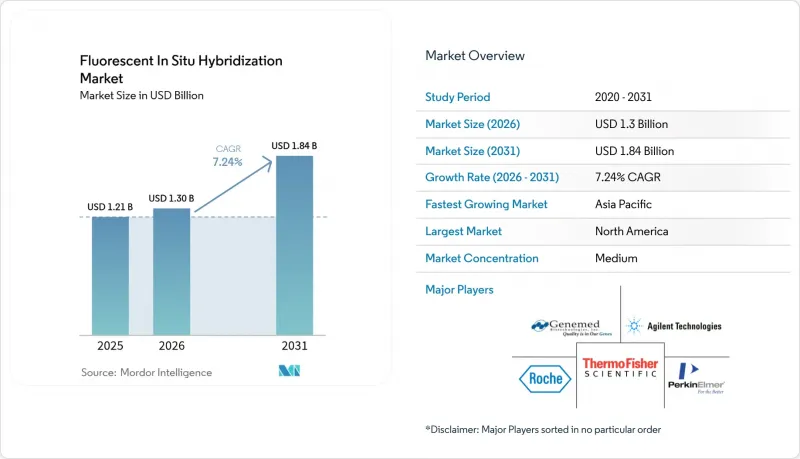
This report is Segmented by Product Type (Instruments, Kits & Reagents, Software & Services), Application (Cancer Diagnostics, Genetic Disease Screening, and More), End User (Clinical Diagnostics Laboratories, and More), and Geography (North America, Europe, Asia-Pacific, Middle East & Africa, South America). The Market Forecasts are Provided in Terms of Value (USD).
Global Fluorescent In Situ Hybridization Market Trends and Insights
Rising Global Cancer Incidence & Wider Genomic Testing Reimbursement
Cancer-related FISH volumes grow as payers approve broader genomic panels for breast, lung, and hematologic malignancies. The FDA endorsement of Roche's PATHWAY HER2 test for biliary-tract cancer in 2024 showed how regulatory recognition enlarges patient pools beyond traditional settings. Insurers view precision diagnostics as a cost saver when matched therapies avoid ineffective regimens. Laboratories pair FISH with next-generation sequencing to heighten diagnostic accuracy and still secure reimbursement. This virtuous cycle supports steady uptake across hospital and reference labs in North America and Europe.
Escalating Adoption of FISH in Companion Diagnostics for Targeted Oncology Drugs
Pharmaceutical pipelines depend on chromosomal translocation and gene-amplification assays to qualify trial cohorts. The FDA approval of zanidatamab for HER2-positive biliary-tract cancer, backed by a FISH-based companion diagnostic, underscored FISH's role in unlocking niche oncology markets. Co-development models align drug and assay timelines, lowering clinical risk for both parties. High assay specificity limits false positives, protecting therapeutic effect claims. As trial sponsors build in-house cytogenetics groups to shorten study cycles, the fluorescent in situ hybridization market gains a durable revenue stream.
Shortage of Cytogenetic Technologists in Developed Economies
Vacancy rates in US cytogenetics labs reached 13.2% in 2024 and nearly 27% of current technologists expect to retire within five years. Automation eases slide preparation and scoring, yet final case sign-off still demands certified staff. Laboratories therefore face overtime costs and delayed turnaround, which can blunt the fluorescent in situ hybridization market's near-term growth in North America and Europe. Vendor training programs and remote-expert networks offer partial relief, but credential pipelines remain stretched.
Other drivers and restraints analyzed in the detailed report include:
- Rapid Fall in Probe Manufacturing Costs Due to Ink-Jet Oligo Synthesis
- Expansion of Digital Pathology Platforms Integrating AI-Augmented FISH Image Analytics
- High Capital Outlay for Fully Automated FISH Workstations
For complete list of drivers and restraints, kindly check the Table Of Contents.
Segment Analysis
The segment opened 2025 with kits and reagents supplying 43.78% revenue, emphasizing the consumable foundation of the fluorescent in situ hybridization market. DNA probes dominate routine HER2 and ALK testing, while RNA probes gain traction in spatial transcriptomics. Instruments account for roughly one-third of sales, split between manual microscopes for low-volume labs and high-throughput automated stations. Software and services form the balance, expanding as cloud-based analytics gain regulatory acceptance.
Digital imaging systems, buoyed by AI algorithms, are the fastest risers at 9.32% CAGR. Median HER2 signal count rose from 4.0 to 7.5 per nucleus on a super-resolution platform, proving diagnostic uplift. Automation reduces chemical exposure and turnaround times, winning favor with overstretched laboratory staff. Vendors that align consumables with scanners through closed-loop ecosystems deepen customer lock-in and stabilize the fluorescent in situ hybridization market size at the product level. Digital platforms also open remote-read opportunities that lighten the technologist's burden. Cloud architectures transfer image data across sites without quality loss, while AI triages high-risk slides for senior review. This workflow lets regional hospitals access subspecialty expertise without geographic constraints, broadening the fluorescent in situ hybridization market reach in rural settings. As probe and imaging suppliers co-develop turnkey bundles, pricing moves toward outcome-based models tied to report volumes, aligning vendor and laboratory incentives.
Complete Report Scope:
- By Product Type
- Instruments
- Automated FISH Workstations
- Manual Fluorescence Microscopes
- Digital Imaging & Analysis Systems
- Kits & Reagents
- DNA Probes
- RNA Probes
- PNA / LNA Probes
- Software & Services
- Instruments
- By Application
- Cancer Diagnostics
- Breast Cancer
- Lung Cancer
- Hematologic Malignancies
- Genetic Disease Screening
- Neurological Disorders
- Companion Diagnostics
- Cell & Gene-Therapy Manufacturing QC
- Others
- Cancer Diagnostics
- By End User
- Clinical Diagnostics Laboratories
- Hospital Cytogenetics Departments
- Academic & Research Institutes
- Pharma & Biotech Companies
- Contract Research Organizations
- By Geography
- North America
- United States
- Canada
- Mexico
- Europe
- Germany
- United Kingdom
- France
- Italy
- Spain
- Rest of Europe
- Asia-Pacific
- China
- Japan
- India
- Australia
- South Korea
- Rest of Asia-Pacific
- Middle East & Africa
- GCC
- South Africa
- Rest of Middle East & Africa
- South America
- Brazil
- Argentina
- Rest of South America
- North America
Geography Analysis
North America held 42.55% revenue in 2025, anchored by comprehensive insurance coverage, large cancer-center networks, and an ecosystem of reference laboratories. The United States benefits from clear FDA pathways and national proficiency-testing programs that ensure assay quality. Canada provides stable growth through universal healthcare, while Mexico's private-hospital segment adopts portable FISH readers for oncology screening. The region also houses many AI start-ups that license algorithms into existing lab information systems, raising platform value.
Europe, led by Germany, the United Kingdom, and France, contributed to global demand. IVDR compliance raised near-term costs, yet set standard quality benchmarks that favor vendors with robust documentation. Italy's deployment of deep learning for digital slides advanced reimbursement discussions for telepathology services. Spain and other Southern markets integrate companion diagnostics into national cancer strategies, broadening patient access. Despite currency pressures, public health digitization funds support the procurement of automated FISH systems.
Asia-Pacific is projected to record the highest 9.83% CAGR. China's public-insurance reforms now list multiple FISH assays, driving rural uptake. India's premier institutes pilot AI tools that shorten report times and standardize interpretation. Japan's aging population raises screening volumes, while Australia and South Korea combine developed reimbursement models with vibrant biotech pipelines. Local probe factories lower costs and circumvent logistics delays, which sustains adoption in Southeast Asia. Portable, battery-powered readers serve field oncology programs in Indonesia and Vietnam, expanding the fluorescent in situ hybridization market reach.
- Agilent Technologies
- Abbott Molecular
- Thermo Fisher Scientific
- Roche
- PerkinElmer
- Bio-Rad Laboratories
- Merck
- QIAGEN
- Oxford Gene Technology
- BioView
- Biocare Medical
- Genemed Biotechnologies
- OPKO Diagnostics
- Advanced Cell Diagnostics
- Abnova
- Biodot
- Cytocell Ltd
- Danaher
- Empire Genomics
- ZytoVision
Additional Benefits:
- The market estimate (ME) sheet in Excel format
- 3 months of analyst support
TABLE OF CONTENTS
1 Introduction
- 1.1 Study Assumptions & Market Definition
- 1.2 Scope of the Study
2 Research Methodology
3 Executive Summary
4 Market Landscape
- 4.1 Market Overview
- 4.2 Market Drivers
- 4.2.1 Rising Global Cancer Incidence & Wider Genomic Testing Reimbursement
- 4.2.2 Escalating Adoption of Fish in Companion Diagnostics for Targeted Oncology Drugs
- 4.2.3 Rapid Fall in Probe Manufacturing Costs Due to Ink-Jet Oligo Synthesis
- 4.2.4 Expansion Of Digital Pathology Platforms Integrating AI-Augmented Fish Image Analytics
- 4.2.5 Growing Demand for Single-Cell Cytogenomics in Cell & Gene-Therapy Process QC
- 4.2.6 Commercialization of Portable, Battery-Powered Fish Readers for Low-Resource Settings
- 4.3 Market Restraints
- 4.3.1 Shortage of Cytogenetic Technologists in Developed Economies
- 4.3.2 High Capital Outlay for Fully Automated Fish Workstations
- 4.3.3 Reproducibility Challenges in Multiplex RNA-FISH Probes
- 4.3.4 Stringent Validation Hurdles for Laboratory-Developed Fish Tests Under IVDR (EU)
- 4.4 Technological Outlook
- 4.5 Porter's Five Forces Analysis
- 4.5.1 Threat of New Entrants
- 4.5.2 Bargaining Power of Buyers
- 4.5.3 Bargaining Power of Suppliers
- 4.5.4 Threat of Substitutes
- 4.5.5 Intensity of Competitive Rivalry
5 Market Size & Growth Forecasts (Value in USD)
- 5.1 By Product Type
- 5.1.1 Instruments
- 5.1.1.1 Automated FISH Workstations
- 5.1.1.2 Manual Fluorescence Microscopes
- 5.1.1.3 Digital Imaging & Analysis Systems
- 5.1.2 Kits & Reagents
- 5.1.2.1 DNA Probes
- 5.1.2.2 RNA Probes
- 5.1.2.3 PNA / LNA Probes
- 5.1.3 Software & Services
- 5.1.1 Instruments
- 5.2 By Application
- 5.2.1 Cancer Diagnostics
- 5.2.1.1 Breast Cancer
- 5.2.1.2 Lung Cancer
- 5.2.1.3 Hematologic Malignancies
- 5.2.2 Genetic Disease Screening
- 5.2.3 Neurological Disorders
- 5.2.4 Companion Diagnostics
- 5.2.5 Cell & Gene-Therapy Manufacturing QC
- 5.2.6 Others
- 5.2.1 Cancer Diagnostics
- 5.3 By End User
- 5.3.1 Clinical Diagnostics Laboratories
- 5.3.2 Hospital Cytogenetics Departments
- 5.3.3 Academic & Research Institutes
- 5.3.4 Pharma & Biotech Companies
- 5.3.5 Contract Research Organizations
- 5.4 By Geography
- 5.4.1 North America
- 5.4.1.1 United States
- 5.4.1.2 Canada
- 5.4.1.3 Mexico
- 5.4.2 Europe
- 5.4.2.1 Germany
- 5.4.2.2 United Kingdom
- 5.4.2.3 France
- 5.4.2.4 Italy
- 5.4.2.5 Spain
- 5.4.2.6 Rest of Europe
- 5.4.3 Asia-Pacific
- 5.4.3.1 China
- 5.4.3.2 Japan
- 5.4.3.3 India
- 5.4.3.4 Australia
- 5.4.3.5 South Korea
- 5.4.3.6 Rest of Asia-Pacific
- 5.4.4 Middle East & Africa
- 5.4.4.1 GCC
- 5.4.4.2 South Africa
- 5.4.4.3 Rest of Middle East & Africa
- 5.4.5 South America
- 5.4.5.1 Brazil
- 5.4.5.2 Argentina
- 5.4.5.3 Rest of South America
- 5.4.1 North America
6 Competitive Landscape
- 6.1 Market Concentration
- 6.2 Market Share Analysis
- 6.3 Company Profiles (includes Global level Overview, Market level overview, Core Segments, Financials as available, Strategic Information, Market Rank/Share for key companies, Products & Services, and Recent Developments)
- 6.3.1 Agilent Technologies
- 6.3.2 Abbott Molecular
- 6.3.3 Thermo Fisher Scientific Inc.
- 6.3.4 F. Hoffmann-La Roche Ltd.
- 6.3.5 PerkinElmer
- 6.3.6 Bio-Rad Laboratories
- 6.3.7 Merck KGaA (Sigma-Aldrich)
- 6.3.8 Qiagen
- 6.3.9 Oxford Gene Technology
- 6.3.10 BioView
- 6.3.11 Biocare Medical
- 6.3.12 Genemed Technologies Inc.
- 6.3.13 OPKO Diagnostics
- 6.3.14 Advanced Cell Diagnostics
- 6.3.15 Abnova
- 6.3.16 Biodot
- 6.3.17 Cytocell Ltd
- 6.3.18 Leica Biosystems
- 6.3.19 Empire Genomics
- 6.3.20 ZytoVision
7 Market Opportunities & Future Outlook
- 7.1 White-space & Unmet-Need Assessment

