PUBLISHER: Mordor Intelligence | PRODUCT CODE: 2114724

PUBLISHER: Mordor Intelligence | PRODUCT CODE: 2114724
Filter Integrity Test - Market Share Analysis, Industry Trends & Statistics, Growth Forecasts (2026 - 2031)
According to Mordor Intelligence, the filter integrity test market size in 2026 is estimated at USD 88.79 million, growing from 2025 value of USD 84.43 million with 2031 projections showing USD 114.29 million, growing at 5.16% CAGR over 2026-2031.
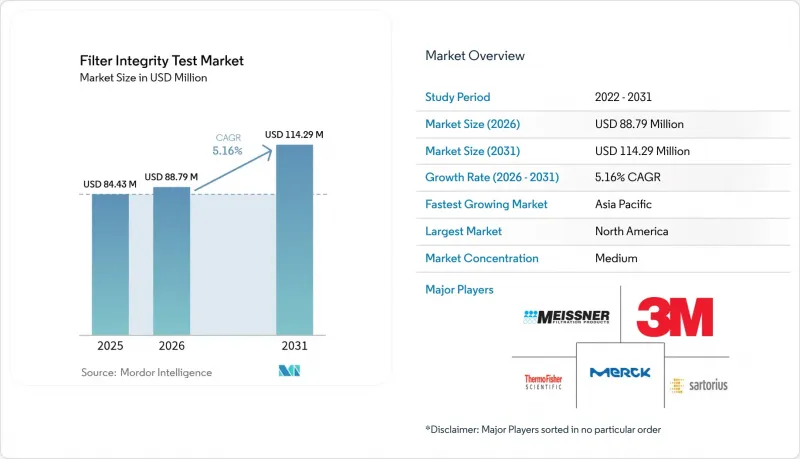
This report is Segmented by Product Type (Manual and Automated), Test Type (Bubble Point Test, and More), Mechanism (Pressure-Based, and More), Filter Type (Liquid Filters, and More), End Users (Pharmaceutical and Biotechnology Companies, and More), Application (Liquid Filtration Integrity, and More), and Geography (North America, and More). The Market Forecasts are Provided in Terms of Value (USD).
Global Filter Integrity Test Market Trends and Insights
Growth in Global Biopharmaceutical Production Capacity
Surging construction of large-scale bioreactors amplifies demand for Filter Integrity Test market solutions as firms validate ever-greater filtration surface areas. More than 16.5 million L of active capacity now spans 1,500+ facilities worldwide, with APAC adding the largest blocks of stainless-steel and single-use suites. Chinese producers report that 90% plan to export globally within a decade, mirroring 100% of surveyed Indian peers. High-profile projects such as Samsung Biologics' USD 1.46 billion fourth plant in Incheon and Fujifilm Diosynth's USD 3.2 billion expansions in Denmark and North Carolina illustrate the multi-site build-outs that each require hundreds of automated testers. These installations emphasize throughput, driving preference for self-diagnosing systems capable of parallel test execution and instant electronic release.
Regulatory Mandates for Sterile Manufacturing Compliance
Regulators elevate integrity testing from best practice to explicit requirement, tightening timelines for market authorization. EMA Annex 1 now obliges Pre-Use Post-Sterilization Integrity Testing for sterile drug filters, materially increasing test frequency in European plants. U.S. FDA guidance on data integrity for bioequivalence studies stipulates complete, accurate, contemporaneous electronic records, spurring upgrades to 21 CFR Part 11-compliant instruments. Harmonized microbial limits, such as the FDA's <= 10 CFU/100 mL bioburden threshold before final filtration, institutionalize routine verification cycles across biologics and vaccine lines.
High Capital Cost of Automated Test Instruments
Cutting-edge integrity testers that conform to EMA Annex 1 can exceed USD 100,000 per unit, discouraging smaller facilities from immediate adoption. Instruments such as the explosion-proof Sartocheck 5 Plus bundle risk-management software, auto-fail-safe logic, and encrypted audit-trails, but the upfront cash outlay remains substantial. Leasing models and pay-per-test service contracts have emerged to lower entry barriers, although uptake in price-sensitive regions still lags.
Other drivers and restraints analyzed in the detailed report include:
- Rising Adoption of Single-Use Filtration Systems
- Digitalization of Quality Control and Process Analytics
- Limited Skilled Workforce for GMP Integrity Testing
For complete list of drivers and restraints, kindly check the Table Of Contents.
Segment Analysis
Automated testers captured 56.88% of Filter Integrity Test market share in 2025 on the back of universal data-integrity mandates. They are simultaneously the fastest-growing at a 7.52% CAGR through 2031 as firms phase out manual rigs that lack electronic record keeping. Leading platforms integrate pre-programmed PUPSIT cycles, remote diagnostics, and predictive maintenance alerts, boosting equipment uptime and batch-release velocity. Manual devices persist in pilot plants and low-volume nutraceutical operations where budget constraints outweigh compliance pressure. Nevertheless, falling sensor costs and cloud-native analytics narrow the total-cost-of-ownership gap, accelerating the switch to automation during facility refurbishments. Across global installations, automated instruments now represent the default specification for any greenfield biologics expansion.
Second-generation units embed artificial-intelligence algorithms that recognize atypical diffusion curves, auto-flagging potential membrane damage before a catastrophic breach can contaminate product. Suppliers validate firmware under GAMP 5 to streamline 510(k) approvals for devices shipped into regulated U.S. lines. This evolution positions automated systems as the linchpin of enterprise-wide electronic Quality Management Systems, cementing their dominance in the filter integrity test market.
Bubble point remains the gold-standard hydrophilic membrane assay with 40.75% share; however water intrusion testing (WIT) leads growth at a 7.12% CAGR. WIT verifies hydrophobic filters without the wetting and drying steps that jeopardize sterility, making it indispensable for cell- and gene-therapy suites running multi-product campaigns. Enhanced algorithmic baselining compensates for humidity fluctuations, broadening WIT's deployability across climate zones. Diffusion/forward-flow protocols retain relevance for validating low-surface-area filters in high-potency drug manufacture, while pressure-hold tests confirm mechanical stability under surge conditions. Over the forecast horizon, WIT adoption is poised to eclipse diffusion in new hydrophobic filter installations, reinforcing its status as the segment's growth engine within the Filter Integrity Test market size.
Complete Report Scope:
- By Product Type
- Manual
- Automated
- By Test Type
- Bubble Point Test
- Diffusion / Forward-Flow Test
- Pressure / Hold Test
- Water Intrusion Test
- Other Tests Types
- By Mechanism
- Pressure-based
- Marker-based
- Visualization
- Acoustic / Sonic
- By Filter Type
- Liquid Filters
- Air / Gas Filters
- By End Users
- Pharmaceutical and Biotechnology Companies
- Contract Manufacturing Organizations
- Other End Users
- By Application
- Liquid Filtration Integrity
- Air Filtration Integrity
- Geography
- North America
- United States
- Canada
- Mexico
- Europe
- Germany
- United Kingdom
- France
- Italy
- Spain
- Rest of Europe
- Asia-Pacific
- China
- Japan
- India
- Australia
- South Korea
- Rest of Asia-Pacific
- Middle East & Africa
- GCC
- South Africa
- Rest of Middle East & Africa
- South America
- Brazil
- Argentina
- Rest of South America
- North America
Geography Analysis
North America led the Filter Integrity Test market with 39.10% share in 2025, anchored by stringent FDA oversight and continuous biologics pipeline funding. Mandated data-integrity audits catalyze replacement cycles toward 21 CFR Part 11-ready instruments. Biotech clusters across Massachusetts and North Carolina embed automated testers into digitally native "factory-of-the-future" footprints, raising regional penetration rates. High vaccine-fill volumes sustain recurrent service contracts that boost aftermarket revenue streams.
Europe follows closely, propelled by EMA Annex 1's compulsory PUPSIT clause that elevates test counts per filter to an all-time high. Investments such as Merck KGaA's €62 million Darmstadt QC facility expand local capacity for on-site calibration, shortening downtime for German and Swiss manufacturers. Sustainability discourse intensifies R&D into recyclable polymer housings and bio-based membranes, offering longer-term differentiation to European suppliers.
Asia-Pacific is the fastest-growing region with a 6.41% CAGR projected through 2031 as China, India, and South Korea race toward global GMP parity. Large-scale CDMO campuses in Shanghai, Hyderabad, and Daejeon standardize on automated testers to satisfy prospective U.S. and EU regulators. Government incentives covering up to 40% of equipment expenditures accelerate adoption, positioning APAC to narrow the installed-base gap with mature markets. Simultaneously, rising semiconductor fabrication in Singapore and Taiwan opens adjacent revenue channels for ultrapure-water filter testing, broadening geographic demand diversity across the Filter Integrity Test market.
- 3M
- Donaldson Company
- Eaton
- Filter Integrity
- Meissner Filtration Products
- Merck
- Pall
- Parker Hannifin
- Sartorius
- Thermo Fisher Scientific
- Danaher
- Porvair Filtration Group
- Critical Process Filtration Inc.
- Cobetter Filtration Group
- Single Use Support GmbH
- Sterlitech
- Ace Filtration Systems
Additional Benefits:
- The market estimate (ME) sheet in Excel format
- 3 months of analyst support
TABLE OF CONTENTS
1 Introduction
- 1.1 Study Assumptions & Market Definition
- 1.2 Scope of the Study
2 Research Methodology
3 Executive Summary
4 Market Landscape
- 4.1 Market Overview
- 4.2 Market Drivers
- 4.2.1 Growth In Global Biopharmaceutical Production Capacity
- 4.2.2 Regulatory Mandates for Sterile Manufacturing Compliance
- 4.2.3 Rising Adoption of Single-Use Filtration Systems
- 4.2.4 Digitalization of Quality Control and Process Analytics
- 4.2.5 Expansion of High-Potency and Advanced Therapies Manufacturing
- 4.2.6 Digitalization of Quality Control and Process Analytics
- 4.3 Market Restraints
- 4.3.1 High Capital Cost of Automated Test Instruments
- 4.3.2 Limited Skilled Workforce for GMP Integrity Testing
- 4.3.3 Data Integrity Risks in Legacy Tester Software
- 4.3.4 Environmental Concerns Over Single-Use Plastic Waste
- 4.4 Regulatory Landscape
- 4.5 Porter's Five Forces Analysis
- 4.5.1 Threat of New Entrants
- 4.5.2 Bargaining Power of Buyers
- 4.5.3 Bargaining Power of Suppliers
- 4.5.4 Threat of Substitutes
- 4.5.5 Competitive Rivalry
5 Market Size & Growth Forecasts (Value, USD)
- 5.1 By Product Type
- 5.1.1 Manual
- 5.1.2 Automated
- 5.2 By Test Type
- 5.2.1 Bubble Point Test
- 5.2.2 Diffusion / Forward-Flow Test
- 5.2.3 Pressure / Hold Test
- 5.2.4 Water Intrusion Test
- 5.2.5 Other Tests Types
- 5.3 By Mechanism
- 5.3.1 Pressure-based
- 5.3.2 Marker-based
- 5.3.3 Visualization
- 5.3.4 Acoustic / Sonic
- 5.4 By Filter Type
- 5.4.1 Liquid Filters
- 5.4.2 Air / Gas Filters
- 5.5 By End Users
- 5.5.1 Pharmaceutical and Biotechnology Companies
- 5.5.2 Contract Manufacturing Organizations
- 5.5.3 Other End Users
- 5.6 By Application
- 5.6.1 Liquid Filtration Integrity
- 5.6.2 Air Filtration Integrity
- 5.7 Geography
- 5.7.1 North America
- 5.7.1.1 United States
- 5.7.1.2 Canada
- 5.7.1.3 Mexico
- 5.7.2 Europe
- 5.7.2.1 Germany
- 5.7.2.2 United Kingdom
- 5.7.2.3 France
- 5.7.2.4 Italy
- 5.7.2.5 Spain
- 5.7.2.6 Rest of Europe
- 5.7.3 Asia-Pacific
- 5.7.3.1 China
- 5.7.3.2 Japan
- 5.7.3.3 India
- 5.7.3.4 Australia
- 5.7.3.5 South Korea
- 5.7.3.6 Rest of Asia-Pacific
- 5.7.4 Middle East & Africa
- 5.7.4.1 GCC
- 5.7.4.2 South Africa
- 5.7.4.3 Rest of Middle East & Africa
- 5.7.5 South America
- 5.7.5.1 Brazil
- 5.7.5.2 Argentina
- 5.7.5.3 Rest of South America
- 5.7.1 North America
6 Competitive Landscape
- 6.1 Market Concentration
- 6.2 Market Share Analysis
- 6.3 Company Profiles (includes Global level Overview, Market level overview, Core Business Segments, Financials, Headcount, Key Information, Market Rank, Market Share, Products and Services, and analysis of Recent Developments)
- 6.3.1 3M
- 6.3.2 Donaldson Company
- 6.3.3 Eaton Corporation PLC
- 6.3.4 Filter Integrity Ltd
- 6.3.5 Meissner Filtration Products Inc.
- 6.3.6 Merck KGaA
- 6.3.7 Pall Corporation
- 6.3.8 Parker Hannifin Corp.
- 6.3.9 Sartorius AG
- 6.3.10 Thermo Fisher Scientific, Inc.
- 6.3.11 Danaher Corporation
- 6.3.12 Porvair Filtration Group
- 6.3.13 Critical Process Filtration Inc.
- 6.3.14 Cobetter Filtration Group
- 6.3.15 Single Use Support GmbH
- 6.3.16 Sterlitech Corporation
- 6.3.17 Ace Filtration Systems
7 Market Opportunities & Future Outlook
- 7.1 White-space & Unmet-Need Assessment

