PUBLISHER: Mordor Intelligence | PRODUCT CODE: 2114725

PUBLISHER: Mordor Intelligence | PRODUCT CODE: 2114725
Facial Fat Transfer - Market Share Analysis, Industry Trends & Statistics, Growth Forecasts (2026 - 2031)
According to Mordor Intelligence, the facial fat transfer market size was valued at USD 2.77 billion in 2025 and estimated to grow from USD 3.04 billion in 2026 to reach USD 4.84 billion by 2031, at a CAGR of 9.73% during the forecast period (2026-2031).
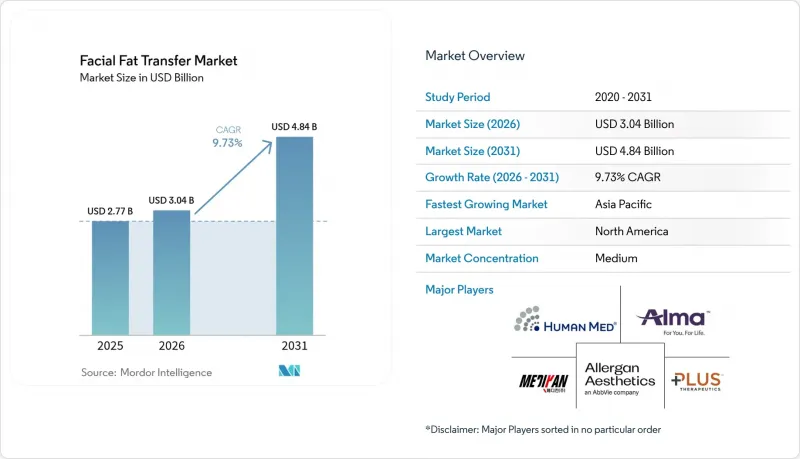
This report is Segmented by Donor Site (Abdomen, Thigh, Flank, Buttocks, Arms, Other Small-Volume Sites), Application (Facial Rejuvenation, Volume Restoration in Facial Lipoatrophy, and More), End User (Hospitals, and More), and Geography (North America, Europe, Asia-Pacific, Middle East & Africa, South America). The Market Forecasts are Provided in Terms of Value (USD).
Global Facial Fat Transfer Market Trends and Insights
Increasing Number of Cosmetic Procedures
Elective aesthetic volumes climbed as injectable treatments grew 7% annually between 2022 and 2024, setting a strong baseline for the facial fat transfer market. Medical spas captured 40-55% of all U.S. and U.K. aesthetic visits after their site count rose from 8,841 to 10,488 in two years, widening patient access and lowering procedural thresholds. Younger adults now request early-stage contouring to delay future aging signs, which funnels demand toward long-lasting autologous volumizers. Surgeons, therefore, position fat grafting as a cost-effective, lifetime solution when compared with repeat filler injections. The trend supports steady capacity expansion across outpatient suites where facial fat transfer market procedures slot easily into half-day schedules.
Growing Ageing Population
Facial volume loss accelerates past age 40, and the >=50 demographic is expanding rapidly in North America and Europe. Older patients prefer permanent, biocompatible correction, allowing autologous fat grafting to outperform temporary fillers in perceived value. Clinical data show simultaneous gains in volume, skin texture, and trophic factors, addressing multiple senescence markers in one session. Hospitals integrate fat grafting into combined facelifts, while spas entice older clients by bundling maintenance regimens such as laser resurfacing. The sizable mature cohort, therefore, underpins a predictable revenue stream throughout the facial fat transfer market.
Presence of Alternative Dermal Fillers with Shorter Downtime
Hyaluronic acid fillers deliver lunch-hour improvements and entail no bruising downtime, stealing impulsive consumers from the facial fat transfer market. Contemporary HA gels last up to 24 months, inching closer to permanence, and manufacturers leverage loyalty programs to lock in repeat purchases. However, cost modeling still favors autologous tissue for patients planning a decade of maintenance. Clinics now segment consultations by lifestyle, steering time-starved individuals to fillers while educating long-horizon clients on fat graft durability. This nuanced positioning limits, but does not eliminate, the restraint on market growth.
Other drivers and restraints analyzed in the detailed report include:
- Rising Preference for Autologous Fillers Over Synthetic Alternatives
- Advances in Cell-Assisted Lipotransfer Boosting Graft Retention
- Unpredictable Fat-Graft Resorption Rates
For complete list of drivers and restraints, kindly check the Table Of Contents.
Segment Analysis
In 2025, the abdomen accounted for 42.56% of the facial fat transfer market, reflecting surgeons' familiarity and procedural convenience. The thigh segment, although smaller, is forecast to grow at 12.13% CAGR through 2031, underscoring evidence that medial thigh adipocytes deliver higher viability and stem-cell counts. Randomized trials recorded a mean final fat layer of 6.03 mm from thigh harvests compared with 4.99 mm from abdominal tissue; 76.9% of thigh grafts achieved "excellent" quality scores. Younger patients show particularly robust cell profiles in thigh fat, prompting a procedural shift that widens surgeon skill sets and equipment needs.
Evidence-driven adoption will gradually rebalance donor patterns, yet abdominal harvesting retains relevance for high-volume cases that exceed thigh reserves. Flank and buttock sites complete full-face rejuvenations, while arm extractions satisfy touch-ups. Technique refinements, low-pressure aspiration, micro-cannulas, and closed filtration-optimize cellular survival regardless of site, supporting consistent outcomes across the facial fat transfer market.
Complete Report Scope:
- By Donor Site
- Abdomen
- Thigh
- Flank
- Buttocks
- Arms
- Other Small-volume Sites
- By Application
- Facial Rejuvenation
- Volume Restoration in Facial Lipoatrophy
- Acne & Trauma Scar Revision
- Post-oncologic Reconstruction
- Dermatological Defects & Burns
- By End User
- Hospitals
- Ambulatory Surgical Centres & Specialty Clinics
- Medical Spas & Aesthetic Centres
- By Geography
- North America
- United States
- Canada
- Mexico
- Europe
- Germany
- United Kingdom
- France
- Italy
- Spain
- Rest of Europe
- Asia-Pacific
- China
- Japan
- India
- Australia
- South Korea
- Rest of Asia-Pacific
- Middle East & Africa
- GCC
- South Africa
- Rest of Middle East & Africa
- South America
- Brazil
- Argentina
- Rest of South America
- North America
Geography Analysis
North America controlled 39.25% of the facial fat transfer market share in 2025 on the strength of early innovation adoption, deep specialist networks, and insurance support for reconstructive indications. The United States hosts over 10,000 medical spas and numerous fellowship programs that refine grafting protocols, while Canada and Mexico leverage cross-border tourism for competitive pricing. FDA guidance on adipose-derived stem cells imposes strict compliance, yet once systems secure clearance, trust accelerates patient uptake across the region.
Asia-Pacific posts the fastest trajectory with a 13.95% CAGR to 2031 as China, Japan, South Korea, and India invest in aesthetic infrastructure. Urban professionals allocate more disposable income to appearance-oriented services, and regional experts develop pan-facial contouring methods tailored for Asian skeletal and soft-tissue patterns. Satisfaction rates reach 96% in young Asian cohorts, validating culturally aligned techniques. Government-backed digital health tools and AI-driven consultation apps further normalize elective surgery, broadening the facial fat transfer market in the region.
Europe sustains steady growth under cohesive regulatory frameworks that stress evidence-based medicine. Surgeons integrate fat grafting into multidisciplinary cancer aftercare, and cross-border procedure access eases patient choice within the Schengen Area. Middle East & Africa and South America represent emerging clusters where rising affluence and medical tourism offset limited domestic specialist numbers. Investment in training and equipment is ongoing, positioning these regions for future share gains in the global facial fat transfer market.
- AbbVie (Allergan Aesthetics)
- Alma Lasers (Sisram)
- Anthony Products Inc.
- Cytori Therapeutics Inc. (Plus Therapeutics, Inc.)
- DMS Biotech
- Human Med
- Medinordic
- Medikan International
- MicroAire
- Ranfac
- Lipogems International
- Tulip Medical Products
- BTL
- InMode Ltd.
- Cynosure
- Rion Aesthetics
- Tiss'You Biotech
- Revolve (AirX)
- Palomar Technologies
- Suneva Medical
Additional Benefits:
- The market estimate (ME) sheet in Excel format
- 3 months of analyst support
TABLE OF CONTENTS
1 Introduction
- 1.1 Study Assumptions & Market Definition
- 1.2 Scope of the Study
2 Research Methodology
3 Executive Summary
4 Market Landscape
- 4.1 Market Overview
- 4.2 Market Drivers
- 4.2.1 Increasing Number of Cosmetic Procedures
- 4.2.2 Growing Ageing Population
- 4.2.3 Rising Preference for Autologous Fillers Over Synthetic Alternatives
- 4.2.4 Advances in Cell-Assisted Lipotransfer Boosting Graft Retention
- 4.2.5 Demand for Implant Removal & "Natural" Aesthetics Post-BIA-ALCL Scare
- 4.2.6 Surge in Male Facial Sculpting Influenced by AI-Driven Virtual Consult Apps
- 4.3 Market Restraints
- 4.3.1 Presence of Alternative Dermal Fillers with Shorter Downtime
- 4.3.2 Unpredictable Fat-Graft Resorption Rates
- 4.3.3 Regulatory Scrutiny on Stem-Cell-Enhanced Grafts
- 4.3.4 Rising Incidence of Vision-Threatening Embolic Complications Publicised Online
- 4.4 Porter's Five Forces Analysis
- 4.4.1 Threat of New Entrants
- 4.4.2 Bargaining Power of Buyers
- 4.4.3 Bargaining Power of Suppliers
- 4.4.4 Threat of Substitutes
- 4.4.5 Intensity of Competitive Rivalry
5 Market Size & Growth Forecasts (Value in USD)
- 5.1 By Donor Site
- 5.1.1 Abdomen
- 5.1.2 Thigh
- 5.1.3 Flank
- 5.1.4 Buttocks
- 5.1.5 Arms
- 5.1.6 Other Small-volume Sites
- 5.2 By Application
- 5.2.1 Facial Rejuvenation
- 5.2.2 Volume Restoration in Facial Lipoatrophy
- 5.2.3 Acne & Trauma Scar Revision
- 5.2.4 Post-oncologic Reconstruction
- 5.2.5 Dermatological Defects & Burns
- 5.3 By End User
- 5.3.1 Hospitals
- 5.3.2 Ambulatory Surgical Centres & Specialty Clinics
- 5.3.3 Medical Spas & Aesthetic Centres
- 5.4 By Geography
- 5.4.1 North America
- 5.4.1.1 United States
- 5.4.1.2 Canada
- 5.4.1.3 Mexico
- 5.4.2 Europe
- 5.4.2.1 Germany
- 5.4.2.2 United Kingdom
- 5.4.2.3 France
- 5.4.2.4 Italy
- 5.4.2.5 Spain
- 5.4.2.6 Rest of Europe
- 5.4.3 Asia-Pacific
- 5.4.3.1 China
- 5.4.3.2 Japan
- 5.4.3.3 India
- 5.4.3.4 Australia
- 5.4.3.5 South Korea
- 5.4.3.6 Rest of Asia-Pacific
- 5.4.4 Middle East & Africa
- 5.4.4.1 GCC
- 5.4.4.2 South Africa
- 5.4.4.3 Rest of Middle East & Africa
- 5.4.5 South America
- 5.4.5.1 Brazil
- 5.4.5.2 Argentina
- 5.4.5.3 Rest of South America
- 5.4.1 North America
6 Competitive Landscape
- 6.1 Market Concentration
- 6.2 Market Share Analysis
- 6.3 Company Profiles (includes Global level Overview, Market level overview, Core Segments, Financials as available, Strategic Information, Market Rank/Share for key companies, Products & Services, and Recent Developments)
- 6.3.1 AbbVie (Allergan Aesthetics)
- 6.3.2 Alma Lasers (Sisram)
- 6.3.3 Anthony Products Inc.
- 6.3.4 Cytori Therapeutics Inc. (Plus Therapeutics, Inc.)
- 6.3.5 DMS Biotech
- 6.3.6 Human Med AG
- 6.3.7 Medinordic
- 6.3.8 Medikan International
- 6.3.9 MicroAire Surgical Instruments
- 6.3.10 Ranfac Corporation
- 6.3.11 Lipogems International
- 6.3.12 Tulip Medical Products
- 6.3.13 BTL Aesthetics
- 6.3.14 InMode Ltd.
- 6.3.15 Cynosure
- 6.3.16 Rion Aesthetics
- 6.3.17 Tiss'You Biotech
- 6.3.18 Revolve (AirX)
- 6.3.19 Palomar Technologies
- 6.3.20 Suneva Medical
7 Market Opportunities & Future Outlook
- 7.1 White-space & Unmet-need Assessment

